


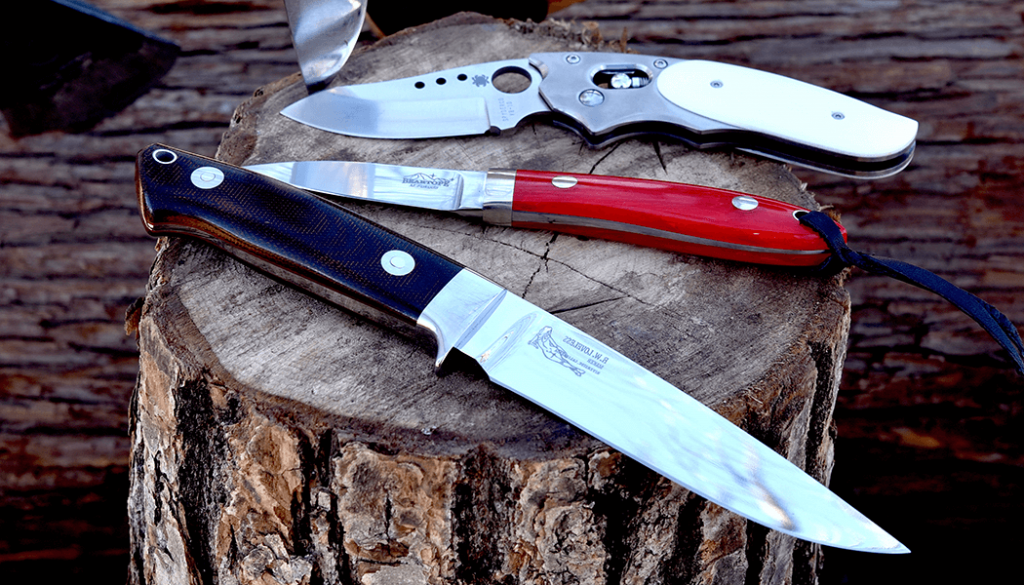
table of contents
This is an introductory book that will make you want to become someone who can use good blades
Knives are said to be essential equipment for outdoor activities, but in reality, they are not always used when it comes to general mountain climbing, and in a sense they are a supporting role. Still, I think that anyone who enjoys the outdoors has at least some desire to be able to skillfully use a knife that they are satisfied with in the field. I also have fond memories of my time as a student, when I was passionate about canyoning, and for no apparent reason, I longed for a sharp sword hatchet hanging from my waist
However, for some reason, I had always had the image in my mind that blades, which have evolved in diverse ways all over the world as tools indispensable for human survival, were too big an opponent to be approached with half-hearted admiration, and it is true that this made me hesitate to seriously dive into that world.While it is now easy to find a reasonable knife to use for mountain climbing, when asked to choose a knife that is irreplaceable to you, it is the world of outdoor knives where you suddenly find yourself at a loss as to where to start or how to do it
Why are there so many different types of outdoor knives, and what are their respective characteristics?
What kind of knife should I have? How should I handle it properly and how should I approach it correctly?
If I was going to be serious about choosing, I wanted to learn more than just know-how, and not just about a specific genre, but about the rich world of cutlery itself. I wanted to properly acquire that kind of knowledge, but until now I hadn't really come across anything that suited my needs
One day, by chance, the editorial department received a book from Seibundo Shinkosha entitled "Outdoor Cutlery Manual: From How to Use Knives, Hatchets, and Axes to Knife Making."



The book not only provides practical know-how about various blades for outdoor use, but also covers the historical and cultural background surrounding blades, as well as the author's thoughts on the people who carry on these traditions into the present day. The book exceeded my expectations, and I would like to introduce some of the appealing aspects of the book
Not just knowing how to cut, but knowing what kind of blade to use and how to cut
As the name "manual" suggests, this book is basically an explanatory book that starts with detailed explanations of the different types of blades and the differences in material, shape, and function of each part, and goes on to cover how to safely handle and maintain them. First and foremost, you'll be amazed at the countless types of blades that exist for different uses and purposes, but it also explains the purpose of each blade and how they have evolved (differentiated) in specific areas, making it easy to understand and convincing
Furthermore, a major feature of this book is the extraordinary variety of blades it introduces, not just the very practical range of folding knives, fixed-blade knives (sheath knives), and multi-tools common in outdoor activities, but also a wide range of blades that are unlikely to be used for hobbies, such as hatchets and axes, as well as skinners for skinning animals, carving knives used in woodworking, and draw knives for stripping bark. Regardless of whether you use them or not, the book (along with its abundant photographs) allows you to fully appreciate the depth of the blades that humanity has evolved into a civilization
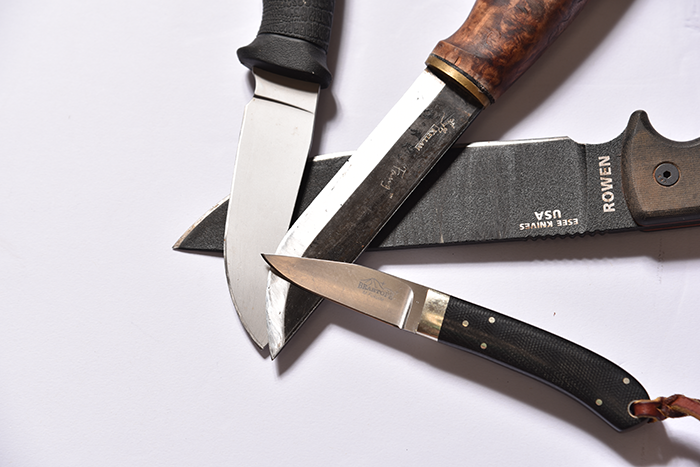
The explanations of knives reveal a deep respect for the users and makers who have lived alongside them
While the clarity of the carefully written explanations above is important, it's not that that moved me so much that I wanted to highlight it here. Rather, it's the respect for the people who have been brought up in the course of living in a civilization known as blades, and the depth of their perspective, which can be seen throughout the book
While this book presents itself as a manual/guide written with the intention of making it easy for beginners to understand, what it really wants to convey lies beyond that know-how: a celebration of the noble way of life of people who live with knives while confronting nature. The more I read, the more I feel this way. For example, the author describes a hunting trip he took with a rancher he knew in North America:
They dragged a large elk, butchered it, and loaded it onto an ATV*. They built a campfire nearby and roasted the elk. Wayne did it all with just a puukko knife. He did it skillfully, as if it were the most natural thing in the world. As a Scandinavian immigrant, this comes naturally to him. Genuine bushcraft is deeply rooted in them as a part of their lives. The knife casually hanging from their waist makes anything possible, along with the wisdom they have cultivated. They use knives as tools to face life. I would like to emulate this spirit and face myself
*ATV (All Terrain Vehicle) - an all-terrain vehicle. An off-road four-wheel buggy
Also, when I visited the Aizu Matagi to experience hunting, this is what happened
After the Matagi hunters had killed their prey, they began butchering it with a knife resembling a small knife. I was amazed at how deftly they did it and how sharp it was. I thought it was a special knife, but it turns out it was made from an old file. The sheath and handle are all handmade. (Omitted) Their definition of a good blade is one that is an extension of the hand. That's all there is to it. I too would like to become a user who has confidence in my own techniques and can show through my technique, not with words, that the knife is an extension of my hand
What emerges from this is a book that goes beyond superficial knowledge of how to choose and use knives (which of course is a necessary premise), and is about the sense of fulfillment one can gain from mastering the use of knives as an extension of one's body, and is the author's philosophy and ideal way of being as a human being. This is what makes this book so appealing, going beyond the realm of a manual
The latter half of the book, with its 36 color pages showcasing actual custom knife-making techniques, could be considered somewhat redundant for a user's guide. However, the author's genuine passion for the modern makers who continue the tradition of knife-making in real time makes it an enjoyable read, and leaves you genuinely impressed. Despite the book's packed-in volume, it's surprisingly easy to read in one sitting


Summary: Recommended as the first book to learn about the world of knives
I don't have much knowledge about outdoor knives, so I don't think I'm worthy of saying this, but I think this book will provide beginners with all the information they need to know about how to look at, choose, use, and maintain the types of knives commonly used in outdoor activities. The extensive use of photographs is also a plus for beginners. However, for those who just want that, it's true that it's packed with information on axes, hatchets, custom knives, and more, even if it's not quite superfluous
Furthermore, this book goes beyond a guidebook in that it offers a glimpse into the richness of the vast and deep world of blades and the charm of "real" tools. In that sense, I recommend it as the first book for anyone who is serious about choosing a good knife, rather than someone who wants to gain knowledge quickly
As an aside, Outdoor Gearzine immediately contacted the author, Mr. Arai, because we felt that someone with such a love for tools would be able to somehow provide useful information to the readers of this site. We are not yet sure how this attempt will materialize, but we are sure it will result in some new and valuable content. Please look forward to future developments!