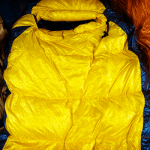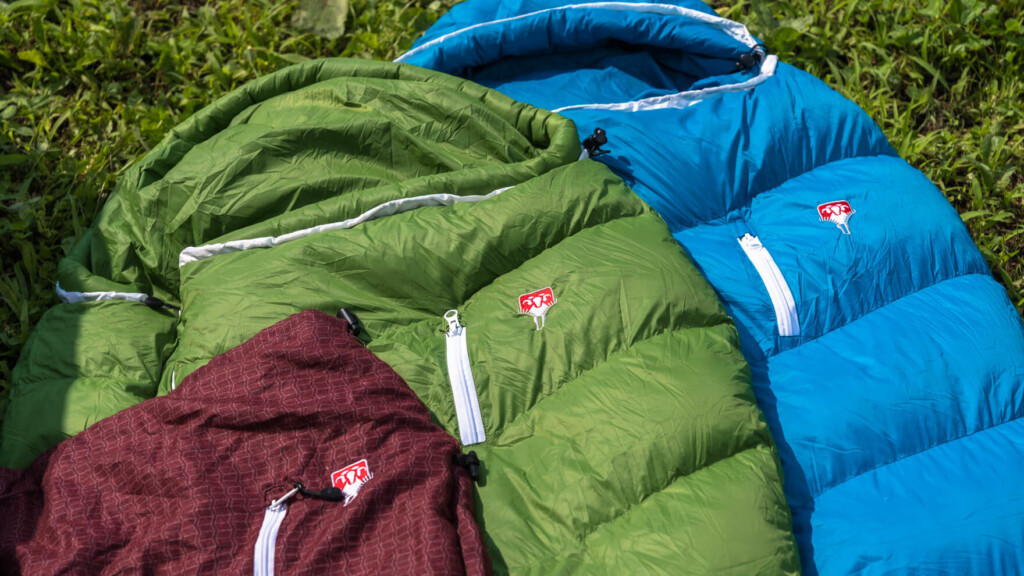
When it comes to comfortable sleeping bags (sleeping bags/shraf) for use in the mountains, the first thing that comes to mind is down (feathers)
It's true that if you only consider the insulation per weight (i.e., lightness and warmth), there's hardly any padding material on the planet that beats down. But let's stop and think for a moment. Is "lightness and warmth" really the determining factor in a sleeping bag's comfort only in certain "ideal environments"?
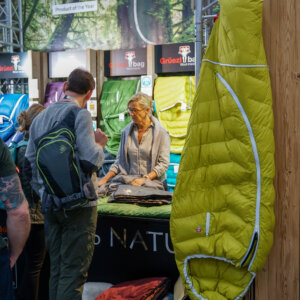

I first learned about it a few years ago at ISPO, an outdoor exhibition in Munich, Germany, and kept a close eye on it, hoping it would come to Japan. Finally, this season, it will be imported and sold by Evernew. What's more, as of July 1, 2021, it is currently being sold at a discount on the crowdfunding site Makuake.com
So I borrowed a sample from Evernew and slept in it several times, literally experiencing its comfort. I'd like to write about what I discovered about this sleeping bag's capabilities and the completely new comfort it offers that I've never experienced before
table of contents
- Features of Gruezi Biopod Down Wool
- Main specifications and evaluation
- DownWool is an innovative synthetic padding created by overcoming the hidden weaknesses of down
- DownWool's mechanism: Down and wool complement each other's weaknesses and utilize their strengths
- What exactly is "comfortable" about it?
- Are you concerned about the weight and compactness?
- Careful consideration has been given to the small details that are important for a comfortable sleep
- Summary: Sleeping bags that are comfortable, practical, and sustainable without pretense are the future of sleeping bags
Features of Gruezi Biopod Down Wool
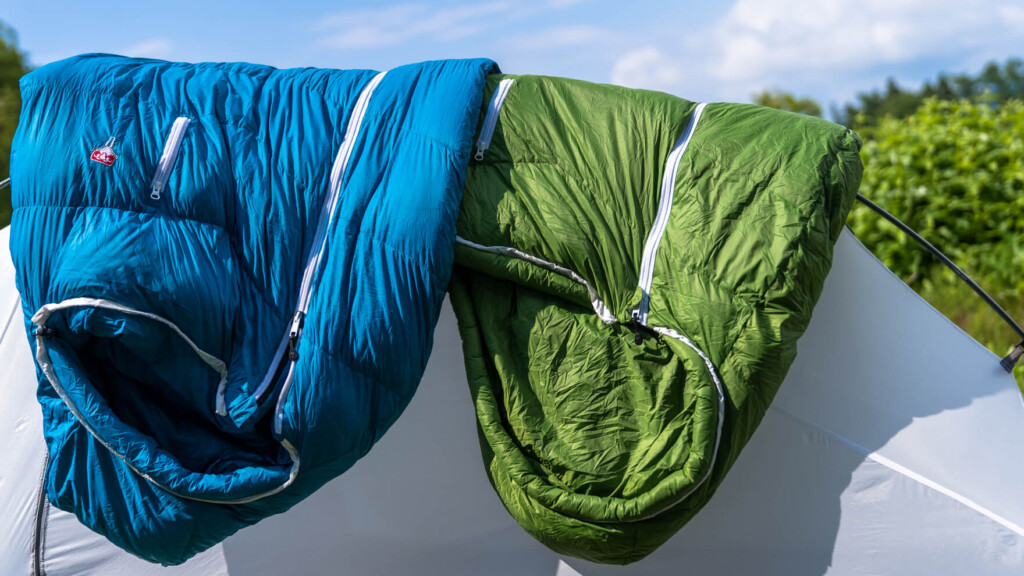
The samples I borrowed this time were items handled by the Makuake project (DownWool Subzero / DownWool Summer / Feater), but to avoid duplication, I will generally be reviewing "DownWool Subzero" unless otherwise noted
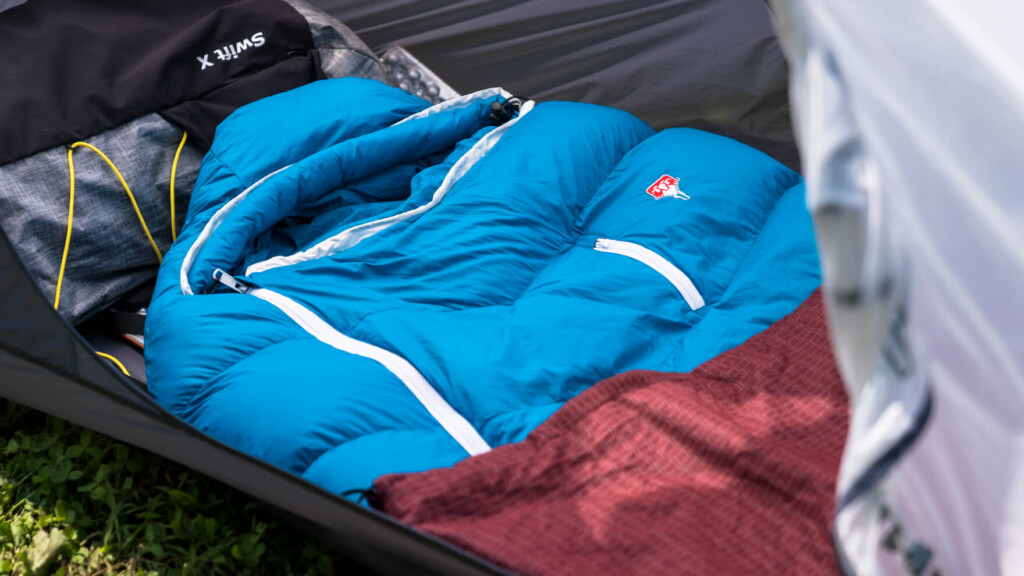

Recommended points
- Practical comfort that ensures a healthy sleep even in harsh environments, without being too hot or too cold
- Wool's moisture resistance prevents the sleeping bag from getting too stuffy
- Curved zipper line for easy leg entry
- Pocket for small items
- Environmentally conscious design with minimal use of synthetic materials
Points of interest
- Slightly heavier and bulkier than down
- Currently, only the 175cm size is available in Japan
- expensive
Main specifications and evaluation
| item | Biopod DownWool subzero 175 | Biopod Down Wool Summer 175 |
|---|---|---|
| size | Total length = 200 x 77 x 50 cm (suitable for heights up to 175 cm) | Total length = 200 x 77 x 50 cm (suitable for heights up to 175 cm) |
| Storage size | Compressed volume = 19x20mm diameter 5.5L | Compressed volume = diameter 19 x 17 5L |
| official weight | 850g (+storage bag 80g) | 700g (+storage bag 74g) |
| Filling Weight | 345g | 242g |
| Material (surface/lining) | 380T nylon / 20D 100% nylon Breathable and water-repellent | 380T nylon / 20D 100% nylon Breathable and water-repellent |
| Filling material | Down Wool Down 70% (Duck Down 650+FP・90/10) Wool 30% | Down Wool Down 70% (Duck Down 650+FP・90/10) Wool 30% |
| Manufacturer's stated temperature range (℃) |
*The operating temperature range is tested based on EN23537 and is indicated on each product. The T-EXTREME temperature range may cause frostbite. This is a dangerous temperature range for use |
*The operating temperature range is tested based on EN23537 and is indicated on each product. The T-EXTREME temperature range may cause frostbite. This is a dangerous temperature range for use |
| accessories | Compression stuff bag | Compression stuff bag |
| Heat retention | ★★★★☆ | |
| weight | ★★★☆☆ | |
| Portability | ★★★☆☆ | |
| Comfort | ★★★★★ | |
| Functionality | ★★★★★ | |
| Versatility | ★★★★★ | |
| comprehensive evaluation | ★★★★☆ | |
DownWool is an innovative synthetic padding created by overcoming the hidden weaknesses of down
"DownWool" is a high-end padding material developed exclusively by Grützi. It is a synthetic padding made from a blend of 70% duck down and 30% wool, both of which are natural materials

Why this blend? The background to the creation of this new fill was the ambitious goal of fundamentally solving the problem of moisture that plagues 100% down sleeping bags, which are generally considered the most comfortable sleeping bags
Down is an excellent insulator and lightweight material. However, it is not good at handling moisture, and unfortunately, its true potential can only be realized in low-humidity, dry conditions. In damp, humid environments, condensation inside a tent, sweat and water vapor from people, and other humid conditions, the insulating effect of down is significantly reduced
Currently, synthetic fiber filling and water-repellent down (water-repellent down) are viable alternatives to padding that is resistant to getting wet or damp. However, synthetic fiber filling is significantly heavier and bulkier than down, and water-repellent down cannot be considered a permanent solution at this time, considering the durability of its water-repellent effect
DownWool's mechanism: Down and wool complement each other's weaknesses and utilize their strengths
A small German outdoor bedding brand came up with the idea of combining down and wool to overcome the drawbacks of down without losing its advantages, and to do so in an environmentally friendly and sustainable way
One of the many unique characteristics of wool is that it not only provides insulation but also has the ability to "store moisture within the fibers." In a padding that combines down and wool, when moisture fills the baffles, the wool acts as a kind of natural dehumidifier, absorbing the moisture and keeping the humidity low. In other words, wool takes over the task of dealing with moisture, which down is not good at, allowing the down to stay dry and maintain 100% insulation performance at all times
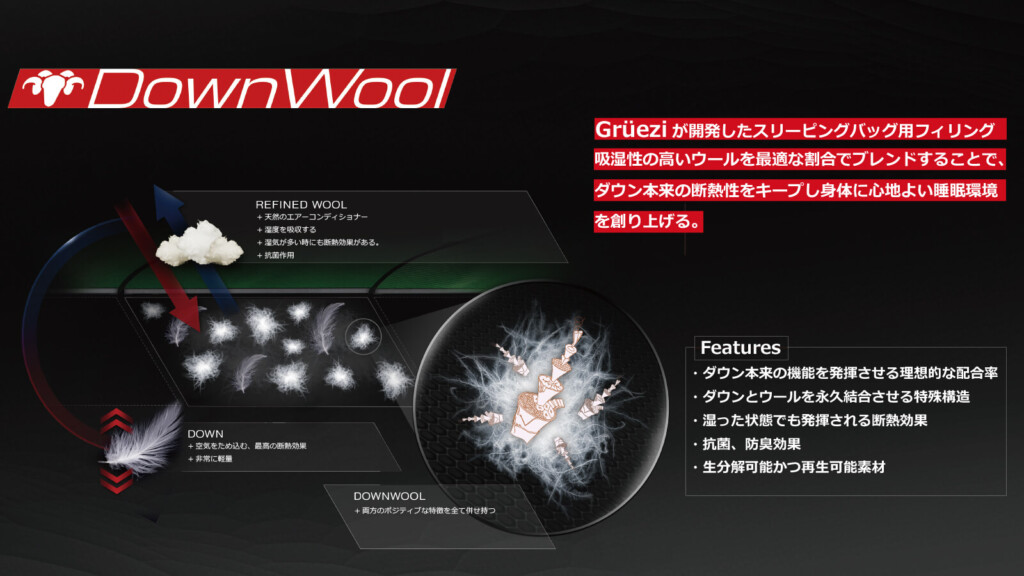

It sounds simple, but the technology to bond the down and wool fibers without separating them, and finding the best blend of down and wool, are no easy feat. The ratio of "down:wool = 7:3" was arrived at through numerous field tests and experiments, and is said to be the best balance of insulation, moisture management, and weight
What exactly is "comfortable" about it?
After much trial and error, Grützi developed this unique DownWool combination to provide optimal insulation and a perfectly dry sleeping environment without adding significant weight. It goes without saying that your sleeping environment has a huge impact on the quality of your sleep. To see how it actually felt, I borrowed a sample and slept in a tent overnight, as well as in various other temperature and humidity environments, with the air conditioning on full blast and the air conditioning off in my bedroom
And what I found was that the comfort of the Biopod DownWool subzero 175
It's a strange sensation that "alleviates the discomfort of being hot, cold, or uncomfortable to sleep in extreme situations that you might have experienced with previous down jackets."
Perhaps it could be said that it is "wider than down and provides a stable and comfortable sleeping experience in any situation."
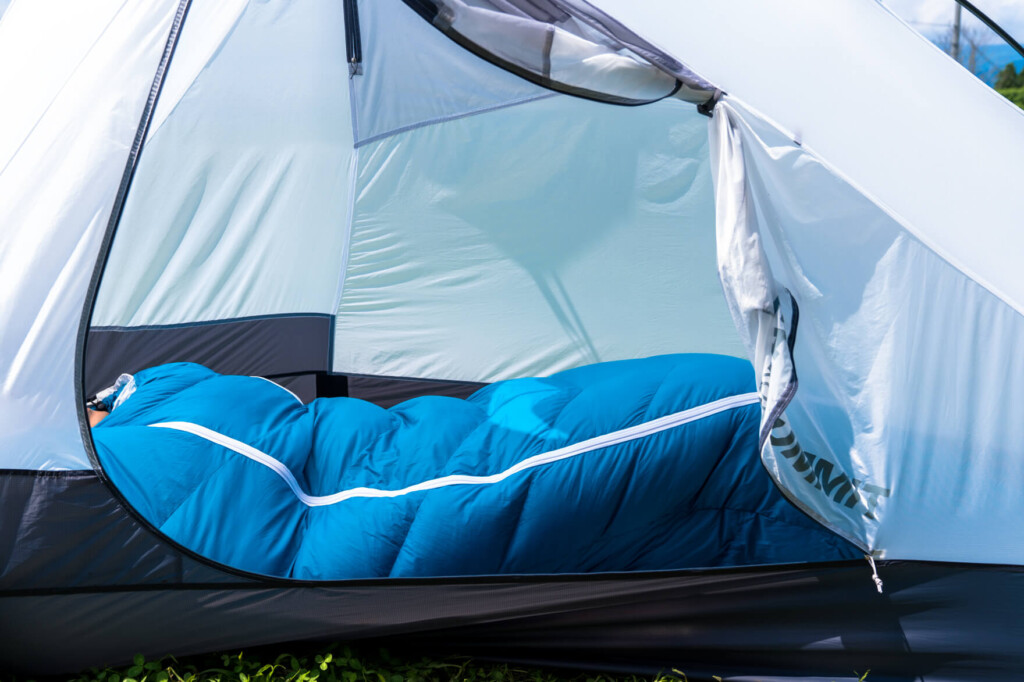

Now, this is just my opinion, but at temperatures around the middle of the temperature range (low humidity) and when you're just starting to sleep, there's no particular difference in comfort compared to a 100% down sleeping bag. It's unfortunate that the down used in this product isn't particularly "lofty," with a fill power of 650 or more*, but even so, the warmth and texture of high-quality down that envelops you in warmth remains unchanged, even with the wool blend. The fine nylon feels comfortable against the skin, and it feels almost the same as sleeping in a 100% down sleeping bag
*What manufacturers place the most importance on is "balancing environmental impact with technical performance" rather than high specifications. I feel that this is not unrelated to their policy of only using renewable natural materials, as well as raw materials produced in a responsible manner from animals raised in accordance with strict animal welfare standards, such as mulesing-free wool and RDS-certified down
However, in my experience, when the inside of the sleeping bag starts to warm up and you start to feel a little sweaty, with down, the sweat doesn't go away and the inside gets stuffy and uncomfortable to sleep in, but with DownWool, it sticks just before it gets too uncomfortable, and I get the impression that the inside of the sleeping bag stays comfortable for longer
Down is a lovable, reckless creature that always thinks only of insulation, no matter the environment, but wool gently supports this recklessness, reducing the stuffiness that makes sleeping uncomfortable and filling the sleeping bag with mild warmth. It's an exquisite combination that is very impressive
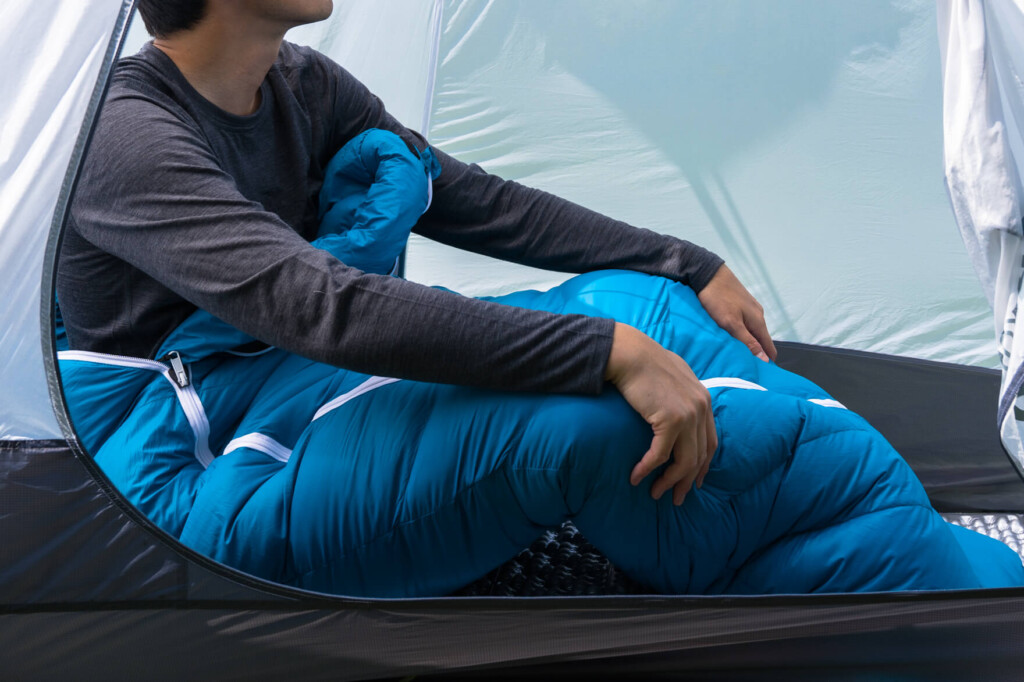
Although I haven't been able to use it in extremely cold conditions, I was still very satisfied with the comfort it provided even when sleeping in colder conditions. Because the wool controls humidity regardless of whether the temperature is high or low, the down always performs to its full potential, providing consistent comfort across the entire temperature range, except . The chamber structure (only available on the Subzero) is impressive, as it prevents uneven loft even with fewer partitions and prevents cold spots.
We thought that this high level of functionality that creates overall comfort might actually make it more comfortable than down, in the sense that it can maintain its insulating performance regardless of the environment, compared to down, whose insulating performance is inevitably unstable depending on the environment
By the way, it seems that only the 175cm model will be imported to Japan this time, but for me, who is 176cm tall, it was the perfect size to use. However, I have to say that it would be a shame for people who are larger
Are you concerned about the weight and compactness?
Weighing approximately 850g excluding the included storage bag the Biopod DownWool subzero 175 is by no means particularly light compared to a 100% down sleeping bag with the same level of warmth, but it is not significantly heavier either.
It's not an easy comparison because each company's height and temperature range are different, but for example, NANGA 's water-repellent down model UDD BAG 450DX (comfortable temperature 1°C to minimum -4°C, 178cm) weighs about 825g, while NEMO's synthetic fiber sleeping bag FORTE™ 35 (minimum -1°C, 183cm) weighs 960g. Of course, for those who are even slightly concerned about weight, this is a difference that cannot be ignored, but when compared among the standard models of each company, it is not a noticeable difference.
Similarly, in terms of volume (compactness) when packed, down is the most compact, followed by DownWool, which is the most compact. Thanks to the included stuff sack with drawcords and compression straps, it can be compressed quite compactly
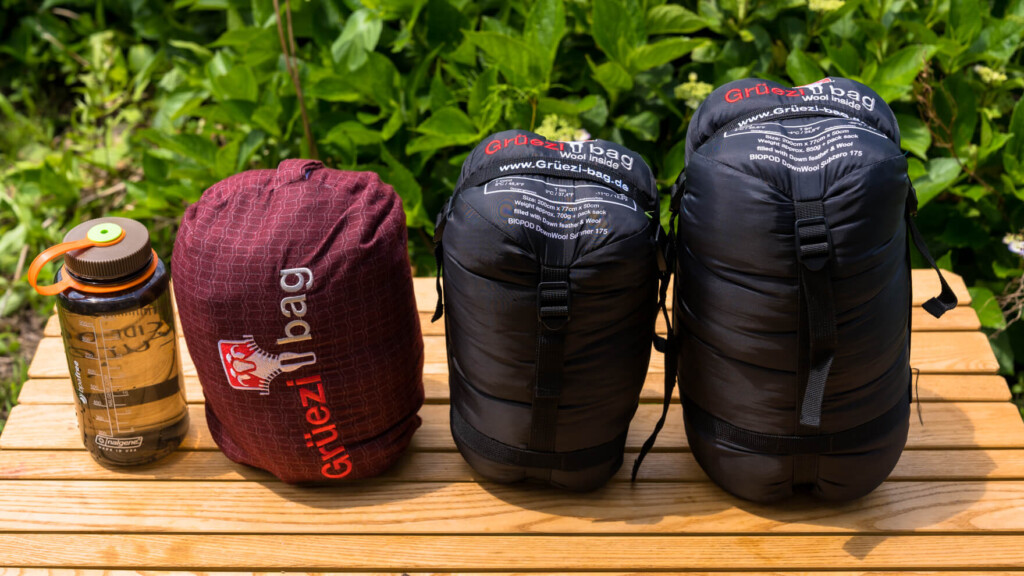
From left: Nalgene bottle (1L), Feater inner sheet, Biopod DownWool Summer 175, Biopod DownWool Subzero 175
It's definitely smaller than the average three-season synthetic sleeping bag, and about the same size as a winter down sleeping bag
Careful consideration has been given to the small details that are important for a comfortable sleep
Their commitment to true comfort, rather than relying simply on materials or gimmicks, is clearly evident in the details
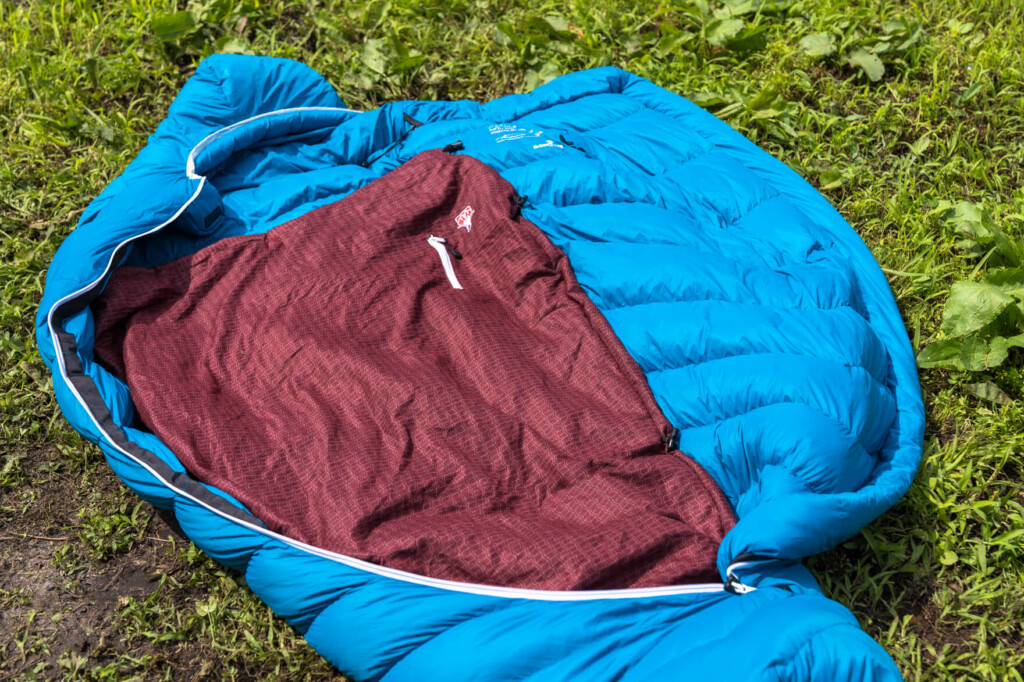
The main zipper follows the side of the sleeping bag and curves down towards your feet, creating a unique line (see photo below). By the way, the white color of the zipper makes it easier to see in the dark inside the tent
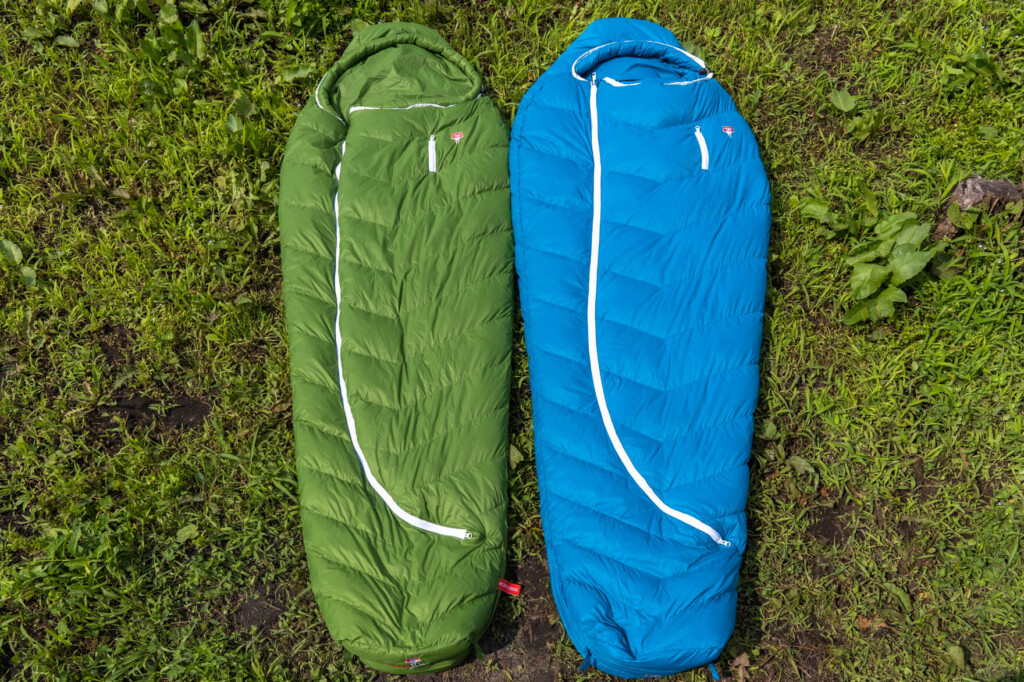
If you feel a little hot, you can keep the upper body fastened and open the double zipper at the bottom to expose just your legs (see photo below)

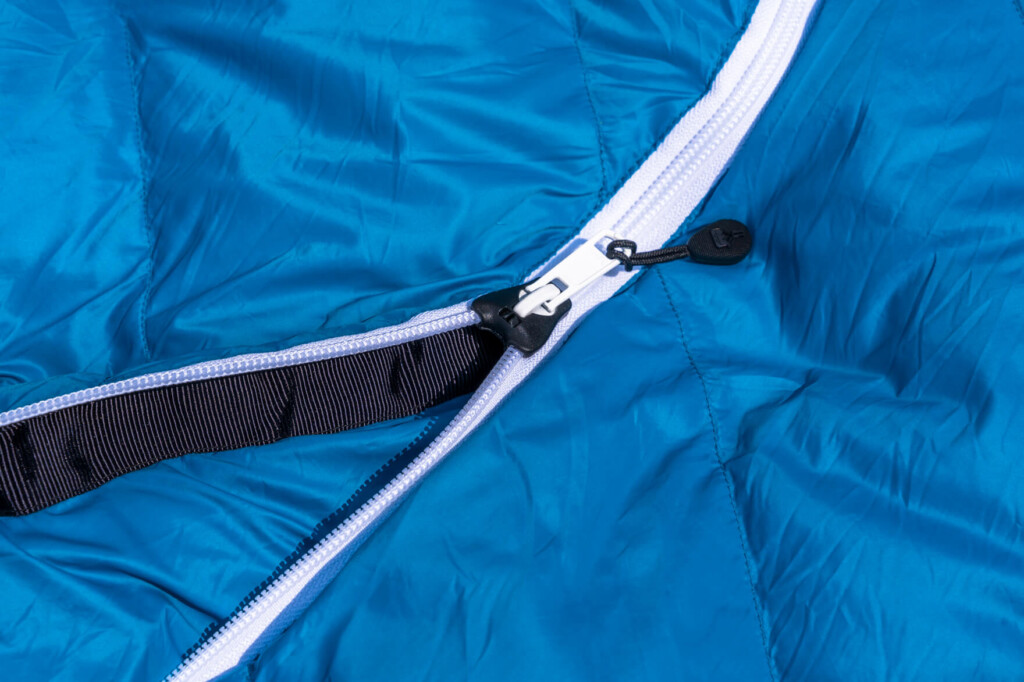
The zipper is a large YKK zipper that is used in many high-quality sleeping bags and is less likely to catch on the fabric. It was also surprisingly light and smooth (see photo below)
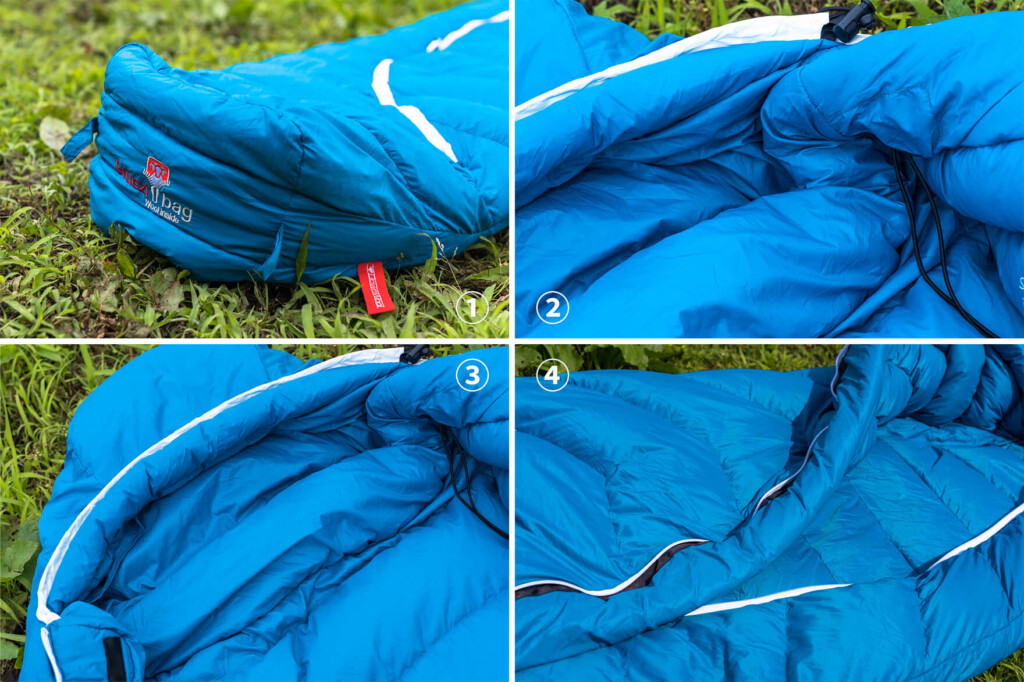
The feet, where cold is most likely to occur, are shaped three-dimensionally to prevent any gaps (photo below, ①, subzero only). The hood and neck area can be adjusted to fit your head size with drawcords to fill gaps and prevent you from feeling the cold at all (photo below, ②). Additionally, around the face, where heat loss is most likely to occur, and behind the zipper, face baffles, neck baffles (subzero only), and zipper baffles are securely positioned (photos below, ③ and ④), blocking out cold air and keeping warmth close to the skin
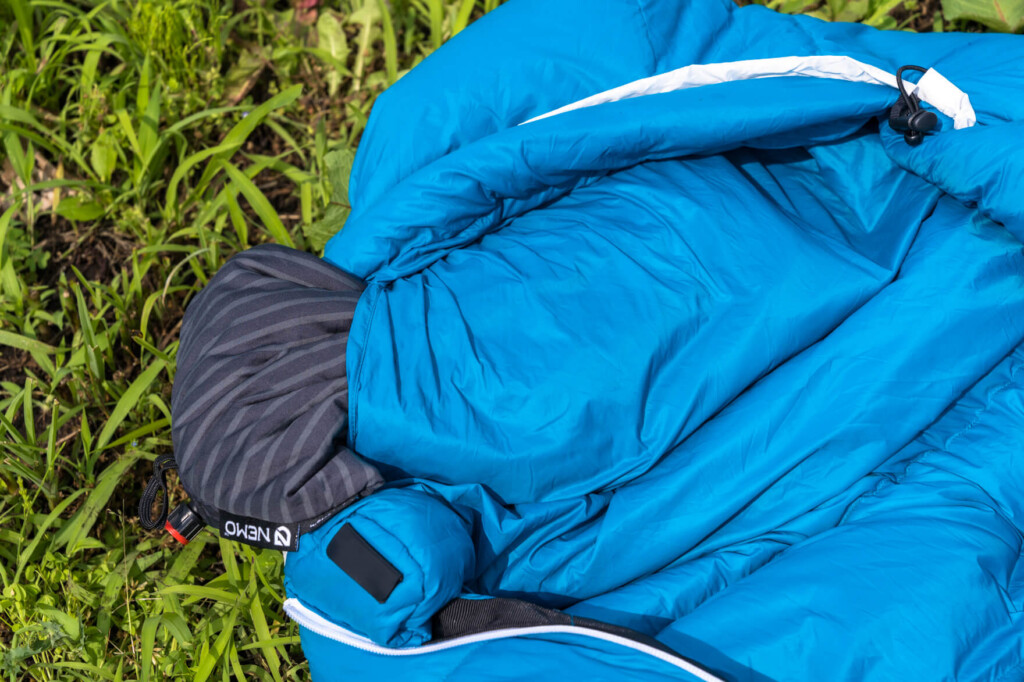
There's even a pillow pocket at the back of the head (see photo below) that you can stuff with a fleece jacket or something similar and use as a pillow. I usually use a stuff sack filled with clothes instead, but this is much better as it stays in place behind the head at all times
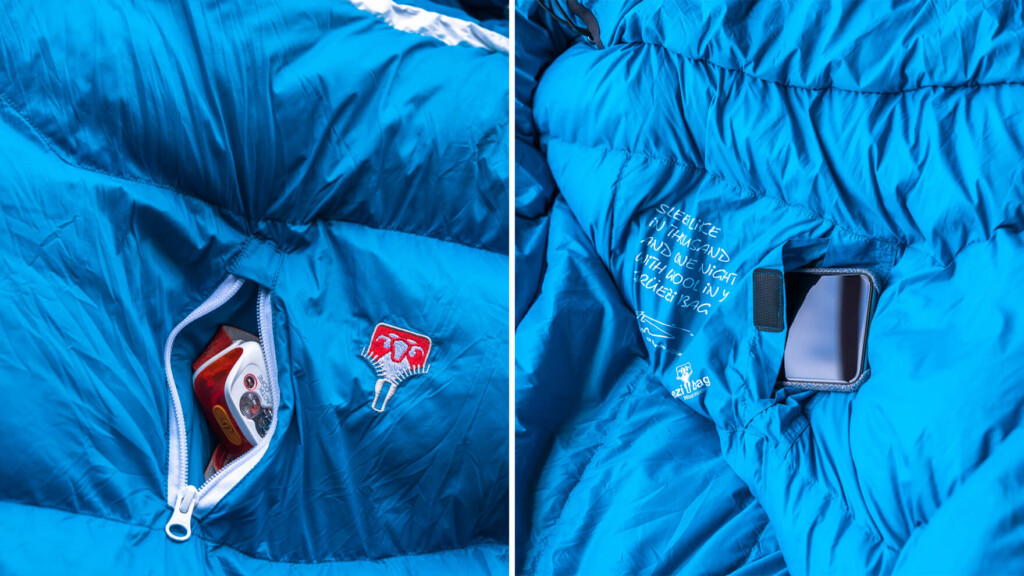
There is a zipper pocket on the outside chest and a Velcro pocket on the inside where you can store a headlamp or smartphone (see photo below)
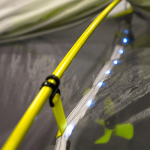
There is also an attachment that allows you to set the optional heated inner sheet "Feater" without it slipping (photo below)
Summary: Sleeping bags that are comfortable, practical, and sustainable without pretense are the future of sleeping bags
Even on a global scale, sleeping bags are not updated very often, but this was one of the most impressive sleeping bags I have come across in recent years. I would not be surprised if a major manufacturer released a sleeping bag based on the same concept in the near future. This sleeping bag is not just a gimmick, but one that gives you a sense of its overall high quality, built on solid vision and technology. Its high level of attention and perfection is also evident from the fact that it won the OutDoor INDUSTRY AWARD 2017
It will soon be imported and sold in Japan through Evernew. The early discount sale on Makuake, running until July 11, 2021 (ending soon!) Subzero Summer which can withstand temperatures as low as 3°C Feater , a mobile battery-powered heating booster that can be attached to either model or used on its own (the inner sheet also looks quite useful). Price is one of the product's drawbacks, so why not take advantage of this opportunity to get it at a slightly cheaper price?
Go to the official Evernew brand page
Related reading