


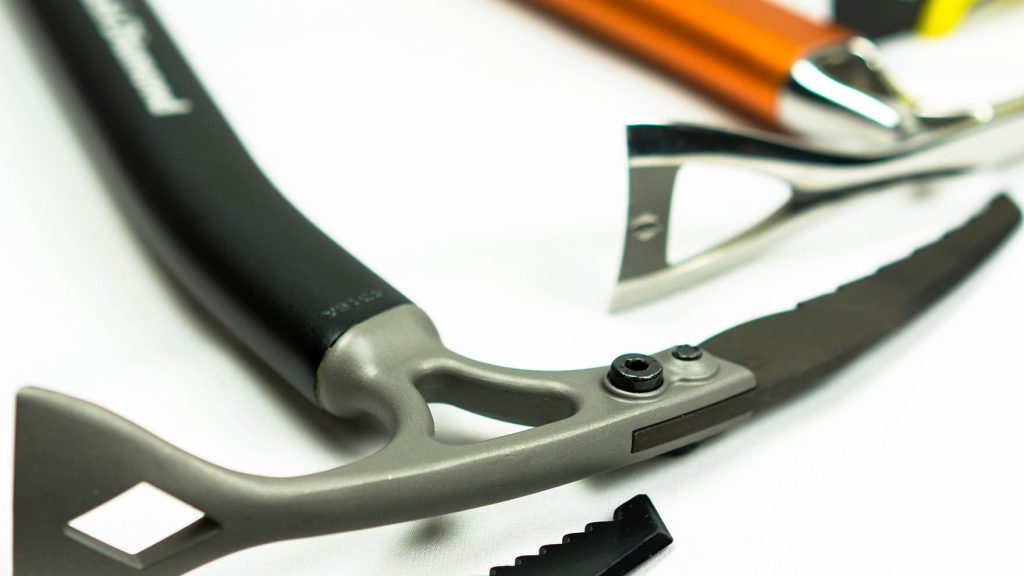
table of contents
- Whether you have a special attachment to it or not, it is an indispensable symbol of mountaineers in the snowy mountains
- In summarizing the selection
- table of contents
- What is an ice axe? - Names of its parts and 10 roles -
- Point 1: Classification by shape – Don’t overreach yourself –
- Point 2: Length – Choose based on height and activity
- Point 3: Weight and strength - Choose according to your purpose
- Point 4: Ease of use - Don't take it lightly
- Point 5: Others - Accessories that you should prepare
- summary
Whether you have a special attachment to it or not, it is an indispensable symbol of mountaineers in the snowy mountains
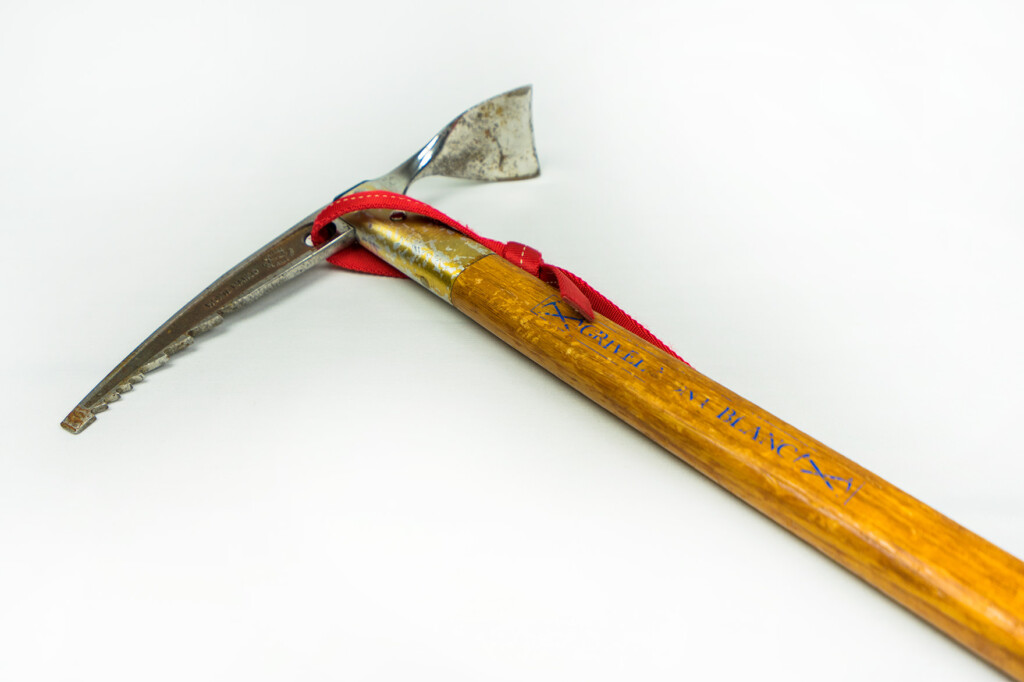
My first ice axe is a memorable one. I just found out it was made by Grivel
The first ice axe I ever owned was over 20 years ago. It was a 70cm long wooden model lying around the club room, probably left behind by a former student. At the time, wooden shafts were already becoming outdated in terms of functionality, but what attracted me to it wasn't its functionality, but rather the irresistible vintage feel of the wood shaft, soaked in linseed oil, that somehow stirred my desire to climb mountains just by wearing it. That feeling hasn't faded, and even though I've replaced it with a new model, I still can't let go of this ice axe
I'm not the only one who is fascinated by this dignified and elegant appearance. Among the many types of mountaineering equipment, the ice axe has long been loved by many climbers, both in the East and the West, as a symbol of the culture of mountaineering
In the past, ice axes were handcrafted one by one by blacksmiths, and like Japanese swords, they were also said to be the "soul of mountaineers." Incidentally, the German word for ice axe is Eispickel, the English word is Ice Axe, the French word is Piolet, and the Italian word is Piccozza. The Italian word sounds weak
It is said that it originated in the mid-19th century when a local mountain guide came up with the idea of combining the "walking sticks" used to maintain balance and the "axe" used to break through ice and snow, which were carried separately at the time during mountain climbing in the European Alps, where vast glaciers lie across the mountains (Horita Hiroshi, "Challenge to the Mountains - Climbing Equipment Speaks," Iwanami Shinsho). Now, more than 100 years later, having evolved and diversified, it is no longer special equipment that embodies a soul in a single model, but is no different from ordinary mountain gear, which can be selected from a wide variety to suit different purposes and uses
Once you buy an ice axe, it's not something you'll often replace, but since I bought a new model this season, I thought I'd take another look at how to choose the best ice axe, and I've put together the latest information
In summarizing the selection
As we will discuss later, there are many different types of ice axes depending on the purpose, from general traverses to technical climbing, and from specialized models to models that cover a wide range of terrain, but for the time being this article does not focus on so-called ice climbing, such as climbing ice walls.We are assuming usage scenarios ranging from general snowy mountain climbing to variation routes such as snow ridges, where there are some steep slopes that require security
Furthermore, climbing techniques and mountaineering equipment evolve daily, influencing each other. Even if you have personal experience, it is still quite limited. Even when it comes to ice axes, which are gear that must be used in fairly severe conditions, the reality is that even professionals have a variety of differing opinions and claims. Therefore, this time we have taken a more careful approach, going back as deeply as possible to past guide articles and other sources to conduct three-dimensional research and compile a comprehensive summary
Furthermore, there's nothing better than having the latest, specialized information. So this time, I decided to take part in the gear classes offered free of charge by XX Sou and XX Sports multiple times to broaden my knowledge, including the latest developments. As an aside, even though these gear classes are free, they are taught by active guides and athletes, and you can ask questions directly, so I recommend them more than I expected
table of contents
- What is an ice axe? - Names of its parts and 10 roles -
- Point 1: Classification by shape – Don’t overreach yourself!
- Point 2: Length – Choose based on height and activity
- Point 3: Weight and Strength – Choose according to your purpose – (Page 2)
- Point 4: Ease of Use – Don’t take it lightly – (Page: 2)
- Point 5: Other accessories you should prepare (page 2)
- Summary (Page 2)
What is an ice axe? - Names of its parts and 10 roles -
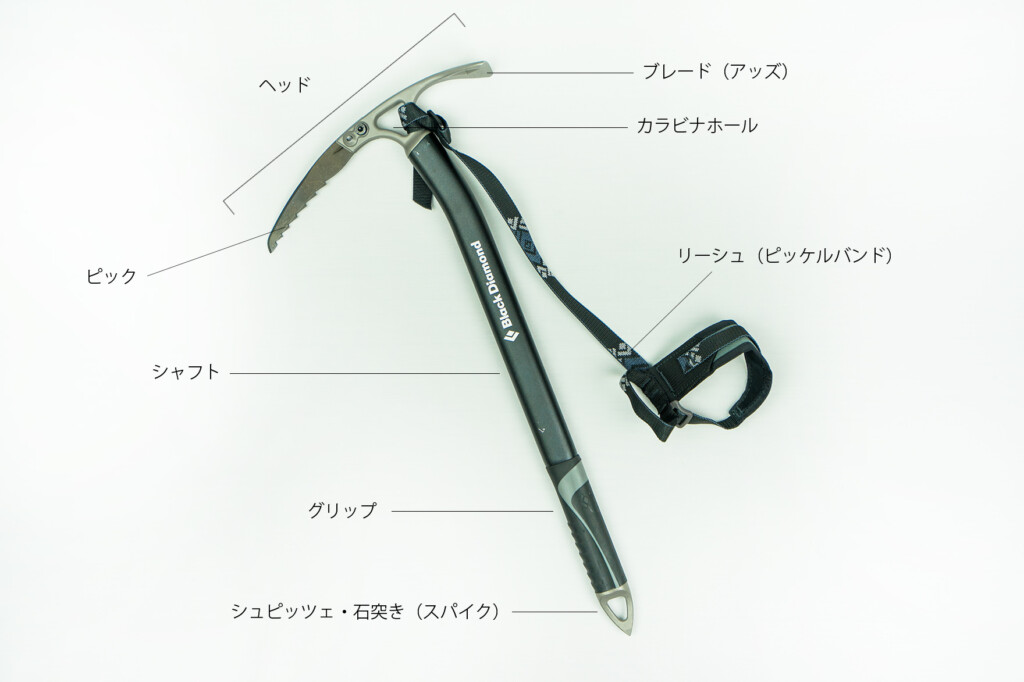
What exactly is an ice axe used for? As a basic knowledge, let's write down the main functions of an ice axe. First, as you can see from its origin, its role during normal walking is as follows:
- Use as a walking stick to provide balance when walking
This is the most basic role of an ice axe. However, with the widespread use of walking sticks, the necessity of using an ice axe is becoming less and less in some situations
- Use a pick or spitze as a support point on steep slopes
- The moment you stumble, it will stick into the slope to prevent you from falling
- When hit by strong winds or gusts, bend your body and ice axe to take a wind-resistant position
- Take a position to stop yourself from falling if you fall on a slope
These are the most important and critical roles, both now and in the past, when it comes to going to snowy mountains as a team. The main reason is that all of these can only be done with an ice axe, and at the same time, they directly affect your life
- Bury it in the snow to use as a securing point
- Carving out a hard slope to create a platform or a shelf to lower your backpack
- Use them as tent pegs (Caution: Be careful not to get them buried in snow and unable to be removed)
- Breaking hard ice that cannot be broken with a shovel (such as when leveling a campsite)
- Maintaining balance during glissades and silissades (speedy downhill techniques)
It would be good to learn that there are many effective uses for these things if used flexibly and effectively
Point 1: Classification by shape – Don’t overreach yourself –
When you look through a catalog to choose an ice axe, the first thing you'll probably worry about is the shape. Recent ice axes for mountain climbing can be roughly divided into the following three categories based on their shape (see table below)


Example of an axe for technical climbing (PETZL Ergo)
Before we get into that, let me reiterate the premise that even though they're called curved, models that are completely curved like a banana are for technical (ice) climbing, where you climb by resting your entire weight on a pick stuck into an icicle or similar, so snow-climbers should forget about them for the moment (photo). Even with that in mind, while straight shafts were the only option in the past, recently it seems that many mountaineering types with a slightly curved base (head side) of the shaft and ultra-lightweight types for ski touring have appeared
| type | For general traverses (trails) | For mountaineering (mixed routes) | For ski touring |
|---|---|---|---|
| image |  |
 |
 |
| Features | The primary consideration is maintaining balance while walking. For this reason, the shaft is basically straight. The pick angle is relatively gentle and the adze is slightly larger. It is mainly used on gentle slopes where you can walk on two legs, by thrusting the shaft into the ground to gain stability | They have many features that make them more suitable for technical climbing, such as steep slopes and snow ridges, than for maintaining balance on gentle slopes. They use stronger materials overall, have curved shafts, and sharper, angled picks that allow for powerful driving even into hard ice and snow. Some models even allow you to change the picks to suit the difficulty of the route | While it has the same basic features as a standard mountain climbing model, it has a shorter shaft and the materials and shape of the parts have been made as light as possible. It is ideal for backcountry skiing where frequent use is not expected, or for fast and light mountain climbing where weight reduction is the top priority. It is intended for use in emergencies such as maintaining balance on unexpectedly steep slopes |
| Strength |
|
|
|
| weakness |
|
|
|

As shown in the table above, mountaineering types have the advantage over straight shafts of increasing the impact force (ease of driving) into the snow when swinging the ice axe down, giving your fist more room when gripping the top of the shaft to stab the pick on steep slopes, and making it easier for the pick and shaft to come into contact with the ground, providing better support and a greater sense of stability, in short, increasing maneuverability on steep slopes.For these reasons, it is clear that the steeper the slope or the more technical the route, such as on mixed areas of rock and snow, the more advantageous a curved shaft becomes
When you are about to choose, you tend to be drawn to the ones with lots of new products and those that look cool, but I'm a little skeptical about how many people actually need mountaineering types
The routes that are most often seen in guidebooks and records have long been traversed by our predecessors using traditional straight shafts, and it's also true that models for general traverses are, above all, inexpensive and have many convenient features for beginners. Some may argue that using both poles and ice axes is more comfortable on some slopes, but I don't think it's realistic advice to tell someone with little experience in snowy mountains to skillfully use both poles and ice axes
For example, if I were to take someone up a snowy mountain for the first time, I would want them to get used to walking with an ice axe early on, while the slopes are gentle, so they can get a feel for it. Furthermore, the opportunity to go on a difficult route won't come around anytime soon, so by then they'll have found the one that really suits them. Considering all these factors, I would recommend a reasonably priced straight shaft first, unless they have a very high level of confidence or preference
Tips for choosing
- First, consider whether to use a stockings or not . If you do use a stockings, you need to be physically strong enough to carry more luggage, be able to accurately judge whether to use a stockings or ice axe as a whole, and be experienced enough to switch without hesitation even in difficult situations.
- If you are not using them with trekking poles your first pair of poles be a straight-shaft pole designed for long-distance hiking (slightly longer in length), as they are inexpensive, lightweight, easy to use on gentle slopes, and simple to use .
- If you plan to use them in conjunction with walking poles you can rely on the walking poles up to gentle slopes, so we recommend mountaineering poles (shorter length) which are advantageous on steep slopes, or ski touring poles (lightweight type) if you can be sure that there are almost no dangerous places where you cannot climb without sticking a pick in your poles .
Point 2: Length – Choose based on height and activity
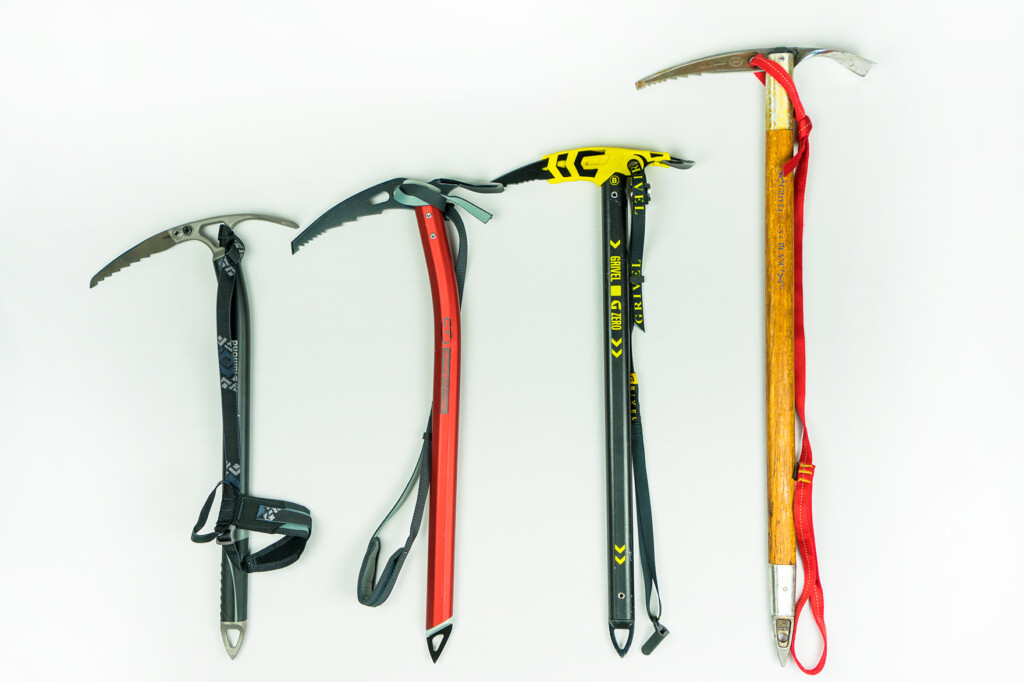
Differences in length. From left: Black Diamond Venom Adz (50cm), Climbing Technology Alpine Tour (55cm), Grivel G Zero (58cm), Grivel unknown model (70cm)
Why has the optimal length of an ice axe become shorter?
Most ice axes come in multiple lengths, even within the same model, and currently there is a wide variation between 50 and 75 cm. What is the current general consensus on the optimal length? According to the 2015 PEAKS Special Latest Snow Mountain Gear Guide , the average length is around 60 cm, with 55 to 70 cm being the easiest to use depending on your height. The slightly older Mountain Gear Encyclopedia states that the best-selling sizes in 2009 were 55 to 65 cm.
This is not necessarily wrong, but it does leave me feeling a bit unsettled
A mountaineering equipment guide from the 1970s even recommended a much longer ice axe than we know today, with some recommending a length of around 70-85cm (Takahashi Kazuyuki, "Research on Mountaineering Equipment," Uni Publishing). Why has the recommended optimal length become so short, even though the mountains and people are the same? I've been pondering this for a bit. If you don't have time, feel free to skip this part
There are certainly several reasons why the optimal length has changed in this way. The first one that comes to mind is that shorter ice axes became more popular as climbing techniques evolved. According to " Mountaineering Equipment Encyclopedia " and other sources, the climbing technique developed in the early 1970s, "Piolet Traction" or double axe (a method of driving the pick into the ice wall with a short shaft) became popular, and models suitable for this technique began to appear one after another. At the time, the ideal size for Piolet Traction was said to be around 50 to 65 centimeters (Takahashi Kazuyuki, "Research on Mountaineering Equipment," Uni Publishing).
Another reason is the increasing use of ski poles in combination. It has long been the general opinion that ski poles are more advantageous than ice axes when digging through deep snow (Takahashi Kazuyuki, "Research on Mountaineering Equipment," Uni Publishing), but the April 1990 issue of "Yama to Keikoku" mentions the advantages of ski poles as walking sticks, stating that "for long-distance hiking, a pole of about 55 to 75 centimeters, based on height, is appropriate," and that "adjustable ski poles may not have as many functions as ice axes, but they are effective as all-purpose walking sticks."
Judging from these descriptions, it's not too hard to guess that over time, the trend in the role of ice axes shifted from "a walking stick for maintaining balance" to "a fulcrum that you swing the shaft over and drive it into the ground." As users demanded this trend, manufacturers began to make shorter and shorter models. The media also began to provide information tailored to these situations, and before we knew it, it had become common knowledge. But maybe I'm overthinking it
In other words, what I wanted to say is that if the recommended optimal length has become shorter for the reasons mentioned above, then surely the optimal length for general snowy mountain traverses should remain the same as it was in the past?
What's the best way to measure your optimal length?
So, finally, we're getting to the main topic. How do you choose the optimal length? Here, I'll share my thoughts based on a variety of knowledge. In short, it's a simple method of choosing based on your height and the activity (the main terrain on that route) so as not to be overly swayed by current trends. However, what is easy to use varies slightly from person to person, so please only refer to the parts below that make sense to you, and ultimately try to find the size that feels right to you through experience
First, measure your standard size based on your height, etc. to determine the optimal size. There are several ways to do this, based on the opinions of guidebooks and instructors. For example,
- The length is approximately 110cm less than your height
- When you hold the head and stand upright, the tip of the ice axe should be long enough to reach your ankles
- When you hold the head horizontally and point the spitze along your arm toward your torso, it should be long enough to pass under your armpit
By the way, when I tried them out for my own height, they were all about 65cm long, so I don't think it would make much difference no matter how you measure. For now, I'll use this as my standard size for optimal length
From here, you can consider your optimal length for each activity. Specifically, consider the optimal length based on how technically difficult the main terrain or the most difficult crux of the route you are heading towards is, as shown below
[Reference] The length that the author, who is 176 cm tall (standard size 65 cm), felt was just right
Of course, some people may think that if you choose a length of around 60-65cm, you can use one for all purposes. However, there is a risk that you will end up with something that is incomplete no matter what you use it for, so from my personal experience, I recommend that you decide on a purpose and use it appropriately
| kinds | Gentle slope (for traverse) | It's a steep slope, but you can walk it with an ice axe (for variation routes) | Climbing required (for more difficult routes) |
|---|---|---|---|
| Advantageous length |
A longer one is better as it makes it easier to stab the spitze into the ground |
A shorter pick/spitze is better for easier fixation and handling of the shaft |
The shorter the better, as you will be hammering in the ice axe |
| Optimal length (in my case) | Standard size + 5cm (65-70cm) | Standard size -10cm (50~55cm) | Fixed (50cm) |
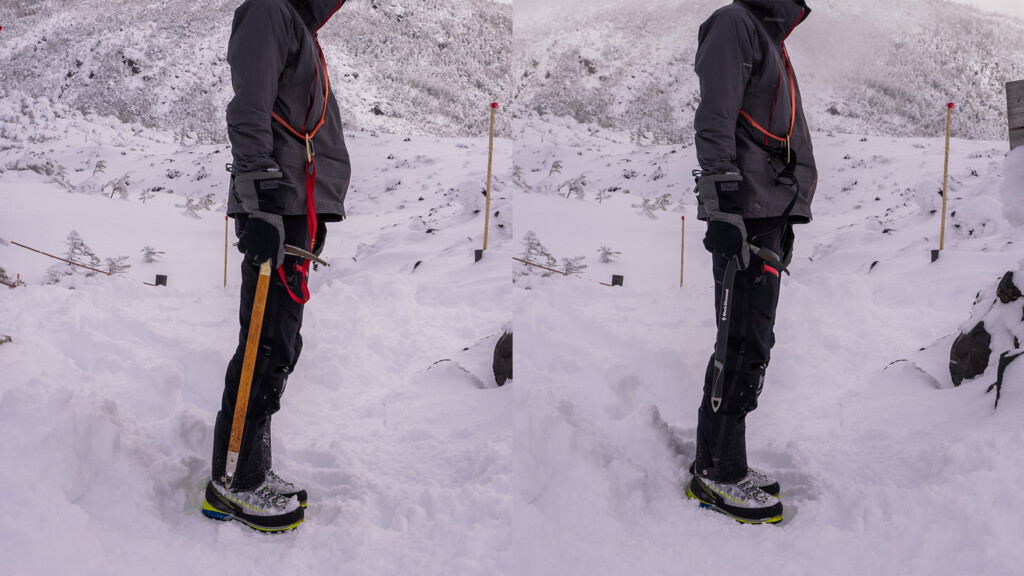
Comparing ice axe sizes by height. The 70cm ice axe (left) is just at the ankle. The 50cm ice axe (right) is not suitable as a walking stick unless the slope is extremely steep
Tips for choosing:
- There is no single length of ice axe that will cover everything. The optimal length will vary depending on your height and the terrain of the route you are aiming for, so it is recommended that you choose multiple ice axes with the intention of using them for different purposes.
- A longer size is easier to use on routes with few steep slopes, while a shorter size is easier to use on routes with many steep or difficult slopes
- If you choose a shorter size, poles are effective for maintaining balance on gentle slopes .
Point 3: Weight and strength - Choose according to your purpose
Is the lighter the lighter the better? ~About weight~
The general theory of mountaineering is that "lightness is justice," and requires a bit of caution when choosing a pickle. The lightweight pickle, which is made of aluminum, not only the shaft but also the head, is naturally highly portable, making it ideal for activities where speed leads to safety, such as walking in backcountry and snowy fields. However, instead, the lightweight pickel is less strong, and even if you drive it vigorously into the hard, tight ice and snow, the blade may not be at all set. For this reason, light models are dangerous if you are trying to actively drive picks. If you consider a technical route from a typical traverse, it is a good idea to choose a highly durable model with a certain amount of weight.
T type? Type B? ~About strength~
Many of the climbing equipment that entrusts life to you have are global standards for safety (durability), and certification ensures that it is a uniform and reliable product. Pickels are no exception, and tests guarantee that they are stronger than a certain level according to the CEN (European Standardization Commission) standards and the UIAA (International Mountain Federation) standards.
In particular, the CEN standard classifies pickles into the following two strengths depending on the strength. *Quoted from the Petzl Manual
- Type T: For those with high strength, it is a technical axe with the "T" mark. A 50 cm shaft must withstand a load of 3.5 kN. Petzl Charle's technical axes are designed to withstand up to 4 kN.
- Type B: The axes with the "B" mark are basic axes, and are less strong than technical axes. A 50 cm shaft must withstand a load of 2.5 kN.
In short, Type B is mainly used to maintain balance when walking and stop slipping on slopes, while Type T is strong enough to anchor or belay when climbing, assuming more impacts than the load that puts your entire weight on.
The strength is outstanding, but it is difficult to imagine scenes where a typical snowy mountain climbing is subject to a very high load, so type B is sufficient. At the very least, you should be sure whether they have passed certifications such as CEN standards. Rather, you should be concerned about the risk that the increased strength will lead to heavy models being unnecessary, making it difficult to operate. Of course, if you're looking to go into a full-scale winter mountain, it's quite a good idea to choose the T-type from the beginning.
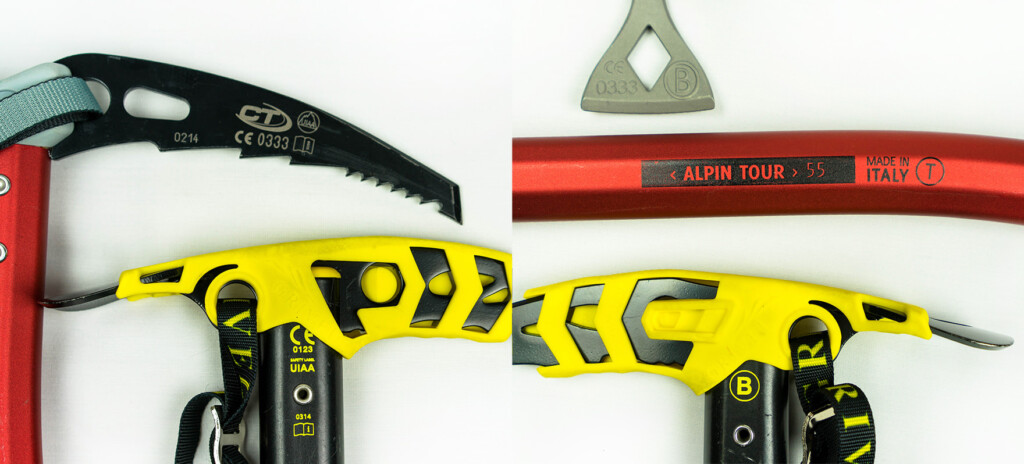
Almost all models from major brands have a certification mark or a "B" or "T" mark somewhere.
Tips for choosing:
- If you are considering a route with a strong climbing element in the future, you should not go for an extremely lightweight model.
- As long as the strength of the pickle is certified by international standards such as CEN, the basic level (B) level is sufficient.
Point 4: Ease of use - Don't take it lightly
It may be a small detail, but one thing you should never forget is the ease of use of the pickel. The head shaft part, which you are constantly holding, is an important point in terms of how quickly and safely you can handle it when changing the way you hold it. Furthermore, speed is the key to stopping a slippage, so even just a little easier to handle cannot be said to be the difference between life and death.
These may not be a concern for people with normal or larger sizes, but for people with smaller hands or women, they may be significantly different than others. By the way, from experience, if the grip is too large and feels like it is squeezing your fingers, it may cause poor blood circulation later, and your hands tend to get colder.
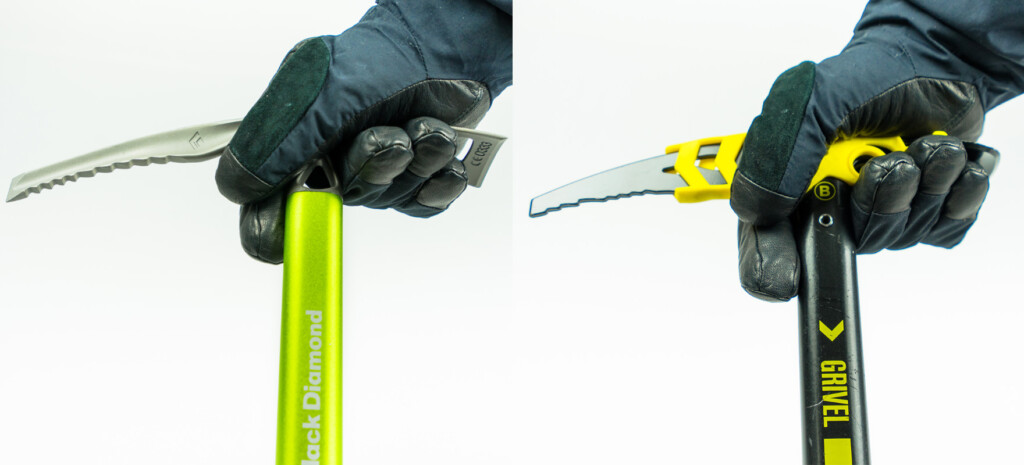
Black Diamond Raven (left) has a slim head that makes it easy to grip, and Grivel G Zero with head protector to prevent cold hands.
Tips for choosing:
- When purchasing, be aware , such as the ease of gripping the head, moderate slippage, and the like
Point 5: Others - Accessories that you should prepare
cover
Pick Blade Spitze is sharper than you imagined, and it is extremely dangerous to wander around the bottom with its bare surface and makes it a great weapon against people. Also, if you handle the item without covering it carelessly, there are probably quite a few people who have experienced the sudden moments of lifting and lowering a backpack, or even squealing it as if it were a sloppy thing. You can buy a commercially available cover, make your own cylindrical cover, or wrap duct tape to make it a cover. Make sure to attach a cover, even if you use any method.
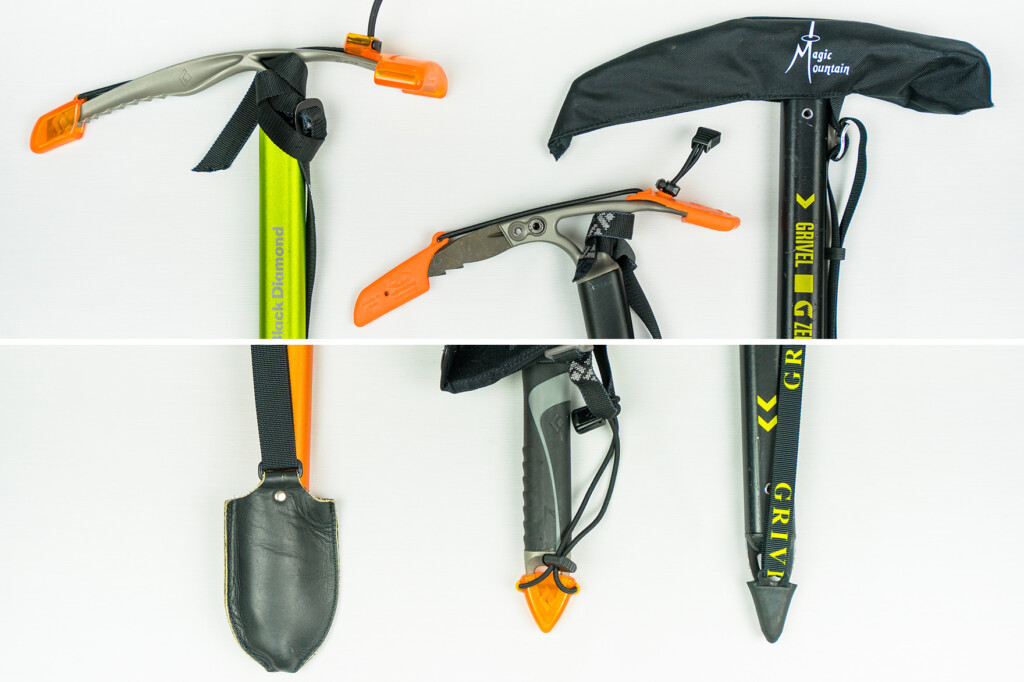
Leash (Pickel Band)
A leash is a band that connects you to the pickel. It is designed to keep the pickle constantly connected to yourself so that you don't let your guard down in any situation, as well as slopes where you can't know when it will fall. It can also be used to ensure safety by embedding the shaft in the snow to serve as an anchor when resting on a slope. It is wise to wear it unless you are at the level of an extremely skilled professional guide.
leashes : shoulder-on-wear and wrist-on-wear we will introduce composite type that the instructor taught us
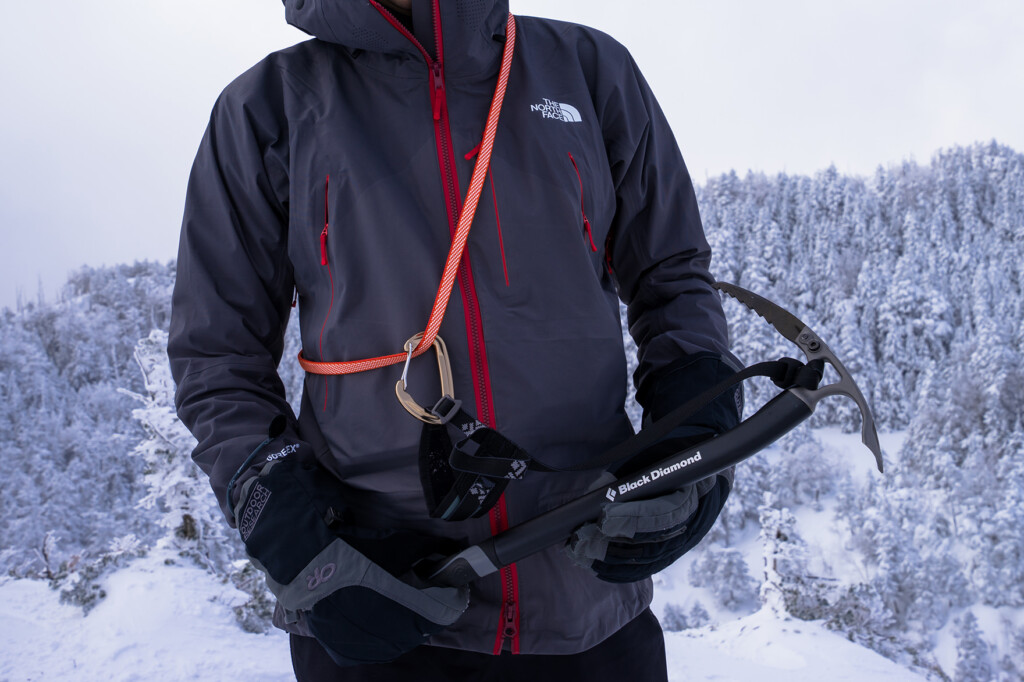
The composite type is a method of using a 60cm tape sling over the shoulder, carabiner, and a wrist leash is connected to it. It is an excellent product that can be used in both ways, usually as a shoulder strap type, and as a wrist-type detachable from the carabiner when climbing.
| Types of leashes | Shoulder type | List type | Composite type |
|---|---|---|---|
| advantage |
|
|
|
| Disadvantages |
|
|
summary
To put it simply, after writing so much at this point, I have experienced that, as far as I have mentioned, whether it is straight or bent, or whether it is a few centimeters long (short) is concerned, is not a fatal issue. What's even more important is how freely you can handle the tools you have been given (selected). In other words, once you decide to do this, the most important thing is to first master how to use the model so that it can be treated like a part of your body. Taking into account what's written here, to be honest, it's best to start by picking up something affordable or something that you find easy to use, without worrying about too much detail. I'll also be looking at some recommended models later.
Finally, just to be safe, even if you go that far, due to the basic nature of mountain tools, the conclusions written here do not apply to everyone in all situations. I have tried to focus on my thinking as much as possible, but I would like to never try to take just the conclusions I have written at face value. Snowy mountains in particular are dangerous activities that can be life-or-death if you climb with half-hearted knowledge and skills, so if you are actually trying to start a winter mountain, we recommend that you always be accompanied and guided by a group with a proven track record, such as mountain clubs, or experienced people.
[References]
- "Mountains and Valleys, May Issue," Yamato and Valleys, 1965
- Takahashi Kazuyuki, "Research on mountain climbing equipment: Full knowledge of how to choose, buy, and use," Uni Publishing, 1979
- Hashitani Akira, "Choosing mountain tools without fail," Yama to Keikokusha, 1989
- Hotta Hiroshi, "Challenge to the Mountains: Mountain Climbing Equipment Talks," Iwanami Shinsho, 1990
- "Mountains and Valleys April Issue" Yamato and Valleys Publishing, 1990
- "Snow Mountain Climbing (Yamakei Technical Book - Complete Guide to Mountain Climbing Techniques)" Yama to Keikokusha, 2006
- "The Complete Collection of Mountain Equipment" Yama and Keikokusha, 2010
- Kasahara Yoshiki, "Experienced Mountain Tools Study," Yamakei Shinsho, 2014
- "Peaks: Latest Snow Mountain Gear Guide" Ei Publishing, 2015
- "Trampin vol.25 Introduction to Snow Mountains (CHIKYU-MARU MOOK)" by Tetsumaru, 2015