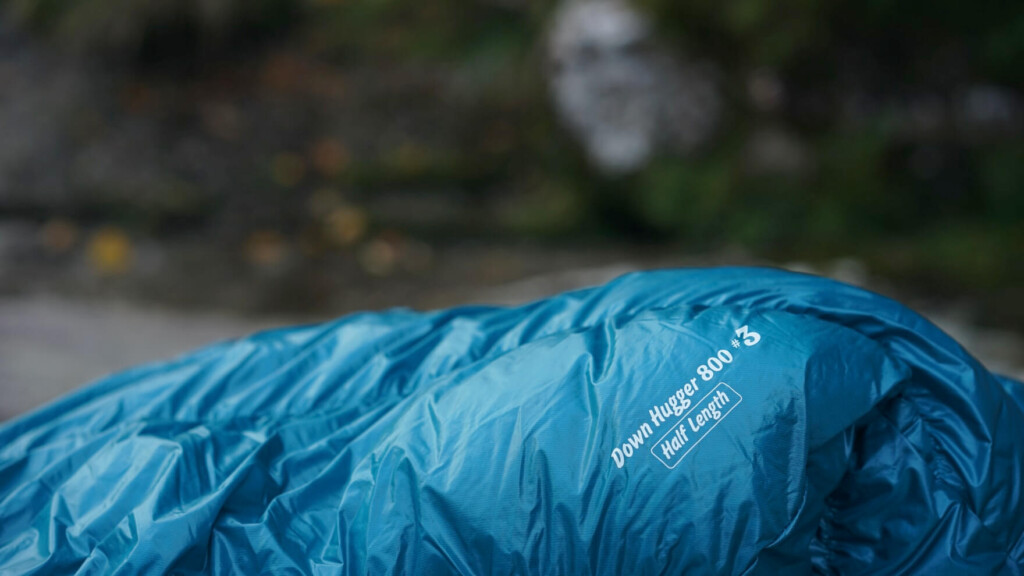
While you may be able to manage if you keep moving even if it's a little cold while you're out and about, the human body barely produces any heat when you're asleep, so choosing the right sleeping bag is extremely important. One wrong move, especially in winter, can be disastrous. If you don't get enough sleep, it will affect you the next day, so you can create a vicious cycle of not being able to sleep → not being able to recover from fatigue, and the whole mountain trip can become a difficult one
This is a common understanding, but people still want to reduce the weight and volume of their luggage. To fulfill this desire, manufacturers are constantly developing lightweight sleeping bags that maintain their warmth
The Montbell DownHugger 800 Half Length #3 we're introducing today is a bag that takes a slightly unique approach to weight reduction. While it's not a new idea, it's a model that can further expand the options in the Montbell sleeping bag lineup, which is renowned for its high quality. It also features some of the subtle little touches that are unique to Montbell, which we enjoyed. Let's take a closer look
table of contents
- Down Hugger 800 Half Length (#3)
- Main specifications and evaluation
- Detailed Review
- A stoic design that simply requires you to slip your lower body through the cylindrical down jacket
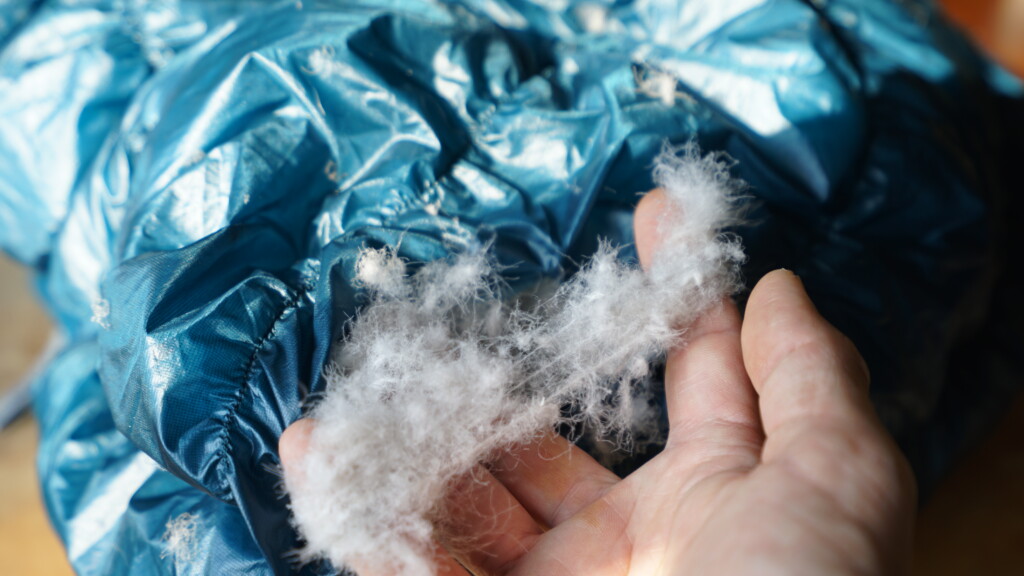
- Lightweight and thin outer and inner fabrics filled with the finest down
- Of course, it's light and compact
- Openings to prevent warm air from escaping
- You can use your legs! (Adjust the temperature, sit cross-legged, walk)
- Actual impressions after using it
- Summary: Recommended for these people
Down Hugger 800 Half Length (#3)
Montbell's DownHugger 800 Half Length (#3) is a sleeping bag that uses the same down as the previous DownHugger 800 #3, but only covers the lower body (up to the solar plexus). This makes it lighter and more compact than the previous model, making it ideal for activities where luggage volume and weight are critical, such as alpine climbing, ultralight hiking, and fastpacking. Its comfortable sleeping temperature range is from 3°C and its usable limit is -2°C, making it suitable for three seasons. However, since it only warms the lower body, you'll need to adjust your upper body temperature with different clothing depending on the season. The lineup also includes three other models: the #1, which has a larger amount of down filling and can be used in four seasons, and the #5, which has reduced down filling and is lighter.
Recommended points
- Lightweight and compact
- Legs can be exposed
- Wide range of uses and applications
Points of interest
- If the drawcord is made of rubber..
- No zipper
Main specifications and evaluation
| item | Specifications and reviews |
|---|---|
| size | Down part 130cm + shell part 40cm |
| Storage size | 12×24cm(2.4L) |
| Official weight (including storage bag) | 411g (439g) |
| Actual weight (including storage bag) | 412g (433g) |
| Down quality | 800FP/EX Down (90% Down, 10% Feather) |
| Manufacturer's stated temperature range (℃) |
|
| Outer fabric | 10D Ballistic Airlite |
| accessories |
|
| Heat retention | ★★★☆☆ |
| weight | ★★★★★ |
| Portability | ★★★★★ |
| Comfort | ★★★★☆ |
| Functionality | ★★★★☆ |
| Versatility | ★★☆☆☆ |
| comprehensive evaluation | ★★★★☆ (Assuming the purpose and scene are chosen appropriately) |
Detailed Review
A stoic design that simply requires you to slip your lower body through the cylindrical down jacket
The basic concept is that you'll be bringing warm clothing like fleece or a down jacket anyway, so let's leave the upper body part of the sleeping bag to those clothes and make it lighter and more compact! Compared to a regular mummy-style mountain sleeping bag, the padding only goes up to around the solar plexus, so you only need to cover your upper body with a thin layer of fabric
Lightweight and thin outer and inner fabrics filled with the finest down
The main fabric is Montbell's proprietary Ballistic Airlite, knitted with 10-denier ballistic nylon yarn for a lightweight and thin design. The outer fabric is water-repellent, preventing the insulation from losing its warmth when the padding gets wet and minimizing weight gain. The padding, which is filled up to the pit of the stomach (depending on your height, but for a 173cm person, it would be about that height), is made with 800-fill-power EX Down. EX Down is made exclusively from waterfowl down bred in natural environments with extreme temperature fluctuations, providing superior warmth compared to regular down
Montbell sleeping bags are rated for temperatures between 0 and 7, with the higher the number, the higher the temperature rating. Model #3 is designed for use in temperatures around freezing. The DownHugger 800 Half Length #3, according to the EN13537 (European standard) for sleeping bag temperatures used in Europe and the United States, has a Comfort rating of 3°C, Limit rating of -2°C, and Extreme rating of -19°C. However, this only applies to the abdominal area, where the down is located, so when using the bag in these temperatures, you'll need clothing for your upper body that provides adequate warmth
Unlike regular sleeping bags, the total length is only 170cm, so you cannot fit your head all the way inside. You have to rely on the hood of your clothing to cover your head. There is no zipper, so when you sleep, you enter through the top opening and drape the shell over your shoulders

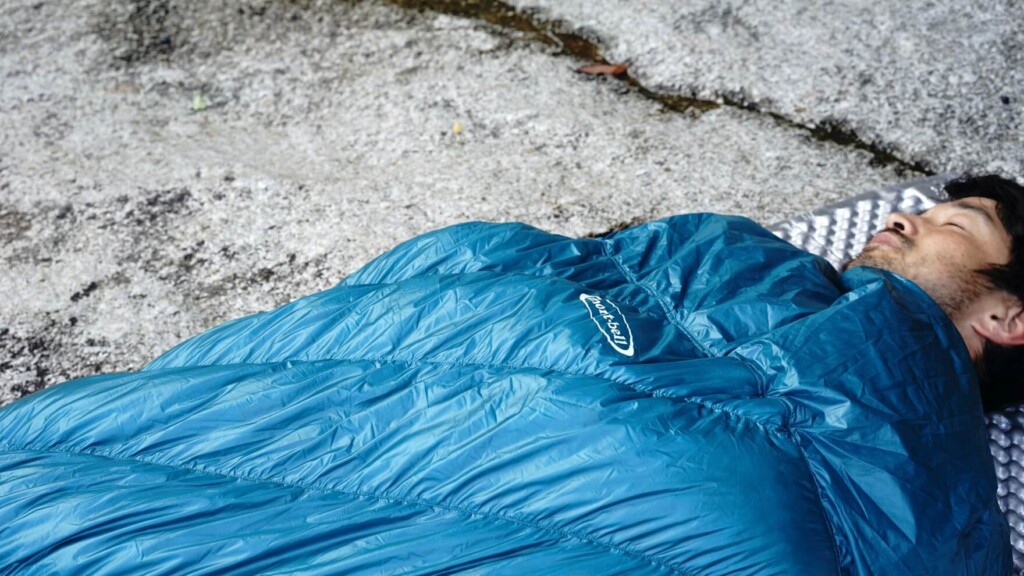
The transition between padded and non-padded occurs just above the Montbell logo
Of course, it's light and compact
Naturally, since it is shorter than a regular sleeping bag, it contains less padding, making it extremely light (actual weight: 412g). Even with the stuff sack included, it weighs just 433g. The regular Down Hugger #3 weighs 575g, and with the stuff sack it weighs 600g. It's 30% slimmer than the full-length version
It also stores compactly. The storage size is approximately 12cm x 24cm. The capacity is about 2.4L. Its height is smaller than a shoe insole (27.0cm). The regular DownHugger #3 has a capacity of 3.4L, so you can reduce the volume by 1L
Compared to the full-length DownHugger 800#3 with the same specifications, it is approximately 30% lighter and more compact in both weight and volume (full-length 575g/3.4L: half-length 411g/2.4L)
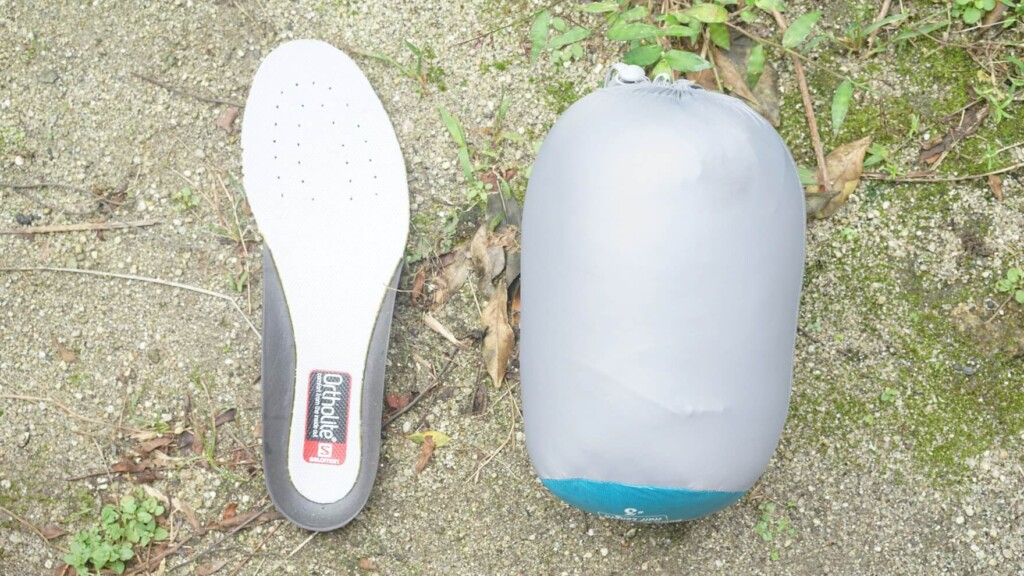
It also stores compactly, with a height smaller than a 27cm shoe insole
A cotton storage bag is included for long-term storage. While storing it in a stuff sack is convenient and takes up little space, storing it in a compressed state can crush the down's loft and, due to poor breathability, can lead to mold and odors. If you're not going to be using the quilt for an extended period of time, storing it in this breathable bag will ensure it performs at its best the next time you use it

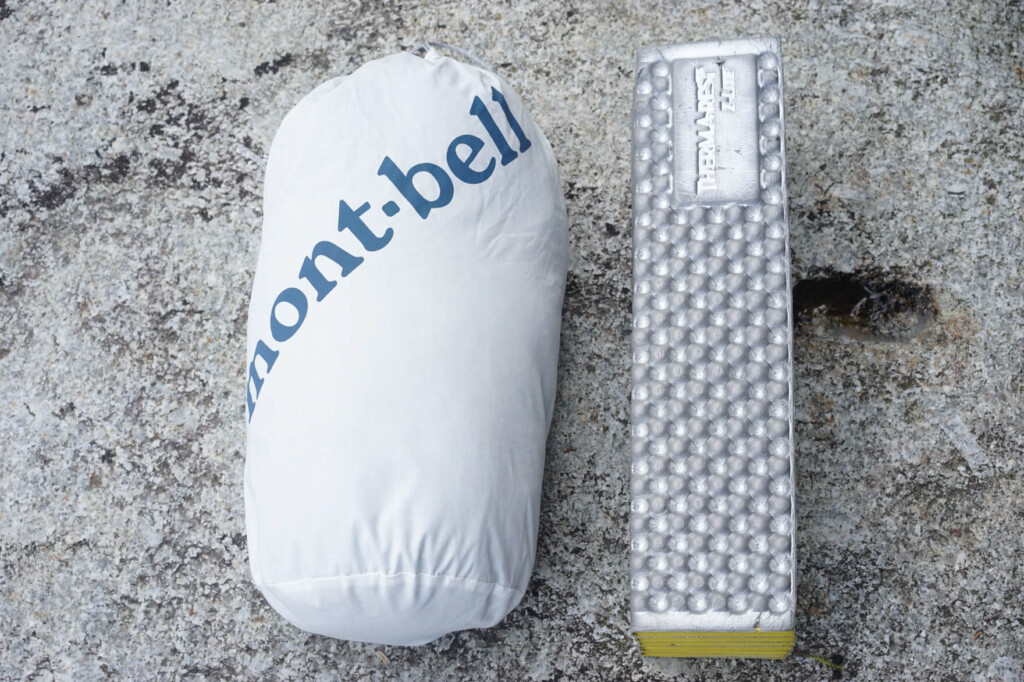
Comes with a breathable cotton storage bag for easy storage
Openings to prevent warm air from escaping
There are drawcords at the opening and at the transition between the down and shell to prevent the jacket from slipping and to increase warmth. These drawcords are made of flat string, not rubber, so they are not stretchy
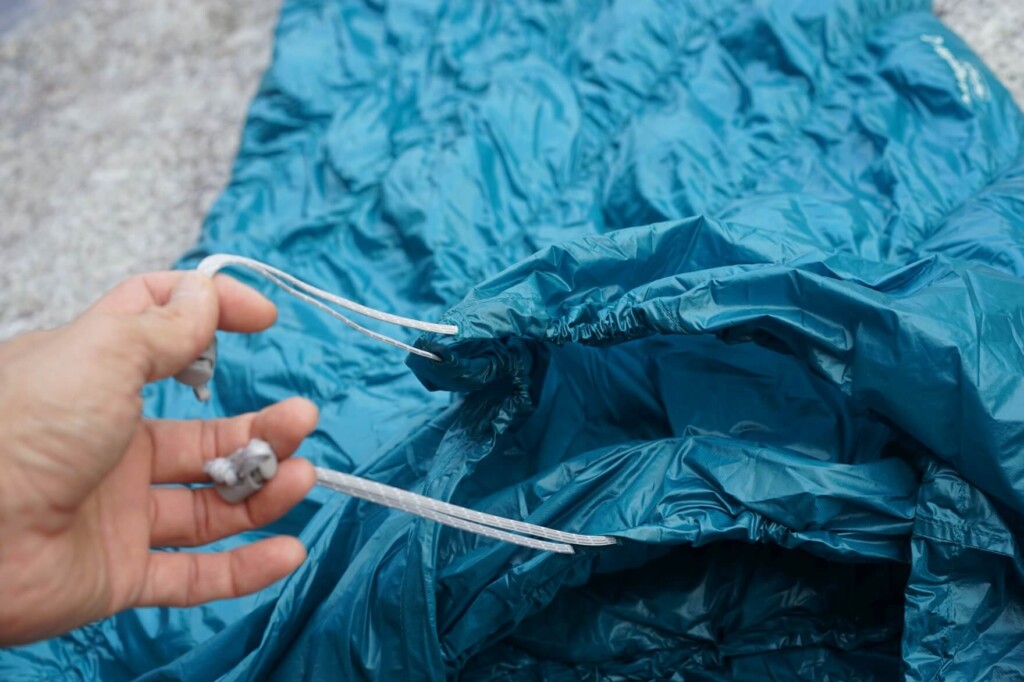
The drawstrings can be tightened at two points: the entrance and the transition to the padding
The shape is trapezoidal, widening towards the top, and the opening is 84cm long
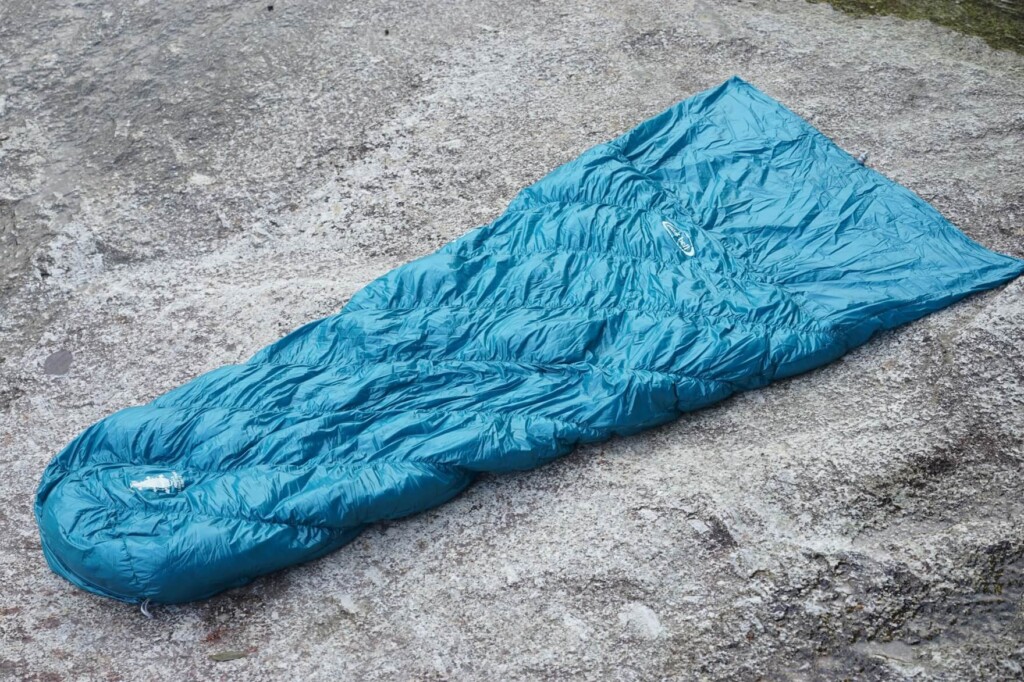
The trapezoidal entrance is wide and easy to enter
You can use your legs! (Adjust the temperature, sit cross-legged, walk)
There is a zipper at the bottom, which can be opened and closed to adjust the temperature. It is 35cm long when laid flat, so if you open it all the way, you can reach down to your ankles, and you can even stand up and move around

The bottom has a zipper closure, allowing for ventilation and allowing for leg room
Although this is a standard feature in Montbell sleeping bags, the bag uses the Super Spiral Stretch System, which increases stretchability while maintaining heat retention, making it easy to sit cross-legged while wearing the sleeping bag or change positions while sleeping
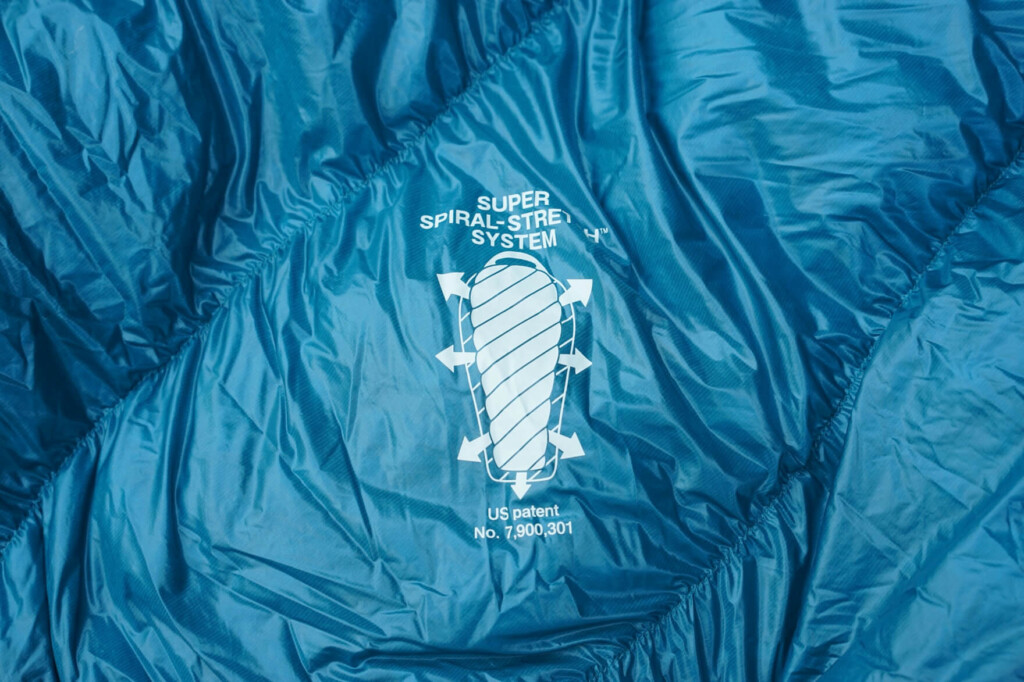
Of course, it also features the stretch structure that is familiar to Montbell
Actual impressions after using it
Every sleeping bag has a temperature range that it can be used in, set by the manufacturer. In this case, Montbell has eight different temperature ranges, from #1 to #7, starting with the "EXP." model for extremely cold climates. Normally, if you choose a sleeping bag that fits the environment and the manufacturer's temperature range, you can use that sleeping bag by itself. However, with this half-length sleeping bag, the setting only applies to the part with the padding
For example, the Montbell #3 sleeping bag has a comfortable comfort temperature of around 3°C, and a limit temperature of -2°C that you can still use. With a full-length #3 sleeping bag, you can use it at that temperature as long as you have that sleeping bag, but it's a different story when it comes to a half-length sleeping bag with a similar temperature range. As long as you limit it to around the solar plexus where the padding is sealed, there will be no problem at that temperature, but above that you'll have to figure out how to use it yourself. That's what it comes down to
The original concept was that since you're in a cold place, you're sure to have some gear. You have down and fleece clothing, so you can rely on that for your upper body, and make the sleeping bag lighter to reduce the amount of gear you need. So it's a perfectly reasonable sleeping bag
So, to sleep in temperatures within the #3 temperature range, you naturally need to wear thermal clothing on the upper half of your body. However, this half-length jacket has a significant advantage. It goes without saying that it is lighter, but it also has more adjustability and can be used in a wider range of conditions. When sleeping in the #3 temperature range, wear your thermal clothing and pull the unpadded shell up to your shoulders. The shell is also windproof, so it prevents heat from escaping, improving heat retention
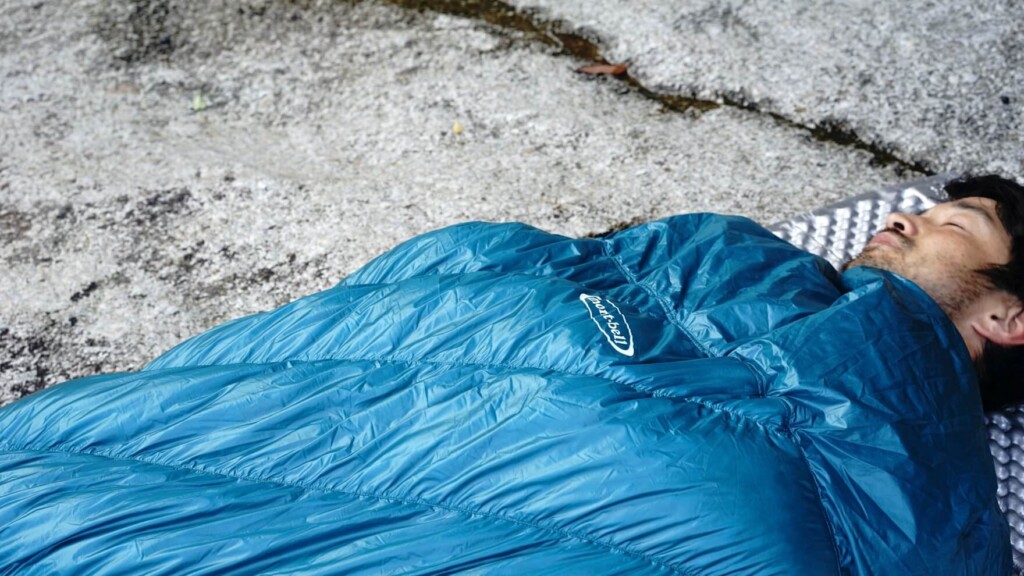
Fitted firmly up to the shoulders
When you feel hot, you can wear your winter clothes and pull down the shell part to allow ventilation and keep you comfortable. Even in warmer temperatures, you can wear light clothing without the shell and still be comfortable
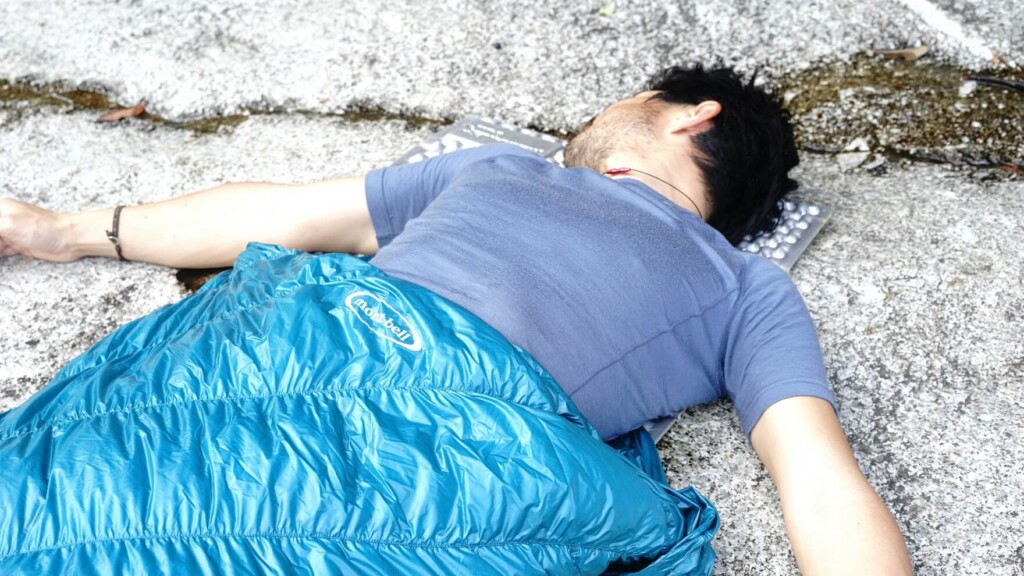
When the temperature is high, lower the shell for comfort
Another interesting feature is that by opening the zipper at the bottom, you can promote ventilation and regulate the temperature. When it gets too hot, open the zipper to ventilate. When the temperature is high, you can stick your feet out. That's how you can use it
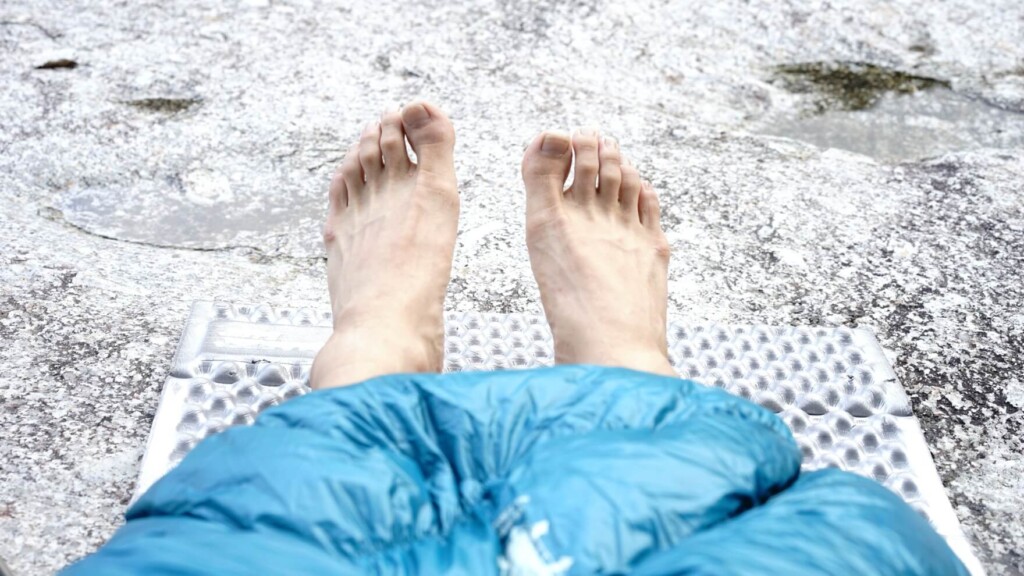
The zipper at the bottom not only serves as a ventilation hole but also allows you to put your feet out
A normal sleeping bag has a long vertical zipper that you open and close to get in and out, but the half-length sleeping bag doesn't have a zipper, likely to make it lighter. This is surprisingly inconvenient, as you have to take it off and put it on when getting in and out. If the whole bag were zippered, it could be removed and used as a quilt, which I thought would broaden its uses even more. It would add quite a bit of weight, though..
While the lack of a zipper makes it inconvenient to get in and out, there is a zipper at the bottom, which you can put your feet through, so you can actually stand up and walk around without opening it. The opening is not that wide, and at most you can get your feet out, so you end up hopping around like a chick. However, this is surprisingly convenient, and is very useful when it's cold and you don't want to get out of the sleeping bag, but you still want to move around a little. As a man, I thought it would be nice if there was a zipper around the waist so you could go to the toilet right there, but I guess that's just being extravagant
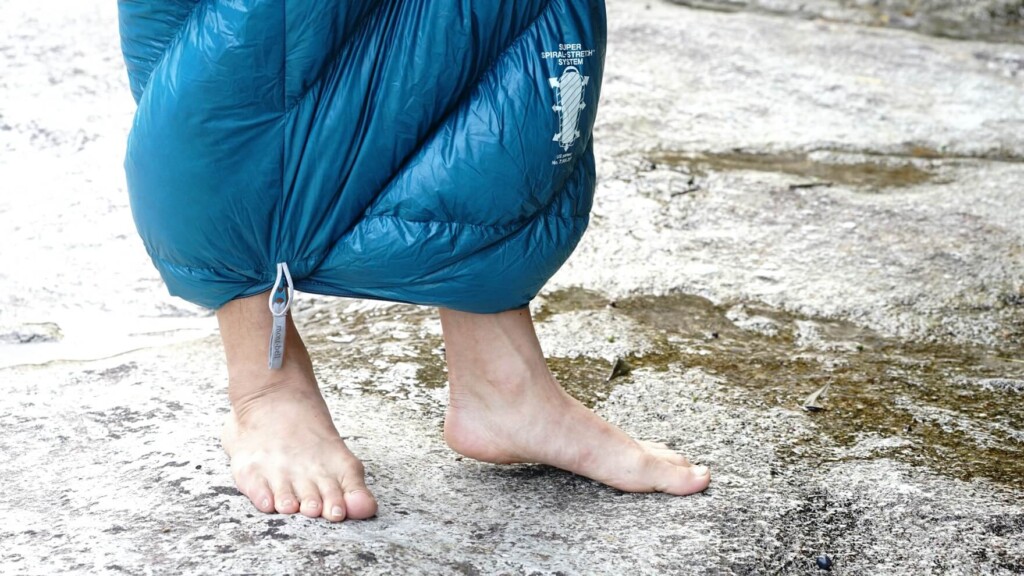
If you unzip the bottom, you can walk in it
There are two drawcords, one at the entrance and one at the transition between the padding and shell. When the sleeping bag is up to your shoulders, tightening the drawcord at the entrance will prevent the sleeping bag from shifting while you sleep, and will also prevent heat from escaping and cold from entering, increasing warmth. When not wearing the shell, tightening the other drawcord will prevent it from shifting. However, tightening the bottom drawcord restricted my movement, making it difficult to decide whether to put my arms out or in, which was stressful. If this drawcord were made of rubber, I might have had a little more freedom while sleeping. It may be possible to change it yourself, but since the bag is a little large overall, this drawcord is essential to prevent it from shifting while you sleep
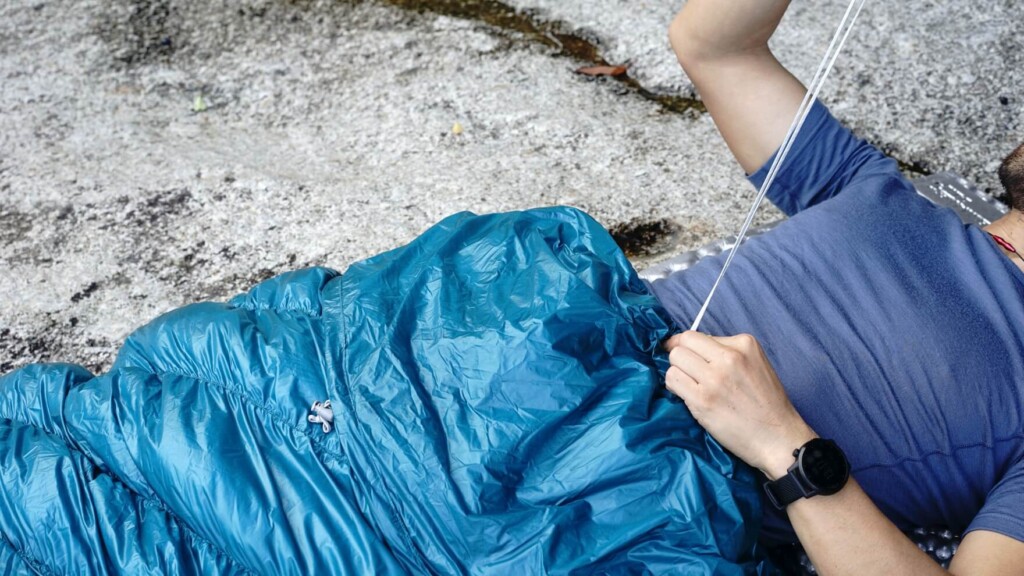
By tightening the drawcord, it prevents slipping and improves heat retention
In terms of weight and capacity, it's not as light as you'd expect. Because it's called "Half," you might assume it's half the weight and capacity, but be careful. That said, the actual weight, including the storage bag, is 433g, which is about 30% lighter than the regular DownHugger #3, and the capacity is also about 30% less, so it's a great choice for anyone looking to reduce weight and capacity even a little
Summary: Recommended for these people
It's a truly unique product. It has the same temperature range as the DownHugger #3, but is lighter and smaller in volume, so it's all good! If you buy it without fully understanding its features, you might end up thinking, "What is this? It's unusable!" and it could end up gathering dust in your closet. It's one thing to do that, but it could even be dangerous to take it to the mountains at this time of year without testing it. For those who understand what kind of product it is and can tell its good points at a glance, this is a sleeping bag whose advantages are obvious without any explanation
As for #3, it can be used for a wide range of purposes, from low mountain climbing in winter to long-distance hiking in summer. It's perfect for those who want to reduce weight and volume even a little, but if you plan to use it at the lower end of the operating temperature range, careful planning and simulation are required
For those who have had doubts about the state of sleeping bags up until now, ultralight hikers who have reached a dead end in their quest for weight reduction, and alpine climbers who just want to shed even a few grams, this bag has its own unique characteristics, but once you get the hang of it, it may become an indispensable item. It may be a bit of a trick, but it seems that for short children and women, it can also be used in a state close to full length
Related reading