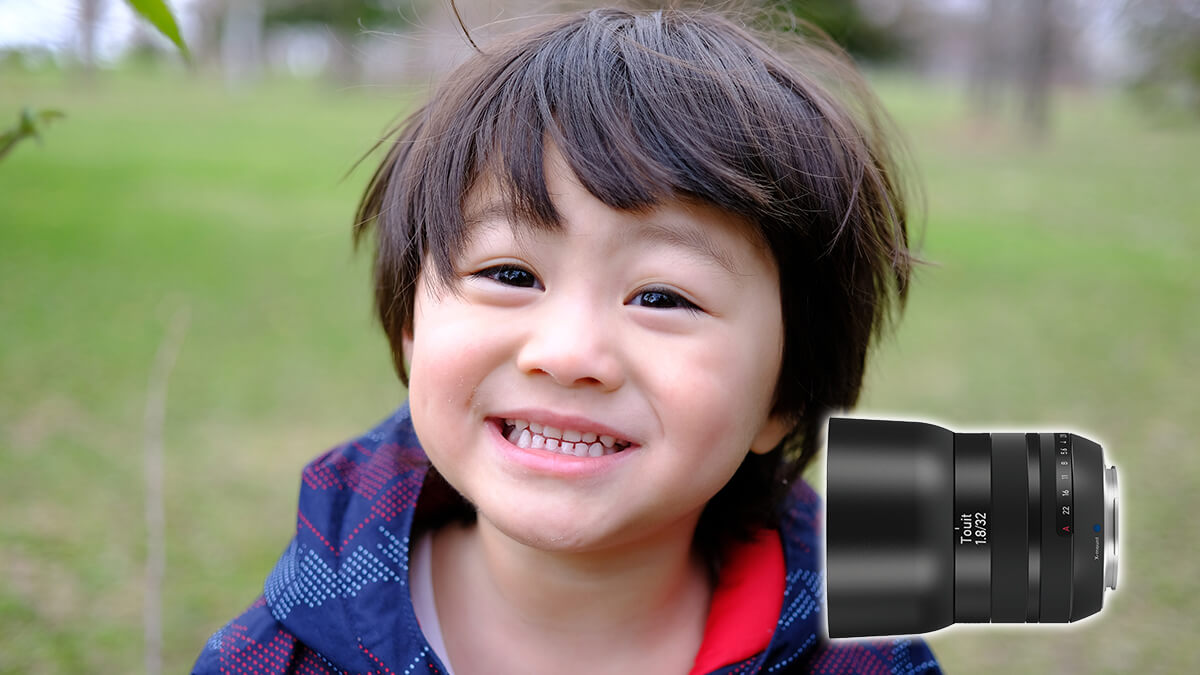
I've been taking charts of camera lenses for a long time, and I had the opportunity to try out the ZEISS Touit 1.8/32. After testing it out and taking it on a family trip in a camper van, I'm convinced that it's a lens I'd recommend for outdoor trips. Here are five reasons why, along with the charts
table of contents
- What is the Zeiss "ZEISS Touit 1.8/32"?
- Five reasons to recommend the ZEISS Touit 1.8/32 for outdoor travel
- The ZEISS brand offers overwhelming satisfaction and joy of ownership
- Lightweight and compact, with a diameter of 75mm, a total length of approximately 75mm, and a weight of approximately 200g
- The brightness of F1.8 is great for dimly lit scenes when traveling
- High-level bokeh with beautiful smoothness and shape
- In addition to these, the excellent central resolution makes the main subject stand out with high expressiveness
- Summary: A lens for taking straightforward, honest photos with an F1.8 aperture
- For more information and to purchase the ZEISS Touit 1.8/32
What is the Zeiss "ZEISS Touit 1.8/32"?
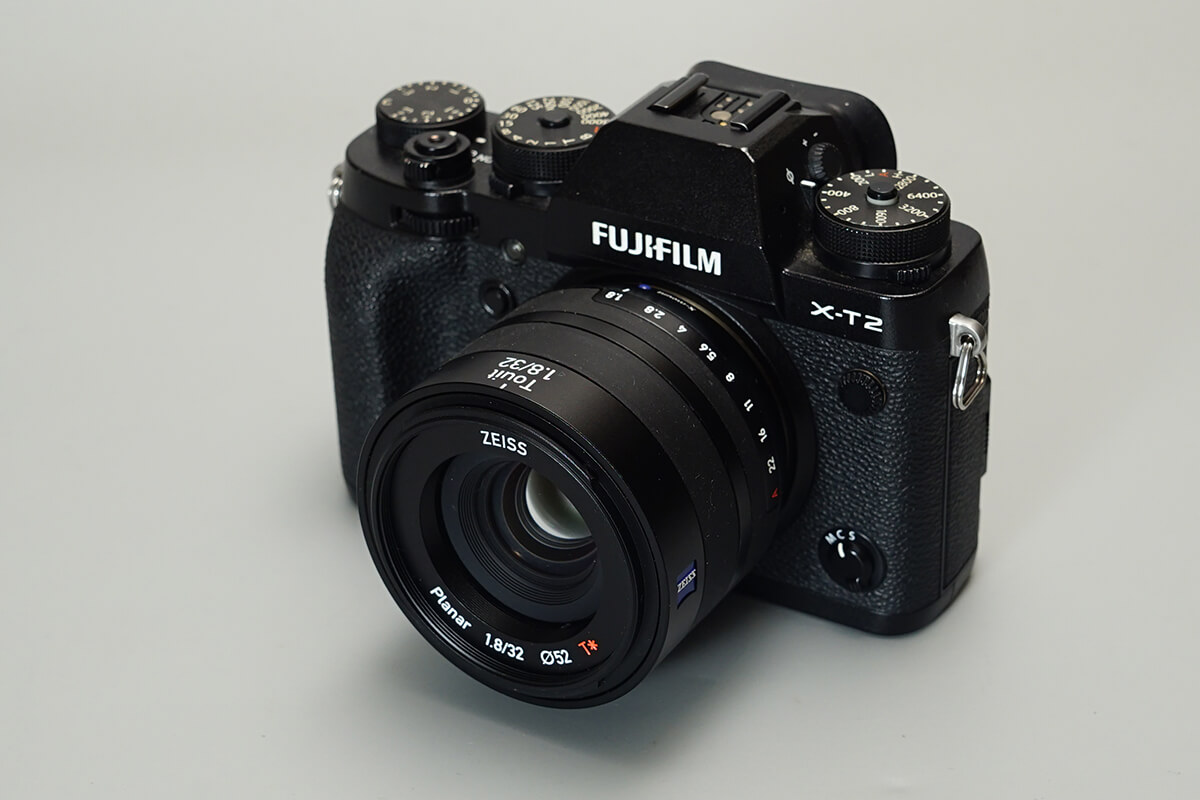
The ZEISS Touit 1.8/32 attached to the FUJIFILM X-T2. The compactness of the ZEISS Touit 1.8/32 is emphasized even though the camera body isn't particularly large
Planar type standard prime lens with maximum aperture of F1.8 for APS-C
Currently, there are three main types of ZEISS lenses available in Japan: those manufactured and sold by Sony for the α series, those manufactured and sold by Cosina, and finally, the ZEISS lenses sold in Japan by Kenko Tokina
The ZEISS Touit 1.8/32 that I tested this time falls into the last category. In addition to the Touit series, there are also the Batis and Loxia series, which are 35mm full-frame Sony E-mount lenses. The Touit series is unique in that it is an APS-C lens and is available not only for the Sony E-mount but also for the FUJIFILM X-mount
I've already taken charts for the Batis and Loxia series, including resolution and bokeh, and published them as e-books in the "Lens Lab" and "Lens Database" series on Amazon Kindle, but the "Touit" series was the only one I hadn't completed. However, I was fortunate enough to have the opportunity to test three lenses: the ZEISS Touit 2.8/12, the ZEISS Touit 1.8/32, and the ZEISS Touit 2.8/50M. my previous article on the ZEISS Touit 2.8/12 in OUTDOOR GEARZINE, I 've now decided to publish an article on the ZEISS Touit 1.8/32.
Of the three lenses currently available in the "Touit" series, the "ZEISS Touit 1.8/32" is a standard prime lens with a field of view equivalent to approximately 48mm when mounted on an APS-C camera. Its maximum aperture of f/1.8 is more than one stop faster than the other two lenses. Another notable feature is that it's based on the "Planar" design, arguably the most famous lens in ZEISS's history of producing a variety of outstanding lens designs. Furthermore, it's lightweight and compact, measuring just 75mm in diameter, approximately 75mm in length, and weighing approximately 200g. And despite being a ZEISS lens, it offers excellent value for money, with a market price of just under ¥100,000. I'll explain its appeal in five points, including the results of my own photographs of Soji Koyama's original charts and actual photos taken on a family trip in a camper van
Recommended points
- The ZEISS brand offers overwhelming satisfaction and joy of ownership
- Lightweight and compact, with a diameter of 75mm, a total length of approximately 75mm, and a weight of approximately 200g
- The brightness of F1.8 is great for dimly lit scenes when traveling
- High-level bokeh with beautiful smoothness and shape
- In addition to these, the excellent central resolution makes the main subject stand out with high expressiveness
Points of interest
- Considering it's a 50mm F1.8 lens, it's priced quite expensively
Main specifications and evaluation
| item | ZEISS Touit 1.8/32 |
|---|---|
| focal length | 32mm |
| Aperture range | F1.8-F22 |
| Lens construction | 8 elements in 5 groups |
| Minimum focusing distance | 0.37m |
| Angle of view (diagonal/horizontal/vertical) | 48° / 20° / 29° |
| Shooting magnification | 1:9 |
| Aperture blades | 9 sheets |
| Filter diameter | 52mm |
| Maximum diameter | 75mm |
| full length | Sony E: 72mm / FUJIFILM X: 76mm (both including caps) |
| weight | Sony E: 200g/FUJIFILM X: 210g |
| design | ★★★★☆ |
| Resolution | ★★★☆☆ |
| Portability | ★★★★☆ |
| The beauty of bokeh | ★★★★★ |
| Low aberration | ★★★★☆ |
| Cost performance | ★★★☆☆ |
Five reasons to recommend the ZEISS Touit 1.8/32 for outdoor travel
The ZEISS brand offers overwhelming satisfaction and joy of ownership
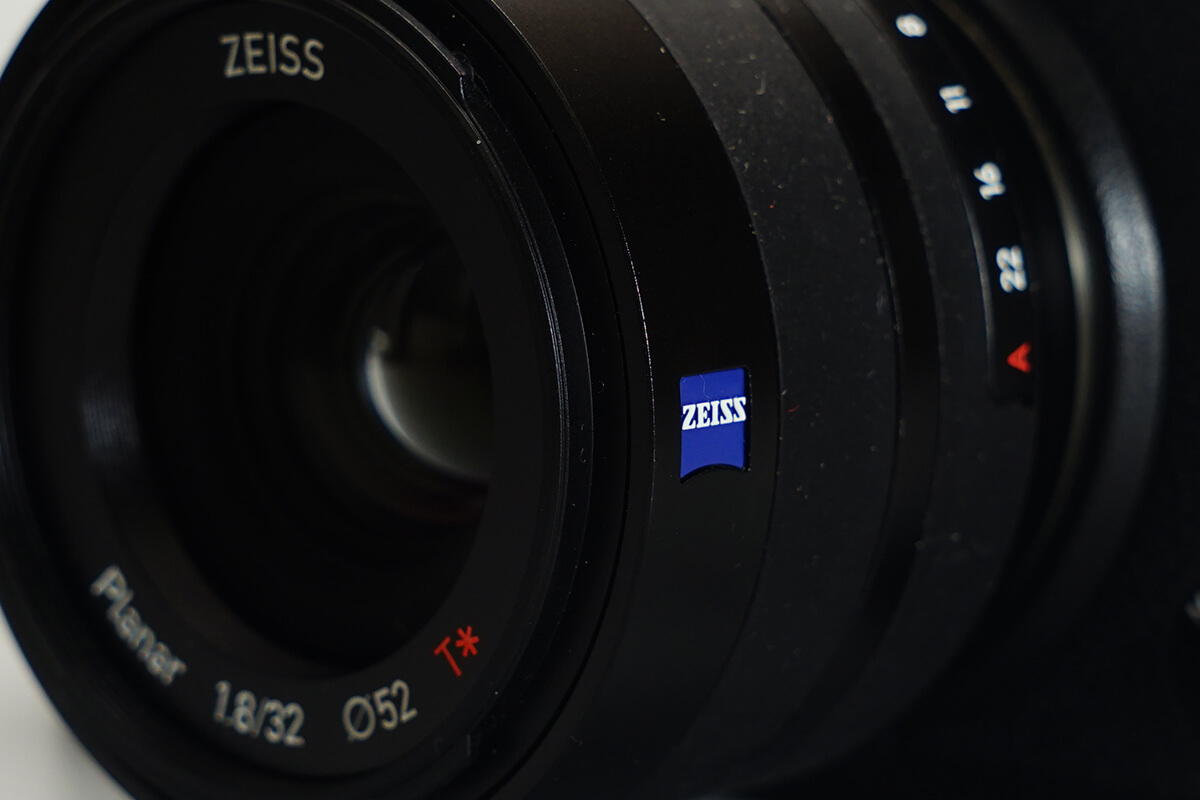
In the case of the ZEISS Touit 1.8/32, the ZEISS logo is engraved on both sides of the lens in white on a blue background. Having this logo makes a big difference
Even if you're not traveling outdoors, there are still restrictions on the amount of luggage you can carry, so you need to carefully select your items. That's why I only want to carry my favorite items, things that make me feel good every time I carry them and use them
If this were a business trip, the priority would be the equipment I bring, so I would make an effort to bring everything I need, but if it's a personal trip, the situation is completely different. I want to go out with as little equipment as possible
In such cases, we recommend the ZEISS Touit 1.8/32. There are several reasons for this, but the first is that it's a ZEISS lens. It's no exaggeration to say that the current market for interchangeable lens cameras is almost entirely dominated by Japanese manufacturers. However, two German brands are in a league of their own: ZEISS and Leica. Both are living, legendary brands whose histories are themselves the history of cameras and lenses
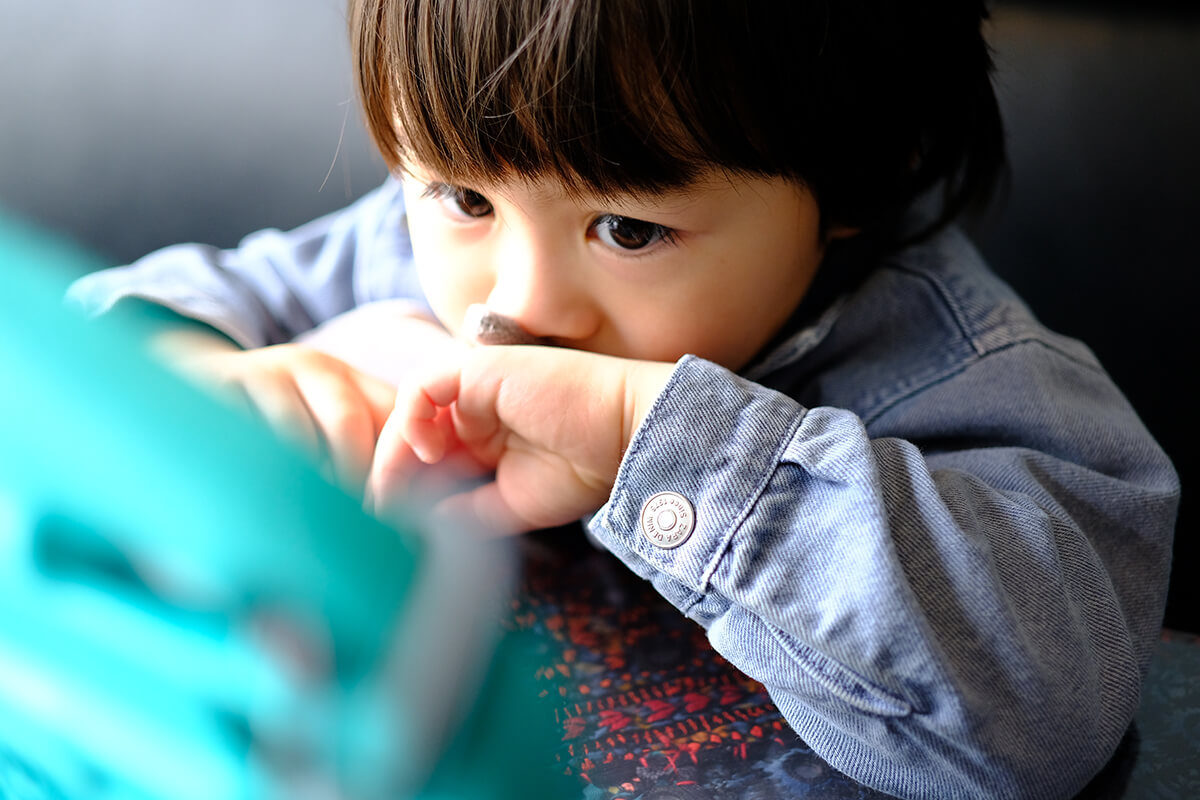
ZEISS Touit 1.8/32 / FUJIFILM X-T2 / 48mm equivalent / Aperture-priority AE (F2.0, 1/250 sec) / ISO 800 / Exposure compensation: +0.7EV / WB: Auto / Film Simulation: Velvia /
Just by taking a photo with a ZEISS lens, my son probably looks a little more refined and intelligent. That's a bit of an exaggeration, but the refined depiction is something you can only get with a ZEISS lens.
It may seem like a very trendy thing to do, but just seeing the "ZEISS" logo on the lens gets me excited, and I think the ability to differentiate yourself from other users and show off your own preferences is a feature that has a big psychological impact on the owner
Another key point about the ZEISS Touit 1.8/32 is that it uses the Planar lens design, which is said to be one of the most successful lens designs among ZEISS, a living legend in the history of camera lenses. This lens design was invented by Paul Rudolph in 1896, and together with T* coating, it is a Planar lens that is synonymous with the company's representative high-performance standard lenses, making it a great joy to own
In a sense, not only does shooting with a ZEISS Planar give you great satisfaction and joy in using it, but the standard lens, the ZEISS Touit 1.8/32, is designed for APS-C cameras and is effectively a standard lens equivalent to 48mm, so it's great that you can easily enjoy not only portraits of any subject, but also landscapes and snapshots
Lightweight and compact, with a diameter of 75mm, a total length of approximately 75mm, and a weight of approximately 200g
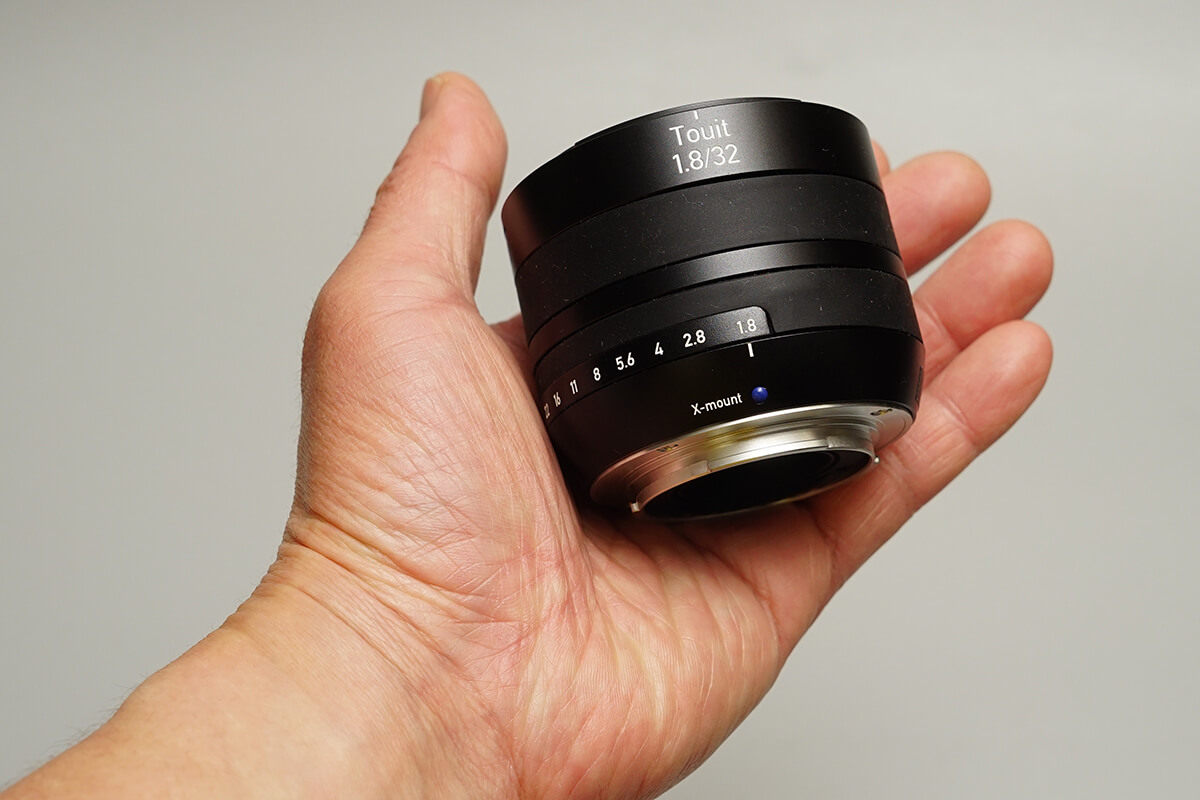
The ZEISS Touit 1.8/32 is held in the hand. I have small hands for an adult male, but the ZEISS Touit 1.8/32 feels even smaller
When it comes to high-end lenses that are bright and have a small f-number, it is generally assumed that they are large and heavy, but the ZEISS Touit 1.8/32 is very compact
The FUJIFILM X-mount model used in this shoot has a maximum diameter of 75mm, a total length including the lens cap of 76mm, and weighs 210g. The Sony E-mount model, which does not have an aperture ring, is even smaller and lighter, with a maximum diameter of 75mm, a total length including the lens cap of 72mm, and a weight of just 200g
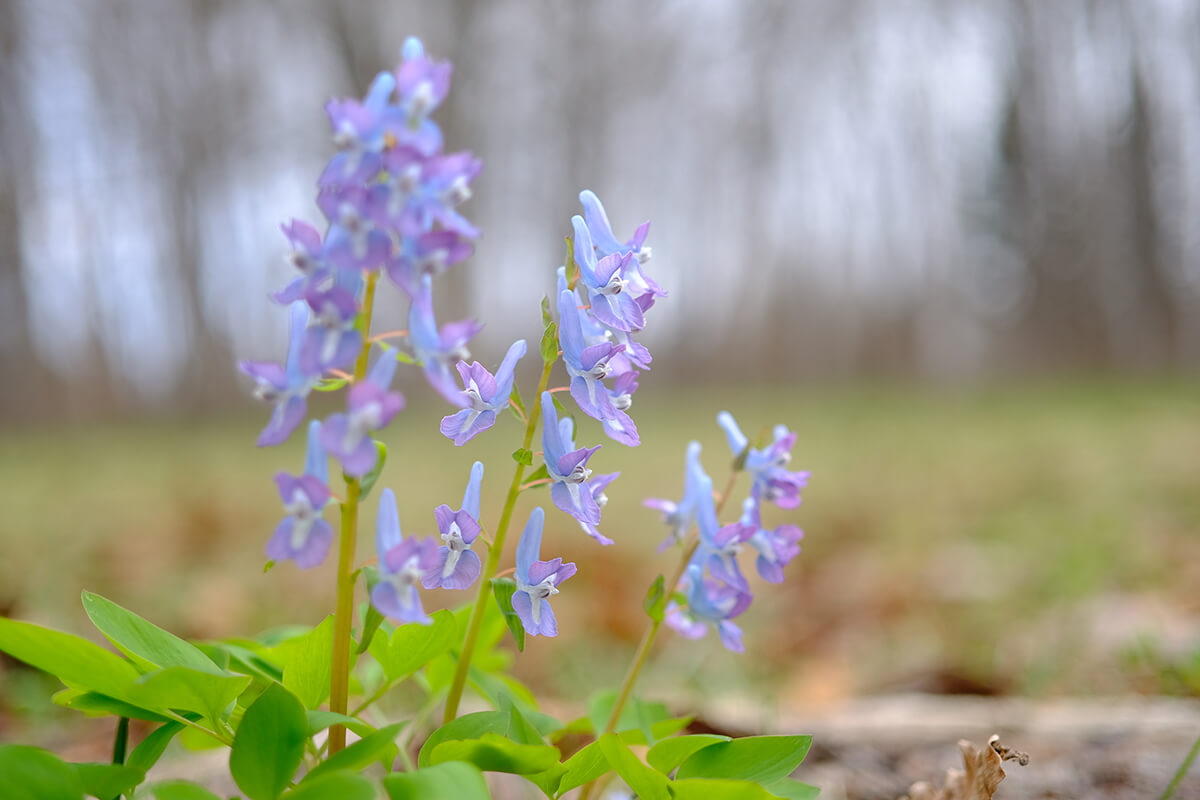
ZEISS Touit 1.8/32 / FUJIFILM X-T2 / 48mm equivalent / Aperture-priority AE (F1.8, 1/250 sec) / ISO 200 / Exposure compensation: +1.0EV / WB: Auto / Film Simulation: Velvia /
The lens is small and light, so it's easy to crouch down and hold the lens. This allowed me to capture even more impressive photos of the small flowers I saw on my travels.
To give you an idea of how small it is, I don't have particularly large hands for an adult male, but I can still fit both hands around the front and rear lens caps, as well as the hood when it's stored in reverse. It's a bit small to fit in a jeans pocket, but it's small enough to easily fit in a jacket pocket
Being compact and lightweight is an overwhelming advantage, not only when traveling, but also when traveling outdoors. The ZEISS Touit 1.8/32 excels in this respect, making it a great choice for situations where you just need to bring one lens. When paired with a compact camera body such as the Sony α APS-C 6000 series, it's a great lens for hiking and other occasions where you want to minimize your luggage
The brightness of F1.8 is great for dimly lit scenes when traveling
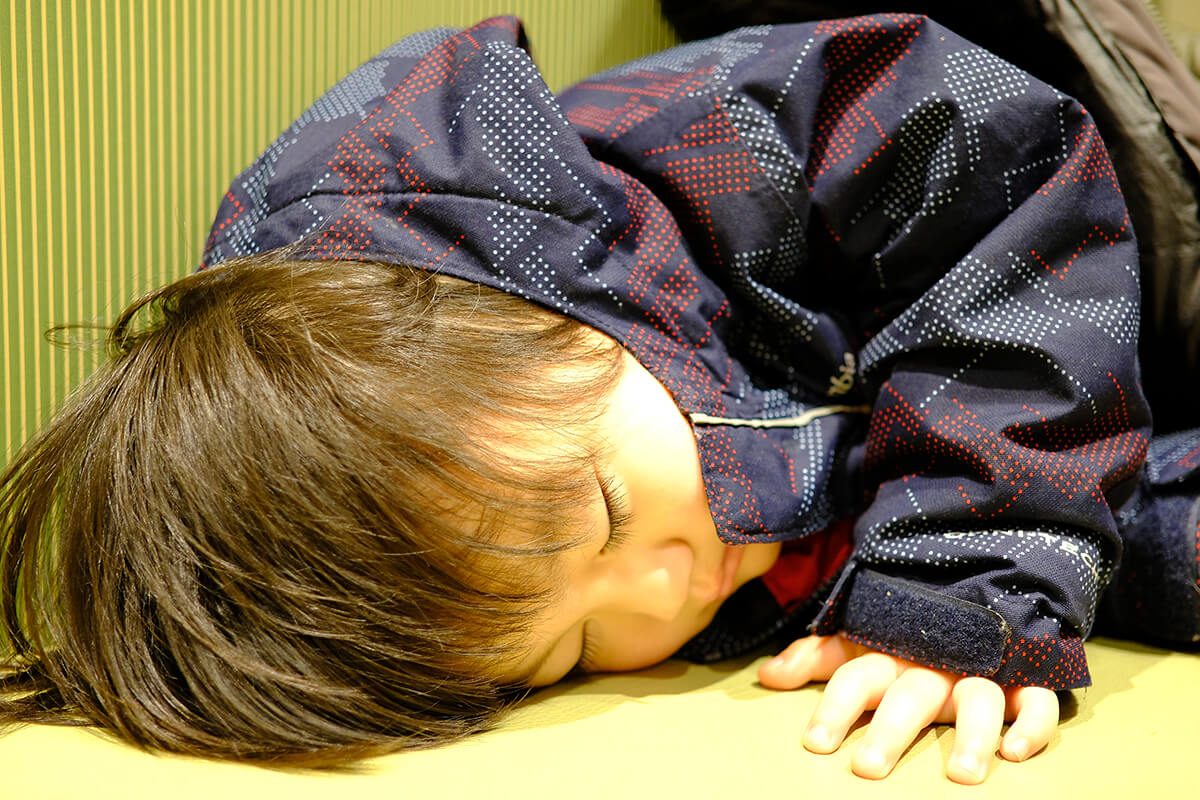
ZEISS Touit 1.8/32 / FUJIFILM X-T2 / 48mm equivalent / Aperture-priority AE (F1.8, 1/60 sec) / ISO 1600 / Exposure compensation: +0.7EV / WB: Auto / Film Simulation: Velvia /
My son passed out by dinnertime at a local izakaya. The lighting inside the restaurant was quite dim, but with the aperture wide open, I was able to secure 1/60 sec at ISO 1600, so there was no need to worry about camera shake.
The ZEISS Touit 1.8/32 is a lightweight, compact, and versatile standard lens that is perfect for travel and outdoor adventures, but what's most important to me is that it's bright
With camera lenses, the smaller the F-number (F○.○) is, the brighter the lens is, and in the case of the ZEISS Touit 1.8/32, the F-number is 1.8. We'll explain in detail how bright this is and why it's useful for outdoor travel
First, regarding F○.○, a typical zoom lens, such as the lens that comes with a camera when you purchase it, has a brightness of around F5.6. Even large, heavy, and expensive professional zoom lenses have a brightness of around F2.8. F1.8 is 3 1/3 stops brighter than the F5.6 of a typical zoom lens, and 1 1/3 stops brighter than F2.8, which is very bright for a zoom lens
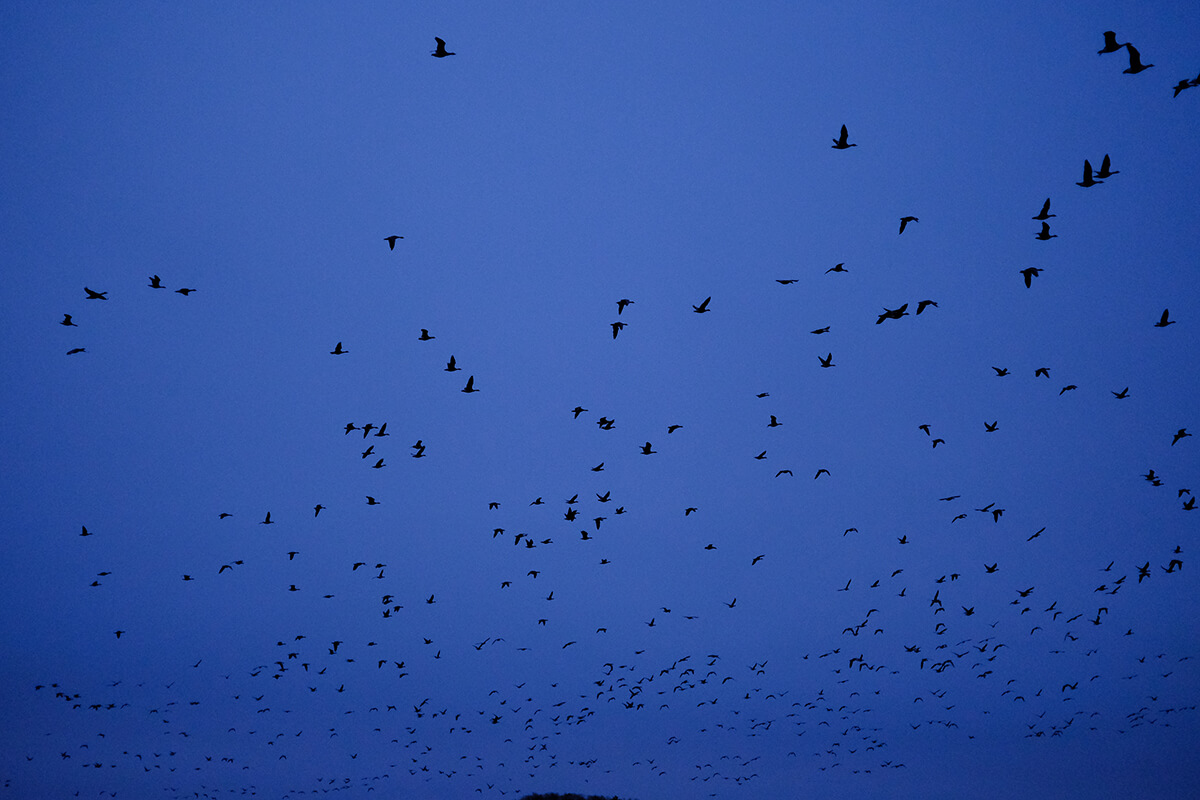
ZEISS Touit 1.8/32 / FUJIFILM X-T2 / 48mm equivalent / Shutter speed priority AE (F1.8, 1/500 sec) / ISO 3200 / Exposure compensation: -0.3EV / WB: Auto / Film Simulation: Velvia /
Photographed a flock of white-fronted geese taking off from their roost before sunrise. Because the lens is bright, a shutter speed of 1/500 sec was secured, and you can see that the geese are not blurred in flight.
If the lens brightness differs by one stop, the shutter speed will be 1/2 if all other conditions are the same. If it differs by two stops, it will be 1/4, and if it differs by three stops, it will be 1/8. For example, a scene that can be photographed with a shutter speed of 1/40 second using the ZEISS Touit 1.8/32 will be 1/15 second with an F2.8 zoom lens, and 1/4 second with an F5.6 zoom lens. It's almost certain that a shutter speed of 1/4 second will result in camera shake, and even at 1/15 second, many people will not be able to take decent photos
Outdoor travel often involves many dark scenes, such as those shown in the sample photos inside a shop, a car, or a camper van. Camping is often even darker, not to mention mountain climbing. With a zoom lens, the bright standard lens "ZEISS Touit 1.8/32" allows you to shoot dark scenes without any issues.
Some people may think that modern cameras are fine because they don't degrade image quality even at high ISO sensitivities. However, even if a scene can be shot at ISO 1600 with the "ZEISS Touit 1.8/32," if the zoom lens has a brightness of f/5.6, the ISO sensitivity setting under the same conditions would be 16000. With such a large difference, image quality cannot be guaranteed, so a bright lens is a significant advantage when shooting.
High-level bokeh with beautiful smoothness and shape
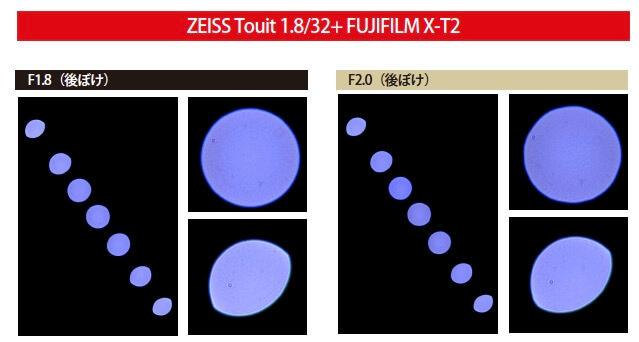
This is a bokeh chart taken to check the beauty of the bokeh of the "ZEISS Touit 1.8/32." The shape and smoothness of the bokeh are of the highest level of beauty
Many people have heard that the brighter the lens, the easier it is to achieve large amounts of blur. To be more precise, camera lenses have the characteristic that the longer the focal length and the brighter the lens, the easier it is to achieve large amounts of blur
The ZEISS Touit 1.8/32 has a relatively small focal length of 32mm on a 35mm camera, but its brightness of F1.8 makes it a lens that can produce a large amount of blur. When taking portraits, for example, blurring the background significantly emphasizes the main subject, making it appear more clearly
I obtain this bokeh by photographing a miniature LED and then create a chart to evaluate the shape and smoothness of the bokeh. The chart above shows the bokeh of the bokeh balls, and the results of the bokeh chart for the "ZEISS Touit 1.8/32" are top-notch
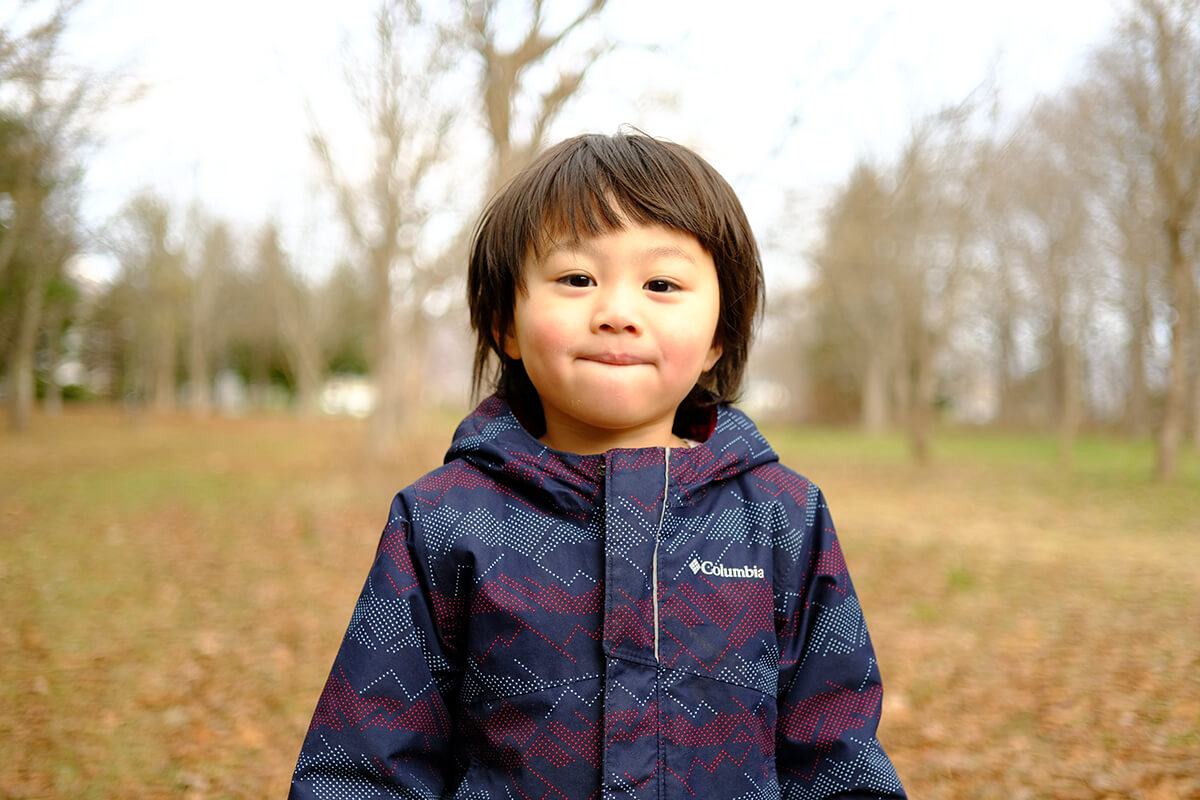
ZEISS Touit 1.8/32 / FUJIFILM X-T2 / 48mm equivalent / Aperture-priority AE (F1.8, 1/1,000 sec) / ISO 200 / Exposure compensation: +1.0EV / WB: Shade / Film Simulation: Velvia /
As a liberal arts lens enthusiast, I'm convinced that the beauty of the bokeh alone makes the ZEISS Touit 1.8/32 worth using. It's a lens that makes you want to shoot wide open.
There is very little edging or coloring on the periphery of the bokeh ball, and there is almost no roughness or noticeable disturbance inside the bokeh ball. Also, perhaps because no aspherical lenses are used, there is no onion bokeh, which is often caused by aspherical lenses and results in concentric wrinkles appearing inside the bokeh ball. This results in the most beautiful bokeh possible, even among prime lenses
In addition, the aperture blades, which are a major factor in determining the shape of the bokeh, are nine-blade, and as you can see from the chart, the aperture is open to F1.8, producing bokeh that is nearly perfectly circular. As you narrow the aperture, there is a slight amount of jitter, but up to around F2.8, there is very little jitter
The ZEISS Touit 1.8/32 is a lens that produces beautiful bokeh
In addition to these, the excellent central resolution makes the main subject stand out with high expressiveness
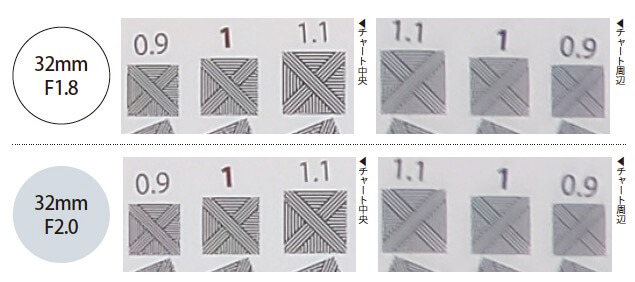
Shooting results for the resolution chart. Even at the maximum aperture of F1.8, the central chart not only resolves the standard 1 and 1.1 charts, but also a significant portion of the even smaller 0.9 chart
The large, beautiful bokeh, combined with the extremely high central resolution of the ZEISS Touit 1.8/32, allows for a high level of expressiveness, with the main subject placed in the center standing out in a stunning way
We use an original resolution chart created by Soji Koyama to check the resolution of lenses and cameras. This chart calculates the theoretically resolvable standard value on a photographed chart based on the camera's effective pixel count, and checks the lens's resolution by looking at how well it resolves the standard value and the charts before and after it
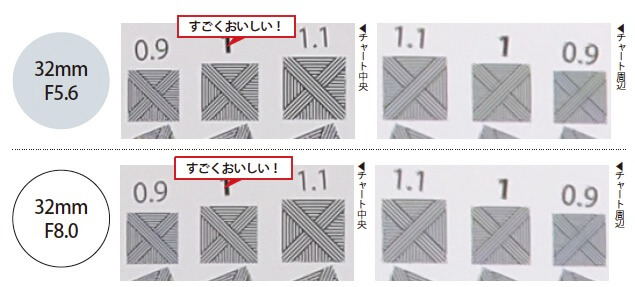
Stopping down to F5.6-F8.0, which is the peak resolution of the ZEISS Touit 1.8/32, significantly improves the resolution at the periphery. If you prioritize resolution across the entire frame, you'll want to stop down to around this range
The resolution test for the ZEISS Touit 1.8/32 lens used the FUJIFILM X-T2, which has an effective pixel count of approximately 24.3 million, so the reference chart was somewhere between 1 and 1.1. However, the center of the test chart resolved the image down to an even smaller 0.9 chart. While the edges are softer and less resolved than the center, the resolution improves as the aperture is narrowed, with the ZEISS Touit 1.8/32's overall resolution peaking between f/5.6 and f/8.0. If you want to maximize resolution across the entire frame, we recommend using f/5.6 to f/8.0. Stopping down beyond f/13 is not recommended, as it reduces resolution
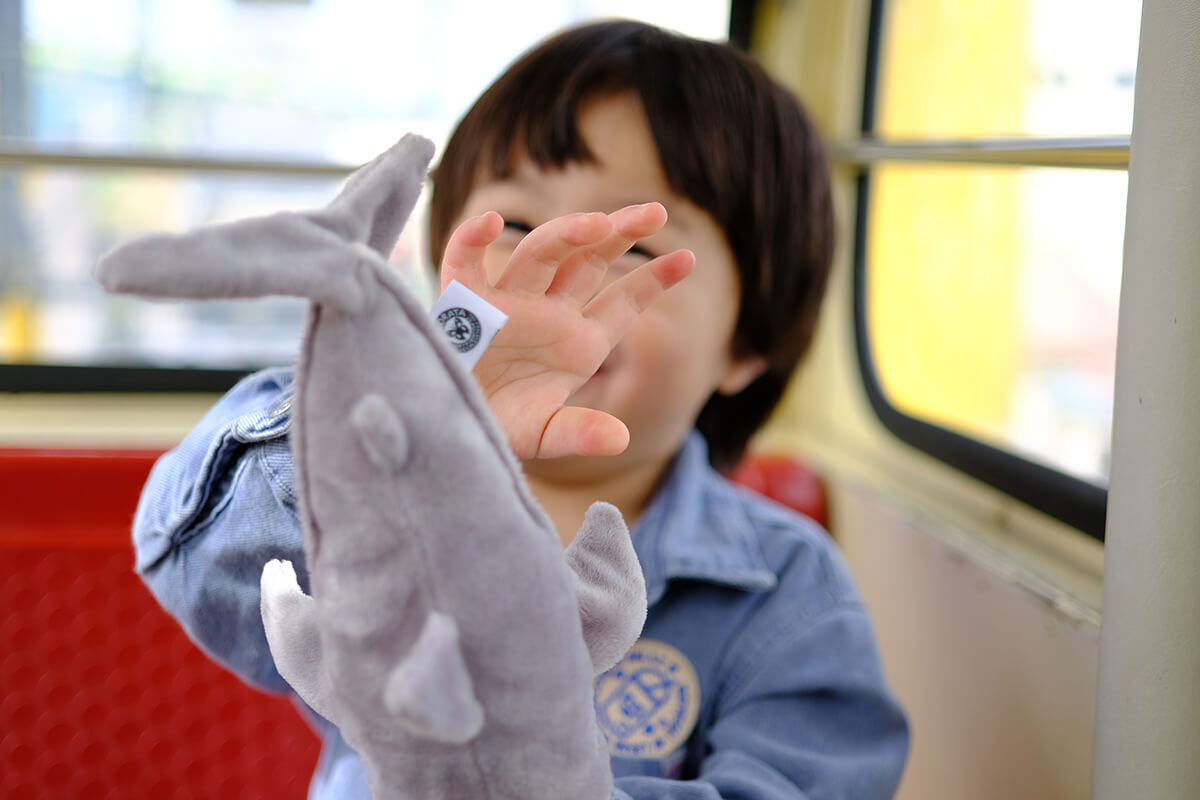
ZEISS Touit 1.8/32 / FUJIFILM X-T2 / 48mm equivalent / Aperture-priority AE (F1.8, 1/1,400 sec) / ISO 200 / Exposure compensation: +1.0EV / WB: Auto / Film Simulation: Velvia /
Please note that the moment the focus is on the palm of the hand, the main subject changes from my son to his palm. The expressive power to emphasize this main subject is the appeal of the ZEISS Touit 1.8/32.
What caught my attention from the results of the resolution test of the ZEISS Touit 1.8/32 was that the resolution in the center was overwhelmingly higher than in the periphery, even at full aperture. When this high central resolution is combined with the large bokeh that occurs at full aperture, the main subject, which is placed in the center and focused on, stands out as if floating out from the background. The effect of emphasizing the main subject as the main focus, as in the photo shown, can be easily achieved, which is truly a testament to the Planar's high expressive power. This is a lens that you will want to enjoy shooting at the maximum aperture of F1.8, for straightforward photos with the main subject placed in the center
Summary: A lens for taking straightforward, honest photos with an F1.8 aperture
The ZEISS Touit 1.8/32 is a highly expressive lens that can capture anything, but is also great for capturing people and fellow travelers on your travels
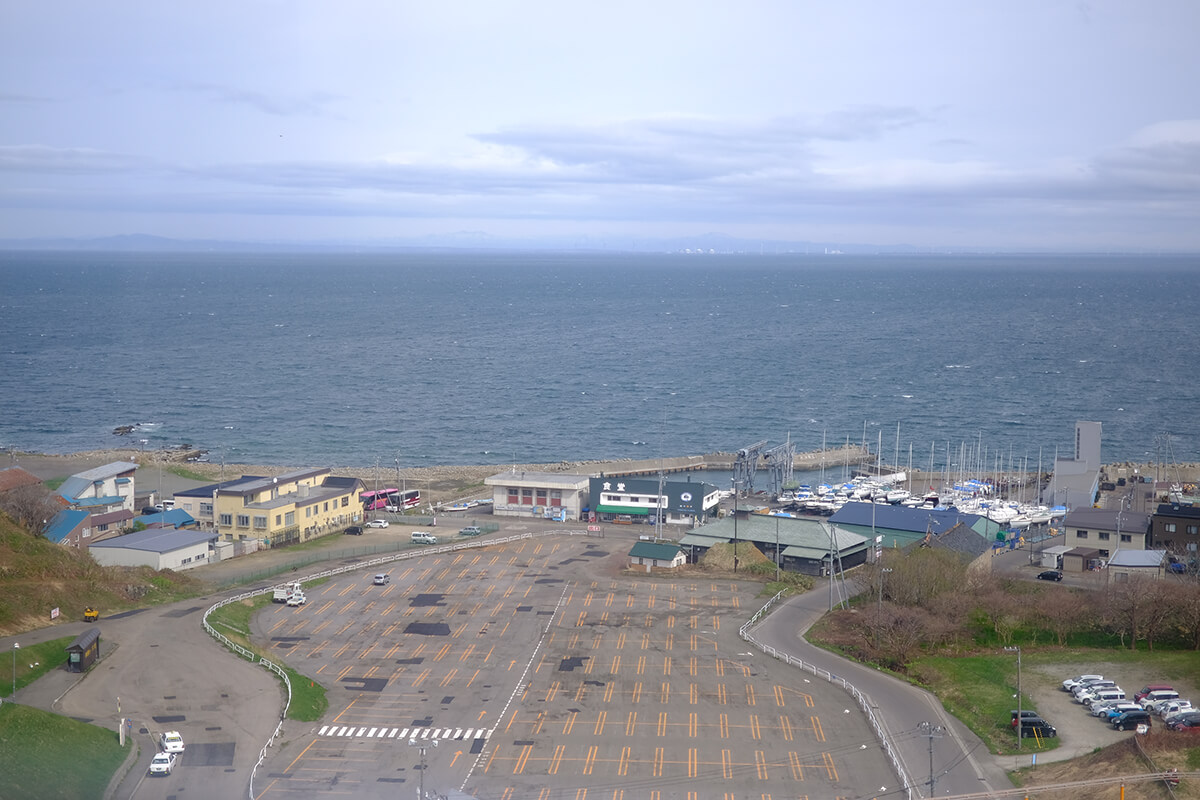
ZEISS Touit 1.8/32 / FUJIFILM X-T2 / 48mm equivalent / Aperture-priority AE (F1.8, 1/3,000 sec) / ISO 100 / Exposure compensation: -0.7EV / WB: Auto / Film Simulation: Velvia /
My son rode a large Ferris wheel for the first time in his life. I recorded what was happening outside. To avoid any Ferris wheel shake, I selected a high-speed shutter speed of 1/3,000 sec at F1.8.
When I go on private family trips in a camper van or something, the people I want to photograph are the family members who are accompanying me. Actually, the scenery at our destination is secondary; I just want to photograph my three-year-old son. I might be able to take pictures of the scenery next year, but now is the only time I can photograph my three-year-old son..
That said, you can't bring that many lenses on a family trip while taking care of the kids. So, if you're looking for just one lens, the ZEISS Touit 1.8/32 is a very attractive choice. It's lightweight and compact, with a standard focal length that's great for portraits and landscapes alike, plus it's fast and boasts beautiful bokeh that's arguably the best. While the central resolution is extremely high, the overall resolution isn't particularly high. However, the expressive power of the lens when shooting at full aperture is overwhelming. Its ability to highlight the main subject, as you'd expect from a ZEISS lens, and the Planar lens, is addictive
The ZEISS Touit 1.8/32 is a lens that many people would like to use, recommended not only for outdoor trips but also for regular travel and everyday use. However, the price is a hurdle. While a market price of under 100,000 yen is an exceptional deal for a ZEISS lens, it is still a little expensive for a 50mm F1.8. However, a ZEISS lens with the white and blue ZEISS logo offers a significant psychological advantage when used while traveling
Photography has a much larger mental element than you might expect, so we highly recommend ZEISS lenses, which lift your spirits just by owning and using them. What's more, the high level of expressiveness that the ZEISS Touit 1.8/32 offers at full aperture will further heighten your excitement, making it a small ZEISS Planar lens with great advantages in both mental and photo quality. Why not give it a try as your first ZEISS lens?
For more information and to purchase the ZEISS Touit 1.8/32
For more product details, please visit the Kenko Tokina official website
Data source
"ZEISS Touit 1.8/32 Lens Database"
Please consider a paid membership to support the site while enjoying exclusive offers and content!
Chitose Saito


Related reading