I started using Discord
As someone who has written several reviews of portable power sources, including those based on my own experiences traveling in a camper van, the specs I care most about for a portable power source are not only the price, size, and weight, but also the capacity and rated output (maximum instantaneous output)
The model I normally use is the " EBL Portable Power Station 1000W after trying out the new, smaller " EBL Portable Power Station 500W 500W model is recommended!" and I'd like to explain why.
table of contents
- What is EBL's portable power supply?
- Detailed Review
- What you can and can't do with a 500W: If you give up on the microwave, a 500W class is almost enough for outdoor use
- First, use the laptop with the "EBL Portable Power Station 500W" charged to 100%
- I saw a gap in the clouds, so I tried charging it with the "EBL Solar Panel 100W 20V"
- It can easily run two electric fans, perfect for emergencies and outdoors
- Continuous use of the Bonarca 15L car refrigerator/freezer to drain the battery
- Summary: Choose a portable power source based on frequency of use and budget
- Details and purchase of EBL "EBL Portable Power Station 500W"
What is EBL's portable power supply?
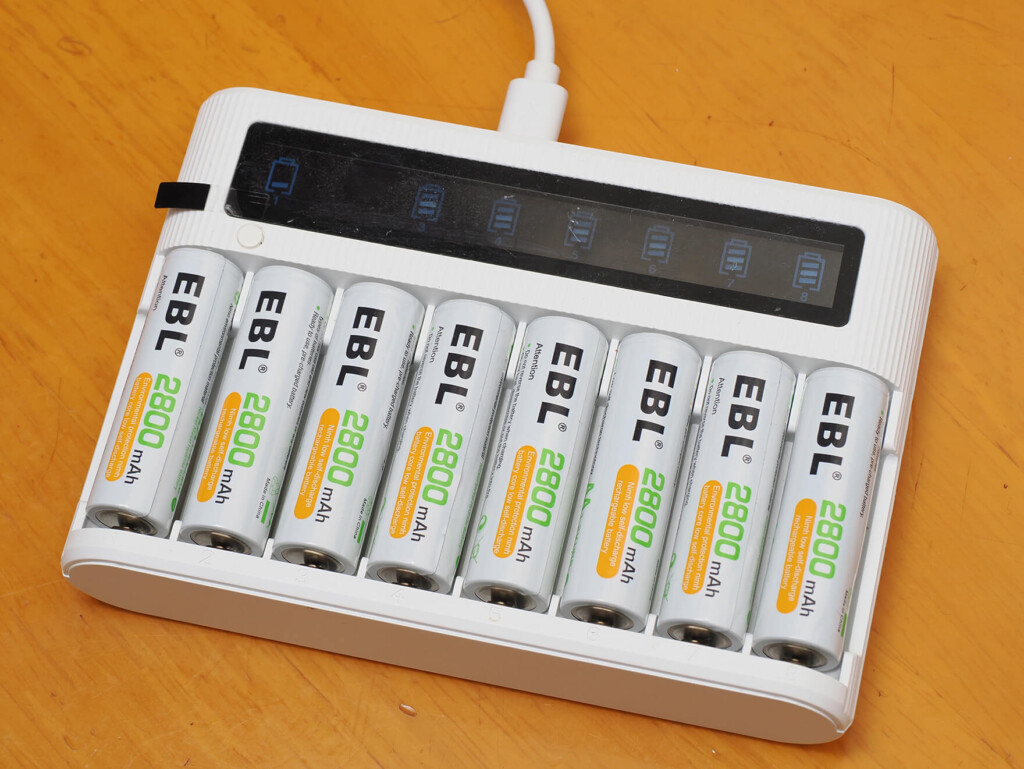
The EBL nickel-metal hydride rechargeable batteries and their chargers are the ones I actually use in clip-on strobes and other equipment. They aren't impressively high-performance, but I've never been dissatisfied with them
A long-established manufacturer that has been producing batteries, battery chargers, etc. for over 20 years since 1998
The " EBL Portable Power Station 500W " is made by a Chinese manufacturer called EBL. Many people are wary of Chinese manufacturers, but it's fair to say that most cost-effective portable power stations are currently made by Chinese manufacturers. Except for those who can afford to ignore the price, it's common for most people to choose portable power stations made by Chinese manufacturers or China-made.
That said, it takes a lot of courage to suddenly purchase a relatively expensive portable power supply from a brand you've never heard of. For that reason, if you'd like to learn more about EBL, I recommend trying out a set of EBL nickel-metal hydride rechargeable batteries and a charger on Amazon or elsewhere. Check out the quality and you'll see that this is a manufacturer far removed from the "cheap, low-quality" image of some Chinese manufacturers. Incidentally, I personally use EBL nickel-metal hydride rechargeable batteries at home and have never had any particular problems
wrote a review of the " EBL Portable Station 1000W in 2022 have been using it for about a year since then without any major complaints EBL Portable Station 500W, " which has roughly half the capacity and is almost the same size. As someone who generally believes that larger capacity is better when it comes to portable power sources, I had a rather nasty question: how much can you use with about 500Wh? So, I decided to give it a try.
Recommended points
- 519Wh capacity is sufficient if you do not use appliances that consume a lot of power
- A low price that is sufficient for emergency use even in ordinary households with little outdoor use
- Although AC (household) power cannot be used during pass-through charging (please check), pass-through charging is supported
- Charge up to 10 devices simultaneously
- Supports charging from a solar panel
- Supports 60W USB PD, making it convenient for laptops
*Although pass-through charging is supported, we recommend not using AC power when charging to protect the battery's performance
Points of interest
- There is no quick charge mode for short-term charging
- Almost the same size as the "EBL Portable Power Station 1000W"
Main specifications and evaluation
| item | EBL Portable Power Station 500W |
|---|---|
| capacity | 140400mAh/519Wh |
| Rated Output | 500W (instantaneous maximum 1000W) |
| Output Waveform | pure sine wave |
| size | Approximately 292×202×194mm |
| weight | Approximately 6.8 kg |
| input | AC charging input (100-240V), solar charging input (12-26V), cigarette lighter input (12V/8A) |
| output | AC output x 2 (100V ±10% / 60Hz), DC output x 2 (14V / 8A), USB-A output x 3 (QC3.0 / 18W), USB-C output x 1 (PD60W), cigarette lighter output x 1 (14V / 8A), wireless charger x 1 (10W) |
| charging temperature | 0-40℃ |
| operating temperature | -10-40℃ |
| Electrical capacity | ★★★★☆ |
| Rated Output | ★★★☆☆ |
| Size and weight | ★★★☆☆ |
| Ease of use | ★★★★☆ |
| Cost performance | ★★★★★ |
| Security of ownership | ★★★★☆ |
Detailed Review
What you can and can't do with a 500W: If you give up on the microwave, a 500W class is almost enough for outdoor use
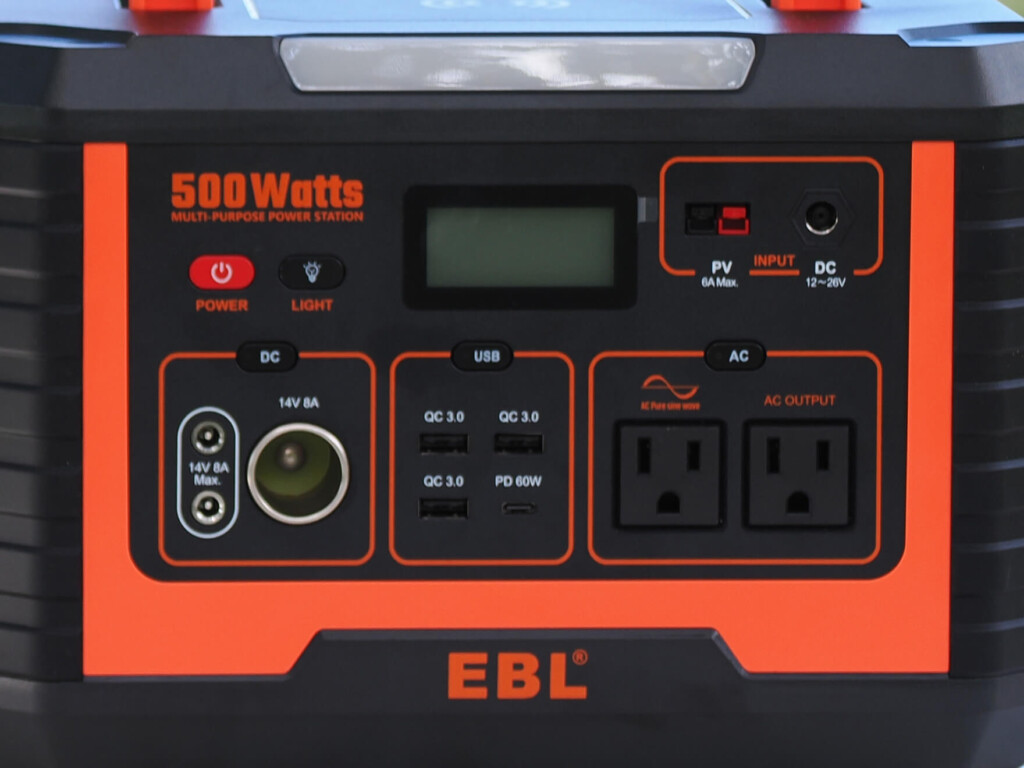
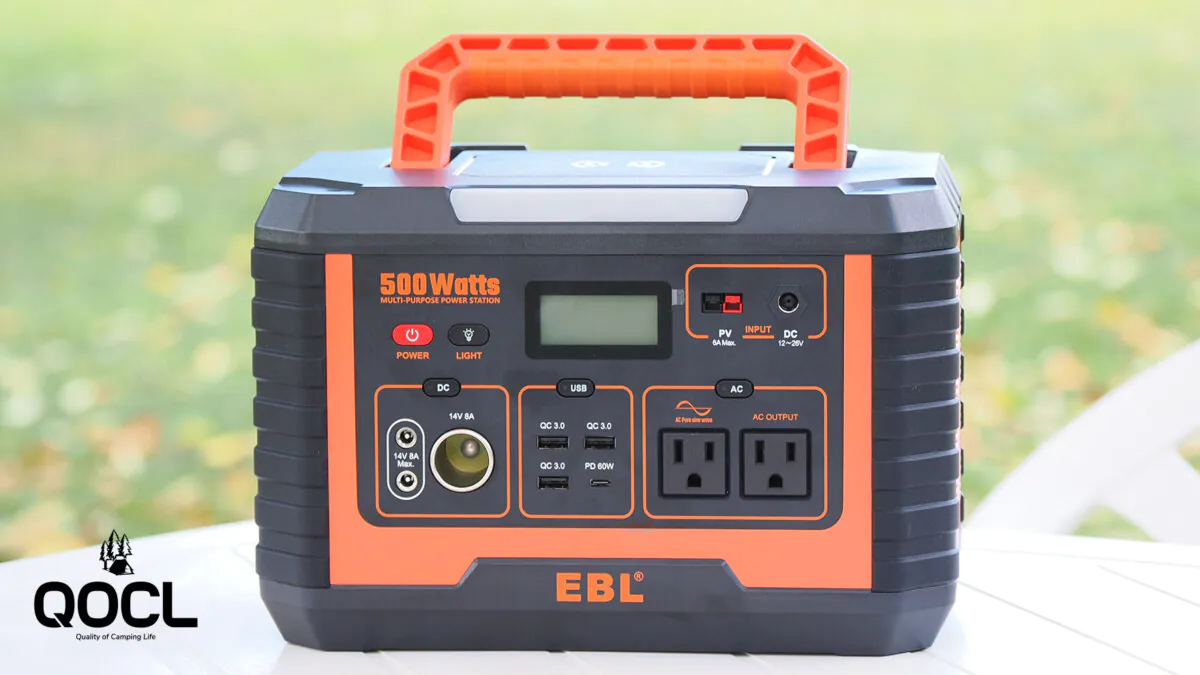
The "EBL Portable Power Station 500W" has "500Watts" written in large letters on the top left of the front of the unit. In fact, the capacity is 519Wh, which is slightly more than 500Wh
Nowadays, even for those who don't regularly enjoy outdoor activities or camping, portable power sources seem essential for emergencies and disasters. However, when it comes to buying one, you may be concerned about how much capacity you need. In reality, there are plenty of high-capacity options available, but the size and weight increase. So, I searched for a portable power source that cost less than ¥100,000 and weighed less than 10kg, so my wife and I could easily handle it with one hand. With this budget, I needed a high-capacity power source in the 1000Wh range. The 500Wh range was within our budget. I ended up purchasing the " EBL Portable Power Station 1000W " and " EBL Solar Panel 100W 20V ," which also included a 100W solar panel, at the very limit of my budget. However, the total cost at the time was about ¥85,000.
In my case, I go on campervan trips fairly frequently, so a price under 100,000 yen would be fine for me, but for those who only go camping a few times a year and are basically using it for emergencies and disasters, it might be a little too expensive. That's where the 500Wh class, like the " EBL Portable Station 500W " we tested this time, becomes more attractive than expected. What's more, the "EBL Portable Station 500W" is much more reasonable than the 1000W.
the 1000Wh class portable power station " EBL Portable Power Station 1000W " with the 500Wh class " EBL Portable Power Station 500W ", there is a difference in battery capacity of about twice as much, and a rated output of 1000W (instantaneous maximum 2000W) versus 500W (instantaneous maximum 1000W). In reality, if you have a 500W electric heater, for example, the theoretical value is that the " EBL Portable Power Station 1000W " can be used for about two hours, while the " EBL Portable Power Station 500W " can only be used for about one hour.
However, even with a 1000Wh class, cooling and heating appliances, such as air conditioners and heaters, often consume nearly 1000W of power, which ultimately only lasts about an hour, so you can't expect much practical benefit. Other high-power appliances include dishwashers, induction cookers, irons, toaster ovens, electric kettles, irons, washing machines, dryers, and vacuum cleaners, but most of these are unnecessary to run outdoors or in emergencies, consuming precious electricity. The only exception is refrigerators, which, depending on their size and power consumption, can operate for several hours during a short power outage, so a large-capacity 1000Wh class may be advantageous. However, allocating precious power from a portable power source to a refrigerator during a power outage with an uncertain duration requires considerable thought
Of these appliances that consume a lot of power, the one I would prefer to use for a short time even if it means consuming electricity from a portable power source is the microwave. In most cases, it can only be used for a few minutes, so the actual power consumption is low, which is also an appealing feature. However, there are many 500W and 600W microwaves that have a maximum instantaneous power output of nearly 2000W, so I chose the "EBL Portable Power Station 1000W". Essentially, I wanted to have a power source to use the microwave while traveling in my camper van
Apart from the microwave, I hardly ever use any appliances, so I don't know for sure, but hair dryers consume a lot of electricity in a relatively short period of time, so they're probably appliances you'd want to use outdoors or in an emergency. Conversely, if you give up on the microwave and hair dryer, there are probably very few appliances that consume a lot of power that you'd want to run even using the power from a portable power source
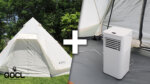
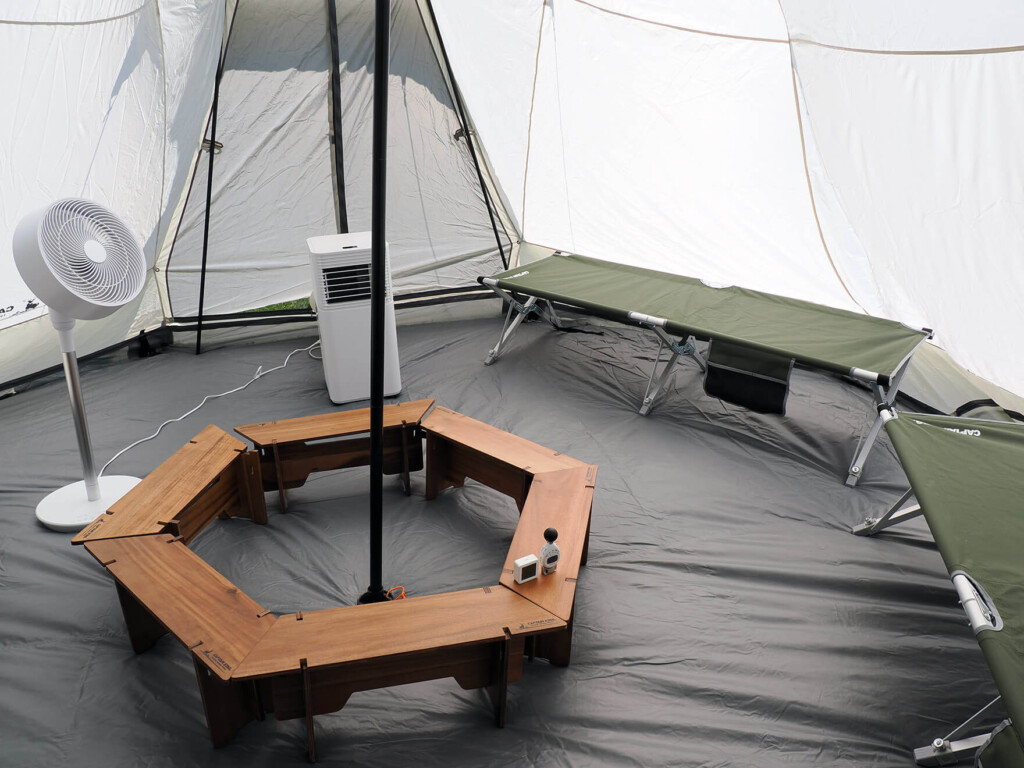
On the other hand, mobile devices that you definitely want to use, such as smartphones and tablets, are originally battery-powered and operate on a few to a dozen watts, so a 500Wh like the " EBL Portable Station 500W " will be able to run for several dozen hours, and even laptops, which consume a relatively large amount of power, are said to consume around 50 to 120W, so if you're just checking emails for the bare minimum, you should be able to use it for several days without any problems, including the built-in battery. To actually test these out, we EBL Portable Station 500W to Forever Camping Paradise , and conducted an experiment.
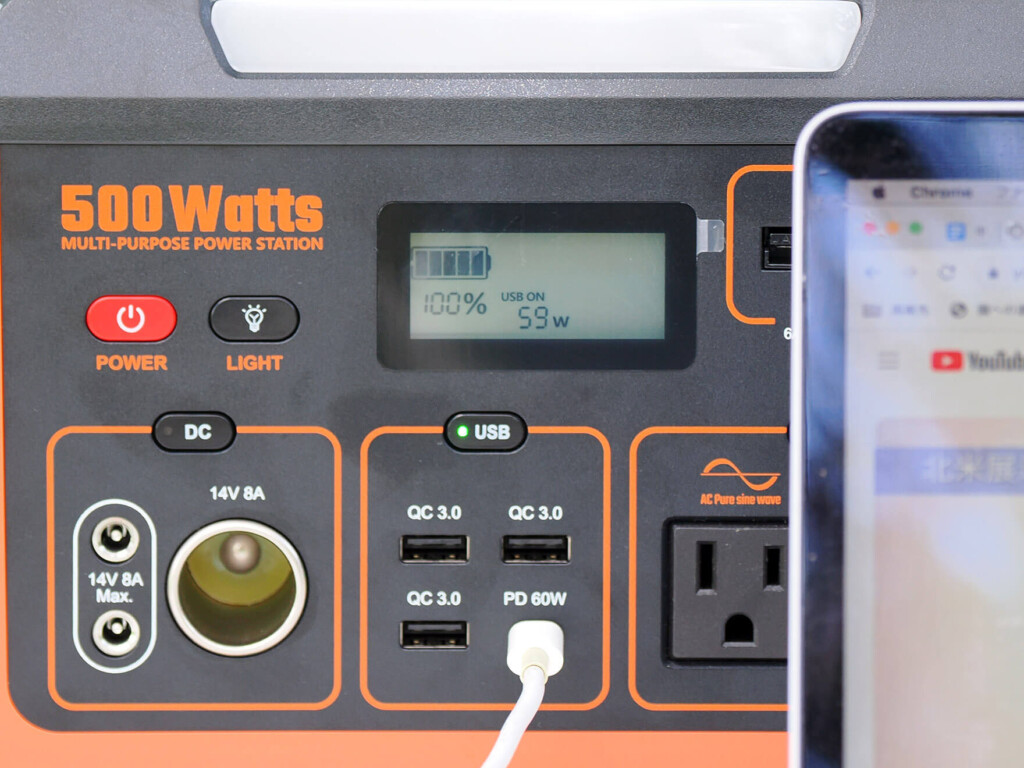
For the test, we used the EBL 500W Portable Power Station, which was charged to 100% using a household AC power source. It can also be charged from a cigarette lighter socket or solar panel
First, use the laptop with the "EBL Portable Power Station 500W" charged to 100%
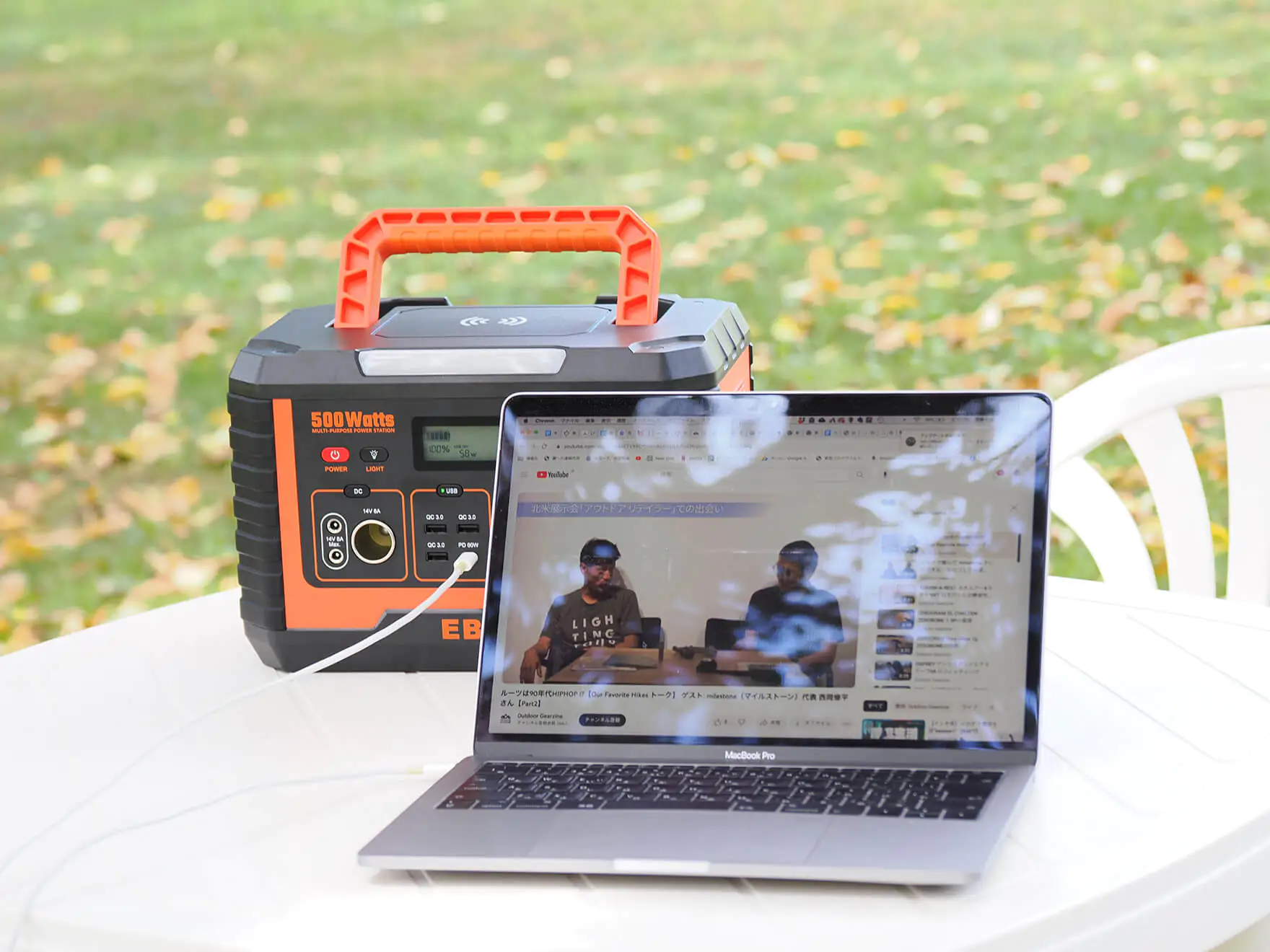
I tried using a laptop with the EBL 500W portable power supply for about 90 minutes, assuming I was checking emails in the morning
actually EBL Portable Station 500W to Forever Camping Paradise and before testing the battery life, I conducted a full charge experiment several times from 0% to 100% using my home AC power (household power). The spec sheet states that the charging time is 7 to 8 hours, but I should note that in my home environment, I charged it from 0% to 100% several times and it only took about 5 to 6 hours.
The first thing I did with the EBL 500W Portable Station, which was fully charged to 519Wh, was to test its power consumption with a laptop. While the portable station itself was fully charged before I brought it in, I should note that the built-in battery of my laptop, a 13-inch 2017 MacBook Pro, was only about 35% charged, so I ran it while it was charging. I also ran it for about 90 minutes and an hour and a half, simulating extended periods of email checking, and played a YouTube video from OUTDOOR GEARZINE
| Hours (minutes) | ratio(%) | Power consumption (W) |
|---|---|---|
| 0 | 100 | 59 |
| 15 | 99 | 58 |
| 30 | 97 | 50 |
| 45 | 95 | 40 |
| 60 | 94 | 34 |
| 75 | 92 | 33 |
| 90 | 91 | 23 |
As a result, after playing videos continuously over Wi-Fi for an hour and a half, the EBL Portable Power Station 500W decreased by 9%. The gradual decrease in power consumption is likely due in large part to the fact that the built-in battery of the MacBook Pro 13-inch 2017, which was initially only about 35% charged, was charged to 100% after 90 minutes. Furthermore, since the MacBook Pro 13-inch 2017 supports USB PD 60W, the experiment was conducted by powering it directly via USB rather than using an AC power source. If possible, it is recommended not to use an AC power source, as this allows for more efficient use of the portable power source's power.
Even when I used my laptop for an hour and a half in the morning, the power consumption was less than 10%
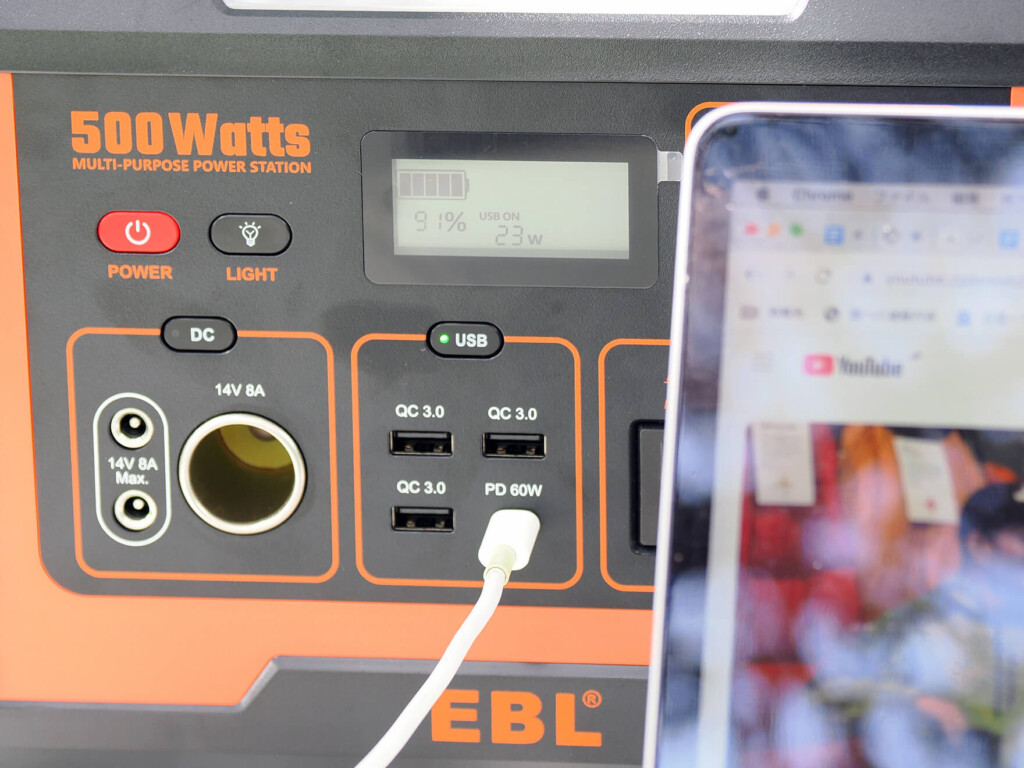
Even when using a laptop, which consumes a lot of power among the mobile home appliances that many people use on a daily basis, the electricity used in an hour and a half was less than 10%, which is a very excellent result
I saw a gap in the clouds, so I tried charging it with the "EBL Solar Panel 100W 20V"
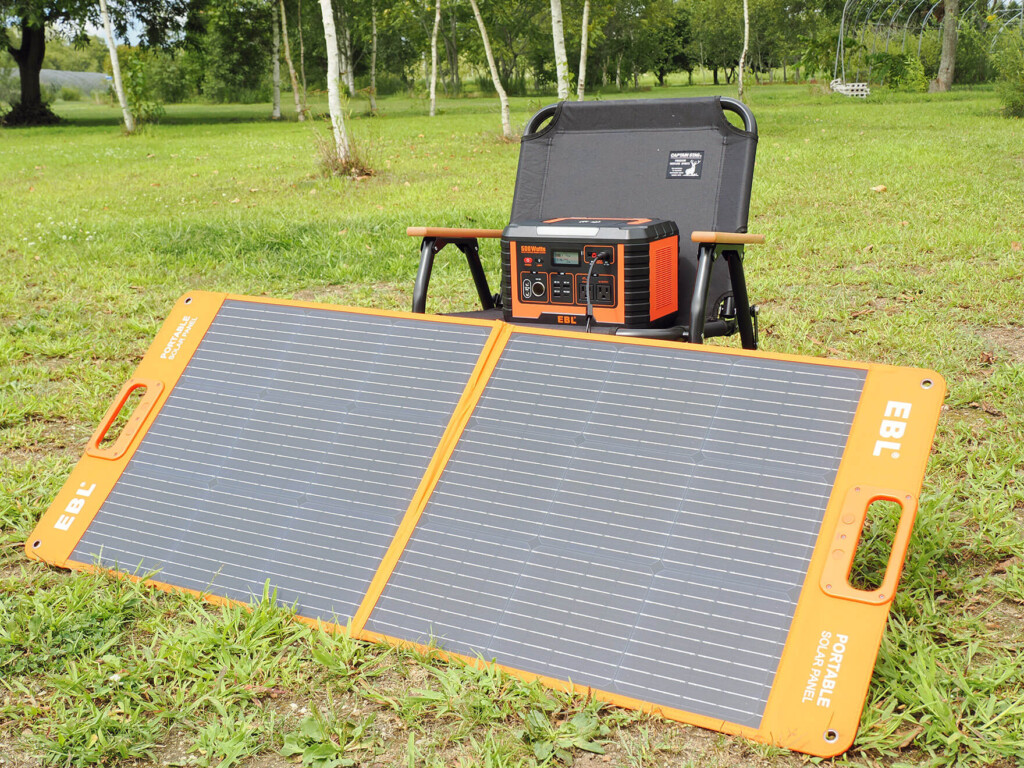
EBL's solar panel, "EBL Solar Panel 100W 20V." I have it in my camper van and use it to charge my "EBL Portable Power Station 1000W."
It was extremely hot on the day of the experiment, but there were many clouds and the sunlight was often blocked. For this reason, I thought it would be impossible to conduct an experiment on charging with a solar panel, as even a slight dimming of the sunlight would have a big impact, but when I saw a gap in the clouds, I also tried EBL Solar Panel 100W 20V which is compatible with the "EBL Portable Power Station 500W".
| Hours (minutes) | ratio(%) | Power consumption (W) |
|---|---|---|
| 0 | 91 | 43 |
| 15 | 93 | 28 |
| 30 | 94 | 24 |
| 45 | 96 | 24 |
| 60 | 96 | 19 |
It was charged to 5% in about an hour. While this recovers more than half of the power consumed by using the laptop for an hour and a half, solar panels are highly dependent on the amount of sunlight they receive. The weather on the day of the experiment is shown in the photo below. the EBL Solar Panel 100W 20V to fully utilize its capabilities. According to the specifications, the EBL Solar Panel 100W 20V the EBL Portable Station 500W in approximately 7-9 hours . In situations where it's difficult to secure a power source, such as during emergencies or long-term camping trips, a solar panel, which charges a portable station fairly quickly on clear days, is an important option to consider. EBL offers both a 100W and a 200W model, allowing you to choose the model that best suits your needs.
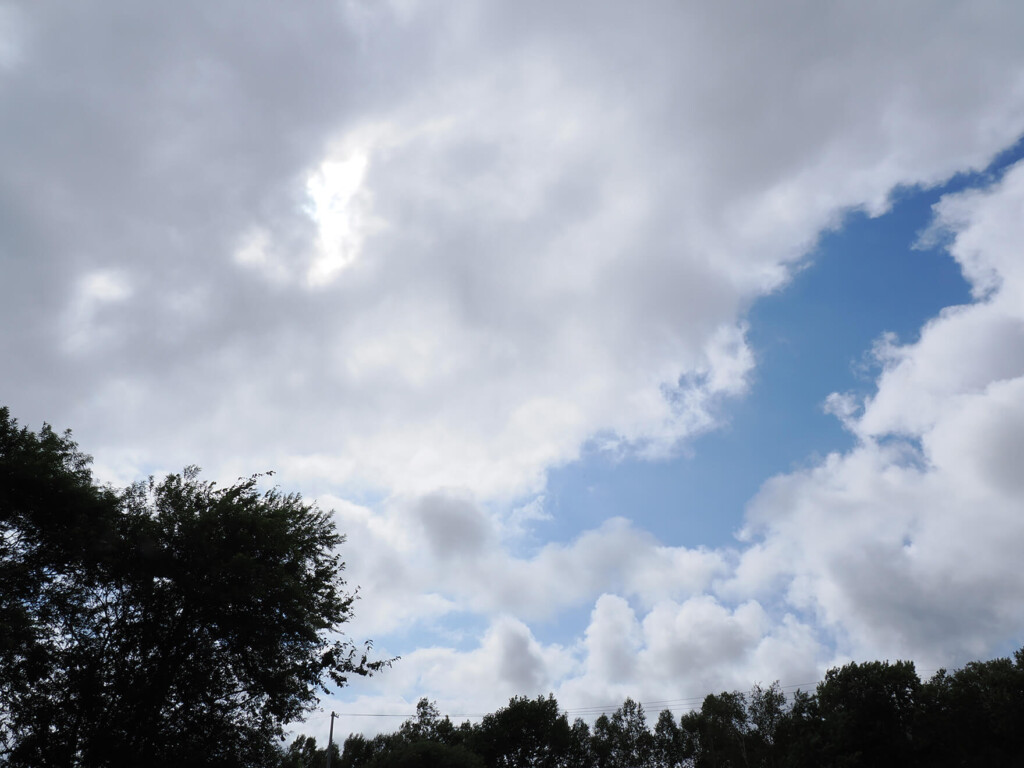
The weather wasn't bad, but it was cloudy, which wasn't ideal for testing the solar panel, but I was able to charge it to about 5% in an hour
It can easily run two electric fans, perfect for emergencies and outdoors
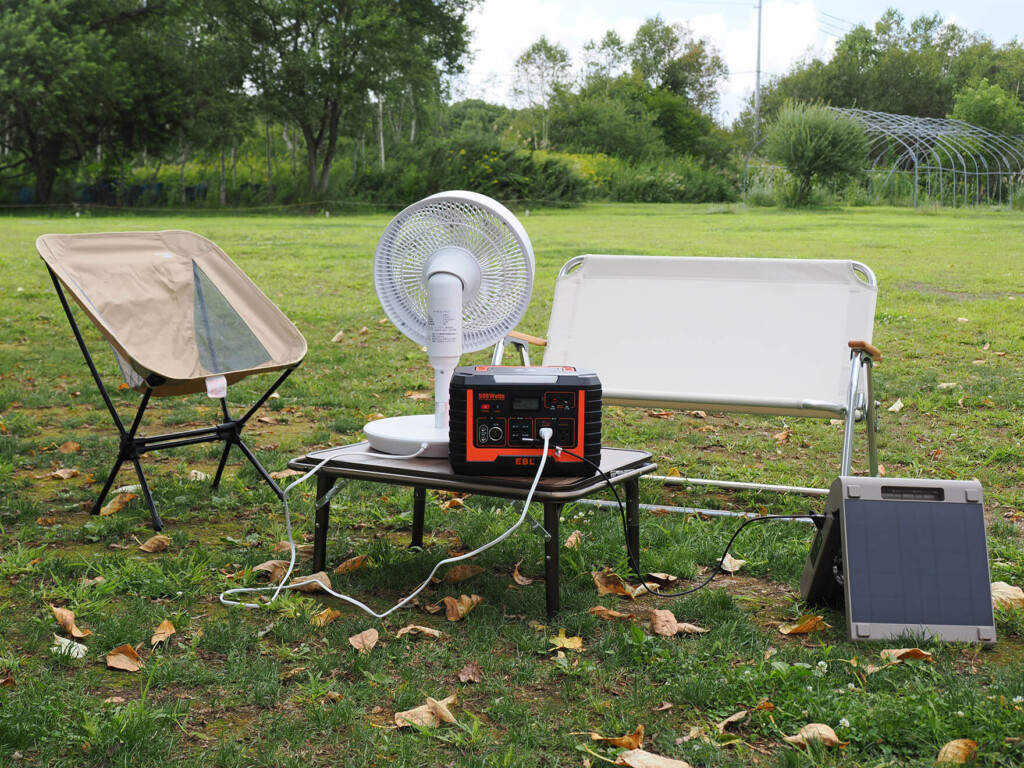
Electric fans are a more practical way to combat the heat than air conditioners, which consume too much electricity. For the test, we used two electric fans at the same time, which was a bit of a tricky situation
How to stay cool during the summer season is an important issue, whether you're outdoors or in an emergency. It would be great if you could use the air conditioner you normally use at home or a spot air conditioner outdoors, but many air conditioners consume more than 1,000W of power, so even EBL Portable Station 500W EBL Portable Station 1000W " are doing well if they can be used for 1-2 hours. However, using up all the power in your portable power source just to run an air conditioner for an hour or so is not a wise use.
So the most practical way to use them is with an electric fan or air circulator. I tested the Tansu Gen "JH01 Circulator" ( market price around 9,000 yen ) and Apix International " Solar Power Fan2 , using them with the " EBL Portable Power Station 500W
The 3D oscillating "JH01 Circulator" was connected to an AC power source, while the solar panel-equipped, battery-powered "Solar Power Fan2" was powered via USB, and both were operated. The reason we ran both fans at once was because modern fans consume little power, and we were concerned that one fan might not be enough to drain the battery of the " EBL Portable Power Station 500W ," so we wanted to test under more challenging conditions.
| Hours (minutes) | ratio(%) | Power consumption (W) |
|---|---|---|
| 0 | 96 | USB 13W + AC 14W |
| 15 | 95 | USB 13W + AC 9W |
| 30 | 95 | USB 11W + AC 7W |
| 45 | 94 | USB 10W + AC 9W |
| 60 | 93 | USB 11W + AC 5W |
The Solar Power Fan2 operates at full rhythmic airflow, while the JH01 Circulator oscillates and automatically adjusts its airflow when temperatures exceed 30°C. Operating both fans simultaneously for an hour consumed only 3% of the power consumed by the EBL 500W Portable Power Station. Even if both fans were operated continuously for six hours, they would consume only about 20% of the power
EBL Portable Power Station 500W " is more than sufficient for camping trips of one or two nights, or for powering a fan to cool down during a power outage
the EBL Portable Power Station 500W is the EBL Portable Power Station 1000W, despite having half the power capacity . However, when you consider the fact that you will be charging smartphones and other devices for the whole family, I feel that the large size of the main unit makes it quite practical to be able to charge up to 10 devices simultaneously, including wireless charging.
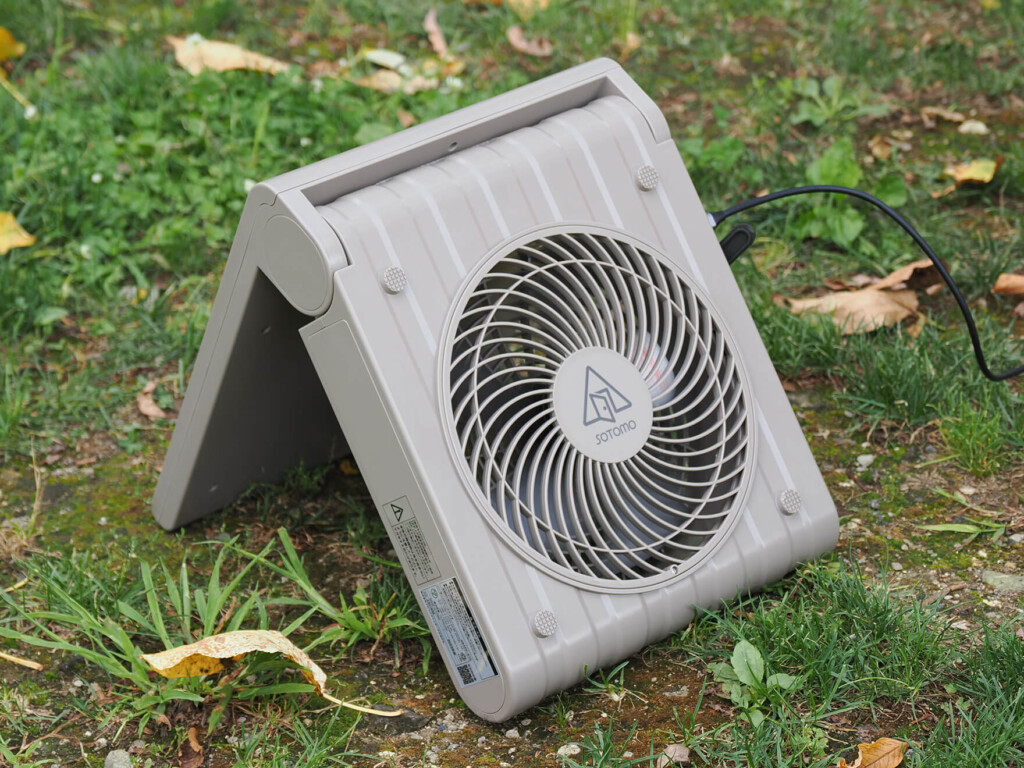
The Apics International "Solar Power Fan2" used in the test is equipped with a solar panel, is waterproof, and can be powered by a battery, making it a reliable device for outdoor use or in emergencies
Continuous use of the Bonarca 15L car refrigerator/freezer to drain the battery
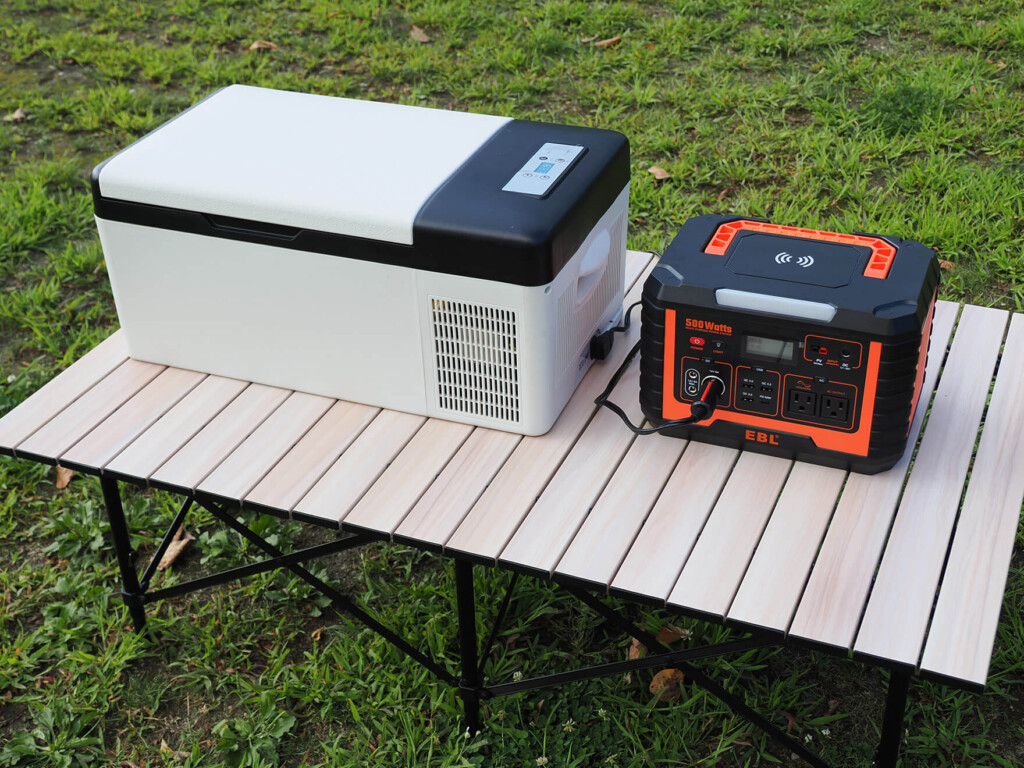
"Bonarca 15L car refrigerator/freezer." I use it as a sub-refrigerator in my camper van and connect it for continuous use. I thought I'd use up the battery
I started by using my laptop to check emails in the morning, and although I did charge it using the solar panel along the way, it took until late evening for the battery on the " EBL Portable Power Station 500W " to reach 93%. I couldn't even use 10%. So I connected my favorite portable refrigerator, the "Bonarca Car Refrigerator Freezer 15L," which consumes electricity continuously and is great for long periods of time when camping, to the DC power cigarette lighter socket and ran it.
The outside temperature was over 30°C, but the temperature was set to 5°C, like when refrigerating food brought to camp. Under these conditions, we observed how long it took for the EBL Portable Power Station 500W
| Hours (minutes) | ratio(%) | Power consumption (W) |
|---|---|---|
| 0 | 93 | 29 |
| 15 | 92 | 40 |
| 30 | 91 | 0 |
| 45 | 90 | 0 |
| 60 | 89 | 0 |
| 3 hours | 81 | 0 |
| 5 hours | 74 | 31 |
| 15 hours | 58 | 44 |
| 20 hours | 53 | 0 |
| 24 hours | 42 | 37 |
| 27 hours | 4 | 0 |
| 28 hours | 0 |
Perhaps it was a mistake to set the Bonarca 15L Car Refrigerator/Freezer to Eco Mode, but the EBL 500W Portable Power Station continued to supply power while maintaining an internal temperature of 5°C for approximately 28 hours, not just one day. When I first turned it on, the internal temperature was approximately 31°C. It took about 30 minutes for the temperature to drop to 5°C, consuming a lot of power during this time. The cooling cycle stops when the internal temperature reaches the set 5°C, and resumes when the internal temperature drops to around 7°C. Therefore, depending on the timing of the measurement, the power consumption often dropped to 0W.
EBL 500W Portable Power Station 's power capacity would be sufficient for more than half a day, but in reality, it lasted longer than 24 hours, and the power ran out approximately 28 hours later. Recording the test results was quite stressful. Incidentally, the lid of the Bonarca 15L Car Refrigerator/Freezer was not opened or closed during the test. In actual use, the lid will be opened and closed frequently when removing ingredients, and the temperature inside the refrigerator will rise each time, so the actual operating time is expected to be a little shorter.However, this result is more than sufficient for a one or two day stay.
Summary: Choose a portable power source based on frequency of use and budget
For general use, the 500Wh class "EBL Portable Power Station 500W" is just right
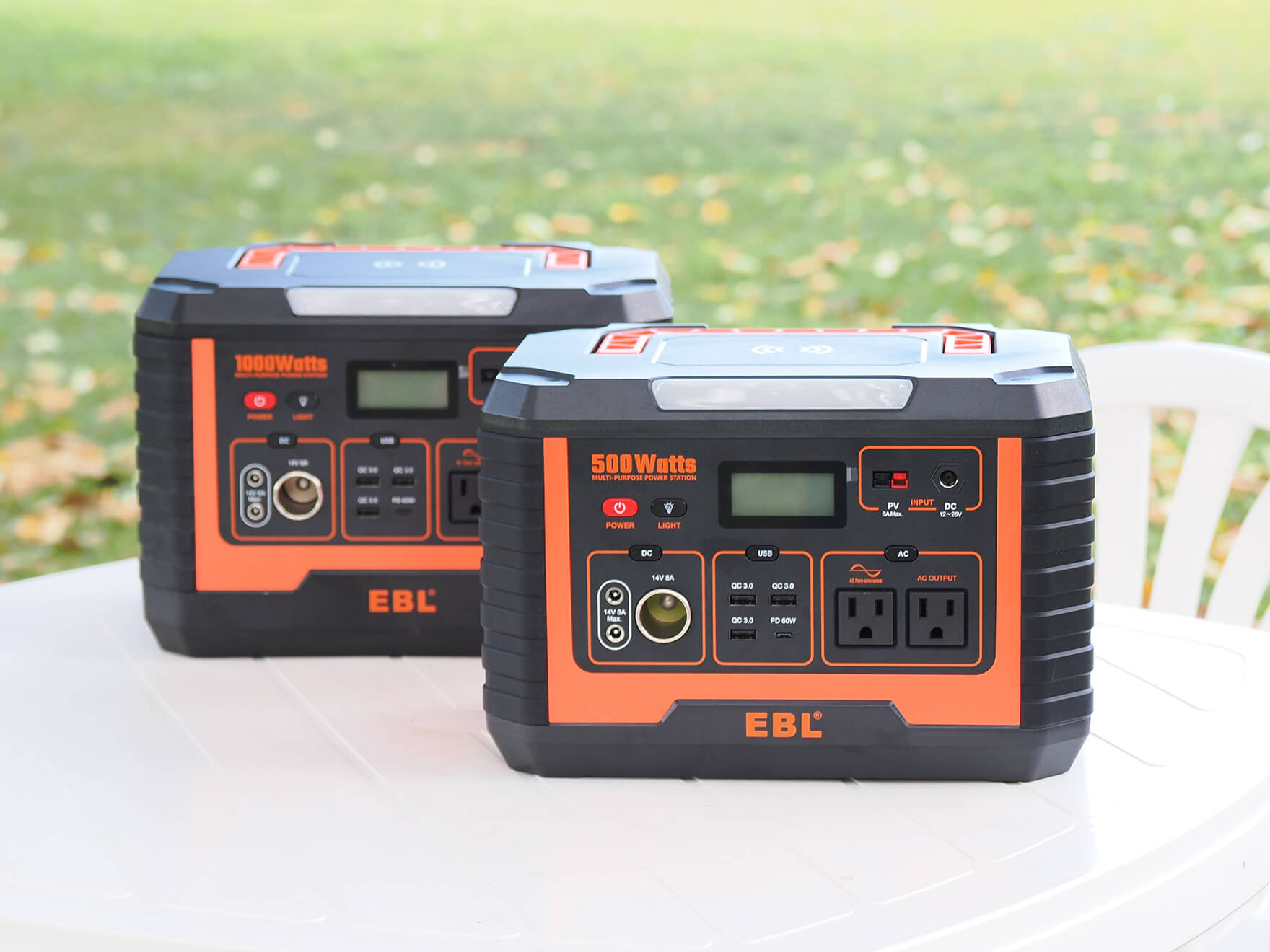
When you line up the two units, you can see that the "EBL Portable Power Station 500W" (front right) is not much smaller than the "EBL Portable Power Station 1000W" (rear left)
Perhaps due to the recent increase in natural disasters, portable power sources are not only being purchased by people to make outdoor activities and camping more enjoyable, but also by people who need them to charge their computers and smartphones, and to run information gathering tools such as televisions and radios in emergencies and disasters. Therefore, price and capacity are very important factors
Generally, the more expensive a portable power source is, the larger its capacity, but models that can be purchased for around 100,000 yen do not have enough electrical capacity to run high-power air conditioners or electric heaters that consume more than 1,000W as if you were using them normally
EBL Portable Power Station 1000W " and the 500Wh class " EBL Portable Power Station 500W EBL's lineup , the difference that I feel is most noticeable is whether or not you can use a microwave and hair dryer.
Naturally, the electrical capacity is twice as large, but unless you plan to run appliances that consume a lot of power, the test results are as mentioned above. If you mainly plan to camp for one or two nights and want to be prepared for short-term power outages, the " EBL Portable Station 500W " will be sufficient. If you have a larger budget and want more peace of mind, I would also recommend EBL Portable Station 1000W EBL Portable Station 500W " at less than 30,000 yen is very attractive.
Rather than worrying about this and that, why not try using a portable power source first and determine what you really need?The 500Wh class `` EBL Portable Power Source 500W '' is more than enough, so why not give it a try and experience its excellent cost performance for yourself?
Details and purchase of EBL "EBL Portable Power Station 500W"
For more product details, please see EBL Portable Power Station 500W
Filming cooperation
Filming cooperation: " Forever Camping Paradise "
Chitose Saito