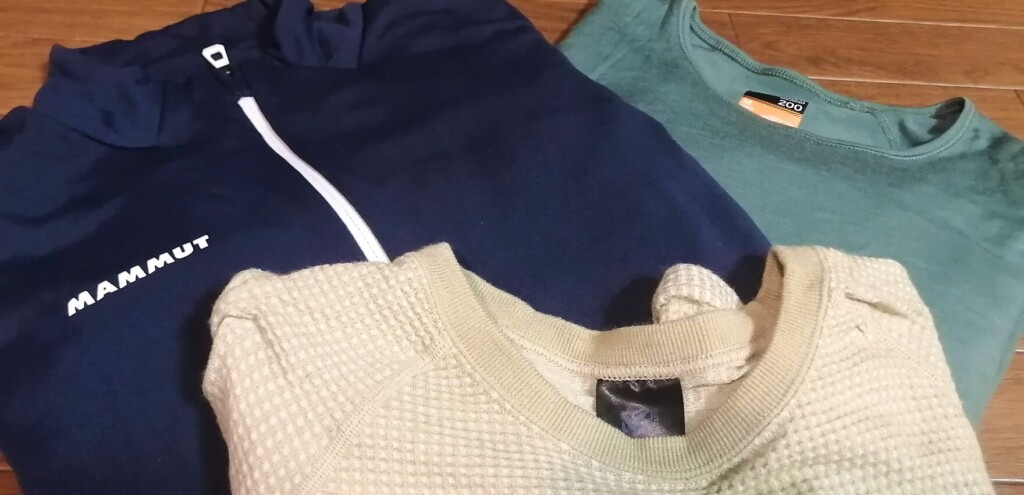
You might be thinking, "It's too late to compare base layers now..." But let me compare them
This is because I have been using a lot of base layers, failing repeatedly, and have become a gypsy base layer. About 10 years ago, when I was a beginner at mountain climbing, they all looked the same and I couldn't tell the difference. Also, I have a tendency to have atopic dermatitis, so I could never imagine wearing wool on my bare skin
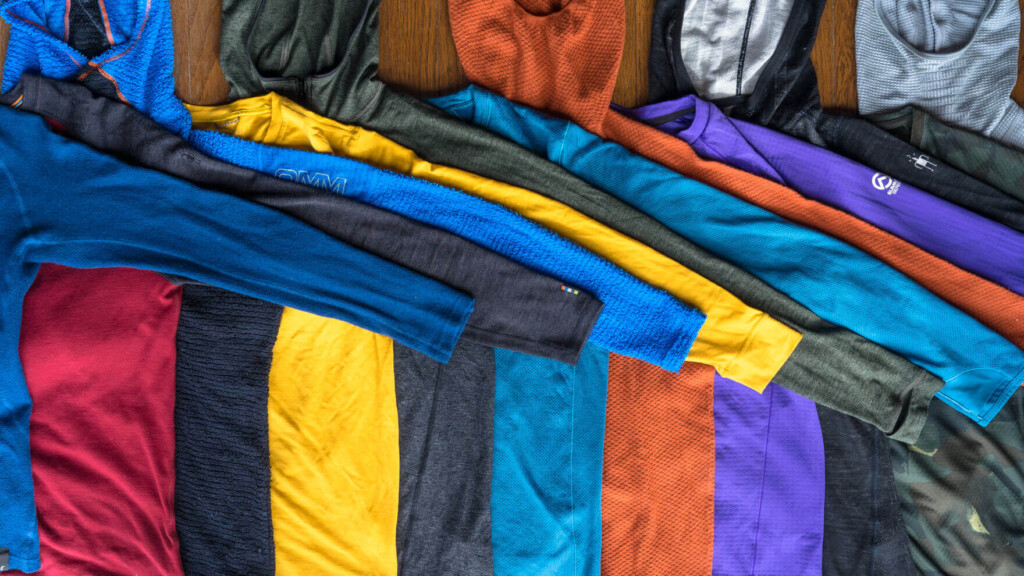
After many failed attempts, I have now settled on a certain base layer. So, based on my experience and reviews of base layers, I will compare women's base layers for mountain climbing, focusing mainly on the differences in materials
table of contents
Base layer confusion
Speaking personally, I never really considered wool as a base layer. Although it happened less frequently as I grew older, when I sweated wearing a wool turtleneck, my neck would itch so much that it would turn bright red. I was afraid of that, so I couldn't wear wool
So, until now, synthetic fibers have been my only choice for base layers. I assumed that any synthetic fiber would do, so as a beginner, I wore a thermal inner layer from a certain fashion brand and headed to Mount Nabewari (Kanagawa Prefecture) in winter. I sweated profusely along the way, and my inner layer was soaked with sweat. By the top of the mountain, I was freezing from the sweat. I quickly took off my inner layer, put on a mountain shirt, and ate some nabeyaki udon, and managed to avoid danger
I was so ignorant. After that experience, I started looking for a quick-drying base layer for mountain climbing, but they were surprisingly expensive for me at the time, so I ended up making a foolish purchase (quick-drying clothing for volleyball and basketball), only to find out that it wasn't suitable for mountain climbing after all, and put it away
I thought maybe wool would work, so I bought some mountaineering gear, but it was too thick, so it was itchy and I shelved it too. I finally settled on Montbell's Geoline medium-weight. It was quite a detour to get there. After that, I found Rab's thin, non-itchy merino wool base layer, which I still use, even though it's quite bulky
About underwear
When I went to Kagoshima Prefecture to climb Mount Karakunidake and Mount Takachiho in winter, I found it colder than I had imagined, so as soon as I arrived in the city, I headed straight to an outdoor shop to buy the clothes I was missing
What he recommended was underwear to wear under a base layer. This was shortly after Finetrack's Dry Layer was released (I think). When I was asking the store clerk about the clothing, he said, "I went to the mountains in France the other day wearing this, and I didn't get cold at all from the sweat. I climbed with just a base layer on top of this." I didn't ask him what kind of mountain it was and how cold it was, but he said, "It certainly doesn't hurt to have it," so I bought it
As predicted, there was wind and snow, but it certainly didn't feel as cold as it had before. It reminded me of how I was shivering on the snowy Mount Kobushigatake. I wasn't wearing underwear then. Ignorance is scary, but gathering information is important. Since climbing in Kagoshima, I always wear underwear
I've gone off on a tangent, but this time I'll be reviewing Millet's "Dynamic Mesh" knitted innerwear, which I've been using a lot lately
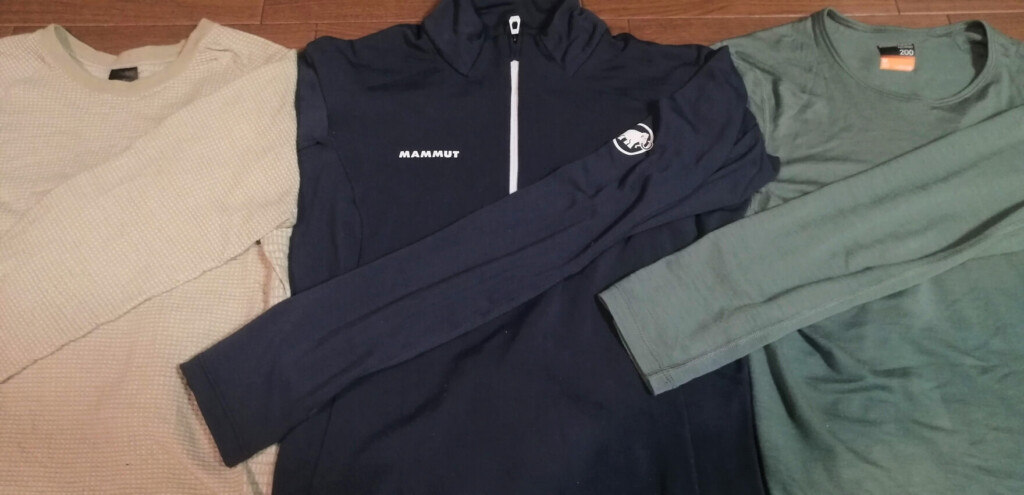

Evaluation points
This site defines the following elements as the functions required for a base layer. However, of course, there is no perfect model that has everything, so when evaluating a base layer, we check the balance of each element
- Comfort... what we call how comfortable something is to wear. The feel, fit, ease of movement, smooth seams, antibacterial and deodorizing properties, UV protection, and other factors all contribute to how comfortable you feel while wearing the garment while on the move, all of which depend on the fabric and tailoring
- Thermal insulation...not just whether it's warm in low temperatures, but whether it can reduce excess heat when your heart rate and body temperature rise (thermoregulation), and even whether it can keep your body temperature constant and dry in various situations while you're active, such as preventing sweat from cooling you down when wet
- Sweat absorption and quick drying: The ability to quickly absorb sweat and release it to the outside of the clothing, allowing it to evaporate, keeping the skin surface dry at all times. If sweat remains on the clothing, it can easily become cold when the sweat evaporates in the cold wind, causing the discomfort of "chilling sweat."
- Deodorizing (odor prevention) properties: Whether or not the product is resistant to odors caused by sweat, etc
By the way, the article below summarizes what kind of base layer you should choose for what purpose and scene
Related articles
Test environment
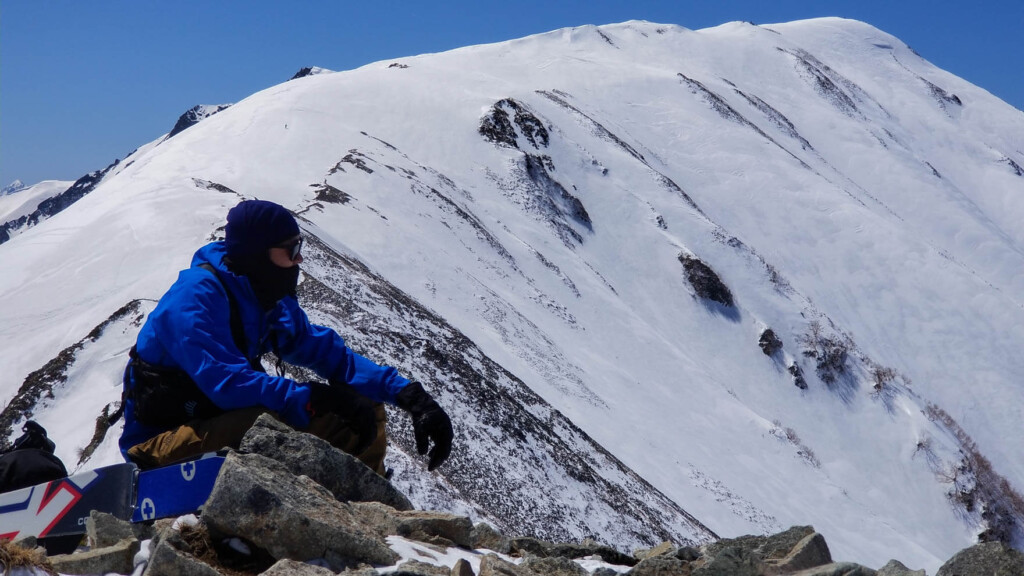
- A mountain in Kanagawa Prefecture with many ups and downs and paved roads. The temperature was around 10 degrees
- The environment is assumed to be late autumn to winter climbing. Please note that the results may be different from those in spring and summer
- Even though synthetic fibers and wool are all lumped together, there are naturally differences in quality and processing depending on the product, so please understand that this impression does not apply to all materials of the same type
- Please note that these feelings are based on personal experience and subjectivity
Test Results & Spec Comparison Table
| item | [100% Wool] Icebreaker 200 Oasis Long Sleeve Crew Neck |
[100% Synthetic Fiber] MAMMUT Moench Advanced Half-Zip Long Sleeve |
[Synthetic Fiber x Wool Blend] MILLET Whole Garment Waffle Wool Crew |
|---|---|---|---|
| Here is ◎ |
|
|
|
| Here is △ |
|
|
|
| Comfort | ◎ | ◯ | ◎ |
| Heat retention | ◎ | ◯ | ◯ |
| Sweat absorbent and quick drying | △ | ◎ | ◯ |
| Deodorizing | ◎ | △ | ◯ |
| Specifications | |||
| Fabric and material |
|
|
|
[By material] Base layer impressions
[100% Wool] Icebreaker 200 Oasis Long Sleeve Crew
As I mentioned at the beginning, I actually had a personal aversion to wool. It's itchy and expensive. I also didn't really like the idea that wool is the only choice for mountain base layers, so I headed straight for synthetic fibers
Just when I thought I was going down the path of hating wool, I suddenly came across Rab's merino wool. This was also a product recommended by a salesperson at an outdoor shop. The salesperson said that he wears just that one item on the winter mountains. When I explained that I didn't like the itchiness, he said, "Well, why don't you try it on?" and so I did. ...It's not itchy! It feels good against the skin! It fits my body perfectly! It was on sale, so I bought it to try it on. I guess I didn't like it before I even tried it on
Apparently, the reason wool was itchy was "due to the thickness of the fibers, not the type of fiber itself" (according to The Woolmark Company's materials), and now it is "effective for eczema sufferers" (according to the same materials). Who would have thought that wool would go from being "itchy" to being used to treat skin diseases?
...and here's a quick refresher on merino wool. "Merino wool is the finest wool, obtained from Merino sheep. Merino sheep are primarily raised in Australia, New Zealand, and France. Its fibers are particularly fine and soft, making it pleasant to the touch. Merino wool with especially fine fibers is called extra-fine merino wool and is used for high-end knitwear, suits, dresses, and more" (https://www.fashion-press.net/words/385). Merino wool is the finest wool, and the finer the fibers, the better the quality. My Rab is a discontinued product that's no longer in production, but it wasn't itchy or itchy, and it felt nice against the skin. Even on sale, it was expensive, so it must have been made from high-quality merino wool. So far, it's in good condition and hasn't been eaten by moths
Now, the good and bad points of merino wool are:
[Good]
- Feels good on the skin and is comfortable to wear
- Highly hygroscopic and water-absorbent
- High heat retention
- Highly breathable
- Highly deodorizing
[Not good]
- Low quick-drying property
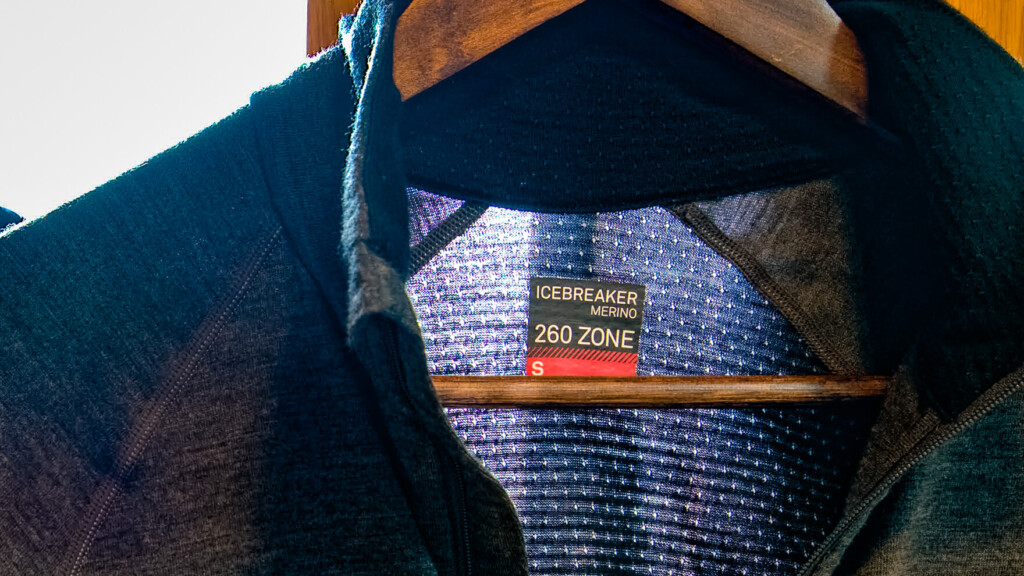
These are the general characteristics. But is this really the case? The product I wore this time was the icebreaker "200 Oasis Long Sleeve Crew."
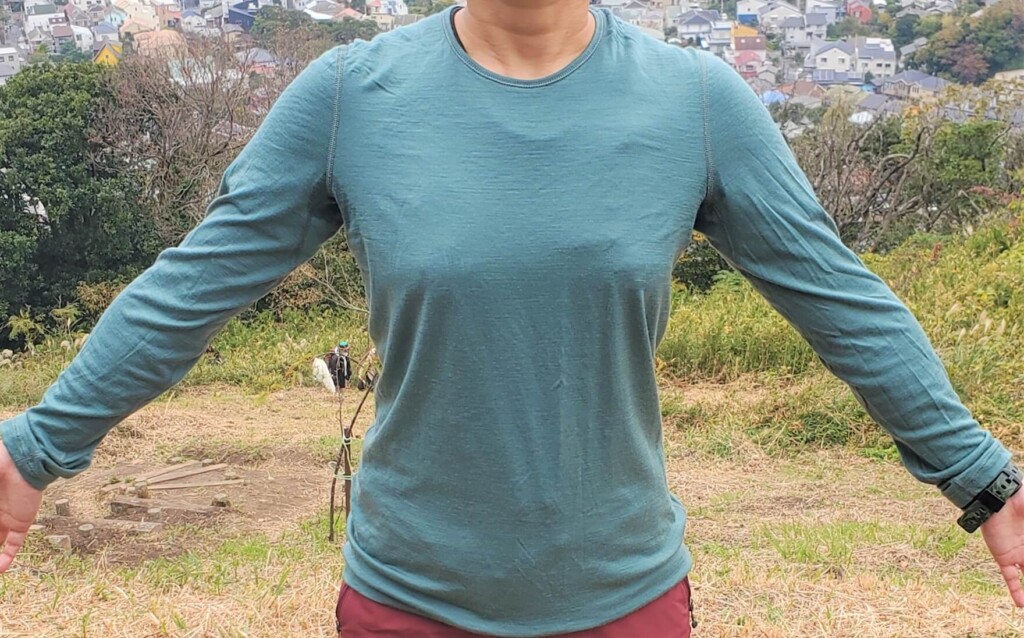

The first thing I noticed was how smooth it felt on my skin. It didn't itch and blended in softly
It's warm and cozy even right after you put it on. The gentle warmth that wraps you up and lasts is a comforting feeling. There's nothing like the warmth of merino wool. It's a great way to get started
I walk silently along the paved road, sweating but not damp. I take a break on a small hill at the top of a steep mountain path. My back and armpits are quite sweaty

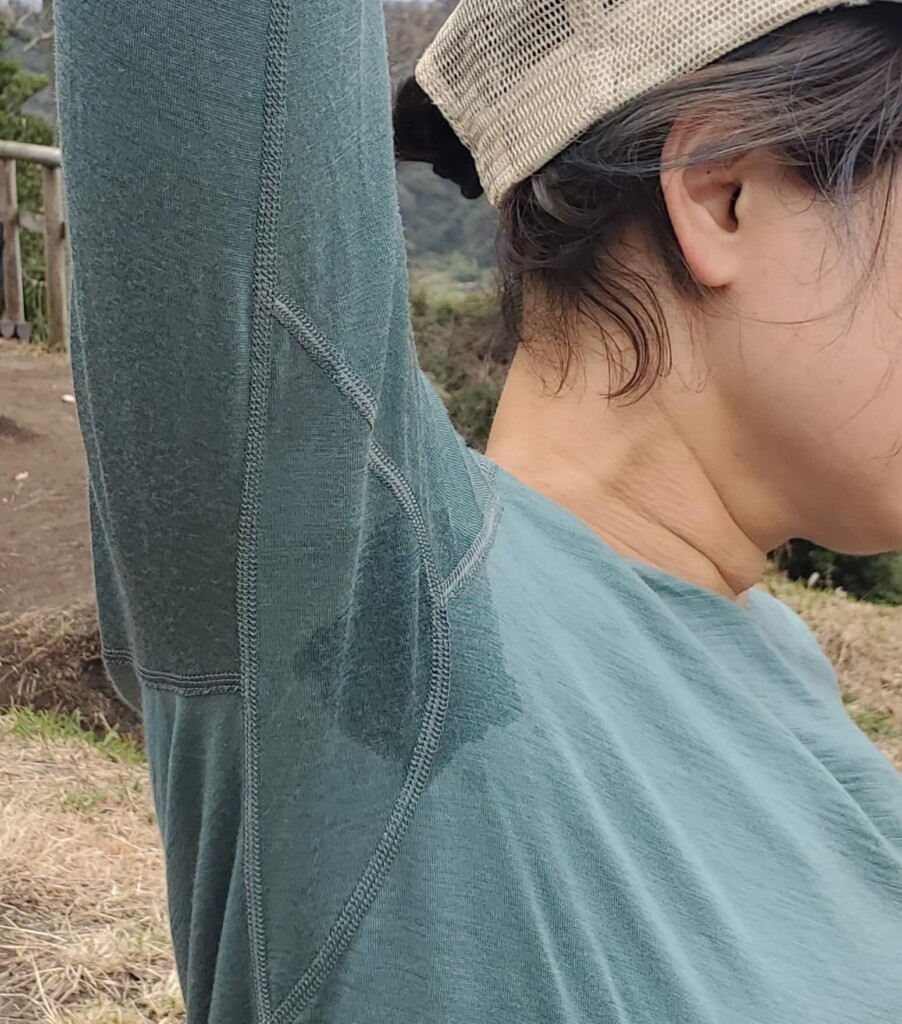
I'm sweating profusely

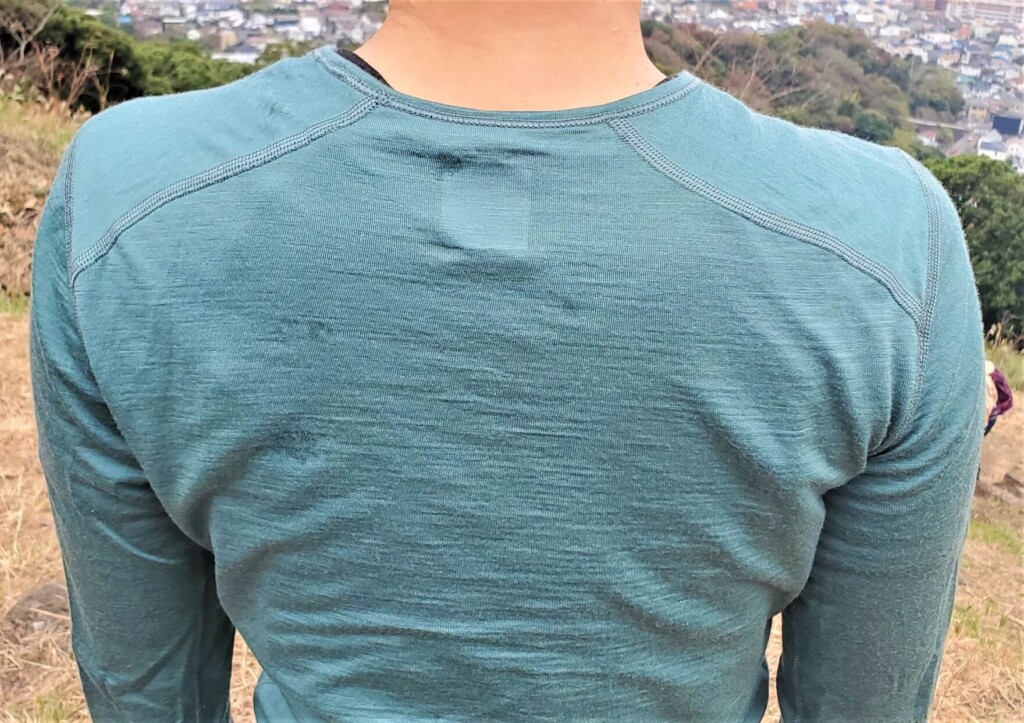
It's hard to see, but my upper back is sweating too
The wind was blowing strongly that day, so my entire body was exposed to the wind. ...It was cold. It was made of medium-weight merino wool, but it was cold. Perhaps because it was highly breathable, the cold wind blew right through my body. I waited 5-10 minutes to see when it would dry. It was freezing. After waiting 10 minutes, I put on a hard shell to protect myself from the wind, but my back still felt cold. Having a cold back takes away body heat and energy, that's what I'm talking about
So, I changed into my next base layer. The thickness of the fabric is good for keeping me warm, but it absorbs and retains all of my heavy sweat (liquid sweat, not gaseous sweat), so it dries much slower than synthetic fibers. The moisture absorption may have had a heat-generating effect when I started walking, but once it absorbed water, there was nothing I could do... Perhaps merino wool isn't the best choice for winter mountain climbing for people who sweat a lot
[100% Synthetic Fiber] MAMMUT Moench Advanced Half-Zip Long Sleeve
As mentioned above, my first decent base layer was Montbell's Geoline mid-weight (100% polyester). My next favorite is The North Face's now-defunct mid-weight. It's made of 81% polyester, 14% Maxifresh (a material with long-lasting deodorizing and antibacterial properties), and 5% polypropylene. I've worn this so much that it's covered in tiny pilling. Incidentally, polyester is prone to pilling. Finally, I'd like to talk about the odor after wearing the garment. Perhaps because it uses Maxifresh, the odor isn't particularly noticeable after use. My other few base layers are mostly made of synthetic materials. Because I sweat a lot, I prioritize quick-drying base layers for fall and winter to protect against chills from sweat
The main synthetic materials used for base layers are polyester, nylon, and polypropylene
The good and bad points of synthetic materials (although the functionality varies depending on the material, processing, and sewing. This is just a rough classification of synthetic materials) are as follows:
[Good points]
- Quick-drying (polyester dries faster than other synthetic fibers)
[Not good parts]
- Poor heat retention
- Low moisture and water absorption (nylon is more moisture-absorbent than other synthetic fibers)
- Almost no deodorizing effect
The specifications are almost the exact opposite of natural fibers. The item worn is the MAMMUT Moench Advance Half Zip Long Sleeve


The material is 49% polyester, 41% nylon, and 10% polyurethane. The polyester enhances quick-drying properties, the nylon makes it soft and less sticky, and the polyurethane gives it stretch. As for comfort, even though it's 40% nylon, it still has the typical scratchy feel of synthetic fibers. I'm used to it so it doesn't bother me, but it can't compare to the gentle softness of merino wool
Now we get moving. It's not particularly warm as it doesn't contain Primaloft (a synthetic fiber with the same heat retention properties as down), but the thick, tightly woven fabric makes it difficult for wind to penetrate and body heat to be lost. As we go up and down small inclines and descents, we gradually start to sweat. It's not summer, so the stickiness isn't a big deal. After a long, steep climb, we're sweating profusely, as is the norm. The fabric has almost no absorbency, so the sweat just sticks to our bodies. It's certainly cold when the wind blows here
I took a short break and started walking again. Perhaps because it's a synthetic fiber, moisture doesn't remain on the surface of my skin for long, and before I knew it, the feeling of being cold from sweat had disappeared, which was a good thing. My back didn't get cold, which is an important point for me. As I walked along the gently sloping mountain path, my clothes, which had been damp from heavy sweat, dried, and the space between the fabric and my skin became dry


My underarm sweat has dried up too

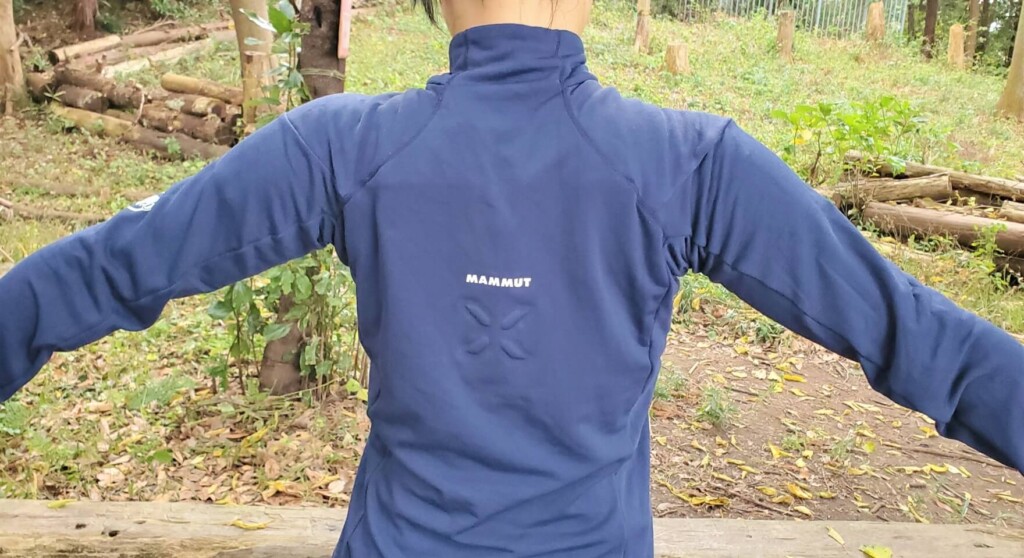
My back isn't cold either
In winter, I don't mind feeling sticky or "fluffy." As long as I don't get cold from sweat, that's fine. I really like the way synthetic fibers dry before you know it. I don't particularly feel them sticking to my skin. However, even though they're not very breathable, they do feel cool when the wind blows. If they contained Primaloft, as mentioned above, it might have been warmer. Synthetic fibers generally don't have high insulation properties, so if you're looking for warmth, I recommend products containing merino wool or special fibers with good insulating properties. For those who are happy with their clothing drying quickly even when they sweat profusely, synthetic fibers are perfect
[Synthetic Fiber x Wool Blend] MILLET Whole Garment Waffle Wool Crew
Lastly, we have the MILLET "Wholegarment Waffle Wool Crew," a new item from last fall/winter, a hybrid base layer made from wool and synthetic fibers
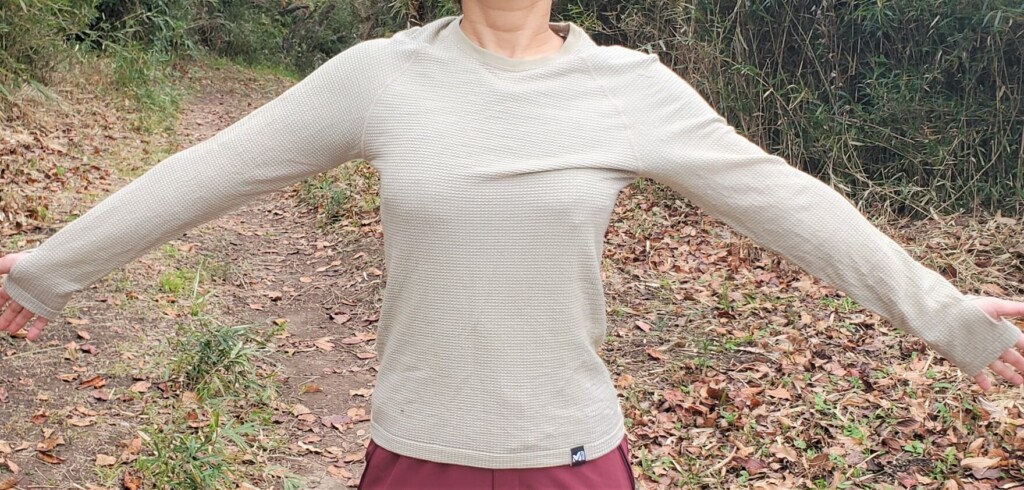

The material is 70% wool, 26% nylon, and 4% polyurethane. The wool enhances warmth and moisture absorption, the nylon and polyurethane provide quick-drying properties, and the polyurethane and wool enhance flexibility. This is my first natural and synthetic blend, combining the benefits of both wool and synthetic fibers. I'm curious to see how it feels
The moment you put it on, you feel warm. The waffle fabric is soft and gentle against your skin. It feels like warm air is trapped between your skin and the fabric. The fabric is thick, as you'd expect, and is 70% wool. The heat retention is impeccable. It's especially effective on shady roads. Even if you gradually sweat, the wool's moisture absorption doesn't bother you. When the wind blows, the damp fabric dries, leaving your skin comfortable. There were times when I felt hot while I was out and about, but the wool's moisture-regulating properties and the synthetic fiber's quick-drying properties prevented me from overheating
However, it was disappointing that it couldn't cope with the heavy sweat I got after climbing a series of steep climbs. The fibers absorbed all the water, so the sweat on my back and armpits didn't dry easily. I did feel a slight chill

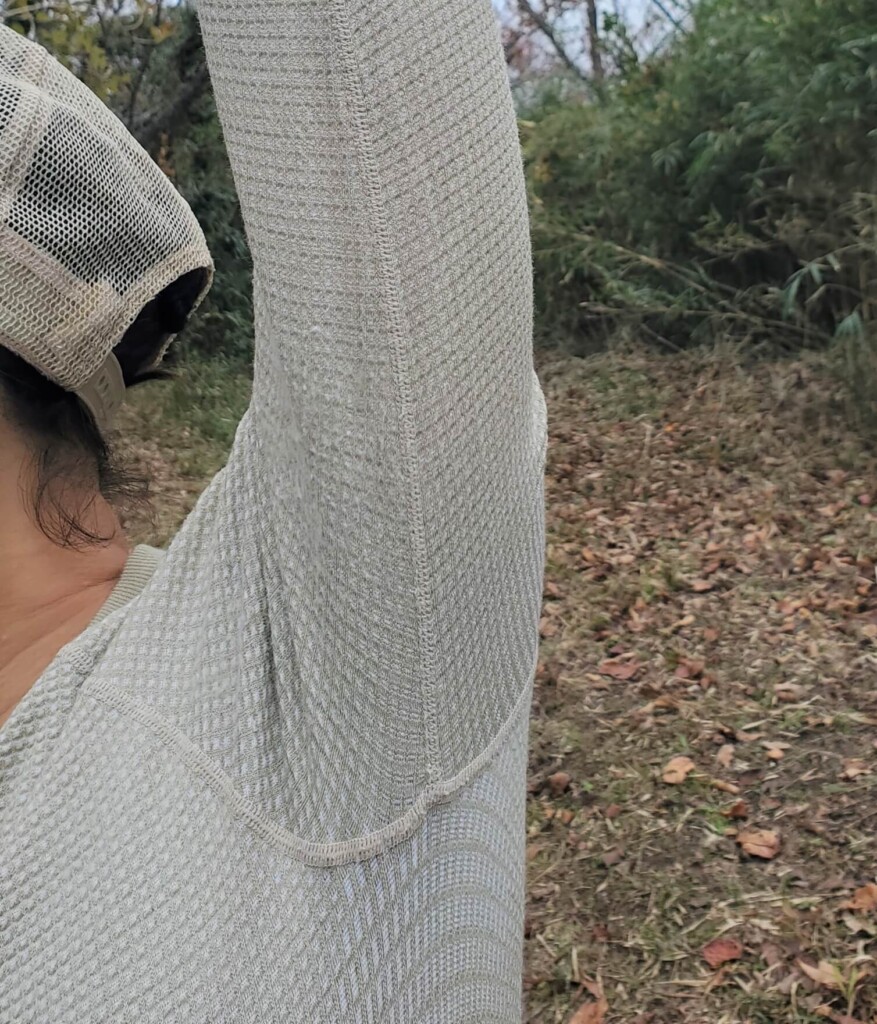
It's hard to see because it's beige, but I'm sweating under my arms

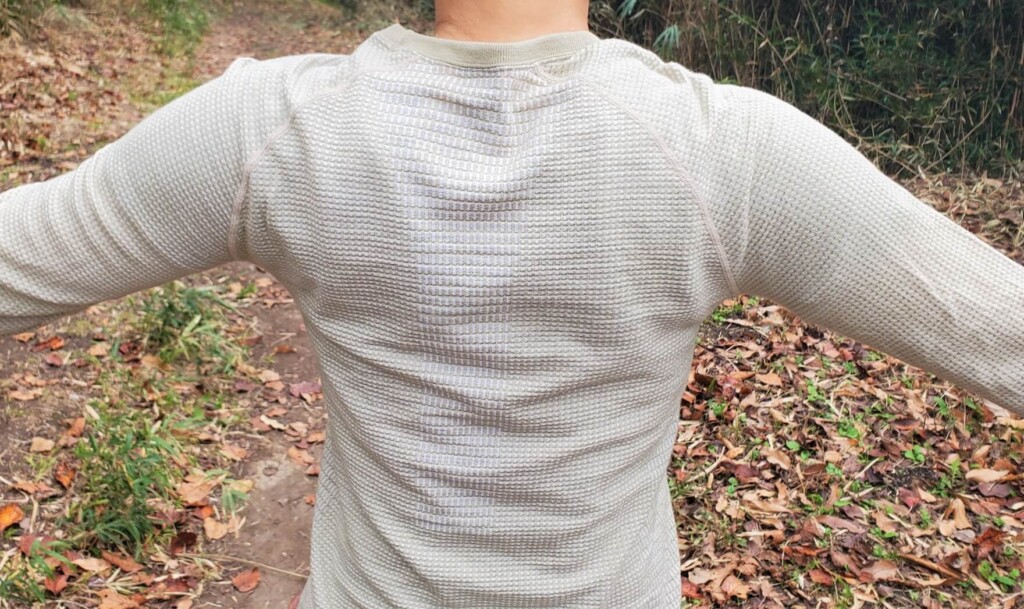
My back is sweating a lot. The center is made of a breathable knit

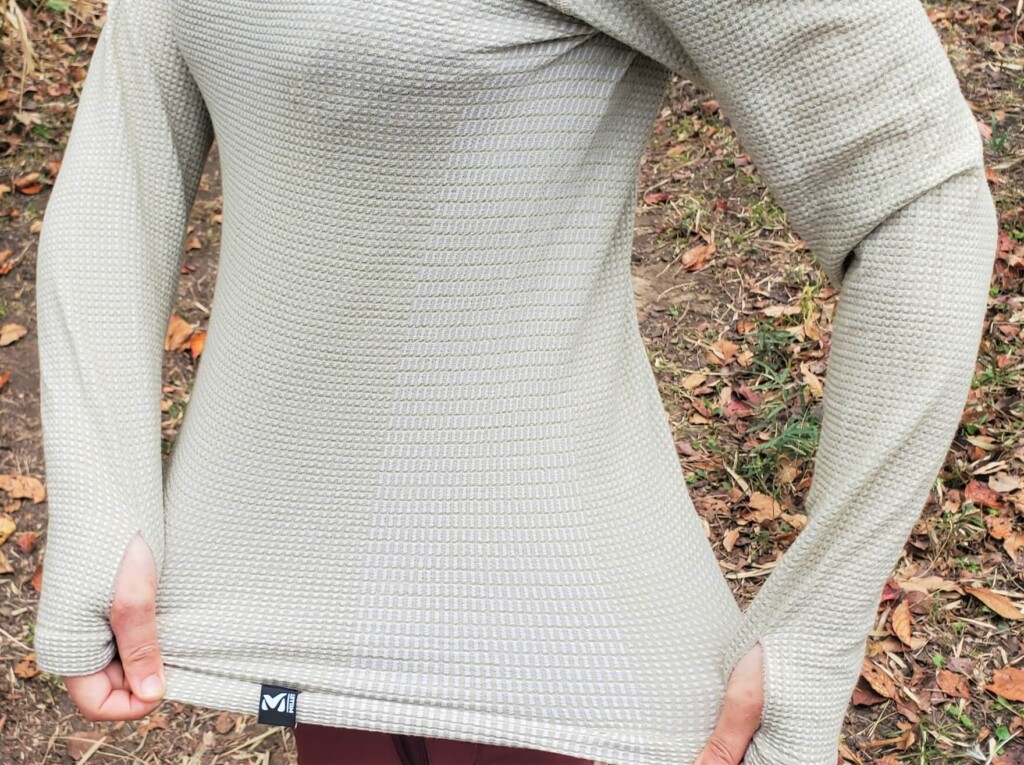
Good ventilation for the sides
It seems that it has exceeded the limit of quick drying. The slow drying time of merino wool is noticeable. Just like when I wore the Icebreaker, it didn't seem to dry even after waiting for a while. If I stayed still, I would get cold from sweat. I thought it would become my favorite, but it seems that it was too much for my sweating. It was perfect to wear, so it's a shame
Comparing the odors of synthetic fibers and wool
The last thing left is a comparison of smell. As you might expect, merino wool = no smell, synthetic fibers = smell, and hybrids = smell. After just a few hours of wearing them a day, the synthetic fibers "stink..." and the hybrids with a high merino wool content also "stink..." This is despite the fact that synthetic fibers are treated with odor-preventing agents and merino wool has a high odor-eliminating effect
I understand why people who hike long trails or mountain hikes choose merino wool. I don't know if anyone else besides me has noticed the unpleasant odor, but when I wear it, I can clearly smell it. Whether or not you can tolerate it is up to each individual, so I'll leave that up to you
summary
To summarise my thoughts after comparing them, I would say the following:
[100% wool]
For those who do not sweat excessively or overheat, for those who do not sweat much, for those who do not sweat excessively ..
[100% synthetic fiber]
For high-intensity exercise such as trail running, mountain climbing for those who walk at a fast pace, and those who sweat a lot
[Wool x synthetic blend]
It's suitable for low-intensity exercise, hiking at a normal pace, and for people who don't sweat a lot but do sweat moderately. It's versatile and can be used for all purposes
Products are often hyped with enticing claims like "Completely blocks out the wind," "Quick-drying and warm," and "Excellent deodorizing effect," but when you actually use them, you might find yourself thinking, "Huh?", for better or worse. You won't know until you try them. That's why I wanted to share the process of how we got to where we are today through trial and error
Your base layer is the closest layer to your skin and is an important piece of clothing that can even determine your life. Winter is a time when we tend to focus on outerwear like down, fleece, and hard shells, but this might be a good opportunity to reevaluate your base layer choices
Related reading