Of course, a winter sleeping bag (shraf) is an essential item when camping in a tent in the mountains in winter or spending the night in the bitter cold
Recovering your exhausted body through a warm, comfortable sleep will have a big impact on how you behave the next day. On winter mornings, it's often so comfortable inside your sleeping bag that you find it hard to get out
On the other hand, as is the case all year round in the mountains, if you spend the night without adequate bedding, you may not be able to sleep due to the cold, wake up several times during the night, and in the worst case scenario, you may even suffer from hypothermia. In that sense, although a sleeping bag is expensive, it is one piece of equipment that you need to choose carefully
So, what kind of sleeping bag should you choose? Since you'll be using it in freezing cold temperatures, it goes without saying that it needs to have good insulation. If you're camping or sleeping in a car, it's fine to just bring something warm, even if it means carrying a little extra luggage. However, that's not the case when using it for hiking or other activities. The question becomes how to achieve that warmth efficiently without sacrificing convenience or safety
As an aside, the down filling used in winter sleeping bags has specs that are comparable to those of low-quality high-end duvets, allowing you to enjoy an exquisite sleeping experience even down below
So, in order to find the one item that you can absolutely trust for winter outdoor activities, we compared and tested the winter models from three of Japan's most popular domestic manufacturers
Both sleeping bags are models that are expected to be widely used in most of Japan's 2,000m-class mountains during the harsh winter season. I couldn't help but be amazed at the craftsmanship that goes beyond just their heat retention capabilities, and is crafted with the user in mind down to the smallest details
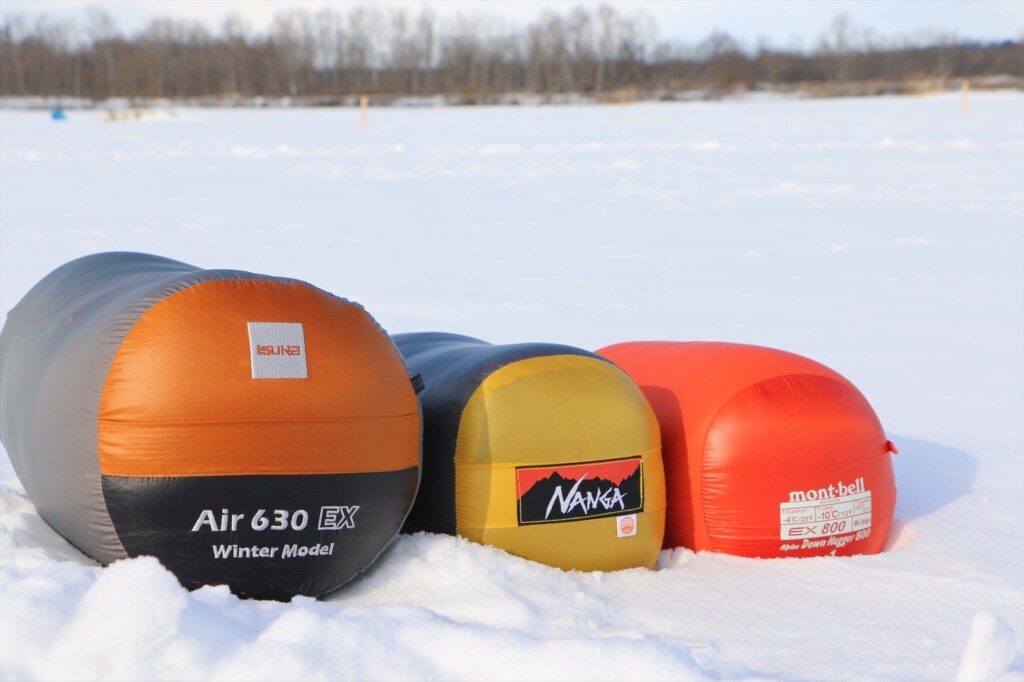
table of contents
table of contents
- About the items tested this time
- Test Results & Spec Comparison Table
- Impressions of each model
- Detailed review of each item
- summary
About the sleeping bags we compared this time
The three models we compared this time are the three most well-known brands of sleeping bags for serious outdoor and mountain climbing. There are many excellent models overseas, but in Japan, these three companies are so dominant that they are unable to penetrate the market. This is because these brands have such high reliability in terms of basic performance
So, wouldn't you like to compare these three and see which one is better (or worse)? That's the theme of this comparison test!
There are many different models of winter sleeping bags depending on the quality and amount of down, but for this particular environment, we chose a lightweight model suitable for mountain climbing, with a maximum operating temperature of around -10°C, to ensure it would be suitable for mid-level mountains (2,000m above sea level south of Tohoku) in the harsh winter
- ISUKA AIR 630EX
- Mont-Bell Alpine Down Hugger 800 #1
- NANGA UDD BAG 630DX
Test environment
The test period spanned two seasons, from 2018 to 2019, during Hokkaido's harsh winter. The test was conducted while camping in a tent, in a car, and outdoors in strong winds. The sleeping arrangement consisted of a base layer, fleece, and down jacket for the upper body, and a base layer and trekking pants for the lower body
I also tried to sleep in a sleeping bag at home to test its comfort. In total, I ended up sleeping in a sleeping bag for about two months!
The following five points were set as indicators for the evaluation items and the review was conducted
- Heat retention...Needless to say, the most important factor in a winter sleeping bag. Of course, just because it's warm doesn't mean it doesn't matter how heavy it is. Also, this is only a comparison between the models we've looked at here, so it doesn't apply to all models from the same brand
- Weight: Winter mountain gear is bulky, so you want to keep the weight as low as possible. However, the balance with heat retention is also important, so simply being light is not enough
- Comfort: Check how comfortable it is to sleep on. It can be frustrating if the mattress is too cramped in an effort to balance weight and warmth
- Portability (storage capacity): As with the weight mentioned above, this is an important point to consider when carrying the device
- Functionality and water repellency: We check how well the product meets the actual usage scenarios of users, including ease of use and ability to withstand adverse conditions
Test Results & Spec Comparison Table
If you find it difficult to see the table on the lightweight display for smartphones, click here.
| comprehensive evaluation | AAA | AAA | AA |
|---|---|---|---|
| item |  |
 |
 |
| Reference price | 51,840 yen | 37,800 yen | 51,840 yen |
| Here is ◎ |
|
|
|
| Here is △ |
|
|
|
| Heat retention | ★★★★★ | ★★★★☆ | ★★★☆☆ |
| weight | ★★★☆☆ | ★★★★★ | ★★★★☆ |
| Comfort | ★★★★★ | ★★★★☆ | ★★★★☆ |
| Portability | ★★★☆☆ | ★★★★☆ | ★★★★☆ |
| Functionality | ★★★★☆ | ★★★☆☆ | ★★★★★ |
| Specifications | |||
| item | ISUKA AIR 630EX | Mont-Bell Alpine Down Hugger 800 #1 | NANGA UDD BAG 630DX |
| Manufacturer's specified temperature range (℃) |
*ISUKA's own standards |
*EN13537 |
*EN13537 |
| Size (cm) | 80 (shoulder width) x 213 (total length) cm | Up to 183cm | Maximum length: 210 x maximum shoulder width 80/cm (up to 178cm tall) |
| Actual weight (including storage bag) | 1150g | 924g | Approximately 1,080g |
| Storage size (cm) | φ20×34cm | φ17×34cm(6.2L) | φ17 × 31cm Accessories: Shoulder warmer included |
| material | 100% nylon (nylon 66) | Outer: 10-denier Ballistic® Airlite [Polkatex® processing] | 15dn nylon sheer water repellent finish |
| Down quality | 800 fill power white goose down (90/10) | 800 fill power EX down | 770 fill power European duck down (90/10) with ultra-water-repellent finish |
| Down amount | 630g | not clear | 630g |
| Zipper specifications | YKK anti-snap zipper | R (right) zipper | YKK anti-snag zipper |


Impressions of each model
ISUKA AIR 630EX
Here is ◎
- Excellent heat retention
- touch
- Fit
- The zipper is very smooth
Here is △
- Shallow hood
- Storage size and weight
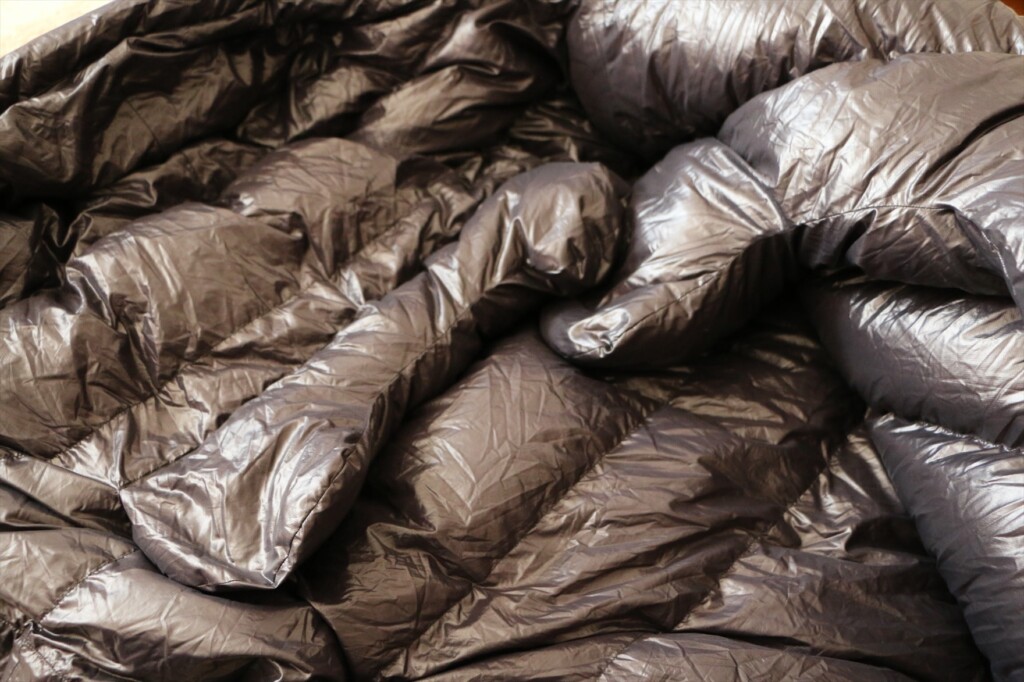
The shoulder warmers wrap around the front and back of the neck and fit naturally without the need for adjustment
In one word, it can be described as "simple and sturdy." It is a model that focuses on one thing: a comfortable sleep, and is packed with high heat retention and simple functions, making it safe to use even in the harshest winters
The soft inner fabric and the highly resilient 800FP white goose down filling not only allowed me to sleep soundly until morning even during field tests at -15°C, but also provided an exceptional sleeping comfort that rivals that of a luxury down comforter
In my opinion, this model has the best heat retention of the three. In particular, the extra down in the foot area kept my feet warm until the morning. This made me think that the manufacturer's specification of "minimum operating temperature -15°C" is probably close to the "limit temperature" defined by the EN standard
Unlike the other two models, the U-shaped shoulder warmer that wraps around the neck is not tightened with a drawstring, but the soft fabric fits well, so it doesn't bother me. In fact, I personally prefer it without a drawstring, as it's simpler and doesn't get in the way
In addition, the draft tubes located in the zipper area effectively prevent cold air from getting in. The zipper, which is designed to reduce snagging, generally works well, but it did sometimes snag, so I feel there is still room for improvement
In the waterproof test, the outer fabric was water-repellent, and even after showering for about three minutes, the water did not penetrate the down. However, once the down got wet, it became soggy, making it difficult to use in the field
The hood is the shallowest of the three models and does not completely cover the entire head, so when used outdoors in strong winds, it was inevitable that my head and face would get cold
Although it is the most expensive sleeping bag on this list, I think that the warmth, comfort, and functionality it offers are well worth the price. It's a product of ISUKA, a brand Japan is proud of. This is a model that I can confidently recommend
Mont-Bell Alpine Down Hugger 800 #1

Here is ◎
- Stretchability
- Storage capacity
- light
- Water-repellent outer surface
Here is △
- Neck fit
- Zipper jamming
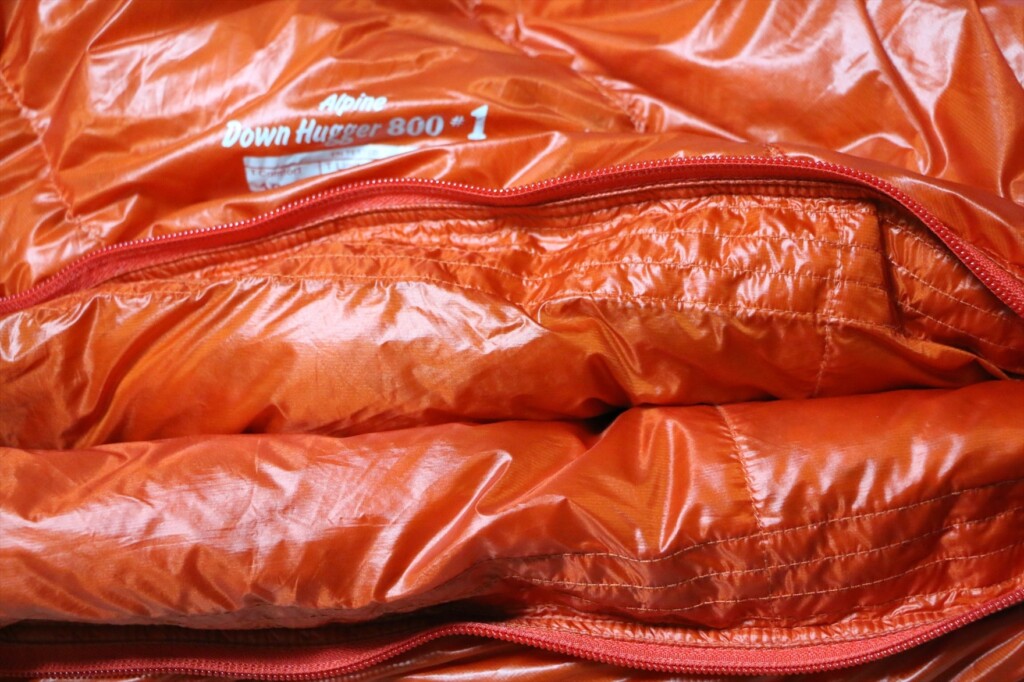
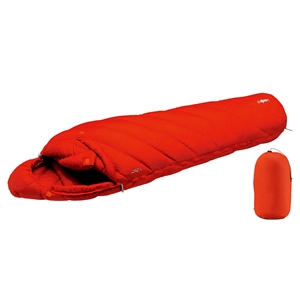
Montbell is the only brand that has double draft tubes to prevent cold air from coming through the zipper
As it is the cheapest of the three models, I honestly underestimated it at first, but in conclusion, my expectations were exceeded in a good way. It is truly a high-cost performance product
The first thing that surprised me was the high level of insulation. Filled with 800FP EX down, which boasts high resilience, the sleeping bag felt a little warmer than the NANGA, which has the same temperature rating, although it wasn't as warm as the ISUKA. This subtle difference doesn't seem to be due to the quality of the down, but rather to the various mechanisms that prevent cold air from entering, such as the densely woven outer fabric "Ballistic Airlite," the neck baffle around the neck, and the "Double Draft Tube" attached to both sides of the zipper
And best of all, Montbell's unique "Spiral Stretch System" allows even me, a quirky sleeper, to move around comfortably inside the sleeping bag, providing unparalleled comfort. I was able to easily change clothes inside the sleeping bag, and since it allows me to sit cross-legged, I can wear it even when I'm not sleeping during the coldest of months. It's also warm and extremely convenient
The included stuff sack also uses the same spiral stretch system as the sleeping bag, which not only reduces stress when storing it, but also allows it to change shape to fit into dead space inside the backpack, making packing much easier
Unfortunately, the zipper got stuck quite often. It happened about once in three tries, especially when closing the zipper from the inside while inside the sleeping bag. Even then, forcing it closed could damage the fabric, so the more careful I was, the longer it took, which was very stressful
Overall, it is lightweight, has excellent cost performance, and offers unparalleled comfort with features such as stretchability, but I feel that it falls short of the other two in terms of comfort and the craftsmanship of the small parts
NANGA UDD BAG 630DX
Here is ◎
- touch
- Large hood
- Water-repellent down
- Smooth zipper that is hard to pinch
- Storage size
Here is △
- Heat retention
- Cold air from the zipper
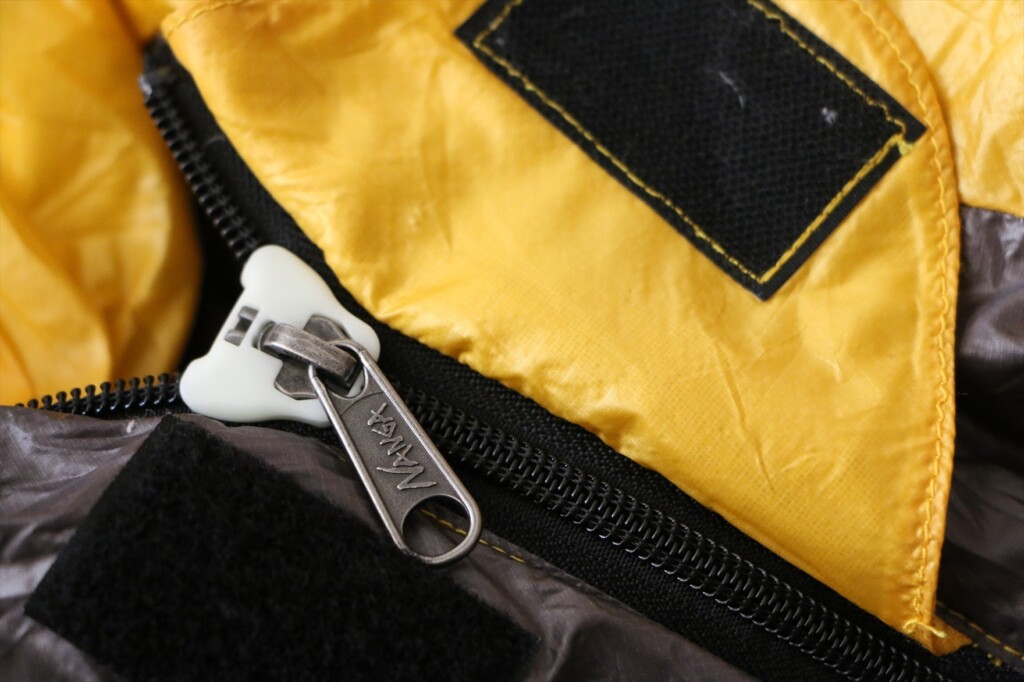
The most comfortable zipper I found this time was NANGA's anti-snag zipper
Speaking of NANGA, they offer a very welcome "lifetime warranty." This system makes users want to treasure their products for the rest of their lives. NANGA has released the UDD BAG 630DX, which is made from DX down, made from European white duck down washed domestically. This DX down has been given an ultra-water-repellent finish, resulting in a water-resistant down that "allows moisture to pass through but does not absorb water," making it the UDD
While water resistance is a concern, let's start with the warmth. The insulation was more than satisfactory within the specified temperature range (up to -10°C). The neck and draft tubes are well-designed to prevent cold air from entering, and the large hood keeps the head warm, making it an excellent design. However, when compared in more severe environments, such as temperatures exceeding the limit, around -15°C, or in strong winds, this jacket was the most susceptible to cold. I felt the cold particularly strongly through the zipper and my feet. While this may be due to differences in down quality, I was surprised that it felt colder than the Montbell jacket, which meets the same EN standards
Now, as for its water resistance, when we submerged the down in water, it immediately floated up. Even after repeated submersion, the result was the same: the down got a little wet, but it didn't become soggy. This result was surprising, as the other two models not only didn't float up after repeated submersion, but they also became soggy. Of course, down that gets wet loses its heat-retaining properties, but UDD, which repels some moisture and water, is less likely to lose its heat-retaining properties even when used for long periods in harsh environments
The zipper is luminous and designed to reduce snagging. It's very easy to see even in the dark, which is very helpful. The snagging reduction feature also works well. In reality, if you close the zipper too quickly without stretching the fabric, it will still get caught to a certain extent
Although it is slightly less warm than the other three models, it has unique appeal, such as the ease of use and security of the water-repellent down, the fine details including the luminous zipper, and the reliability of the lifetime warranty system
Next page: Detailed review of each item
On the previous page, we introduced the rankings of the compared models, a list of their ratings and specifications, and our recommendations based on that. From here, we will provide additional information about the ratings, the criteria used, and why we came to those ratings
Detailed review of each item
Heat retention
Heat generated inside a sleeping bag has the tendency to move and rise from warm areas to cold areas. The key to a warm down jacket is how effectively it can retain heat by preventing this warm air from escaping and by using the sleeping bag, which also acts as an insulating layer between the warm air and the outside air. For this reason, the quality of the down, FP, and the structure of the sleeping bag are all important factors. For more detailed information on this topic, please see this article .
Of the three models, ISUKA and Montbell 800FP goose down, NANGA uses 770FP duck down. What we learned from this comparison is that ISUKA and Montbell leads to a difference in heat retention, while Montbell and NANGA appears to lead to a difference in heat retention.
We also tested the windproof and heat-retaining properties of the sleeping bag by sleeping inside it for about an hour outdoors in strong winds (maximum instantaneous wind speed of 13.0 m/s). Normally, you would be inside a tent and not be directly exposed to the wind, but we conducted this test as a field test
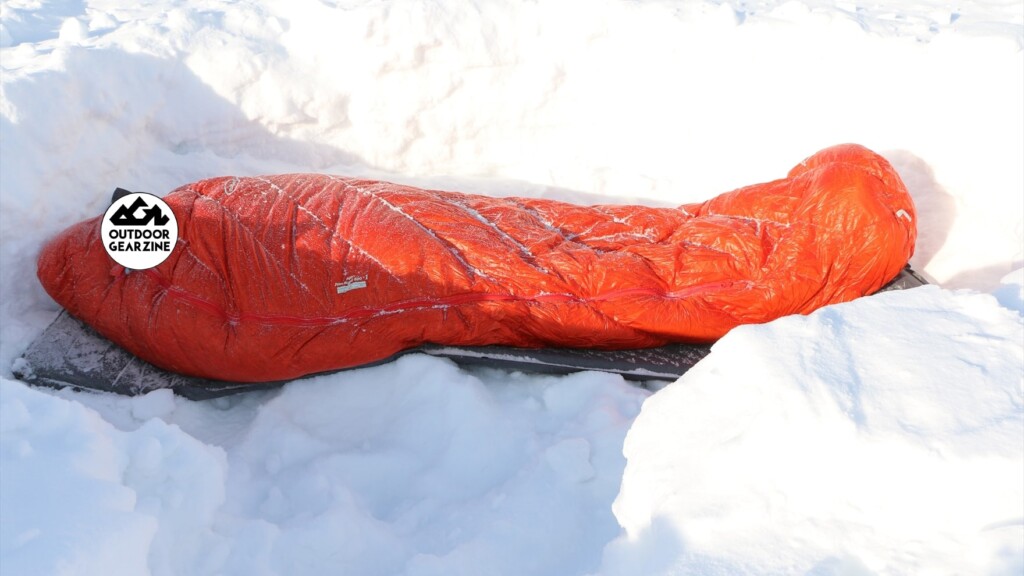
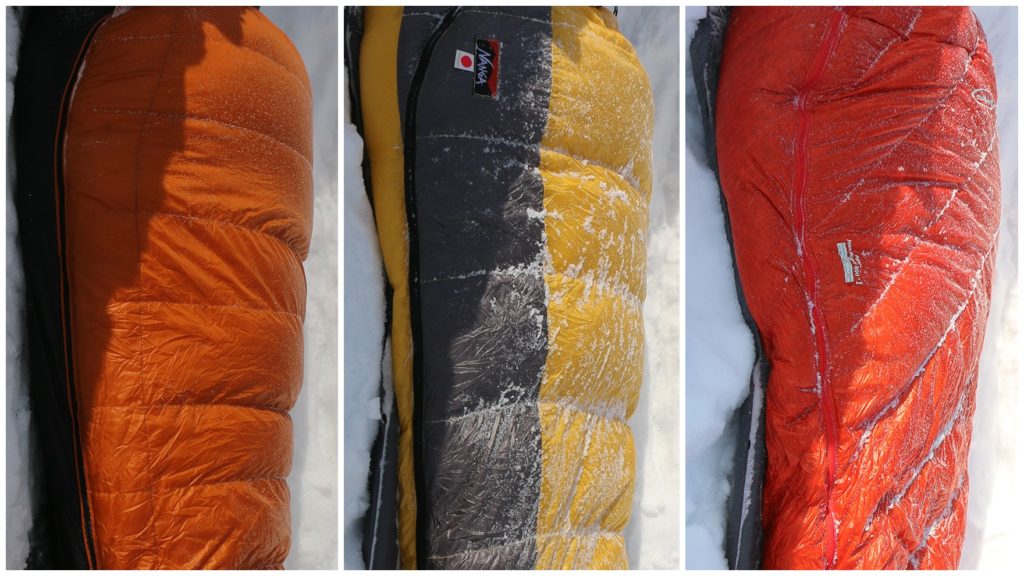
When you sleep on exposed snow, you can clearly see how easily the cold air passes through
As a result, the ISUKA offered excellent wind protection and warmth for the body, but the shallow hood meant that the head was exposed to a lot of cold air. In comparison, the Montbell had a deep hood that protected the head, kept the body warm, and was windproof, so I was able to withstand it for an hour without any problems. On the other hand, the NANGA allowed me to feel the cold all over my body, and after an hour my body became cold, making it far from comfortable.
weight
To ensure warmth, it is necessary to increase the amount of padding, and heat retention and weight are proportional. While it is best for mountaineering equipment to be compact and lightweight, achieving this balance is difficult for winter sleeping bags, which must maintain warmth. In terms of the three models reviewed here, I think all of them are quite lightweight considering their heat retention. Of these, the Montbell Alpine Down Hugger 800 #1 is noteworthy, weighing in at just 924g, which is below 1000g for its class.
Comfort
Of course, it's important to be warm inside your sleeping bag, but you also want to sleep comfortably. Looking at the materials used for the interior walls of the sleeping bags, the fabrics of ISUKA and NANGA were very soft and comfortable against the skin. Montbell felt a bit crisp and hard, and it also made the loudest noise when turning over. It wasn't to the point where it was difficult to sleep, but it bothered me. However, the stretchability was excellent, and even I, who sleeps in an awkward position, was able to sleep soundly.
The fit the ISUKA was excellent. While the other two models tighten around the neck with a drawcord, the ISUKA 's U-shaped shoulder warmers fit snugly, keeping the neck warm. Its unique 3D structure also conforms to the body, ensuring the entire body fits snugly into the sleeping bag, minimizing wasted space that can reduce warmth. Meanwhile the Montbell 's neck area feels slightly less comfortable than the other two.
Portability (storage)
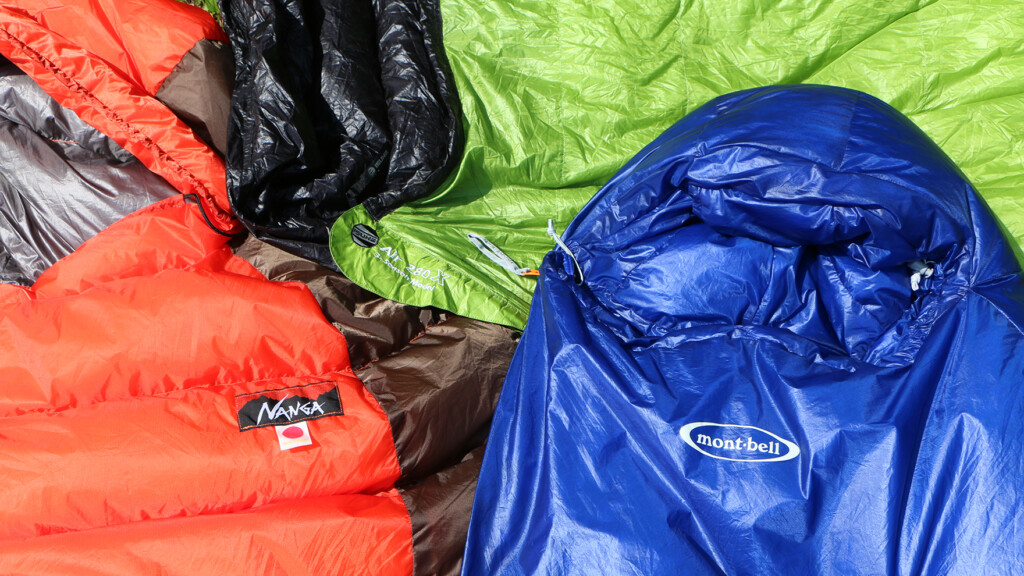
NANGA is the most compact, Montbell . ISUKA is the largest While it has excellent heat retention, it does have to compromise on weight and size.
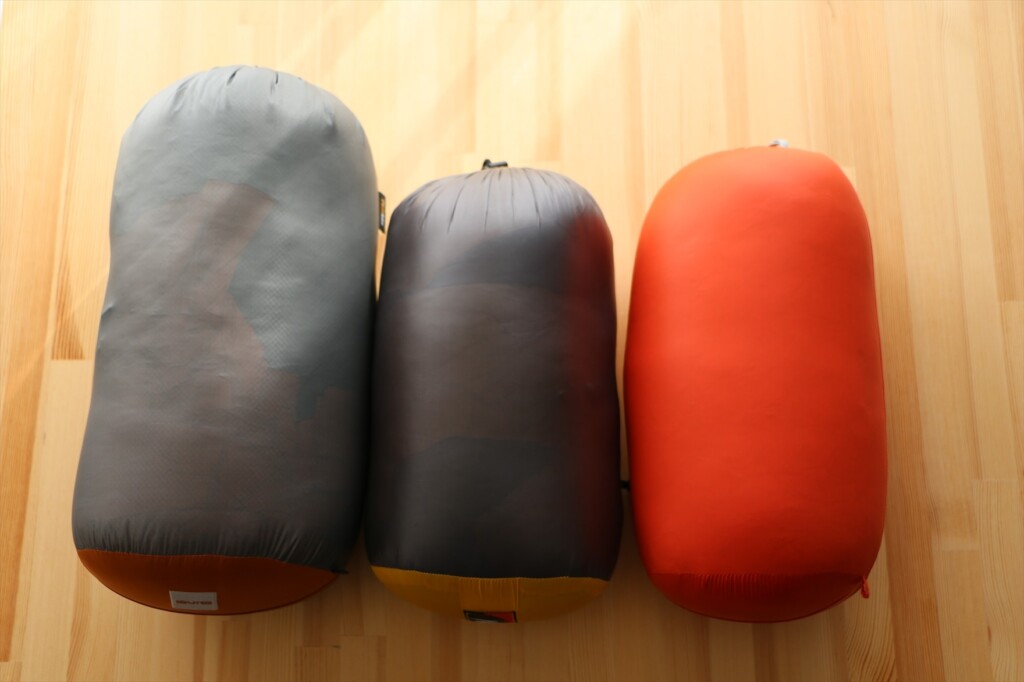
From left: ISUKA AIR 630EX, NANGA UDD BAG 630DX, mont-bell Alpine Down Hugger 800#1
On the other hand, packing a down sleeping bag can be surprisingly difficult, and depending on the item, it can require a great deal of effort. To reduce this burden, manufacturers have devised ingenious stuff sacks to accompany it. In this regard, Montbell 's stuff sack was exceptional. It uses the same spiral stretch system as sleeping bags, so the fabric stretches as you compress the sleeping bag, reducing the burden during storage. Another plus point is the wide opening. It also changes shape when packing; rolling it around stretches it out, elongates, and becomes slim. This is incredibly convenient, allowing it to fit perfectly into the dead space inside the backpack. The stuff sack also has two drawcords, making it extremely easy to compress. Models with two drawcords are indeed extremely convenient.
Functionality
First, let's talk about zippers. Honestly, each manufacturer has devised ways to prevent jamming, but there is no zipper that is completely jam-proof. The probability of jamming increases when closing the zipper from the inside with any model. Of the zippers, ISUKA had the least jamming frequency and was extremely smooth when opening and closing. Furthermore, NANGA zippers use phosphorescent resin, making them highly visible in the dark. This was a very useful feature.
Next, we looked at the water repellency of the surface. We conducted two tests to verify this
In one test, we continuously exposed the sleeping bag to shower water for 3, 5, and 10 minutes before evaluating the water repellency of the outer material and the penetration of water through the zipper. In the other test, we submerged the sleeping bag completely in a bathtub, soaking the down in water to see if it was still usable

We tested the product by showering it for a certain period of time to check whether it was watertight
The results showed that after three minutes of continuous showering, the NANGA jacket was damp overall, while the other two models did not allow water to penetrate the down until five minutes later. This water-repellent performance is truly impressive. In particular, the Montbell jacket showed some water penetration into the down after 10 minutes, but most of it was through the zipper, and the water-repellent properties of the outer fabric remained intact. You can have great confidence in the water-repellent properties of Polkatex, which boasts "the world's highest level of water repellency." None of the three models were able to prevent water from penetrating through the zipper. This may be an issue for the future.
Next, we submerged the sleeping bags in water stored in a bathtub. NANGA 's ultra-water-repellent down performance was outstanding. Even when submerged, the sleeping bag immediately floated up, making it difficult to submerge the entire bag. We repeated this several times, but the result was the same: the down never got soaked. The other two models sank completely into the water after about three minutes, becoming completely soaked.
If you just want to repel a little bit of water, the water-repellent fabrics from Montbell or ISUKA will likely work well enough, but if you're in a situation where humidity or moisture is chronic, then the UDD BAG 630DX seems like a safe bet.
summary
There were various evaluation criteria, but I think the main things people look for in a winter sleeping bag are heat retention and light weight. Through this test, I decided that if I were to use it on a 2000m-class winter mountain, I would go for the ISUKA AIR 630EX the Montbell Alpine Down Hugger 800#1 if I wanted something that would be able to withstand the cold but was also lightweight and portable . It would also be a good choice for people who prioritize cost performance.
On the other hand the NANGA UDD BAG 630DX showed that in terms of heat retention, the UDD BAG 810DX, which is one class higher, may be the equivalent of the two models compared here (or the AURORA light 600). While it depends on personal preference, we recommend this model for long mountain trips spanning several nights, with the temperature range mentioned above being a little stricter.
Finally, through this test, I was reminded that, although it goes without saying, when choosing a sleeping bag, heat retention performance is the most important thing. If a sleeping bag doesn't keep you warm, all other features are useless. After determining the temperature range that suits your needs, it's best to choose a bag while being mindful of the compromises and priorities you're willing to make, such as lightness, compactness, comfort, and other small features and parts. It's not a cheap purchase, so you want to choose carefully. I hope this test will be helpful when choosing your sleeping bag
We also recommend this article about sleeping bags
- Stay warm from the inside out with the perfect sleeping bag – How to choose and 8 recommendations
- How to choose a winter sleeping bag for a comfortable winter tent stay in the mountains and our top 8 recommendations
- Comparison Review: Ultralight 3-Season Sleeping Bags - A showdown of the best products for ultimate lightness and warmth
- What to throw away and what to keep? How to choose the best sleeping pad (mat) and our three recommendations
TAC
We are looking for reviewers
Outdoor Gearzine is always looking for members who love the outdoors and want to write reviews about outdoor gear. For more information, please visit the REVIEWERS page here !
Related reading