table of contents
Is this really 40L? Overwhelming storage capacity, even suitable for camping in a tent in the Yatsugatake Mountains
Karrimor enjoys a large following in Japan thanks to its stable usability and sophisticated design and coloring. Until this year, the Ridge series was the most popular backpack for general mountain hiking, measuring around 40L. However, in 2015, the Intrepid was released with various improvements, including improved usability. I got it soon after its release and used it for everything from snowpack to camping in summer mountains. It's so easy to use that it threatens to challenge the Ridge's status as a staple. Let's get started with the review
, please see this page.
Detailed Review
Item name (price)
Karrimor Intrepid 40 (Reference price: 24,840 yen)
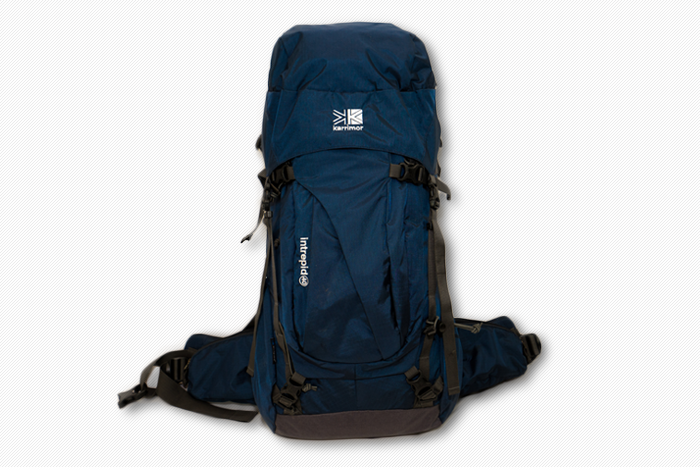
front

Back
Main specifications and evaluation
Click here for a side-by-side comparison of 30L medium-sized backpacks
| item | Specifications and reviews |
|---|---|
| Fabric | KS-N210RS Silvergaurd /KS-N420 |
| Color | ice D.Airforce Terra |
| size/back length | Type1=42cm, Type2=47cm, Type3=50cm |
| capacity | 40L |
| weight | Type1=1.43kg, Type2=1.6kg, Type3=1.7kg |
| Variations | 40L only |
| access | Top/front access |
| Hydration | ◯ |
| Rain cover | × |
| Front slash zip pocket, side pockets, canopy back pocket, hip belt pocket |
|
| Comfort | ★★★★ |
| stability | ★★★★★ |
| Storage capacity | ★★★★ |
| Ease of use | ★★★★ |
| Versatility | ★★★★ |
| design | ★★★★★ |
| price | ★★ |
| Overall score | ★★★★★ |
This is amazing!
Its overwhelming storage capacity makes you wonder if it's really 40L
Generally, the capacity indications for backpacks are measured by each manufacturer, so while they're not necessarily wrong, they can't be trusted too closely. This one, however, completely surprised me, in a good way. The main compartment (single compartment) alone easily holds 40L, but what's surprising is that the other components (canopy, attached front pocket, and side pockets) are also large and generously sized, so you'll probably find the capacity is much more generous than you'd expect (see photo below). However, on the other hand, it might be a little too much for a day trip...
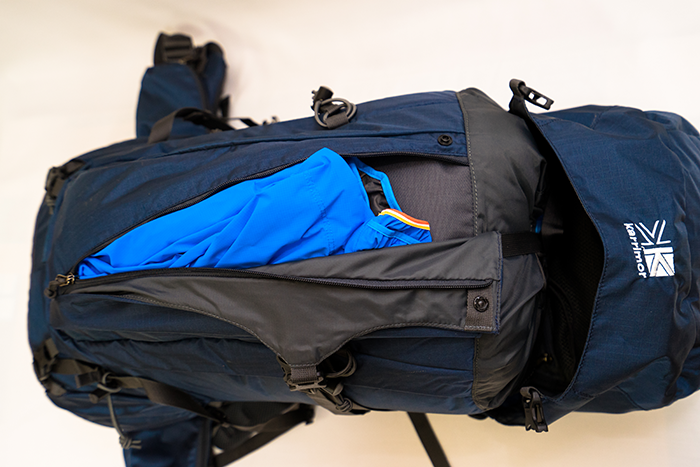
The "slash zip pocket" has a large diagonal zipper that opens and closes, making it extremely convenient for storing gear and jackets
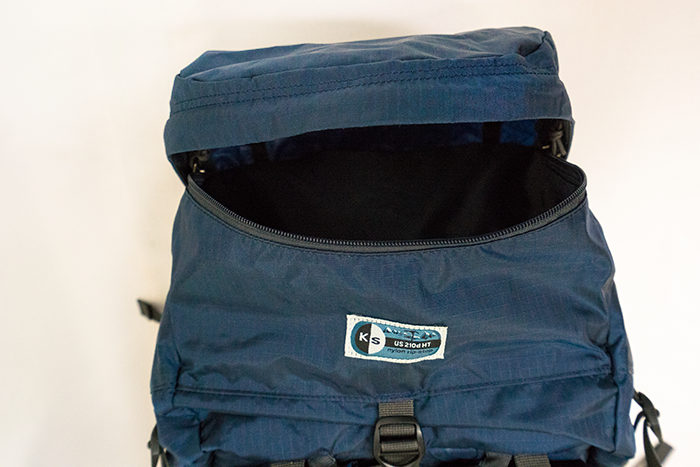
It may be hard to tell from the photo, but the pockets in the canopy are laughably large
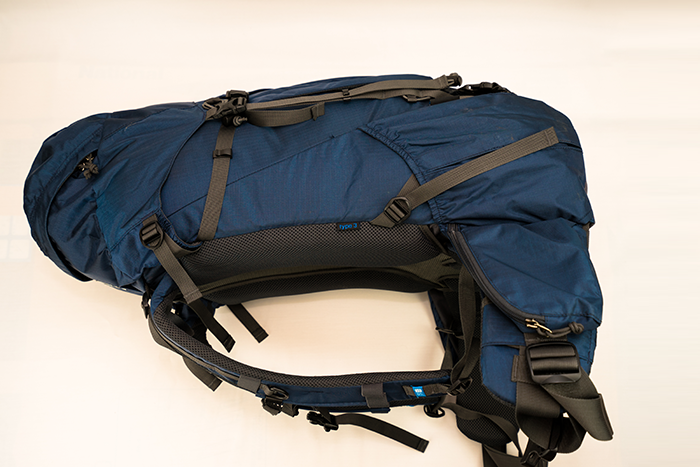
Side pockets and hip belt pockets are also standard equipment on both sides. They are generally usable without any problems, but the hip belt pockets could have been a little larger
Another great feature that lets you use all that storage without stress is the U-shaped opening front access (see photo below). This is something you'll see in many large packs over 50L, but it's great that they've gone to such lengths on a pack this size . Even those who like two-compartment models with separate top and bottom compartments will probably be satisfied with a single compartment if they have a front access that opens up from the bottom like this.
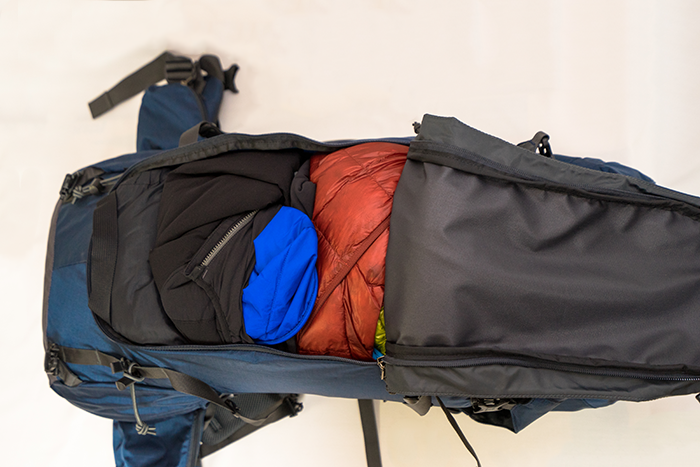
All things considered, there aren't many 40L backpacks that offer such bold front access
Sturdy construction for a stable carrying experience
A common problem with backpacks in this class (up to 40L) is the wide variation in weight between models: whether to prioritize lightness with a simple belt or comfort with a sturdy belt. While I appreciate the concepts of each, I'm unwilling to compromise on comfort, and I'd like to say that the solid construction of this model's back panel, shoulder harness, and hip belt is excellent. It's obvious when you compare it with other models, but the thickness of the cushioning in the areas that come into contact with the body, the wide contact area, and the plate (PE plate) structure that firmly transfers weight to the hips all feel like the same attention to detail you'd expect when carrying a large pack. I'm sure this is related to the high storage capacity mentioned above, but taking all these points into consideration, this pack is clearly designed more for hut and compact tent-based trekking than for day hikes .
Surprisingly, it's also great for climbing? Various functions
When you list the features as shown below, it seems that the camera actually has a range of functions that could be used for variation routes and stream climbing
- A large front pocket (as mentioned above) keeps your gear within easy reach
- There is also an attachment between the top and the canopy for attaching a rope
- Two securely fitting pole carriers
- The canopy position can be adjusted backwards so that it does not get in the way of your head when wearing a helmet
- Uses a fabric that is even more abrasion-resistant and durable than regular ripstop nylon
This is not so good
The harness is a little stiff
It might not be a problem if the load isn't too heavy, but the other day, when I was hiking overnight in a tent in the Yatsugatake Mountains (which was a pretty heavy load), I felt some chafing on the shoulders and hips where they were constantly touching my body, so in that sense, the shoulder and hip straps felt a little stiff to me. Since it didn't cause any fatigue in unnecessary parts of my body when I actually carried it, I don't think there's an issue with the stability of the load, but I think it's mainly a problem with the material of the parts that come into contact with my body (although this could be addressed with a soft pad or something)
weight
It seems inevitable that a backpack that is so well made will end up being heavy
Summary: What activities is it recommended for?
This model delivers excellent performance in the two basic areas required of a backpack: a stable and comfortable fit and ample storage capacity (with plenty of easy-to-use pockets), and is undoubtedly recommended for users just starting out in mountain climbing. This test clearly demonstrated that this is an excellent pack that stretches the best of Karrimor, not too simple and yet easy to use without any strange quirks. It can be used for everything from regular trails to staying in mountain huts and even camping in tents. In my case, I went to the Yatsugatake Mountains in June, and in addition to my usual gear, I was able to pack (just barely) a full set of camping gear: tent, sleeping bag, mat, pot, gas, water, and alcohol (the only thing I left completely up to the other campers was the food)
As I mentioned in the review, I think it has the potential to be used for more or less technical activities. I haven't heard much about the ability to slide the canopy back, so I think it would be great for mountain climbing (although I haven't tried it). (It's pretty hellish to have a pack that gets stuck on your head when swimming in a mountain stream, lol.)





Check out this article about backpacks
- How to Choose the Right Mountaineering Backpack and 10 Recommended Backpacks for Beginners
- 10 Lightweight Backpacks for Beginners in Fastpacking
- 10 New and Recommended Daypacks for Day Hiking and Everyday Use [Classic & Unique]
- Comparison Review: Comparing the best beginner backpacks for those just starting out in mountaineering
- Comparison Review: Comparing lightweight backpacks perfect for light hiking and fastpacking
Related reading