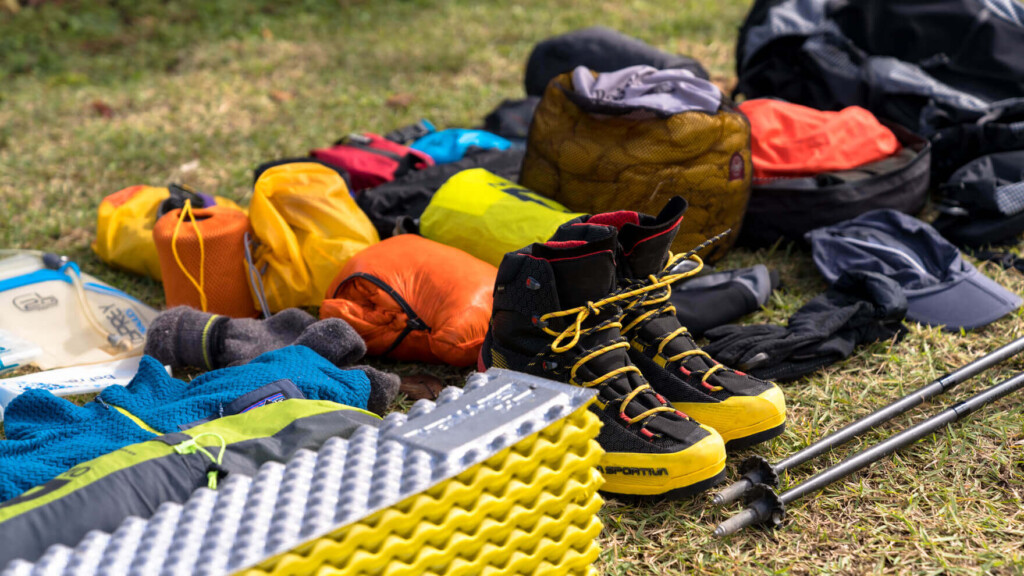
In the mountains near the Kanto region, where I work, the best time for hiking and trekking is from late September to around November
The temperature isn't too high, the wind is cool and refreshing, it's not humid, and there are few insects. Best of all, the leaves start to change color gradually from the higher elevations, reaching their peak at the foot of the mountain around late October. There's a slight risk of snow from November onwards, but if you're on a low mountain you can enjoy a quiet and atmospheric winter hike
So, I've come up with a list of my personal recommendations for the best equipment, "First Choice" (hereinafter referred to as "FC"), perfect for camping hikes during this season
While running this website, I've tried out various different types of gear on a daily basis, and here I've compiled a list of my "currently recommended" mountain gear, which I've settled on as my starting lineup after considering the overall situation. The intended season is from late September through autumn, winter, and early spring, and it's a tent trek up to an altitude of about 2,000m in the Okuchichibu-Okutama area, which I recently hiked overnight. While I'm primarily targeting temperatures just above freezing at night, the temperature naturally varies significantly between early autumn and midwinter, so I've included several options. Of course, you can still enjoy hiking along the proposed route without all of this high-spec gear. However, this list is a culmination of years of searching for the ideal mountain gear, as every hiker probably thinks at least a little: "I want to hike with better gear."
I hope this gear list will serve as a packing checklist for those new to mountaineering, and as fuel for seasoned travelers to fantasize about creating their own dream equipment list
A list of other options for autumn/winter hiking gear is available at this link
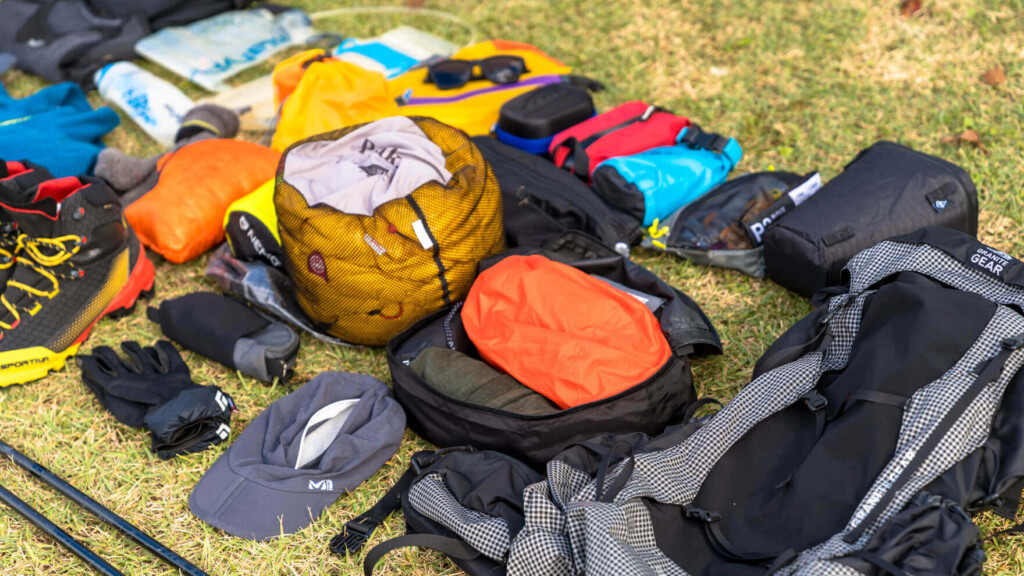

table of contents
Recommended Gear List Details
There are many different ways of thinking about this, but the basics of choice are "lightweight," "durable," "easy to use," and "versatile." The tools we've picked out here all have some of these advantages in many ways, although they may differ in their respective categories
What to wear
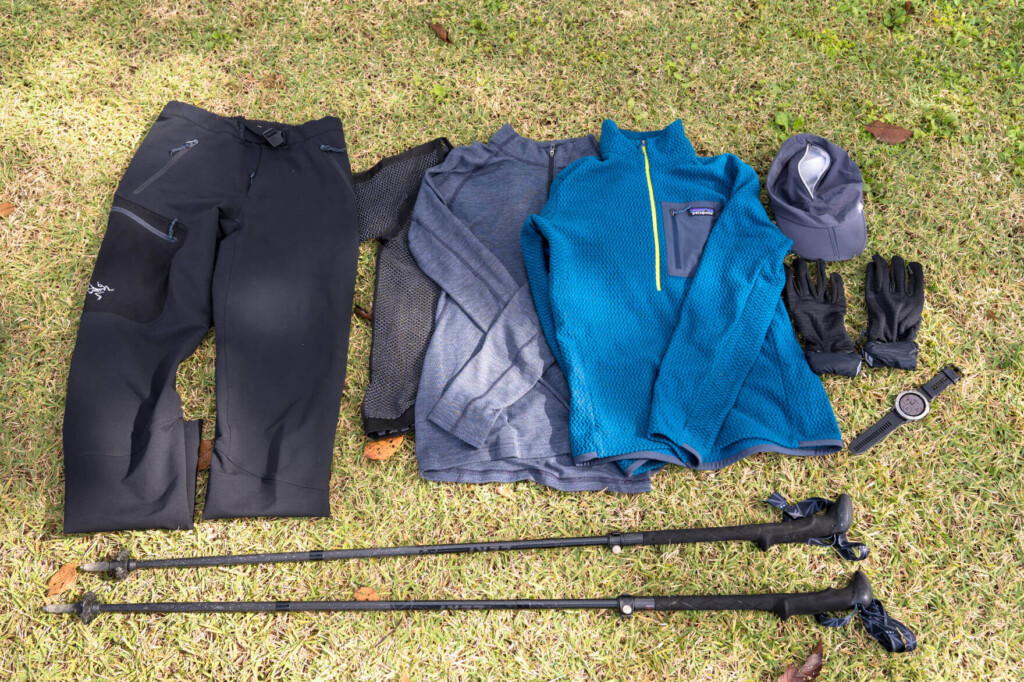

| type | Item Name | remarks | Weight (g) |
|---|---|---|---|
| Underwear | MILLET Drynamic Mesh Short Sleeve | This is especially essential in autumn and winter when sweat can easily cause chills | 110 |
| Base layer | MONTANE Primino 220 Zip Neck | It contains merino wool and has a zip neck for easy ventilation | 276 |
| Mid-layers & outerwear | Patagonia R1 Air Zip Neck | Wear it when it's chilly in the mornings and evenings. If it looks like it's going to be windy, wear a windproof jacket | 262 |
| trekking pants | Arc'teryx Gamma AR Pants | Based on a double-woven medium-weight soft shell, it focuses on ease of movement and silhouette | 474 |
| Hats and Caps | MILLET bench cap | This cap is sweat-absorbent, quick-drying, and easy to fold, making it versatile | 53 |
| Trekking gloves | Black Diamond Wind Hood Grid Tech | It's good to have some degree of heat retention and windproofness to prevent your fingertips from getting cold. This model is convenient because you can switch between windproof and non-windproof | 55 |
| trekking poles | LEKI Black Series Micro Vario Carbon | Overall, it is recommended for its lightness, durability, and ease of grip | 408 |
| Clock (GPS) | GARMIN Fenix 6X Pro Dual Power | For offline maps and tracking. Excels in two areas: GPS accuracy and battery life | 82 |
First, let's talk about the items worn or equipped while moving
In autumn and winter, the wind blowing through is cold, but once you start walking you often end up sweating, so you will need some experience with layering, especially for the upper body
In my case, it may be because I sweat a lot, but during this season, underwear and a base layer are enough when I'm on the move, and when I stop for more than about five minutes, I often want to put on something else, so if the weather is calm, I may not need a mid-layer while I'm out and about
For me, a base layer that combines warmth and comfort of wool with durable, quick-drying synthetic fibers is still the best choice for now. Primaloft's Primino material is particularly well-made, and the MONTANE Primino 220 Zip Neck, which uses this material, is my favorite. There are several options depending on the season, including thin, thick, and hooded, and they are introduced in detail on the gear list page
Although I don't usually wear mid-layers while out and about until autumn, they are often useful when out at night or early in the morning at campsites in cold seasons (and of course as daytime wear in the middle of winter), so I make sure to bring a fleece jacket that's easy to move in for those occasions, or a mid-layer with a windproof outer layer if I'm worried about the wind
I recommend Patagonia's high-performance fleece, the R1 Air Zip Neck, or the Millet Breather Toy Alpha Direct Hoodie. The Millet in particular uses two materials that are currently top-class in terms of performance and functionality: Polartec Alpha Direct (insulation, breathability, quick-drying) and Breather (windproof, water-repellent). I personally find it to be an extremely reliable piece of clothing (I haven't actually been able to get hold of the latest model, but as a fan of last season's model, I'm sure I'll be wearing it often even before I put it on)
Another thing I pay particular attention to is trekking gloves. Since the winds in autumn and winter are cold, I try to choose a model that at least has good windproof functionality. The Black Diamond Wind Hood Grid Tech can be used as regular thin fleece gloves or as simple windproof gloves (for taking my camera in and out), so they are currently the most convenient item for me.
Foot area
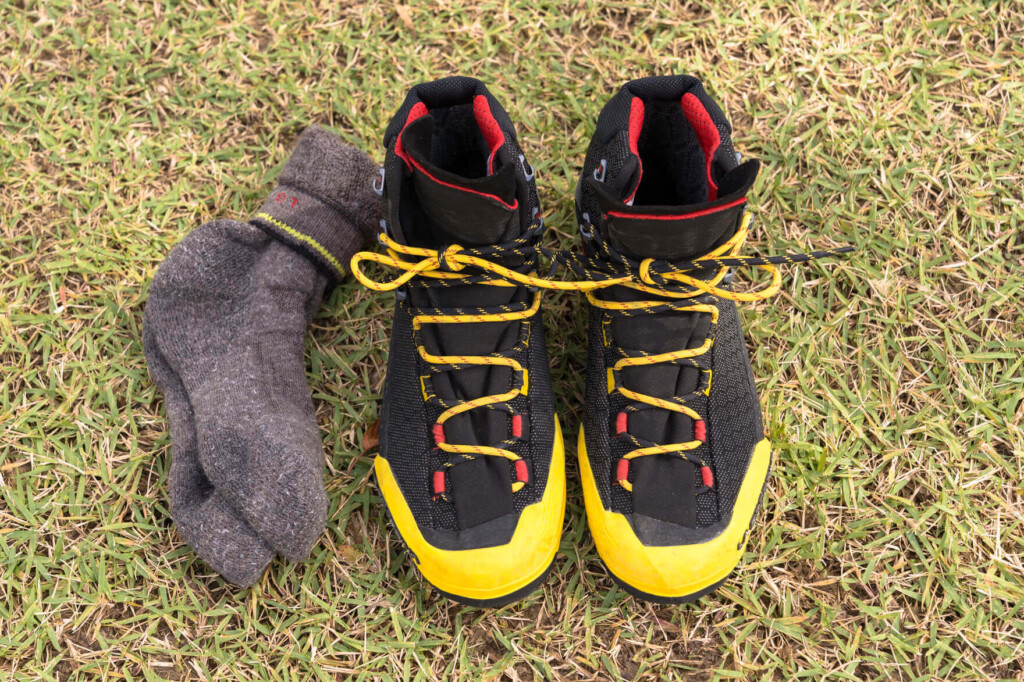
| type | Item Name | remarks | Weight (g) |
|---|---|---|---|
| mountain climbing shoes | LA SPORTIVA AEQUILIBRIUM ST GTX | Mid-cut or larger is the standard. When your luggage isn't light. When there is a lot of technical terrain, such as rocky areas. For low mountains, a more sneaker-like style is fine | 660 |
| trekking socks | Smartwool PhD Outdoor Heavy Crew | It's not too thick, has good heat retention, cushioning, and support | 95 |
| insole | Spring insole Merino Warm (Smart Series) | It is designed for all-around use and also provides a little extra warmth | 48 |
When it comes to hiking boots, the best choice can be tricky as it depends greatly on a variety of factors, such as the distance of the course, the main terrain, the amount of luggage you have, and whether or not you will be running
If I had to choose one boot at this stage that is reliable all-around, rather than being optimal for each specific case, without worrying too much about such subtle differences, it would be the LA SPORTIVA AEQUILIBRIUM ST GTX
With just one pair of these boots, you can carry more than 10kg of luggage, assuming you're camping, comfortably and without fatigue. They also offer a certain level of grip and durability, even when you encounter tough terrain like rocks and mud. They're also lightweight enough for a quick run, and offer ankle flexibility. These are incredibly versatile hiking boots for modern mountaineering. Adding insoles that fit your feet will further enhance your comfort. Of course, you'll want thick socks with plenty of cushioning, warmth, and support
Carrying clothes
| type | Item Name | remarks | Weight (g) |
|---|---|---|---|
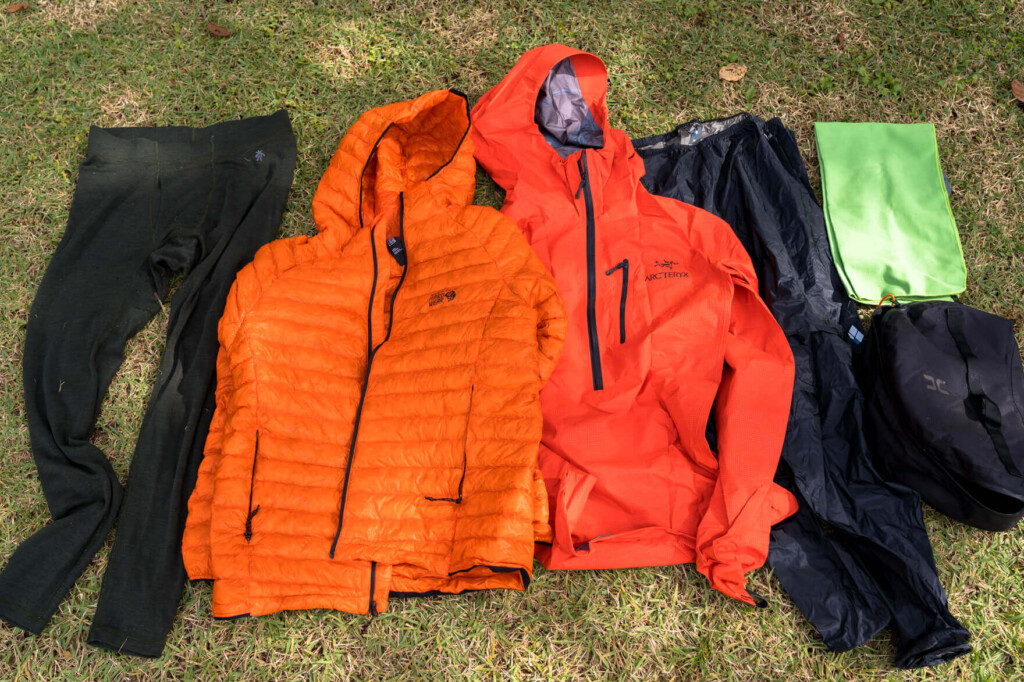
| Rain gear (jacket) | Arc'teryx Alpha SL Anorak | An anorak type that prioritizes mobility. Ideal for mountain climbing where you don't need to take off or put on clothes as often | 198 |
| Rain gear (pants) | Mont-Bell Versalite Pants | Above all, lightweight and compact | 83 |
| Cold weather insulation jacket | Mountain Hardwear Ghost Whisperer UL Jacket | This down jacket is ultra-lightweight yet offers the best possible heat retention | 174 |
| Thermal pants | Smartwool Merino 250 Base Layer Bottoms | This is the basics, but if the temperature drops to around 0°C at night, you'll need another pair of pants | 228 |
| towel | Sea to Summit Dry Light Towel S | 62 |
Next are clothes that you don't normally wear, but that you might need depending on the weather and temperature, such as rainy weather or cold nights
For rain gear this season, you want a certain level of thickness (warmth). But you don't want it to be heavy. That brings us to GORE-TEX, a trusted choice for its waterproof, breathable, windproof, cold-resistant, and durable properties. Lightweight construction is also essential, so an anorak would be fine, as you won't be taking off and putting on that much. And above all, ease of movement and versatility are key. The Arc'teryx Alpha SL Anorak . It's a bit pricey, but its performance is immeasurable. While the focus on the jacket has been on the lightweight pants, the pants have been kept as lightweight as possible.
To be honest, I'm not sure which winter jacket to get, as it depends on how sensitive you are to heat, and how well-insulated you need it to be will depend on how it fits with your sleeping bag
the Mountain Hardwear Ghost Whisperer UL Jacket a simple choice: lightweight, insulated, and comfortable . It's a favorite of mine from the past five years, and it's still evolving.
Thermal pants are worn when your lower body gets cold while you're out and about, or once you've settled down at the tent site, but you basically have two choices: wool inner pants or outer insulation pants such as down pants. Down pants are almost only used at the tent site and are a bit pricey, so we generally recommend wool underwear first. However, if you're heading out in a forecast of extreme cold, it's a good idea to take both wool underwear and down pants with you just in case
packing
| type | Item Name | remarks | Weight (g) |
|---|---|---|---|
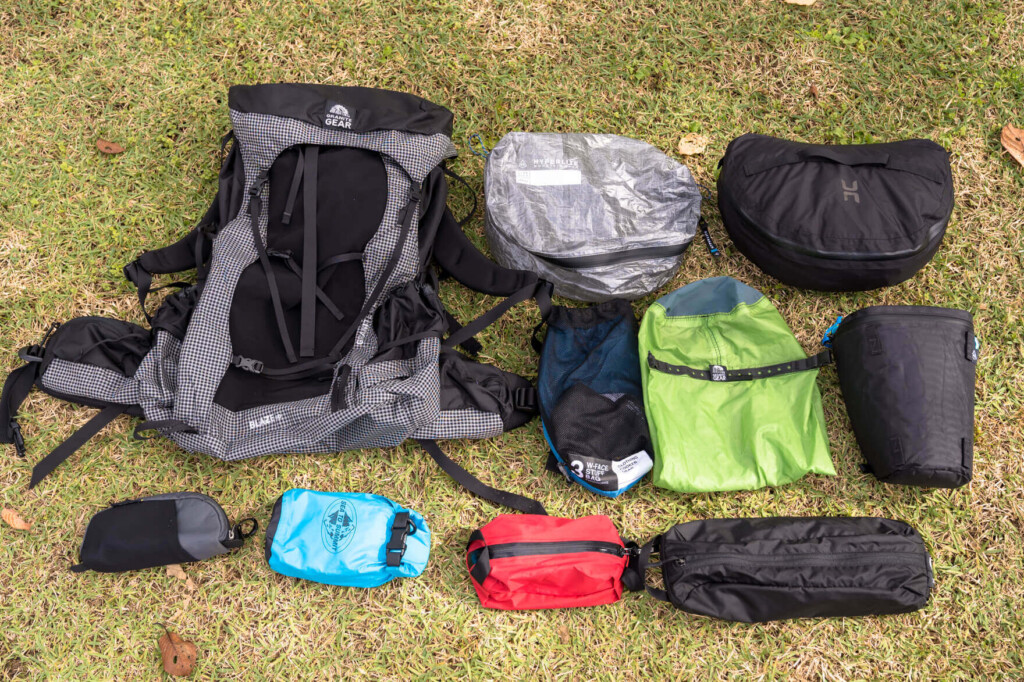
| backpack | GRANITE GEAR BLAZE 60 | For long trips of two nights or more or activities with a lot of luggage. Lightweight design | 1360 |
| stuff sack | HILLSOUND Pack Stack Pro 60L Short | For packing clothes and bedding | 112 |
| stuff sack | HYPERLITE MOUNTAIN GEAR Pods L | For packing clothes and bedding | 37 |
| stuff sack | PaaGoWorks W-FACE POUCH / W-FACE STUFF BAG | For on-the-go snacks. You can separate the wrapping paper before and after eating | 35 |
| stuff sack | GRANITE GEAR Pack Pouch L | Keep small items together. Can also be attached to the outside | 77 |
| stuff sack | ISUKA WeatherTech Pouch | It's waterproof. I put all my toiletries in it. It's not completely waterproof, but it's good for peace of mind | 39 |
| stuff sack | GRANITE GEAR EVENT SIL DRYSACK | Completely waterproof. You definitely don't want it to get wet | 37 |
| stuff sack | Sea to Summit Lightweight 70D Dry Sack | Completely waterproof. Perfect for emergency kits and other small items that you don't want to get wet | 30 |
| camera bag | HYPERLITE MOUNTAIN GEAR Camera Pod | Emphasis on lightweight | 106 |
| Pouch Holder | PaaGoWorks SNAP | A multi-functional pouch that emphasizes convenience | 85 |
After the gear and clothing, it's time for packing items: backpacks, stuff sacks for waterproofing and organization, and pouches and holders for carrying cameras and other small items
Choosing a backpack is one of the pieces of gear that depends most heavily on a person's mountaineering style, so to be honest, there is probably no one best choice. I understand that these are merely examples, and although it's honestly a very difficult decision, if I had to choose, I'd like to introduce the four companions that I feel most comfortable entrusting my luggage to right now
the GREGORY Paragon 48 if you're prioritizing fatigue for hikes up to one night, the GOSSAMER GEAR GORILLA 40 Ultralight if you're looking to reduce your luggage and pursue lightness as much as possible if you're looking for a balance of comfort and lightness for long trails of two nights or more the OSPREY Aether Plus 60 if you're prioritizing fatigue from heavy loads and ease of storage for mountain climbing . It would take too long to go into the merits of each here, but they're all excellent products with their own unique appeal.
When you think about stuff sacks from the perspectives of "easy to pack (organize)," "light and durable," and "waterproof packs for things that need waterproofing," the traditional simple drawstring bag-type ones have become less and less common in recent years. Furthermore, I recently discovered that the HILLSOUND Pack Stack Pro 60L Short , not only makes packing easier, but can also be used as a pillow when sleeping, making it an indispensable item for camping in a tent.
Housing and bedding
| type | Item Name | remarks | Weight (g) |
|---|---|---|---|
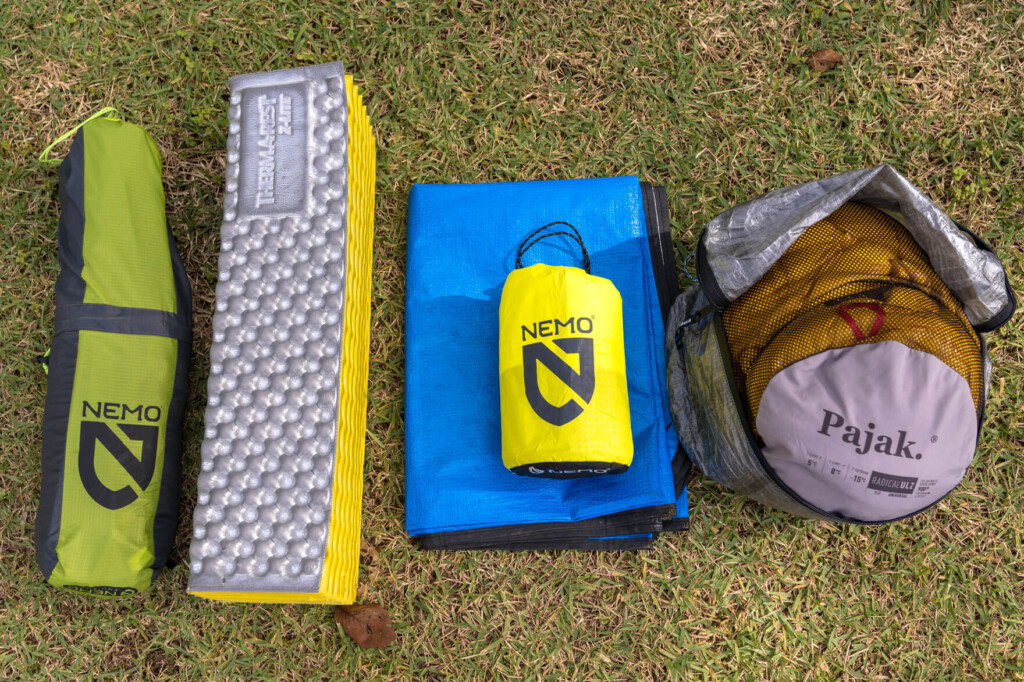
| tent | NEMO Hornet Storm 1P | Emphasis is placed on the balance of lightness, livability, and cold protection | 760 |
| Tent Mat Footprint | THERM-A-REST Z Light Sol | Use it indoors as a tent mat | 410 |
| Tent Mat Footprint | Grabber All-Weather Blanket | It can be used as a ground sheet, blanket, tent mat, tarp, and more | 325 |
| sleeping pad | NEMO Zoa Short Mommy | For the mattress you sleep on. If the temperature is lower, choose a model with better insulation | 295 |
| Sleeping bag | PAJAK RADICAL ULZ | Limit 0℃. For higher temperatures or when lightweight is important. If the temperature drops below freezing at night, choose a warmer model | 615 |
When choosing a tent for a comfortable night on a solo hike in the fall and winter, you want it to be lightweight, yet at the same time comfortable (livable) and "not too cold." For that reason, I think the best tent is one with a double wall to reduce condensation, an inner fabric that isn't mesh, and a comfortable, lightweight construction. The FC is this NEMO Hornet Storm 1P . Since the choice will vary slightly depending on the season, activity, and course, other candidates are listed below.
Regarding sleeping pads and bags, the choices introduced here are lightweight options for people who can tolerate the cold. I will probably use this combination until mid-October, and as autumn progresses and winter approaches, I will upgrade to a warmer mattress and sleeping bag (these choices will be listed separately)
With that in mind, we recommend a combination of three types of mats. a Grabber All-Weather Blanket , a THERM-A-REST Z Lite Sol a NEMO Zoa Short Mummy as a sleeping mattress . Depending on the expected temperature and terrain, you may need to bring all three, or you may need to remove the air mattress or the ground sheet, allowing you to efficiently assemble the items and avoid carrying extra weight.
Finally, the sleeping bag is the PAJAK RADICAL ULZ (Limit 0°C), which is filled with plenty of high-quality down, has a durable yet lightweight fabric, omits a head compartment, and is packable. It's well thought out down to the last detail, making it the most luxurious and functional ultra-lightweight sleeping bag I've ever used. It's perfect for a wide range of activities, from summer stream climbing to autumn hiking.
Cooking/water supply
| type | Item Name | remarks | Weight (g) |
|---|---|---|---|
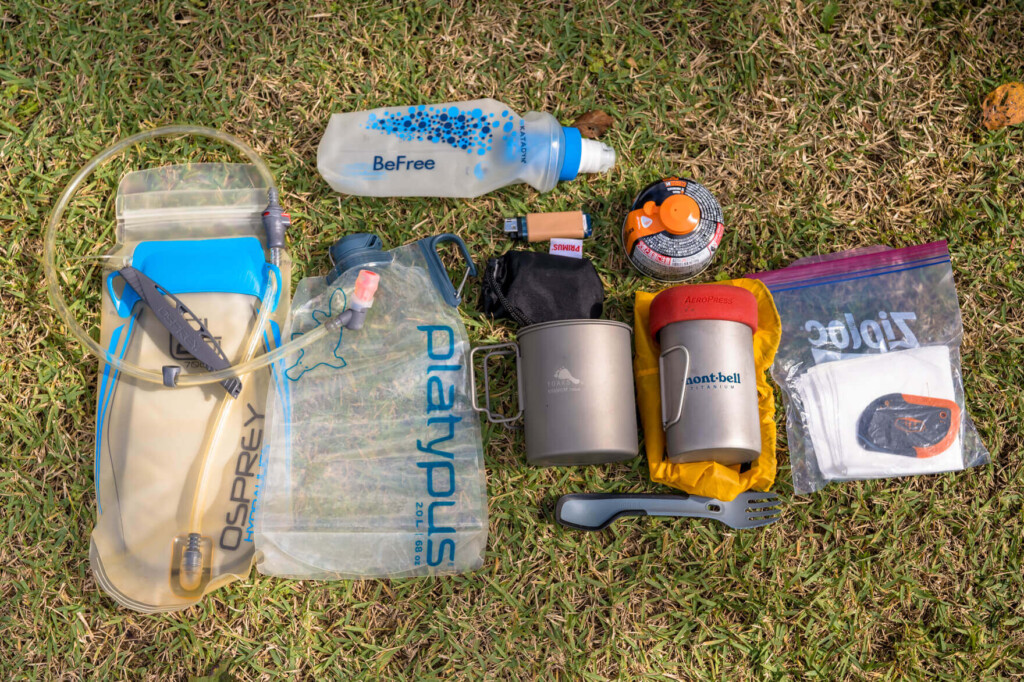
| Hydration | OSPREY Reservoir 2L | Hydration. The back is hard and easy to put in and take out | 250 |
| Cooker | Toaks Titanium Pot POT-750 | For those looking for a lightweight water heater | 103 |
| Mug | Mont-Bell Titanium Cup 600 | Required for making coffee with the AeroPress Go | 80 |
| Cutlery | Morsel Morsel Spork (Mini) | It can be used as both a fork and a spoon. It has a long handle and can also be used as a spatula | 17 |
| Water Bottle | PLATYPUS Duo Lock Soft Bottle | For cooking at the campsite. Compact | 50 |
| Water filter | KATADYN Be-Free 0.6L | 59 | |
| stove | PRIMUS 115 Femto Stove | For those looking for a lightweight water heater | 57 |
| Lighters and matches | 23 | ||
| coffee maker | AEROPRESS AeroPress Go (main unit only) | If you want to enjoy your coffee in luxury | 165 |
| Spatula | GSI Compact Scraper | For cooking or retorting. Clean dishes without water | 23 |
| kitchen paper | 10 |
Regarding cooking utensils, water bottles, and other bottles, please note that it depends on personal preference and familiarity. Whether or not to use hydration is also a matter of personal preference. In my case, I find it convenient for fastpacking because I can easily take a short break without having to take off my backpack. As for other items, a foldable water bottle and filter set is useful
Even if you only need to boil water, it's convenient to have two cookers, one for staple foods and one for soup. I my AeroPress Go with me almost as a matter of course and drink coffee with it, so I think I'm a bit of an unusual FC, but I think it's up to personal preference.
While there isn't much difference between the other cutlery items, I'd like the Morsel Morsel Spork (Mini) . It's easy to eat with, and in addition to its essential functions, it can also be used as a spatula to scrape off any dirt after eating.
Personal belongings and electronic devices
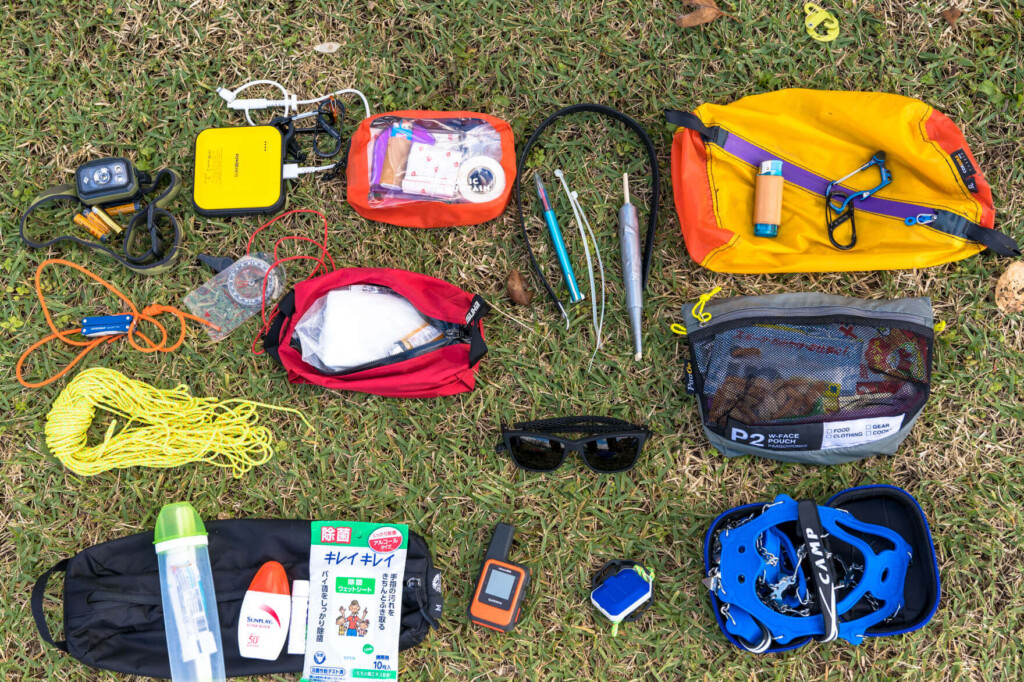
| type | Item Name | remarks | Weight (g) |
|---|---|---|---|
| headlamp | Black Diamond Storm 400 | Emphasis on brightness, battery life, and water resistance | 120 |
| Spare batteries | 44 | ||
| Mobile battery | POWERNESS Mobile Battery U36 | Large capacity, waterproof, and shockproof. USB-C input and output for fast charging. Can also be used as a lantern | 275 |
| Knives and multi-tools | LEATHERMAN SQUIRT PS4 | A trivet with scissors and pliers attached | 56 |
| Compass Whistle | 35 | ||
| Medicine, wound medicine | 153 | ||
| toilet paper | 116 | ||
| plastic bags | 10 | ||
| Spare shoelaces (thin string) | Sold by weight 2mm x 30m | It can be used in a variety of situations, such as when a shoelace breaks, to set up a tarp, or to transport an injured person | 63 |
| Emergency Communication Device | Garmin inReach mini | Satellite communications equipment can be used to send simple messages even in places where radio waves cannot reach, and to request rescue in emergencies | 100 |
| Beacon Cocoheli | Cocoheli | 28 | |
| duct tape | 10 | ||
| sunscreen | 43 | ||
| sunglasses | J Eyewear Lab Neuron4D Polarized | Photochromic sunglasses with an excellent fit and anti-fog properties | 32 |
| toiletries | 46 | ||
| repair tools | 33 | ||
| Pocket Wet Wipes | 27 | ||
| Oil-based pen | 5 |
The list of other electronic devices and accessories doesn't change much just because it's autumn and winter. As I've mentioned several times in other seasonal equipment list features, I always carry a paper map and compass, a medical emergency kit, a knife (trivet), a LEATHERMAN SQUIRT PS4 a Garmin inReach mini and a Cocoheli for emergencies , and duct tape and 2mm x 30m thin rope for various uses in case of an emergency, no matter what mountain trip I go on.
A recent addition to the FC lineup is the POWERNESS U36 mobile battery . I was recently searching for a mobile battery that was shock-resistant, waterproof, and had a high capacity, and I actually tried batteries from various manufacturers, including the well-known Anker, but in the end, this model from an unknown (probably Chinese) brand was the best. Best of all, it charges quickly thanks to USB-C input and output. I was able to use it even at night when the temperature was 0°C, so I don't think I'll have any worries about winter.
Snow countermeasures (in case of an emergency)
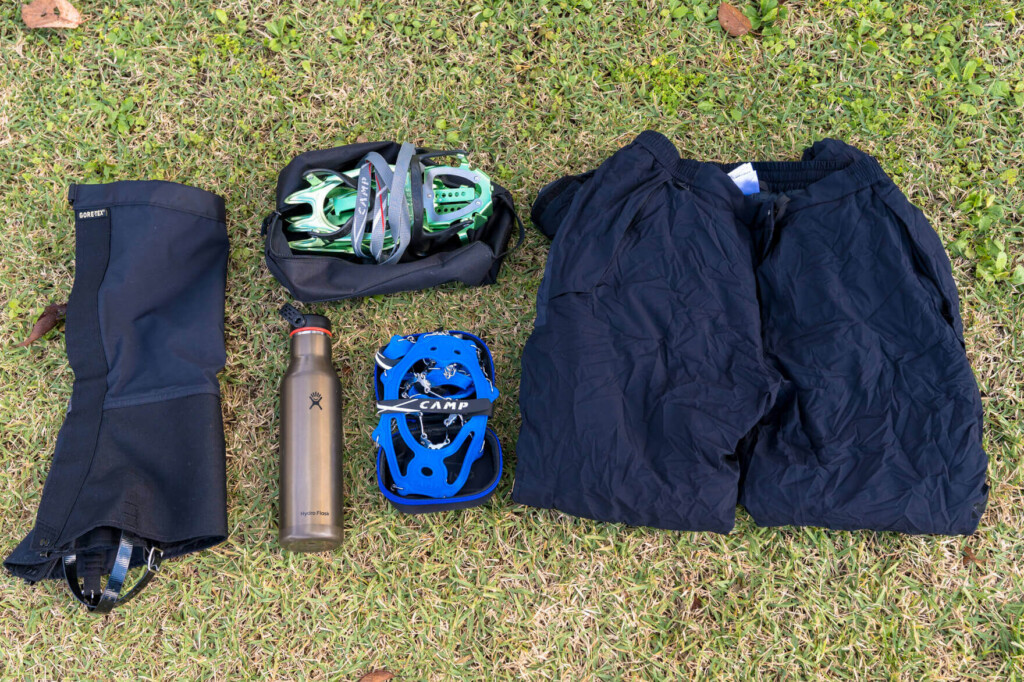
| type | Item Name | remarks | Weight (g) |
|---|---|---|---|
| gaiter | Outdoor Research Crocodile Gators | Emphasis is placed on fit, durability to ensure snow protection, and cold protection | 289 |
| Crampons | CAMP CASSIN XLC490 | It is designed for situations that are not too demanding, and emphasizes lightness and compatibility with a wide range of shoes | 585 |
| Chain spikes | CAMP CASSIN Ice Master | If you're not too worried about snow, these chain spikes will be sufficient instead of crampons | 495 |
| Insulated bottle | Hydro Flask TRAIL SERIES | If you're concerned about heat retention, choose another option, but it's up to your preference | 268 |
Finally, these are items that you probably won't normally bring, but you should pack in your backpack just in case snow or ice is a concern. If you come across rocky slopes near the summit, bring crampons (crampons), and if it's snow or ice on flat or gentle slopes, bring chain spikes. Gaiters are also a good idea if snow accumulation is predicted. Other winter gear such as down pants and a thermos bottle are a good idea to protect yourself from the cold
List of belongings
A list of other options for autumn/winter hiking gear is available at this link
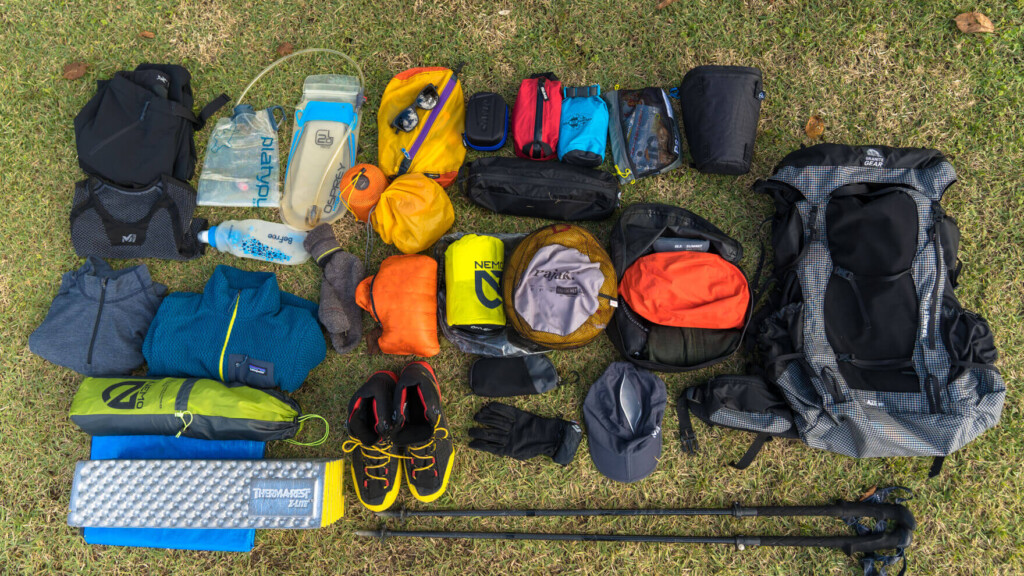
What to wear
- Underwear (tops)
- Base layer (top)
- Mid-layer/outerwear (top)
- Trekking pants (bottoms)
- Hats and Caps
- Trekking gloves
- trekking poles
- Clock (GPS)
Foot area
- mountain climbing shoes
- Trekking socks (bottoms)
- insole
Carrying clothes
- Rain gear (jacket)
- Rain gear (pants)
- Insulated jacket (down)
- Thermal pants (innerwear)
- towel
packing
- Backpack (lightweight)
- Hydration
- stuff sack
- Waterproof Stuff Sack
- camera bag
- Pouch Holder
Housing and bedding
- tent
- Peg
- Tent Mat Footprint
- sleeping pad
- Sleeping bag
Cooking/water supply
- Cooker
- Mug
- Cutlery
- Water Bottle
- Water filter
- stove
- fuel
- Lighters and matches
- coffee maker
- Spatula
- kitchen paper
- Snacks and emergency food
- Dinner, breakfast, coffee
- water
Personal belongings and electronic devices
- headlamp
- Spare batteries
- Mobile battery
- Knives and multi-tools
- Compass Whistle
- map
- Medicine, wound medicine
- Emergency seat
- Smartphone
- toilet paper
- plastic bags
- Spare shoelaces (thin string)
- duct tape
- Emergency Communication Device
- beacon
- sunscreen
- sunglasses
- camera
- Spare camera batteries and remote controls
- toiletries
- Contact lenses
- repair tools
- Pocket Wet Wipes
- Oil-based pen
- Identification card
- Health insurance card
- Mountain climbing plan
summary
In reality, I use tools other than those selected here, but I have chosen the tools in this summary with the aim of being highly versatile and useful to as many people as possible, so I hope that some of them will be helpful. That said, everyone has their own preferences when it comes to mountain gear. Of course, this is not the best, but I hope that it will help you complete your ideal equipment list!
Recently, there are a ton of articles out there that are like "Guide to recommended equipment for mountain climbing", but on the other hand, it seems like there is less and less real, practical information that is truly useful
Just because there are "styles" like "ultralight" or "fastpacking" doesn't mean you have to use only those types of gear. In reality, different people will find different styles that suit them best, with some parts being UL and others being heavy, depending on their physical strength, preferences, and style. Furthermore, media that rely on traditional advertising and revenue from access numbers find it difficult to push products that go against the wishes of advertisers or that are unpopular with users
But what I really want isn't mountaineering, ultralight, fastpacking, or any other type of mountaineering; it's information on the results of trial and error choices made by each hiker based on their own unique walking style. I think it would be great if we could share the idea that each person's trial and error process is part of the joy of the outdoors
The products selected for this equipment list were not provided or negotiated with manufacturers, and were all purchased directly from retailers by me. The site administrator, who has used a wide variety of mountain equipment, has actually used them on hikes in the mountains and has therefore only selected the equipment that he has rated as excellent
By the way, this article also contains banner ads and affiliate links, but they are only for products that have been listed as excellent tools and are independent of reviews. If you look at the entire lineup introduced here, you will see that they have no purpose other than to help run the site as smoothly as possible