



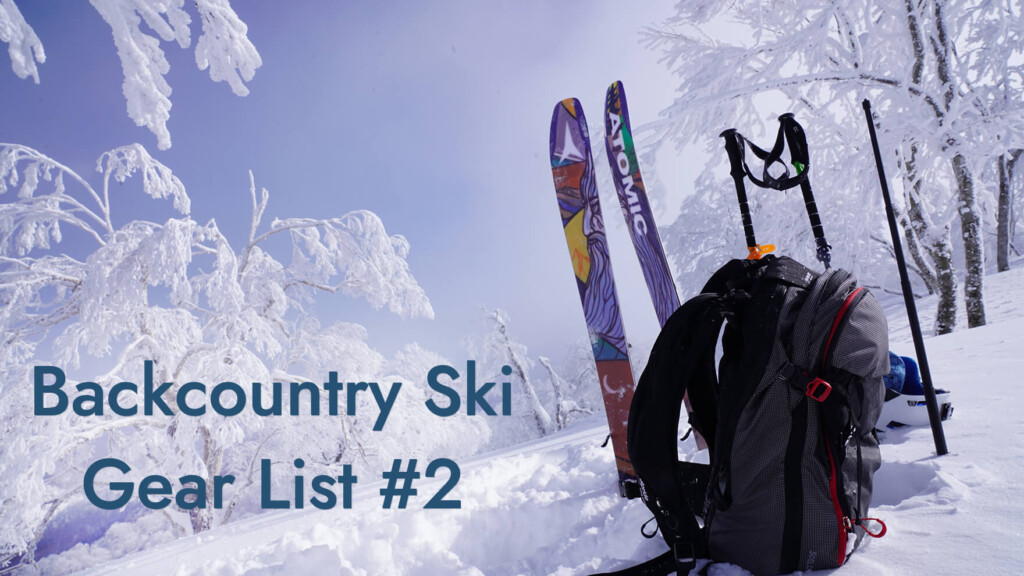
Revealing the backcountry skiing gear list I've been using a lot this season [Part 2]
Written by Yasushi Hisatomi
Following on from last time , I will write about the equipment list that I currently carry with me when enjoying backcountry skiing (for day trips during the high season from January to February).
Just to be clear, as with the previous article, this selection is merely a personal lineup that I am currently satisfied with. It is entirely possible that it will change depending on the purpose, season, and the person's ability and preferences, so I hope you will read it as a reference to get an idea of how to choose equipment. Also, I wrote about the basic criteria for choosing equipment in my previous article , so please refer to that.
Related articles
table of contents
- Equipment list (reposted)
- Comments on each item (Part 2)
- Cold Weather Wear: THE NORTH FACE L3 50/50 Down Hoodie
- Backpack: Osprey Soleden Pro 32
- Goggles: SMITH 4D MAG
- Helmet: Salomon MTN LAB
- Avalanche Beacon: PIEPS Micro BT
- Shovel: ARVA ACCESS TS
- Insulated bottle: Mont-Bell Alpine Thermo Bottle 0.5L
- Ice axe, crampons, and harness: PETZL Ride, PETZL Leopard LLF, and Blue Ice Cocus Light
- Summary: All items listed this time
Equipment list (reposted)
Following on from last time, here is another photo of the equipment I currently carry when backcountry skiing (click on the photo below to enlarge)
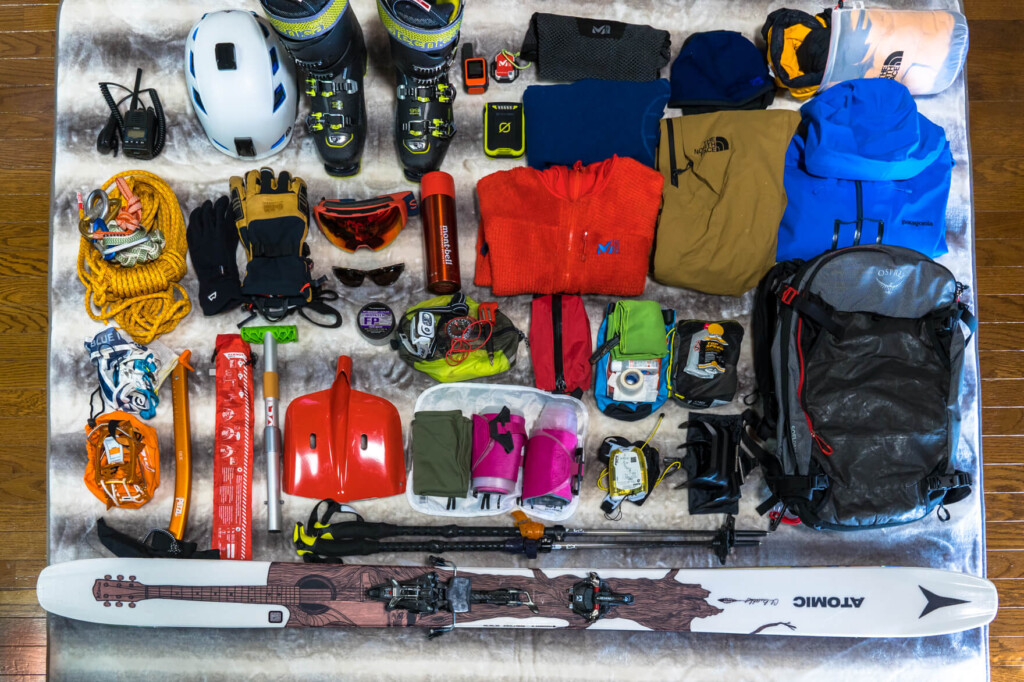
By the way, some things I forgot to include here are underwear, socks, cold drinks such as sports drinks, cameras (SLR, 360-degree camera, GoPro), and spare gloves (I sometimes bring them and sometimes don't). Also, as for the climbing equipment (ropes, carabiners, figure eight rings, harnesses, crampons, axes) and radios, which are all gathered on the left side of the photo, I decide whether to bring them or not depending on the route
Comments on each item (Part 2)
Cold Weather Wear: THE NORTH FACE L3 50/50 Down Hoodie
I bought this this season. Simply put, it's a stuffy down jacket. The 800-fill-power down, with a water-repellent finish applied directly to the feathers, is ultra-lightweight yet incredibly warm, making it perfect for cold weather protection. What's more, the interior features a proprietary independent tube baffle structure, which provides incredible breathability. It's so comfortable you could easily wear it over a hard shell while skiing
This jacket overcomes the drawbacks of down, such as it being prone to getting stuffy and easily susceptible to getting wet, while also retaining its advantages, such as being lightweight and warm.It is so well-made that it is unlikely that a more comfortable down jacket will ever appear in the future
Backpack: Osprey Soleden Pro 32
Whenever possible, I try to use a backpack equipped with an avalanche airbag when backcountry skiing in powder valleys. I 've written extensively about this backpack in a previous review , but it's so comfortable it defies conventional avalanche airbag standards and I'm hooked. It distributes the weight firmly across my waist, the waist buckle is easy to fasten, the back panel is firm, and the shoulder harness is well-cushioned. The storage capacity is also satisfactory. The state-of-the-art airbag system, powered by a supercapacitor, is reliable and easy to use, making it an excellent choice. The only thing I'd like to say is that if it were a little larger, it would be perfect, as it could also fit a DSLR camera.
However, if the route is short and less dangerous, I would choose a snow pack without an avalanche airbag. There are many options depending on your preferences, but right now I'm new Patagonia Descensionist Pack 32L , very useful. It's incredibly light, has minimal specifications, yet offers great storage capacity and a snug fit on the back. I love how comfortable it is to wear, even for a lightweight backpack.

Goggles: SMITH 4D MAG

The Smith 4D Mag I finally purchased last season, is my current favorite pair of goggles. I had been looking for a model with minimal distortion, high-contrast lenses, and as wide a field of view as possible, especially for the comfort of my vision, and then these cutting-edge snow goggles finally arrived, just as I had been waiting for them.
This model not only meets the above criteria, but also features a curved under-eye area, which allows for a wider field of view, a benefit of spherical lenses, making it a highly balanced pair of goggles. It comes with two highly visible ChromaPop lenses as standard, allowing you to clearly see the contours of the snow surface in a wide range of conditions, from sunny to cloudy. The magnetic system makes it extremely easy to put on and take off, and it's fog-resistant and has an ASIA fit, so there's nothing to complain about
Helmet: Salomon MTN LAB
Personally, other than how it fits when I wear it, the other things I look out for when choosing a helmet are how well it breathes and how well it pairs with my goggles. If the helmet doesn't breathe well, my goggles will fog up easily, making it difficult to wear for long periods of time. Also, in the past, my helmet would push my goggles down, making it hard to breathe, so I place importance on how well the helmet fits together with my goggles
Goggles and helmets from the same brand should be well-balanced, but it's difficult to find a brand that satisfies both. The Salomon MTN LAB is a lightweight, breathable, and safe helmet that can be used for climbing in snow-free seasons if you remove the liner. It also fits well with goggles, and I was drawn to its unusual black and white two-tone color scheme.
Avalanche Beacon: PIEPS Micro BT

PIEPS , a long-established brand of snow safety gear . Beacons, essential for searching for buried victims during avalanches, are available from many manufacturers today, but because it's nearly impossible to compare them in the field, it's difficult to know which one is actually best, despite their high price (this year, I'd like to do a comparative review on this site!). However, it's not widely known that there are significant differences in antenna reception sensitivity, operability, and other detailed usability features, and that some models are more quirky than you might expect. Among these, I personally recommend the PIEPS Micro BT (incidentally, the one I was using until recently was the MAMMUT Barryvox).
Its biggest appeal is its light weight, and while its reception range isn't the longest, it's still wide enough (long). Additionally, the search area is a simple, spherical shape, which means buried victims can be found more quickly (and more smoothly) than with other manufacturers. The Bluetooth-connected smartphone app also allows you to check the device's status, offers a training mode for practical practice, and even allows for instant software updates, making it just as convenient as regular electronic devices, even in the world of avalanche gear
Shovel: ARVA ACCESS TS

I keep in mind that I want to reduce the weight of gear that I rarely use (and of course, would prefer not to use if possible), unless I use it frequently. That's why I chose the ARVA ACCESS TS . This is fine if you're just carrying it with you in case of an emergency, as in this case, but if you're planning on doing a lot of serious digging and packing snow, such as setting up a tent on a snowy mountain, a larger, more durable, and more practical shovel would be more convenient.
Insulated bottle: Mont-Bell Alpine Thermo Bottle 0.5L

the Mont-Bell Alpine Thermos It's a lightweight and compact thermos designed for mountaineering . It's durable and has excellent heat retention, but other important features include a cup for carrying hot drinks and ease of use even with gloves on.
Ice axe, crampons, and harness: PETZL Ride, PETZL Leopard LLF, and Blue Ice Cocus Light


The planned route this time does not involve long walks or rappelling along rocky ridges, so the items I carry with me in case I need them are selected based on the same criteria as the shovel, with minimum functionality and lightness being the top priority
The three models we have chosen this time ( PETZL Ride , PETZL Leopard LLF , and BLUE ICE Cocus Lite ) are all ultra-lightweight models that are perfect for carrying on backcountry skiing in emergencies or for temporary situations. However, both PETZL and BLUE ICE are top brands that specialize in climbing and are well-known for their uncompromising manufacturing. They have high functionality and durability that will more than handle even the most severe situations.
Summary: All items listed this time
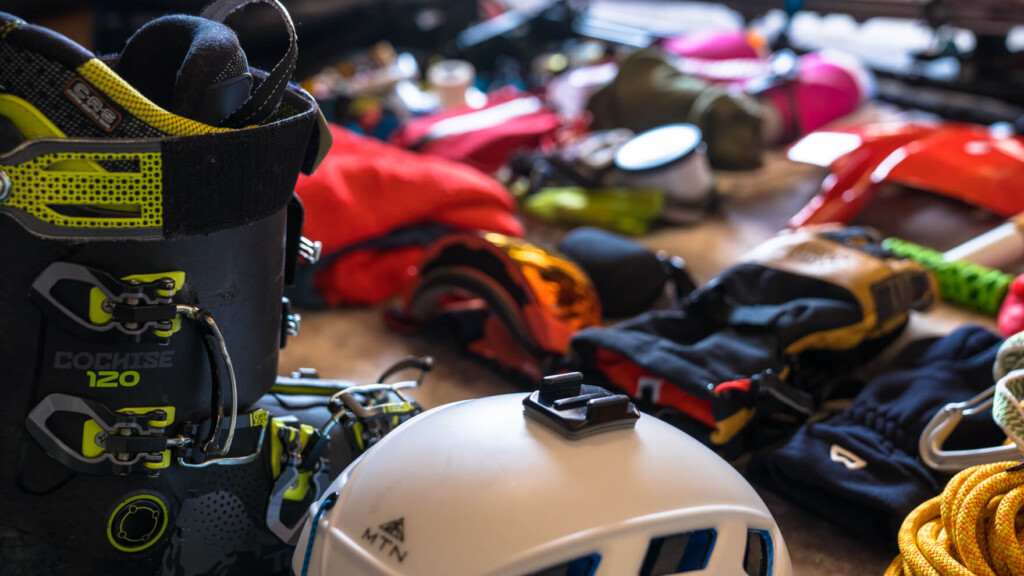
In this two-part article, I have introduced my personal best gear list for day trips on backcountry skiing
Finally, we have compiled a list of the current full-version of day-trip backcountry skiing equipment, including items that we were unable to introduce here, so please use it as reference if you need it
The snow season is almost halfway through. Spring granular snow is just around the corner, and we'll still be able to enjoy the deep thrills of the backcountry for a while longer. This season, let's enjoy the remaining part of the season while being especially mindful of health and safety!
| kinds | Item Name |
|---|---|
| Underwear | MILLET DRYNAMIC MESH |
| Base layer (top and bottom) | Lightweight merino wool base layer |
| Middle layer | MILLET Trilogy Edge Alpha Hoodie |
| socks | Smartwool PhD Ski Socks |
| Hard shell (top) | Patagonia Stormstride Jacket |
| Hard shell (pants) | THE NORTHFACE Purist Bib |
| skis | ATOMIC BENT CHETLER 120 |
| binding | MARKER KINGPIN M-WERKS 12 (and ski crampons) |
| ski boots | TECNICA COCHISE 120 |
| ski poles | G3 VIA CARBON |
| climbing skins | POMOCA FREE PRO 2.0 |
| backpack | Osprey Soleden Pro 32 (or Patagonia Descensionist Pack 32L) |
| goggles | SMITH 4D MAG (and spare sunglasses) |
| helmet | Salomon MTN LAB |
| Snow globe | Mountain Hardwear Exposure 2 Gore-Tex Gloves (and a spare) |
| Winter clothes | THE NORTH FACE L3 50/50 Down Hoodie |
| Avalanche Beacon | PIEPS Micro BT |
| scoop | ARVA ACCESS TS |
| probe | MAMMUT Probe 240 |
| Balaclava | Finetrack Merino Spin Balaclava |
| Insulated bottle | Mont-Bell Alpine Thermos Bottle 0.5L |
| Ice axe | PETZL Ride |
| Crampons | PETZL Leopard LLF |
| Harness | BLUE ICE Caucasus Light |
| rope | 8mm x 20m (length varies case by case) anchor sling |
| Carabiners | Carabiner Eight Ring |
| communication equipment | Smartphone, Garmin InReach mini, Cocoheli |
| Mobile battery | VENTURE 30 POWER BANK |
| headlamp | PETZL Swift RL |
| GPS Watch | Garmin fenix 6 |
| Repair supplies | Tools, wire, ski straps, snow brush, wax |
| Behavioral food/drinks | Gels, sports drinks, etc |
| Towels and hand towels | Quick-drying towel |
| First aid supplies | Taping, bandages, gauze, tissues, disinfectant alcohol, etc |
| Toiletries | Toilet paper, lighter, shovel |
| others | Maps, compass, knife, sunscreen, fine linen, emergency sheet, cameras, etc |
Related reading
 Here's a list of the backcountry skiing gear I've been using this season [Part 1]
 Revealing my regular backcountry skiing gear list for this season (Part 2) [How to avoid being accused of reckless behavior]
 Revealing my regular backcountry skiing gear list for this season (Part 1) [How to avoid being accused of reckless behavior]
 A roundup of the latest gear that caught my eye at Outdoor Retailer Winter Market 2016