



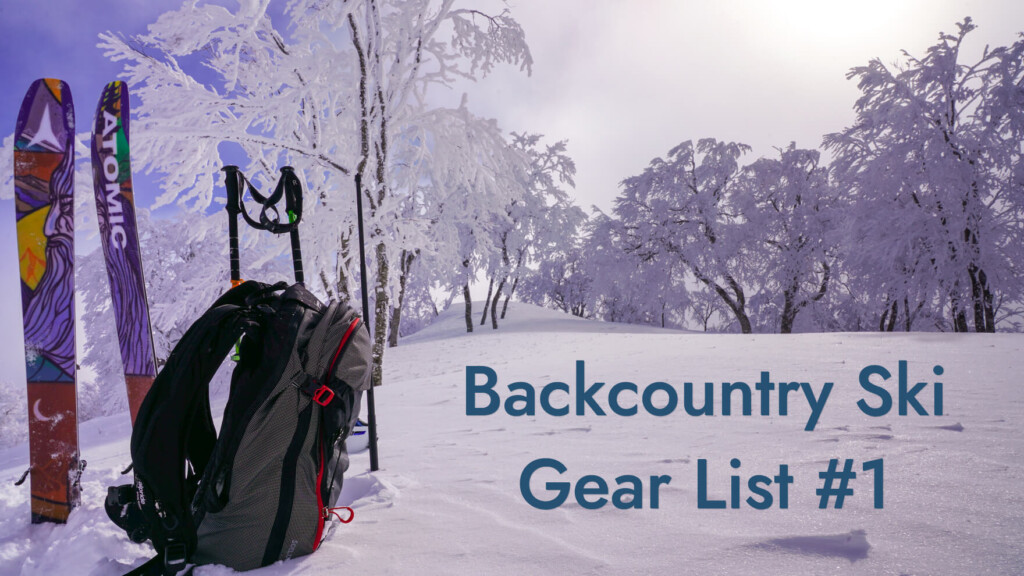
Here's a list of the backcountry skiing gear I've been using this season [Part 1]

Written by Yasushi Hisatomi
I got back into backcountry skiing (BC) about three years ago, and over the past few years it has firmly established itself as my main winter activity. Twenty years ago, when I first started skiing, it was called something unfashionable like "mountain skiing," but now, in stark contrast to what it was back then, I've discovered that there are a lot of incredibly cool and incredibly useful equipment available, and so over the past few years I've been diligently restocking my equipment
As a result, although I wouldn't say this season is perfect, I feel like I have put together a lineup that I am satisfied with, so this time I would like to share with you my current list of regular backcountry ski equipment (for day trips during the high season from January to February)
Just to be clear, although I am satisfied with these choices, they are merely my personal opinion, my preference, and the equipment I have at this point. There may be some choices that more seasoned skiers find outrageous or that some items are missing, and my choices may change soon
In addition to the environmental factor of having very few opportunities to try out ski equipment, I also feel that I still need to do more research myself, so I hope you will read this article without worrying too much and just focus on my thoughts. Also, if you have any better choices, I would appreciate it if you would leave a comment on my Facebook page or somewhere similar
table of contents
- Things to keep in mind when preparing your tools
- Equipment List
- Comments about each item
- Underwear/Base Layer (Tops/Bottoms): MILLET Drynamic Mesh and Merino Wool Base Layer
- Mid layer: MILLET Trilogy Edge Alpha Hoody
- Hardshell (top): Patagonia Stormstride Jacket
- Hardshell (pants): THE NORTHFACE Purist Bib
- Skis & Bindings: ATOMIC BENT CHETLER 120 / MARKER KINGPIN M-WERKS 12
- Ski boots: TECNICA COCHISE 120
- Ski seal (climbing skin): POMOCA FREE PRO 2.0
- Snow Gloves: Mountain Hardwear Exposure 2 Gore-Tex Gloves
- Balaclava: Finetrack Merino Spin Balaclava
- The rest will be in the next episode (second half)!
Things to keep in mind when preparing your tools
When selecting the tools that led me to this point, I was particularly conscious of the following three factors:
- I want to enjoy the powder buffing, however poorly I may be
- Safer
- Lighter
The reason I decided to focus on these three points was because three years ago, I had just returned to BC after a long absence and tried the route "Happo One Munasawa to Garagarazawa", but I was completely exhausted and could only fall like a snowball. Even now, thinking about it, it was terrible
Of course, the cause was my lack of skiing technique, but a big factor was that I was using equipment that reflected the classic mountain skiing I enjoyed 20 years ago (spring mountaineering, ridge traversing, tent camping, and ski touring where "it's okay as long as you don't fall"). At that moment, I realized that I had to choose my equipment based on a different concept than before. In other words, I needed three things: stability for skiing on powder, preparation for thicker avalanches and getting lost, and lightness so that the extra luggage wouldn't be a burden (since I wanted to carry lots of cameras, too). Also, in my own opinion, "downhill technique < physical strength and climbing technique," so I'm proactively trying to make up for my lack of skill with physical strength and money
Let me start by saying that the equipment list I am about to explain is based on my determination and determination to never experience such painful feelings again
Equipment List
Enough of the introduction, let me show you a list of the equipment I currently carry when backcountry skiing (click on the photo below to enlarge)
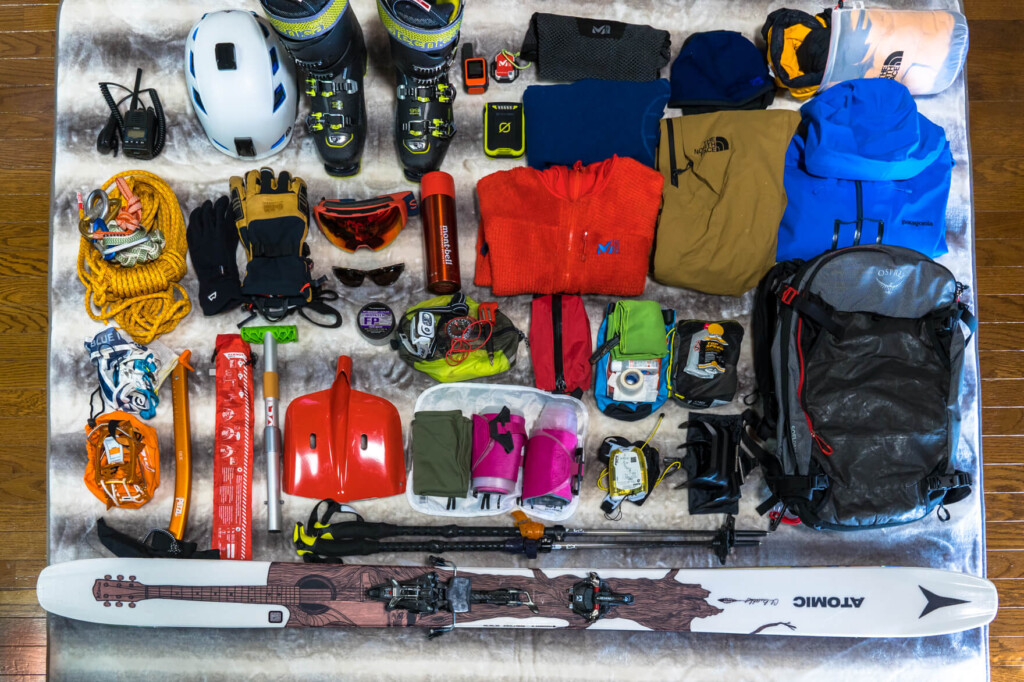
By the way, some things I forgot to pack here were underwear, socks, cold drinks such as sports drinks, all kinds of cameras (SLR cameras, 360-degree cameras, GOPRO), and spare gloves (sometimes I bring them and sometimes I don't)
I also decide what climbing equipment (ropes, carabiners, figure-eight rings, harnesses, crampons, axes) and radios to bring, which are grouped together on the left side of the photo, depending on the route (although I probably wouldn't be able to fit everything in this backpack, including climbing equipment...)
Comments about each item
From here on, I will comment on the equipment list introduced above to the best of my ability
Underwear/Base Layer (Tops/Bottoms): MILLET Drynamic Mesh and Merino Wool Base Layer

As a general rule, a merino wool base layer that's not too thin is best (both top and bottom). Recently, I Millet Drynamic Mesh first next to my skin, so I don't have to worry too much about the type or model of base layer on top to stay comfortable. The key is to wear a synthetic fiber that doesn't stick to your skin as much as possible, which will help prevent stuffiness and discomfort when you sweat. Also, during the peak season in January and February, a base layer with a balaclava hood, such as Patagonia Capilene Air, is recommended as it will keep your neck warm.

Mid layer: MILLET Trilogy Edge Alpha Hoody
For a mid-layer layer between your base layer and outer layer, Polartec Alpha Direct The Millet Trilogy Edge Alpha Hoody has been particularly useful since last year, thanks to its stretchy fleece, easy adjustability thanks to its full and double zippers, and the convenient hood and chest pockets. While I'll consider fine-tuning it depending on the situation, making it thicker or thinner, more windproof, or without a hood, this is the most versatile piece.
Hardshell (top): Patagonia Stormstride Jacket

Again, there are many options, making it difficult to choose just one, but this year, the Patagonia Stormstride Jacket . While I'm not a fan of longer ski jackets, this jacket is a very simple, minimalist, lightweight shell with all the essential features that make it perfect for me right now. Its slim silhouette and minimal pockets and accessories make it perfect for backcountry hikers. The moderate stretch, good ventilation from the fabric, and underarm pit zips make it light, easy to move in, and less stuffy, making it perfect for those dedicated hikers. The limited number of pockets can be covered with other clothing or a bag.
Hardshell (pants): THE NORTHFACE Purist Bib
The North Face Purist Bibs from last year . They're made with FUTURELIGHT™, a proprietary waterproof and breathable material with excellent stretch and breathability, so you can move your lower body around a lot while hiking without stress or discomfort. The bib design also keeps your abdomen warm, and the abundance of pockets makes up for the limited space available in the Stormstride Jacket. However, they do let in some cold air, so I adjust the thickness of the tights I wear underneath depending on the season and location.
Skis & Bindings: ATOMIC BENT CHETLER 120 / MARKER KINGPIN M-WERKS 12
I haven't tried many different skis and bindings, but I chose the ATOMIC BENT CHETLER 120 They have a wide waist and rocker shape that's great for powder, and the right amount of stiffness makes them easy to handle. They also have camber, so I didn't feel much difference in the edge feel when turning compared to previous skis, and most of all, I liked how light they were with excellent maneuverability, and didn't feel like fat skis.
The bindings, the MARKER KINGPIN M-WERKS 12 , are lightweight tech bindings with excellent glide performance. Until recently, I'd been using the Dynafit ST ROTATION 10, a lightweight tech binding that prioritizes balance, but I was looking for a model with even better glide performance, and this was my choice. Personally, I found it to be a great choice. While I'm not yet a particularly aggressive skier, I never feel like my heel is floating, even on the roughest or steepest slopes, and they're stable enough to feel just like skiing with bindings designed for the slopes.
Of course, due to the width and lightness of the skis, it can be a little scary to ski at high speeds on crunchy ice, but other than that I can ski anywhere without any worries
Ski boots: TECNICA COCHISE 120
In fact, the first boots I bought when I resumed BC were the SCARPA F1 EVO. As I mentioned earlier, I was initially focused on touring, so I wanted boots that were light and easy to walk in. I was miserably defeated on the Happo-one Ridge in these lightweight touring boots, so I decided to buy the TECNICA COCHISE 120 (2017/2018 model) .
While the previous boots were, to put it simply, "mountaineering boots you can ski in," these are "freeride boots you can walk in." The cuff is significantly deeper with four buckles, and the flex of the shoe has been significantly increased to 120, which means that even though I'm not a very skilled skier, I feel much more stable when skiing down steep powder slopes with a heavy load, and I'm very satisfied with that. However, although I was prepared for this, the comfort, lightness, and sole shape of these boots are not as impressive as dual-purpose boots, so you'll need to make up for that with your walking technique and physical strength
There's no denying that the skis are quite over-the-top in terms of downhill performance (but what I like about TECNICA is that they still manage to maintain a good balance), so recently I've started looking into something with a better balance that also takes walking comfort into consideration
Ski seal (climbing skin): POMOCA FREE PRO 2.0
From past experience, I remembered that maintenance was a pain when the adhesive strength weakened, so I initially used the Colltex Clariden model. This model features an acrylic-based adhesive layer instead of adhesive glue, and its ease of use was appealing; if the adhesive strength weakened, you could just reapply a new layer. I still use it sometimes, but there is one problem. With twin-tip tails like the BENT CHETLER 120, the hooks tend to come off easily, and the sticker would peel off almost every time I walked
So I started looking for new climbing skins and settled on the POMOCA FREE PRO 2.0. First of all, they're light and thin, making them easy to handle. They offer a good balance between climbing and skiing, and best of all, the optional "Twin Tip Tail Hook" allows me to securely fasten the skins even on BENT CHETLER boots. So far, the adhesive has held up well, hasn't worn out quickly, and hasn't melted or become sticky. So far, I'm completely satisfied with this combination
Snow Gloves: Mountain Hardwear Exposure 2 Gore-Tex Gloves

The Mountain Hardwear Exposure 2 GORE-TEX gloves , offering warmth, operability, and durability . Not only are they fully waterproof, but they're also made with Primaloft Gold Insulation with Cross Core, aerogel, for a thin yet reliable warmth. The flat elastic leash cord is also easy to use. The highly abrasion-resistant full leather palm is extremely durable and looks set to last for years to come. However, because the wrist strap is left open, snow can easily get in when the gloves are off and hanging loose. This often leads to powdery snow getting into your fingertips, making them difficult to remove. That's my only complaint.
Balaclava: Finetrack Merino Spin Balaclava

Balaclavas are essential on ridges where cold winds blow, and while warmth and breathability are essential, the design of the mouth area is surprisingly important, considering that they will be worn for long periods of time. If the mouth is completely covered, the area around the mouth will become soggy and wet from exhalation. Also, when backcountry skiing, you want to make sure it's not too thick, considering how well it will fit with your helmet. The Finetrack Merino Spin Balaclava respects. It can also be worn as a neck warmer, making it easy to adjust to the temperature, and is, without a doubt, the easiest to use.
The rest will be in the next episode (second half)!
This was just my personal backcountry skiing equipment list (first half). It's getting too long, so I'll stop here for today. Next time, I'll talk about the second half, the remaining gear, such as backpacks and avalanche gear (I'll also post a complete list of items at the end)
Related articles
Related reading
 Revealing the backcountry skiing gear list I've been using a lot this season [Part 2]
 Revealing my regular backcountry skiing gear list for this season (Part 1) [How to avoid being accused of reckless behavior]
 Revealing my regular backcountry skiing gear list for this season (Part 2) [How to avoid being accused of reckless behavior]
 10 Recommended Hard Shell Jackets I Impulsively Picked Up This Year [2016-2017]