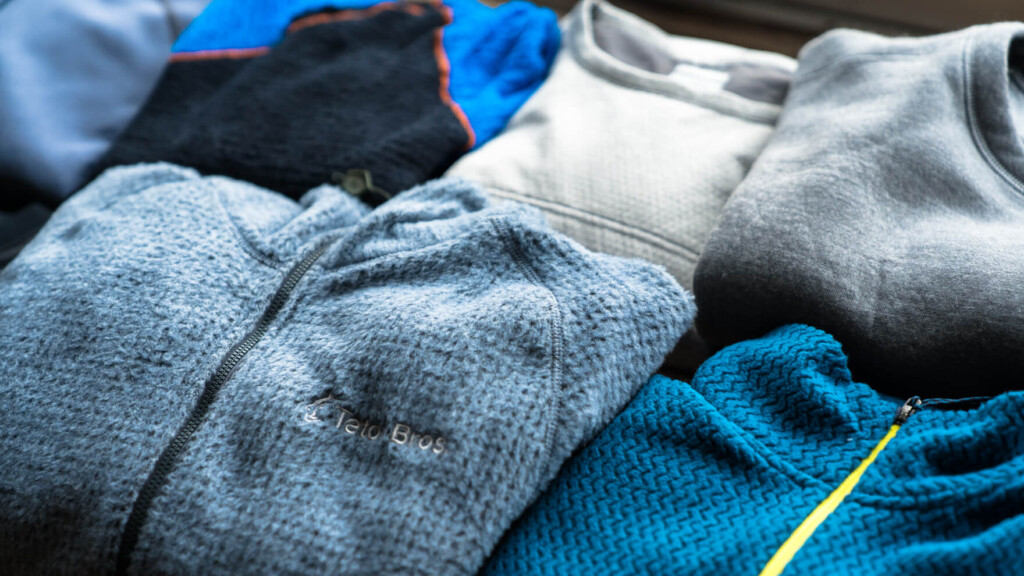
Polartec is a global fabric manufacturer that offers a wide range of synthetic fiber materials essential for high-performance outdoor wear that keeps you safe and comfortable in harsh environments, from cold weather jackets such as fleece and padded parkas to base layers and waterproof and breathable jackets. Anyone who has even a little experience with the outdoors will be familiar with this name
On January 30, 2019, Polartec released a shocking statement: a declaration regarding their "Eco-Engineering™ initiative," which stated that Polartec would move forward with using recycled and biodegradable materials across their entire product line
To find out more about this initiative, what it means, and how it will change the future of outdoor gear, we spoke directly with Eric, the company's EU/Asia sales manager, and Thomas, who is in charge of product development


table of contents
- The impact of "recyclable and biodegradable fibers"
- A 30-year journey towards sustainability that began with recycled fleece
- Polartec's ultimate goal for textiles
- Polartec's latest material embodies "high performance x sustainability"
- Summary: The development of the world's first fully recyclable and biodegradable outdoor wear is no longer a dream
The impact of "recyclable and biodegradable fibers"
The announcement announced a groundbreaking material that combines two properties that are important for preserving the global environment, setting a new standard for sustainable textiles


A 30-year journey towards sustainability that began with recycled fleece
Polartec's commitment to the environment is not something that just started suddenly. It can be traced back to 1993, when they developed fleece products made from recycled polyester

Polartec's overall approach as an environmentally and socially responsible company is outlined in a framework called "Eco-Engineering™."
Eric: Even if a product is friendly to people and the environment, if the factories and facilities that produce it harm people, then it cannot be said to be fulfilling its responsibility to people and the global environment. We have begun production in factories that meet many global environmental standards, including the Bluesign certification, which is given to products that have come through a sustainable supply chain, and the Oeko-tex certification, which certifies that textile products are friendly to people and the earth, as well as many other global environmental standards, and are working on every aspect of our efforts to ensure safe and sustainable production for people and the environment. At Polartec, we call our entire framework, which combines high quality and sustainability not only in the products themselves but also in all processes, including production facilities, "Eco-Engineering™."

The January 2019 statement marks the culmination of Polartec's more than 30 years of efforts to fulfill its environmental responsibilities, and a major milestone for the future
Polartec's ultimate goal for textiles
Developing the world's first fully recyclable and biodegradable fleece, outerwear and other jackets is "not a dream."

The ultimate goal of this initiative is to be the first in the world to be able to produce a full range of recycled and biodegradable fleece, waterproof and breathable jackets, and other padded jackets. We envision a future where everything is made from recycled materials, is more durable than today's products, can be used for longer, and can eventually be recycled, or even return to the soil when discarded, becoming no longer garbage. We will continue our efforts with the belief that such a world will soon be realized
Polartec's latest material embodies "high performance x sustainability"
The high level of Polartec's technological and environmental expertise is fully demonstrated in the latest materials released in succession last year and this year. We asked Polartec about what they think are the appeals and advantages of each of these two materials
Polartec Power Fill

Thomas: Power Fill is "a soft, flexible polyester fiber matrix engineered with unique geometric shapes." The key features of this fill material are its lightweight, high-performance insulation, excellent durability, and the consistency of the fill panels. This eliminates the need for baffles or other separations, eliminating unnecessary seams and maintaining a clean surface. Its durability and stability also translate into ease of use, as it retains its performance even after repeated washing. And of course, the fact that it's made from 100% recycled polyester is a major advantage


At the moment, we only have a basic version, but we are considering more variations in the future. For example, we are developing a version with high breathability to improve comfort and prevent excessive heat buildup, as well as a version with added stretch for greater mobility. Of course, we will also be improving the recyclability and biodegradability of the material at the same time
Furthermore, although only outerwear products are currently available, the possibility of using a versatile insulation like Power Fill in equipment other than clothing is naturally being explored. It has already been applied to gloves and footwear, and I think we will see the release of products in the near future
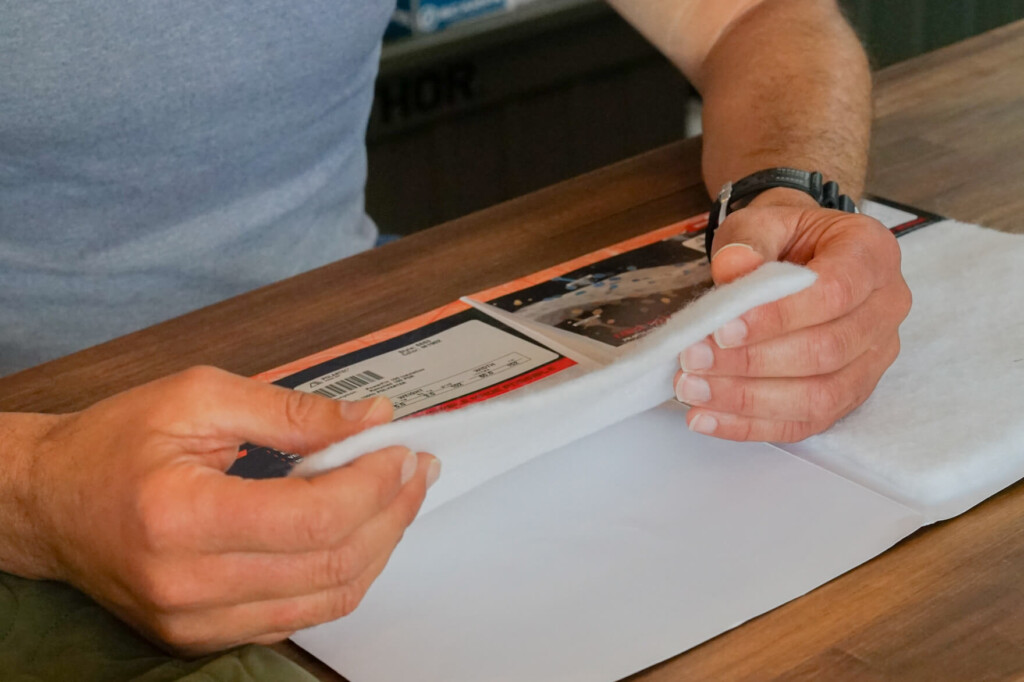
Polartec Power Air
Thomas: The most difficult part of developing Power Air was figuring out how to make it a non-brushed (i.e., non-shedding) cold-weather fabric
Unlike traditional insulations that rely on mechanically raised and sheared yarns, Power Air's unique structure is formed by a dense array of tiny capsule-like cells that literally trap insulating air
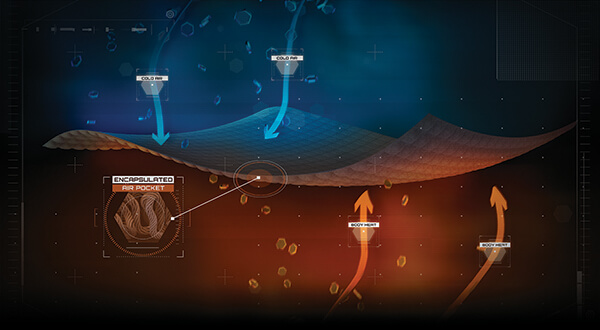

The fibers that are blown out of the capsules create a space that holds warm air, creating an insulating effect. Moreover, because the fibers are confined within the room, the fine polyester particles that are emitted from the fibers do not leak out, resulting in five times the amount of microfibers compared to regular fleece. It also has sufficient stretchability, which is why it is said to be an evolved version of fleece
As this is also only the first year, only the basic version is currently available, but in the future, the stretchability, feel, weight, thickness, etc. will be adjusted and it will be applied to various layers, including base layers
Summary: The development of the world's first fully recyclable and biodegradable outdoor wear is no longer a dream
Living in Japan, where people are not particularly sensitive to the global environmental crisis, it may be difficult to realize the seriousness of this issue. However, their words clearly convey that expectations for achieving sustainability when it comes to synthetic fibers and other materials used in outdoor products, as well as the fact that competition between the various players surrounding them, is steadily and acceleratingly increasing and intensifying
Of course, we must keep in mind that whether these efforts to fulfill our responsibility to the global environment are successful or not ultimately depends on us, the users. We hope to protect a world in which all people can enjoy the outdoors equally, both in the future and for generations to come
Related reading