



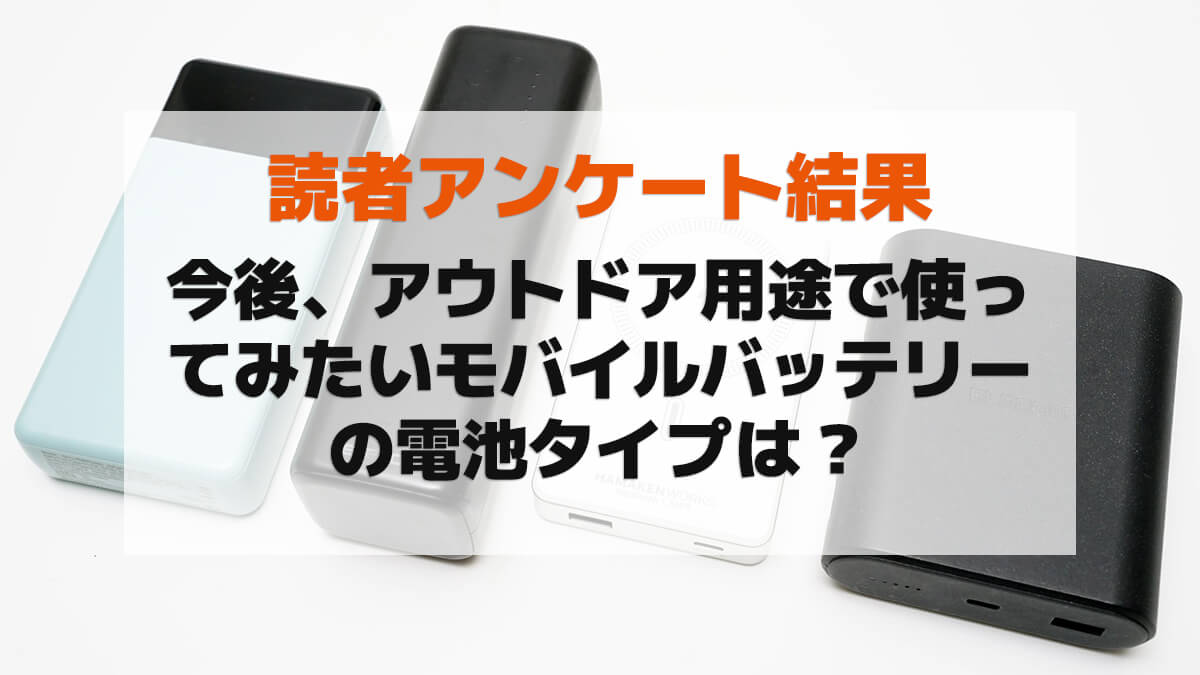
[Reader survey results] What type of mobile battery would you like to use for outdoor purposes in the future?

Written by Outdoor Gearzine Editorial Department
These are the responses to a survey we conducted with readers from January 14th to January 31st, 2026, asking, "Which type of mobile battery would you like to use for outdoor purposes in the future?"
table of contents
- What type of mobile battery would you like to use for outdoor activities in the future? (Please select one)
- What is the most common purpose for using a mobile battery outdoors? (Multiple choices allowed)
- Please select up to three points that you consider most important when choosing a mobile battery
- Please tell us the capacity (mAh) of the outdoor mobile battery you are currently using
What type of mobile battery would you like to use for outdoor activities in the future? (Please select one)
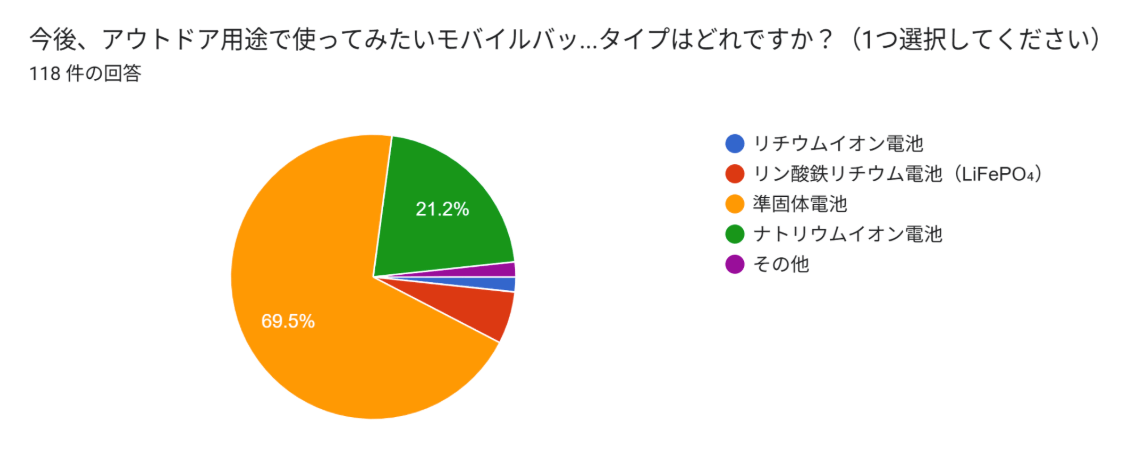
Approximately 70% of respondents chose "quasi-solid-state batteries" as the type of mobile battery they would like to use in the future, followed by "sodium-ion batteries" at approximately 21%, and in third place was "lithium iron phosphate batteries."
These results show that many outdoor enthusiasts are turning their attention to "quasi-solid-state batteries." Below we will introduce some of the reasons why they chose each battery
*The comments in this article are the opinions and experiences of individual readers who responded to a survey. They do not guarantee or assert the performance or safety of each battery type
semi-solid battery
- I hope it can be made lighter and smaller
- Advantages in low temperature environments
- Lightweight and stable at low temperatures
- I personally shoot skiing and backcountry skiing, and I shoot ski-related stuff for work, so performance in low temperatures is very important to me. There are times when I don't have a walkie-talkie, so communicating via smartphone is a lifeline, and even when I do shoot with my smartphone temporarily, I have to worry about the battery to avoid losing my means of communication, which is a big burden in terms of both the quality of the footage and my mental health
- When climbing in the dead of winter, the voltage of the lithium mobile battery was unstable, which caused problems with charging the smartphone
- Excellent durability in low temperature environments
- I thought it was the safest battery because the descriptions of other batteries did not say that they had a low risk of fire
- I think its appeal lies in its well-balanced safety and performance, and its long-term usability. It can be used on a variety of devices, from cars to smartphones, and I think it has great practical value
- My current mobile battery generates a lot of heat, so I'm considering a cheaper quasi-solid-state battery for safety and longevity reasons. Its temperature resistance from -20°C to 80°C is also appealing
- It won't catch fire even if it's dropped or if a nail gets stuck in it. I don't want to think about it suddenly catching fire or smoking inside my clothes
- I'm using a lithium-ion battery, and I'm worried about its vulnerability to cold. On the other hand, I also feel that lightness is important, so I'm looking forward to solid-state batteries that seem to be able to achieve both
- Can be used even in low temperatures
- I sometimes camp in tents on snowy mountains during the coldest winter months, and the fact that it can be used down to -40°C is very appealing and I definitely want to get one
- Peace of mind knowing you can leave it in the car
- Because I'm concerned about safety
- Since it can be dropped, safety and durability are attractive features
- Operates in low temperature environments
- It is more resistant to fire, lifespan, and low temperatures than previous batteries, and I think it overcomes the concerns of lithium-ion batteries. I hope it will be lighter than previous batteries, as I will be using it for mountain climbing
- Since it is often used while sleeping in a car, it is important to have a wide temperature range and be shock-resistant against vibrations in the car
- Currently, I use sodium-ion batteries for outdoor use, so I'm interested in smaller, more powerful quasi-solid-state batteries
sodium-ion battery
- I want to try a new generation of batteries that don't rely on rare earths
- The sodium material gives it an eco-friendly image, has a long lifespan, and can be used in both summer and winter
- High reusability and no use of rare metals
- Because there is little case information
- I'm curious about the safety and price of new products
- I already have all the other items and would like to compare their performance in mid-winter and mid-summer
- I expect it to perform well even when I need to take out my smartphone when I need to, such as when I'm hiking in the dead of winter (i.e., when the device is not sufficiently insulated)
- Sodium-ion batteries have a lower electrical capacity than lithium-ion batteries, but they are safer and have already been commercialized by major companies, so they are relatively easy to obtain
- High reusability and no use of rare metals
- Hoping for a bright future
- The reason I'm interested in sodium-ion batteries is because they seem to reduce the anxiety I've felt in actual usage environments. Outdoors, there are many harsh conditions such as being dropped or experiencing low temperatures, and there are times when I worry about the risk of lithium-ion batteries catching fire or the sudden drop in performance due to the cold. I'm attracted to sodium-ion batteries because they are highly safe and their performance does not drop even in cold climates
Lithium iron phosphate battery
- Because it gives me a sense of security
- I think that lithium-ion batteries inevitably have a high risk of fire. Other options are still in the development stage, have high costs per capacity, and have limited product options. Among them, iron phosphate seems relatively easy to use
- Because it has a proven track record of safety and long life in portable power sources
- Actually, I just ordered it from Amazon, prioritizing safety and balancing weight, capacity, and price
- The low risk of fire is what I'm most concerned about when storing it at home for a long period of time
What is the most common purpose for using a mobile battery outdoors? (Multiple choices allowed)
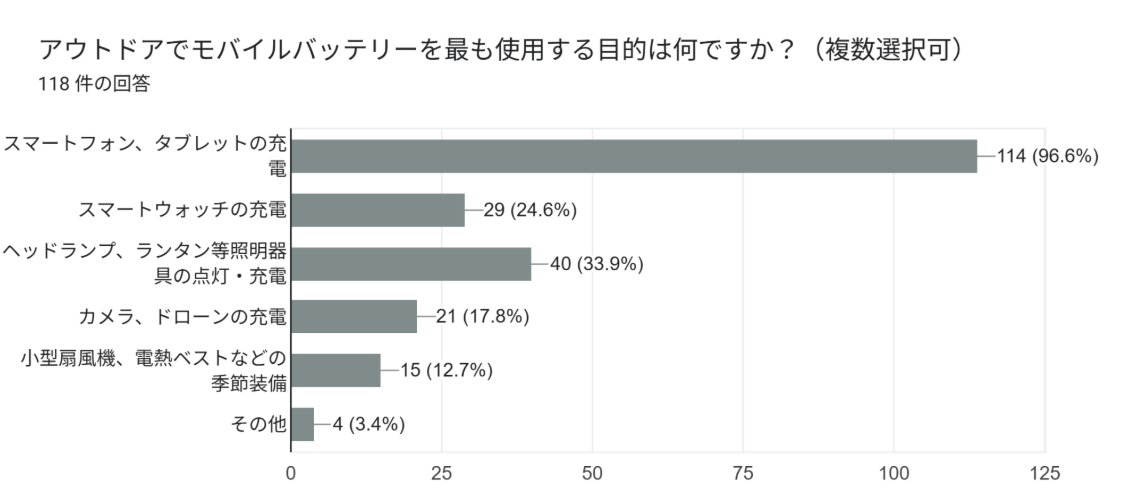
The overwhelming majority of uses were for charging smartphones and tablets, followed by lighting and charging headlamps, lanterns, and other lighting equipment. Since these are vital items in outdoor fields, people may be inclined to choose highly reliable mobile batteries
Please select up to three points that you consider most important when choosing a mobile battery
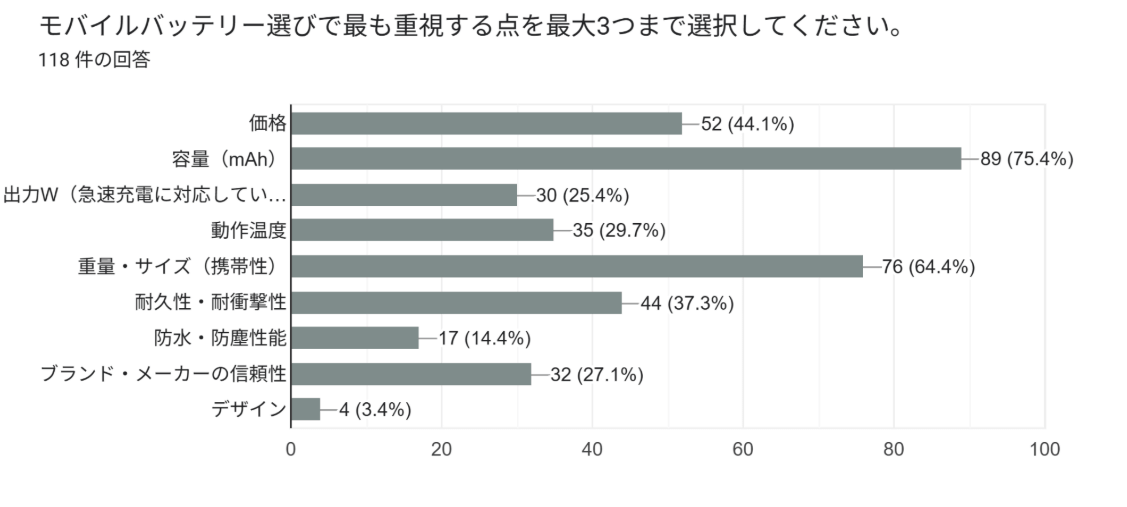
The thing that most people prioritize is "capacity (mAh)," followed by "weight and size (portability)," with "price" coming in third, which is typical of this site. Furthermore, the fourth place after that is "durability and shock resistance," which is probably a result of prioritizing use in outdoor fields
Please tell us the capacity (mAh) of the outdoor mobile battery you are currently using
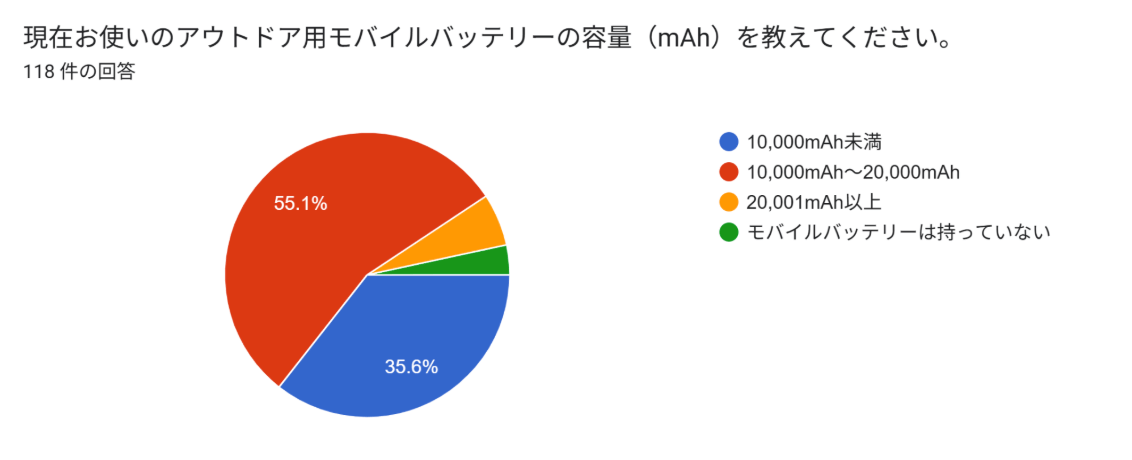
More than half of respondents said they had a capacity of 10,000mAh to 20,000mAh. Next came about 36% who said they had a capacity of less than 10,000mAh, so those using a mobile battery with a capacity of 20,000mAh or more were in the minority. It seems that many people use portable power sources in the outdoor field, so perhaps people don't expect extremely large capacity from a mobile battery. There also seems to be a certain number of people who say they don't have a mobile battery
*When reproducing or using the survey results and graphs published in this release, please clearly state "Source: Outdoor Gearzine (https://outdoorgearzine.com/)."
Related reading
 Lithium cobalt oxide, lithium iron phosphate, sodium ion, and quasi-solid state. We compared all four types of mobile batteries! Which is best for outdoor use?
 The freedom of being able to "leave it alone" without worrying about temperatures ranging from -40°C to 80°C. A thorough review of the next-generation mobile battery, the "HAMAKEN WORKS New SSPB Semi-Solid-State Battery," a long-awaited choice for snowy mountain and car camping users, in the frigid cold of Hokkaido