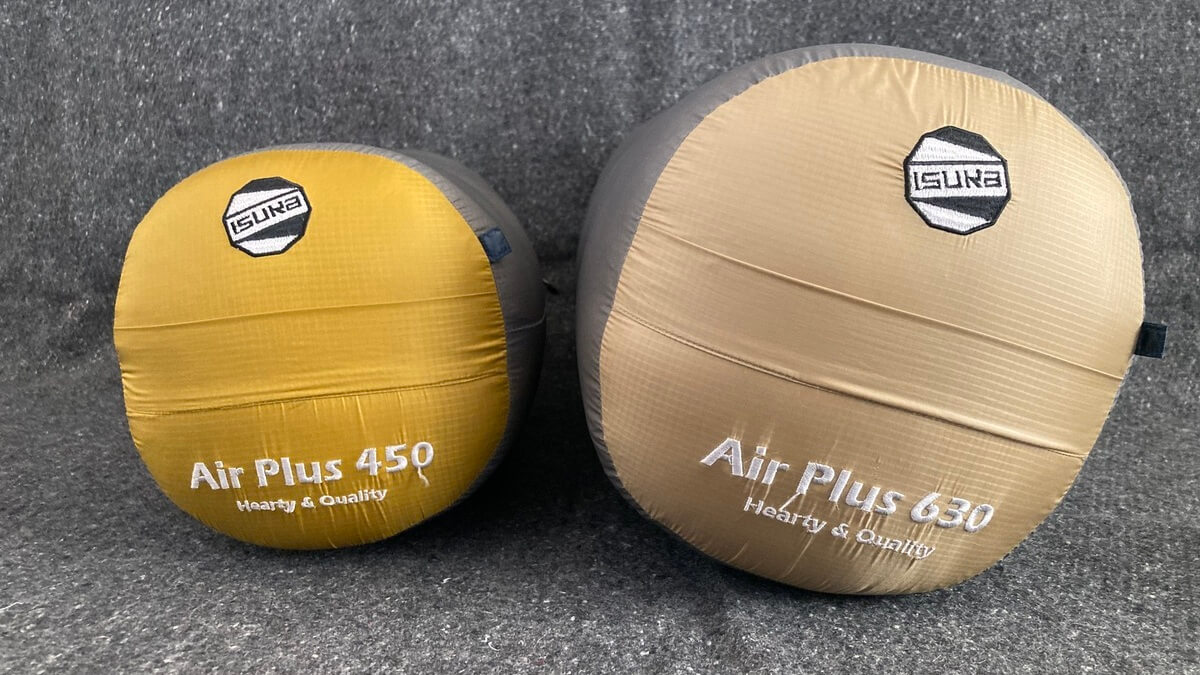
Five reasons why mountain professionals continue to use Isuka's high-quality down sleeping bag "Air Plus." This sleeping bag from a manufacturer that knows Japan's mountains inside and out is different [not Montbell or Nanga]
A sleeping bag (sleeping bag/shraf) is essential for a comfortable sleep when camping in a tent. Unlike regular camping sleeping bags, mountaineering sleeping bags are lightweight and compact, providing maximum comfort and warmth while minimizing the burden of carrying them
When hiking, where you're carrying food, clothing, and shelter, everyone wants to choose a sleeping bag that's as warm and compact as possible. Choosing the best sleeping bag that balances insulation and portability while also keeping within a limited budget is a concern for many hikers, and it's also one of the most difficult parts of choosing gear. Sleeping bags are one of the most expensive pieces of equipment, so mistakes are not an option
Outdoor Gearzine has featured how to choose a sleeping bag and recommended models several times in the past, and one of the sleeping bags chosen in the Best Hiking category was the Iska Air Plus series. Of all the sleeping bags we've used, the Air Plus series boasts undoubtedly the best sleeping comfort, boasting ample warmth, comfort, ease of use, high-quality materials, and a well-balanced, high-level performance that's lightweight and compact. It's a versatile model that can be used in a wide range of seasons and activities, and is suitable for beginners and veterans alike
This time, I'll be introducing the Air Plus series in more detail, detailing exactly what makes it so great and recommended. Having been a long-time user of Iska products, I've served as an Iska ambassador on Instagram. I'll also be sharing a wealth of insider information I secretly shared with Iska that isn't included in the catalog
The Air Plus Series sleeping bags, made by a manufacturer with deep knowledge of Japan's mountains, are lightweight and compact, yet can be used by anyone. They are highly breathable and will ensure a comfortable sleep on your mountain trips
table of contents
- Main features of the Isuka Air Plus series
- 5 reasons why I use the Air Plus series
- Reason 1: High-quality white goose down that goes beyond what can be expressed by FP figures
- Reason 2: Excellent breathability means you won't feel stuffy while sleeping
- Part 3: Optimal size design based on the assumption that the model will look bulky
- Reason 4: Efficient additional functions are installed in the right places depending on the model
- Point 5: A simple zipper with a smooth, non-binding slider
- What I learned from actually using it: the "minimum operating temperature" set by Iska
- Conclusion and Summary: The Air Plus is an all-around sleeping bag that can be used by anyone
Main features of the Isuka Air Plus series

Isuka is a Japanese outdoor equipment manufacturer founded in 1972. With a history of over 50 years, Isuka mainly produces sleeping bags, but also offers stuff sacks, rain bag covers, spats, soft coolers, and more
The "Air Plus" series made by Isuka is the top flagship model in the lineup of down sleeping bags
The Air Plus series is a model that realizes the concepts of "light," "small," and "warm" to an even higher level. It uses high-quality white goose down with a fill power of 820FP, and 30g of down contains more than 2 million filaments and extensions, allowing it to store a large amount of air and providing excellent insulation
The fabric is made of ultra-thin 10-denier ripstop nylon, a "super water-repellent" fabric that has achieved the highest rating of Grade 5 under the JIS standard. Despite its water-repellent properties, it boasts high breathability and reduces stuffiness while you sleep. The three-dimensional design provides ample space around the chest, the largest cross-section of the body, while the back is slightly rounded to envelop the body. The bag is packed with down in the feet, which tend to get cold easily. The inverted trapezoid shape conforms to the shape of the feet, creating a mummy-style sleeping bag that fits snugly to the body
The Air Plus series has a lineup of four models, and the shoulder width is designed to suit the temperature range you will be using, preventing bulkiness. Each model also incorporates the best additional functions and structure to keep out the cold, making it a sleeping bag that makes full use of Iska's technology
5 reasons why I use the Air Plus series

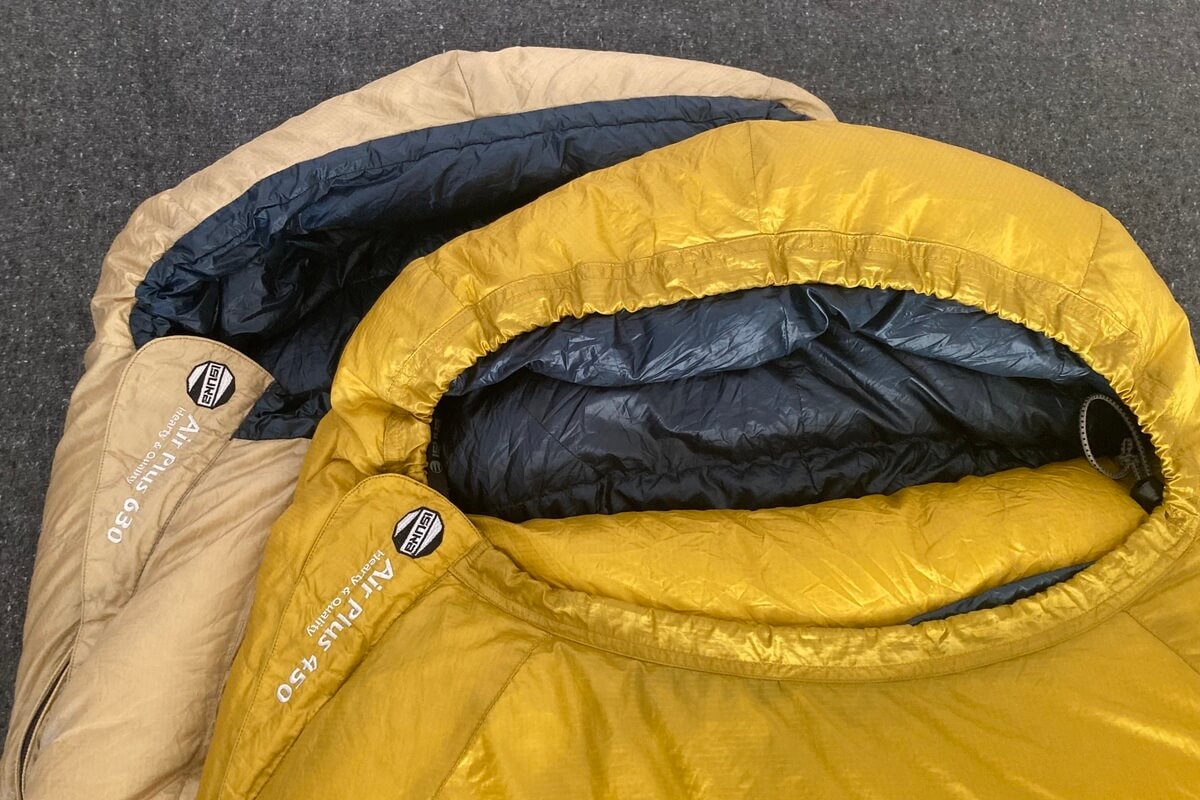
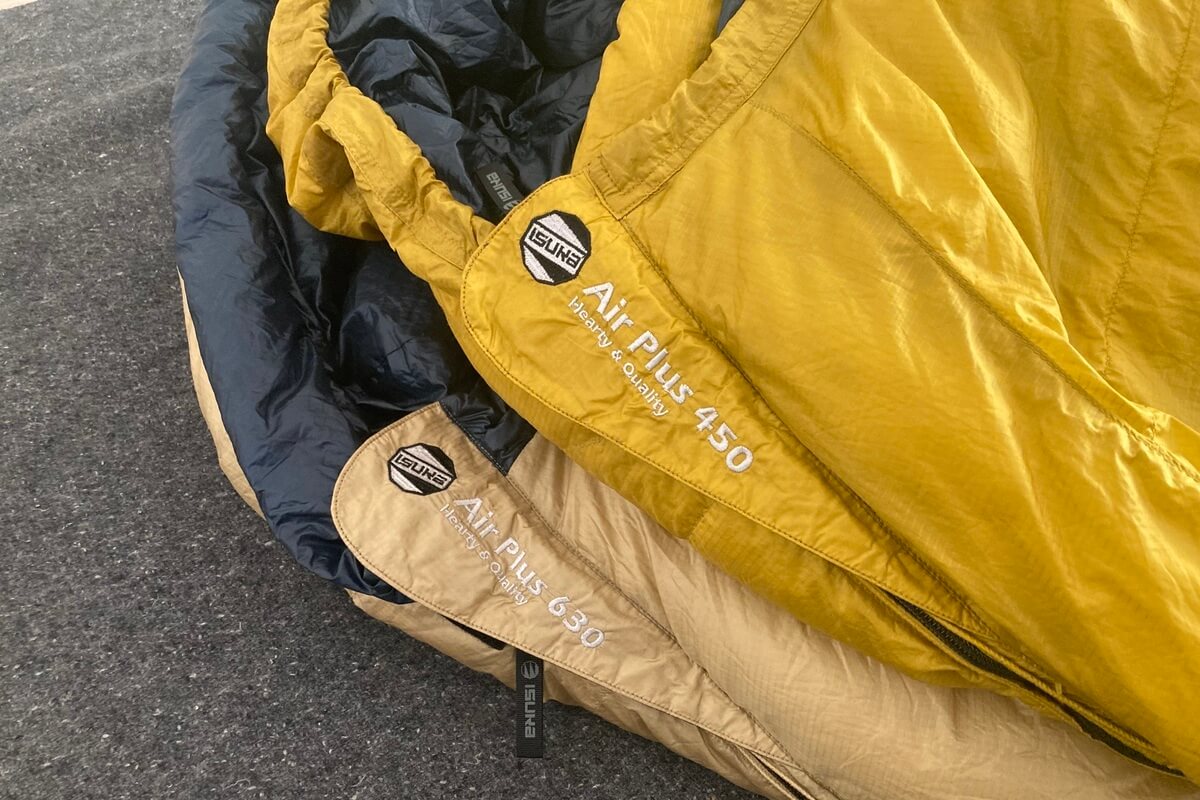
Without further ado, I would like to introduce the reasons why I love the AirPlus series. I will explain what is so good about them, based on the two models I have actually used: the AirPlus 450 and the AirPlus 630
Reason 1: High-quality white goose down that goes beyond what can be expressed by FP figures
The down used in the Air Plus series is white goose down
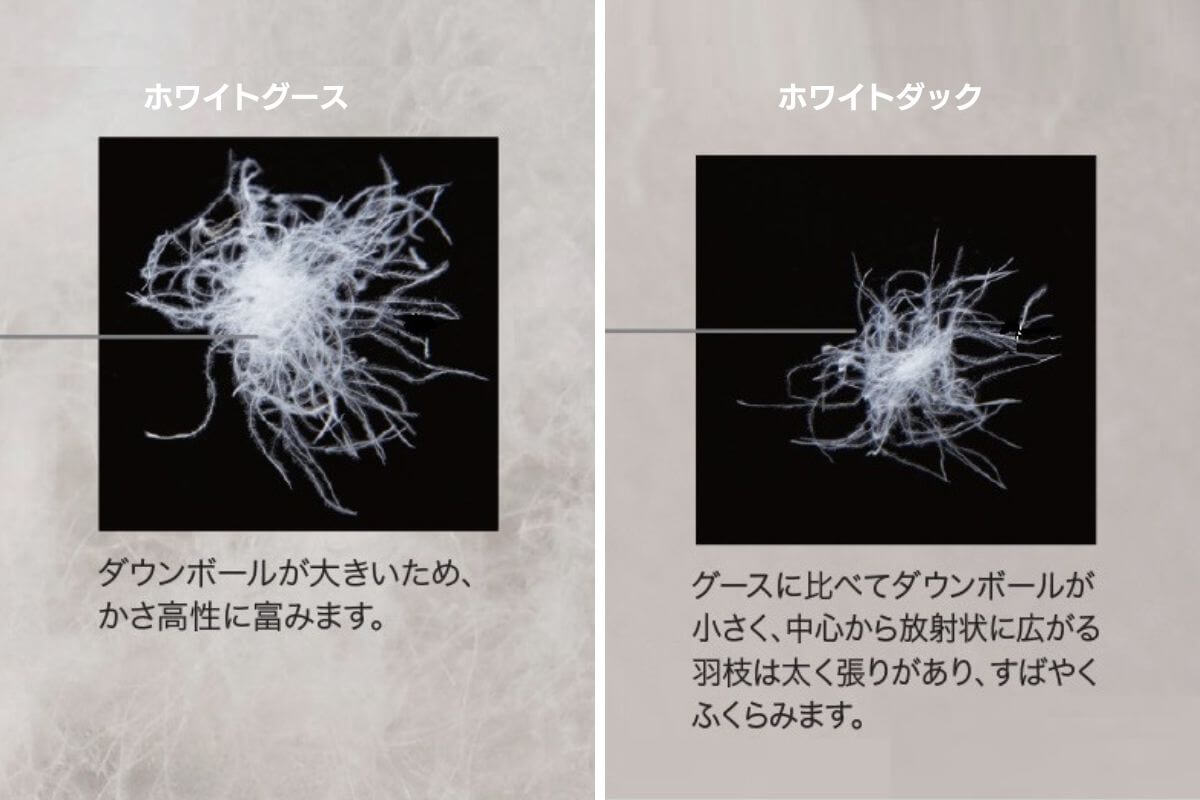
The feathers used in sleeping bags and other down products are collected from waterfowl, mainly duck down and goose down. Although both are waterfowl, the quality of the down is very different

Image provided by: ISUKA
Comparing them, goose down has larger down balls than duck down, allowing it to maintain a higher loft (fluffiness). As down expands, it traps air, creating dead air that provides insulation. When the same amount of down is used, down balls made from larger goose down can maintain a higher loft and have better insulation performance
When I asked Isuka about the difference between goose down and duck down, he told me that there's a difference not only in heat retention but also in durability. Compared to duck down, goose down is more flexible, its feather barbs and shafts are less likely to break, and it's less likely to deteriorate with use, making it more durable. I hadn't really thought much about the deterioration of down's performance with use before purchasing, but when you think about it, sleeping bags are expensive tools, so once you buy one, you want to use it for a long time. Even if the initial investment cost is high, more durable down will likely keep costs down in the long run. If you're thinking about buying a sleeping bag, I definitely recommend considering whether it's duck down or goose down. You can tell by touching it, but not only is there a big difference in durability, but there's also a big difference in suppleness
As of September 2024, the fill power (FP) value of the down used in Air Plus, which indicates the quality of the down, has been changed from 800FP to 820FP. There has been no change from the down that was originally used, but after further testing, the down was found to be of a quality of 820-850FP or higher, and the down was not found to be below 820FP, so the notation was changed
Fill power is one of the standards used to evaluate down performance, and represents the resilience of 30g of down under certain conditions. The higher the FP number, the higher the performance, meaning the same weight can fill more space. Isuka down's FP (fill power) is measured by the global standard, IDFL (International Down and Feather Laboratory)
Apparently, the quality of the measured down is rarely consistent, and there is variation in the quality of the down that is enclosed. Because down is a precious natural material, it is difficult to obtain down of the same quality. Furthermore, it seems that whether the published specifications for the down that is enclosed are a minimum or maximum value depends on the manufacturer. Unfortunately, most manufacturers do not disclose whether they are listing the minimum or maximum value, so we are unable to make a judgment

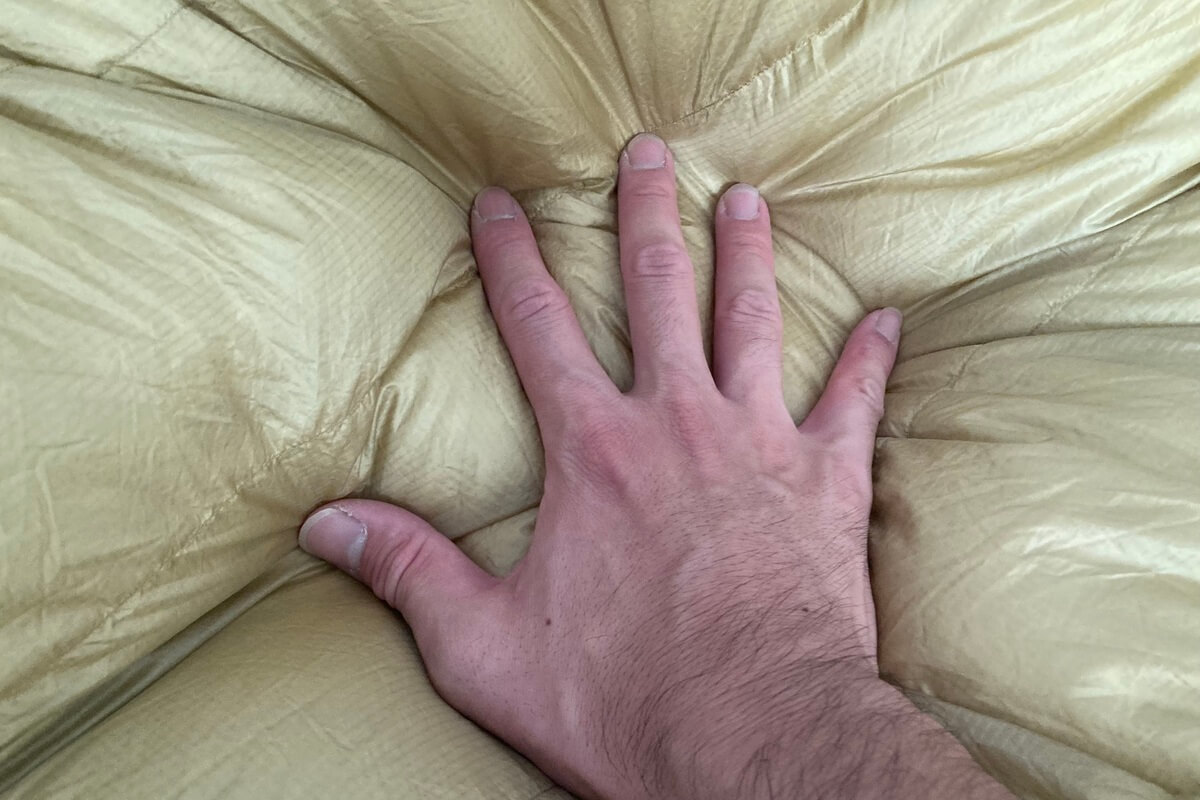
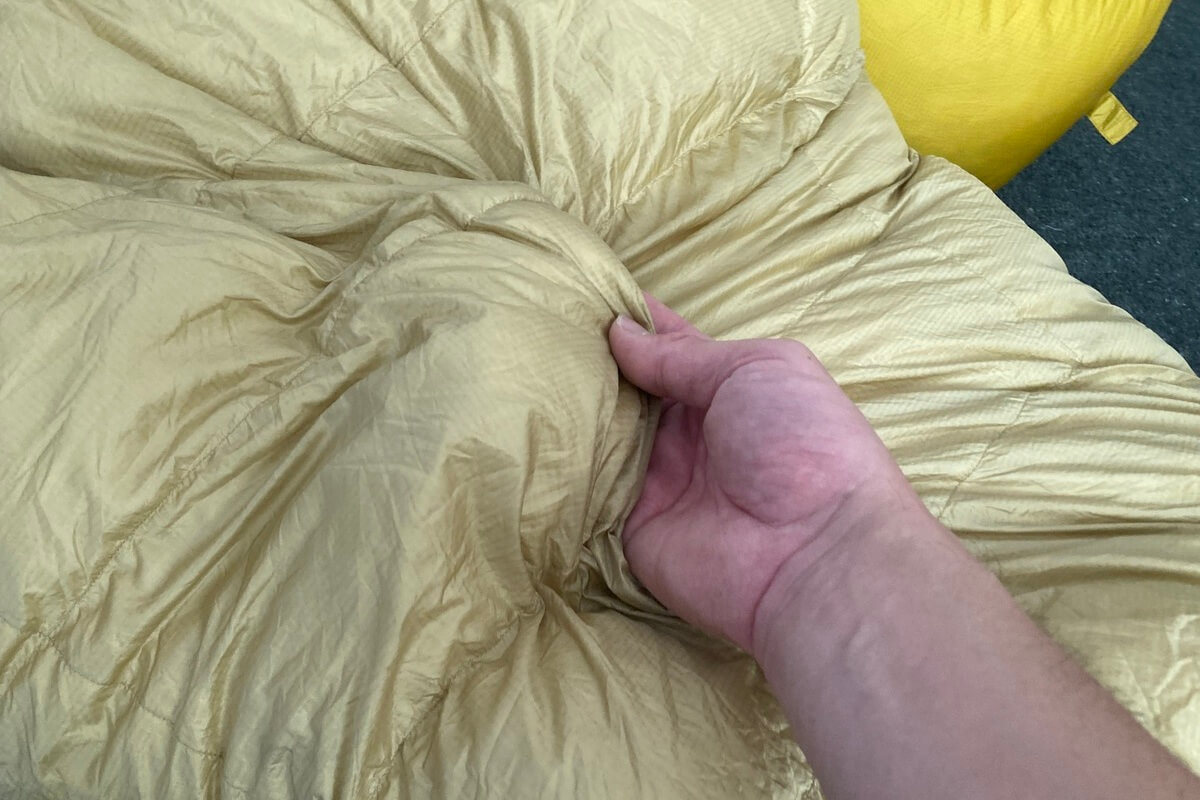
When you touch it, you can tell it's fluffy and made with high-quality down. When you put your hand on it, you immediately feel a gentle warmth
Air Plus officially guarantees a down quality of 820FP in its down testing. 820FP is the minimum they can guarantee, but in reality, the down used is at least 820FP. You can tell just by touching Air Plus that it uses high-quality down. When you get inside the sleeping bag, the supple down instantly clings to your body, keeping you warm
Reason 2: Excellent breathability means you won't feel stuffy while sleeping

The level of breathability is something that cannot be determined from the specifications on the official website. Rainwear and other items have their breathability listed numerically, but this is rarely the case for sleeping bags, so you won't know until you actually use it
I think the best thing about Air Plus is its high breathability. While heat retention is important for a comfortable sleep, the Isuka sleeping bag taught me that breathability is also important
The secret to the Air Plus series' high breathability lies in the quality of the down, its internal structure, and the fabric used. Natural goose down has inherent moisture-regulating properties, which help regulate humidity levels when it gets too stuffy. Furthermore, the internal partitions of the sleeping bag are made of mesh material, which helps to prevent humidity unevenness
Made with ultra-thin, ultra-water-repellent 10D (denier) fabric

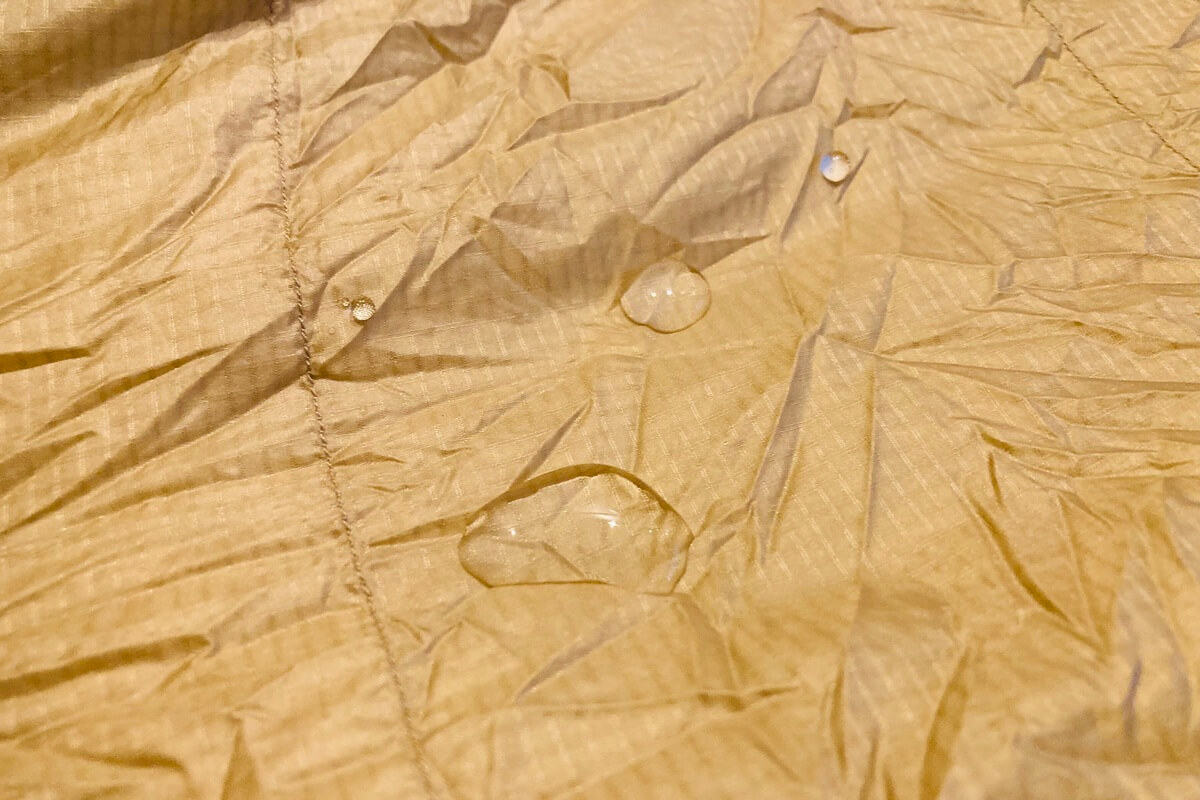
The fabric is made of ultra-thin 10 denier ripstop nylon. The water-repellent fabric has achieved the highest rating of Grade 5 under the JIS standard, and only fabrics that have achieved Grade 5 can be called "ultra-water-repellent." In addition to the down, the fabric is also made of the highest quality materials
The fabric used in the Air Plus series has been changed from "15 denier class" to "10 denier." The original fabric was made with 20 denier warp and 10 denier weft, so it was labeled "15 denier class" as the middle value, but it has now been changed to the thinnest value of 10 denier. The 20 denier warp and rip construction give the fabric increased tear strength and abrasion resistance despite its thinness
Goose down has naturally high water-repellent properties, so it is not processed
Down sleeping bags are compact and portable, and offer excellent insulation (heat retention), but their weakness is that they are vulnerable to getting wet. When down gets wet, the feathers collapse, losing loft and reducing its heat retention
Many down sleeping bags have a DWR (durable water repellent) finish on the down to protect it from getting wet, but the goose down used in the Air Plus series is naturally water-repellent, so by sealing it in without any processing, it is possible to prevent performance degradation and increase durability. Artificially treated water-repellent properties cannot be maintained forever. In the long term, the goose down used in the Air Plus series is highly durable and water-repellent
Isuka seems to be very particular about breathability, and it is essential to prevent the sleeping bag from losing its functionality due to getting wet, especially when used in harsh mountainous areas. In that case, the use of a sleeping bag cover is essential. Considering that putting on a cover can cause some stuffiness, the sleeping bag is designed to have high breathability on its own, and is made from carefully selected materials
Part 3: Optimal size design based on the assumption that the model will look bulky
Even within the same series, Isuka sleeping bags have different shoulder width size designs depending on the grade
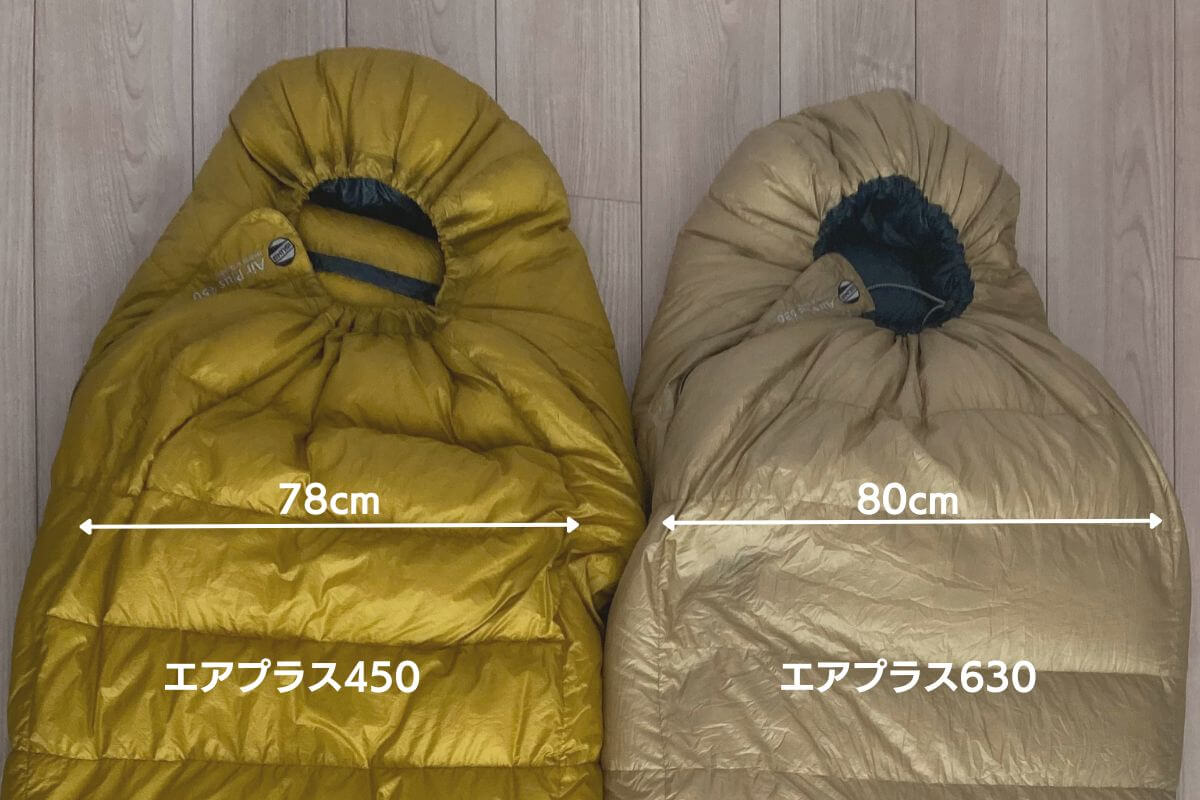
The shoulder width of the Air Plus 450 is 78cm, as it is a so-called three-season model that is not designed for use in low-temperature environments and is not likely to be worn over a lot of layers when sleeping. However, the shoulder width of the winter model, which is designed for use in harsh environments, is a maximum of 84cm, which can accommodate bulkiness when wearing a lot of layers of clothing (the Air Plus 630 has a shoulder width of 80cm)

While other sleeping bag manufacturers may change the shoulder width between the regular and long sizes, as far as I've researched, Iska is the only company that changes the size depending on the grade within the same series. It's a small thing, but the fact that they don't compromise to maximize the warmth of the sleeping bag and change the specifications depending on the grade shows their commitment to making sleeping bags
It's only 2cm, but 2cm makes a big difference. This difference in design makes a big difference, and even when using multiple sleeping bags in harsh environments, the loft (expansion) of the sleeping bags will not be interfered with, maximizing the warmth of the down
Reason 4: Efficient additional functions are installed in the right places depending on the model
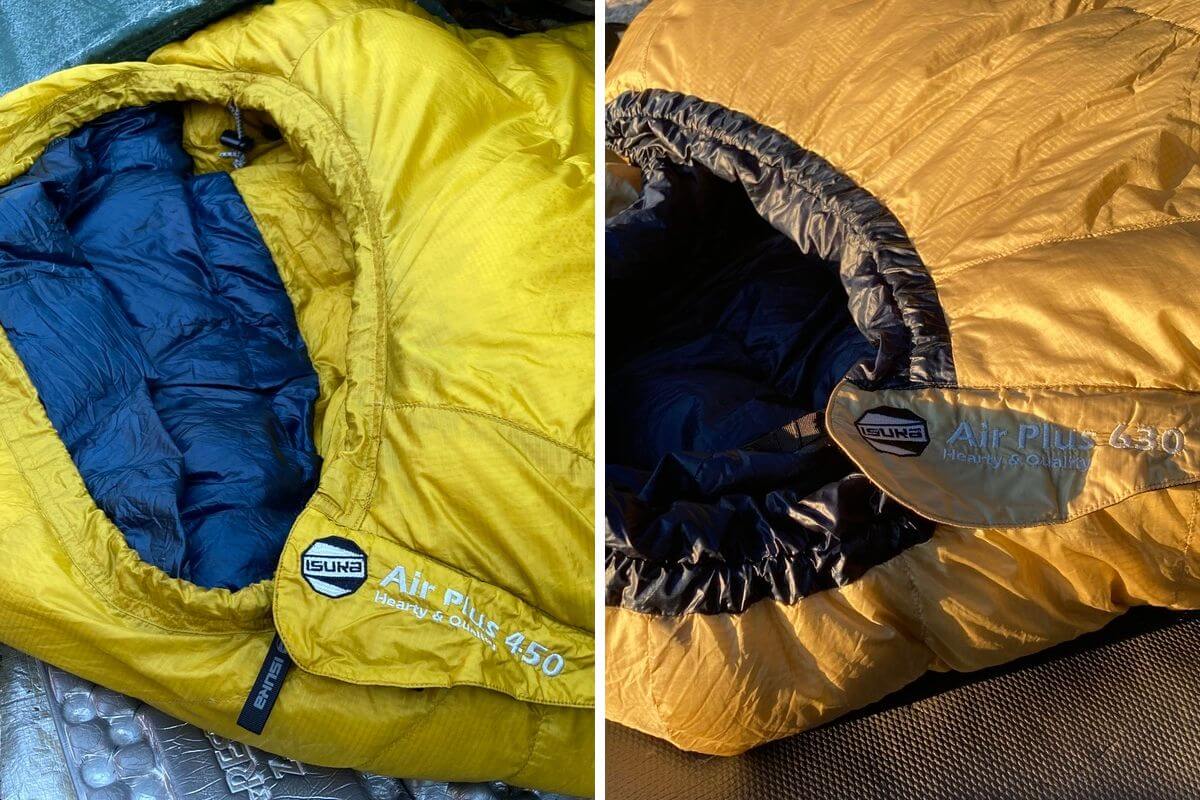
The Air Plus 450 is positioned as a three-season model, while the Air Plus 630 is positioned as a four-season model. Each model has different construction and additional features, and is designed to be equipped with just the right amount of functionality to suit each situation
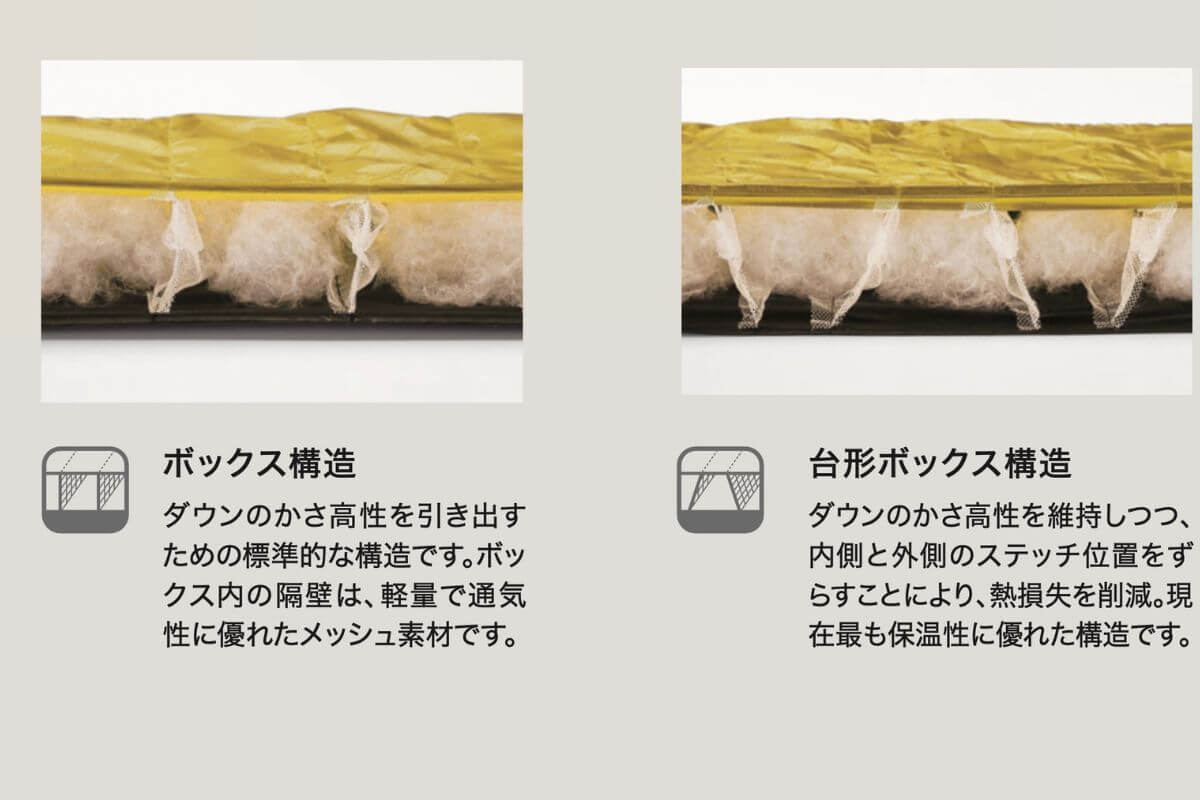
For example, the internal structure in which the down is enclosed is a "box structure" for the Air Plus 450, while it is a "trapezoidal box structure" for the Air Plus 630.Both structures do not impair the heat-retaining properties of the down, but the trapezoidal box structure is the most heat-retaining structure, as it can reduce heat loss by shifting the stitching position on the inside and outside

Image provided by: ISUKA
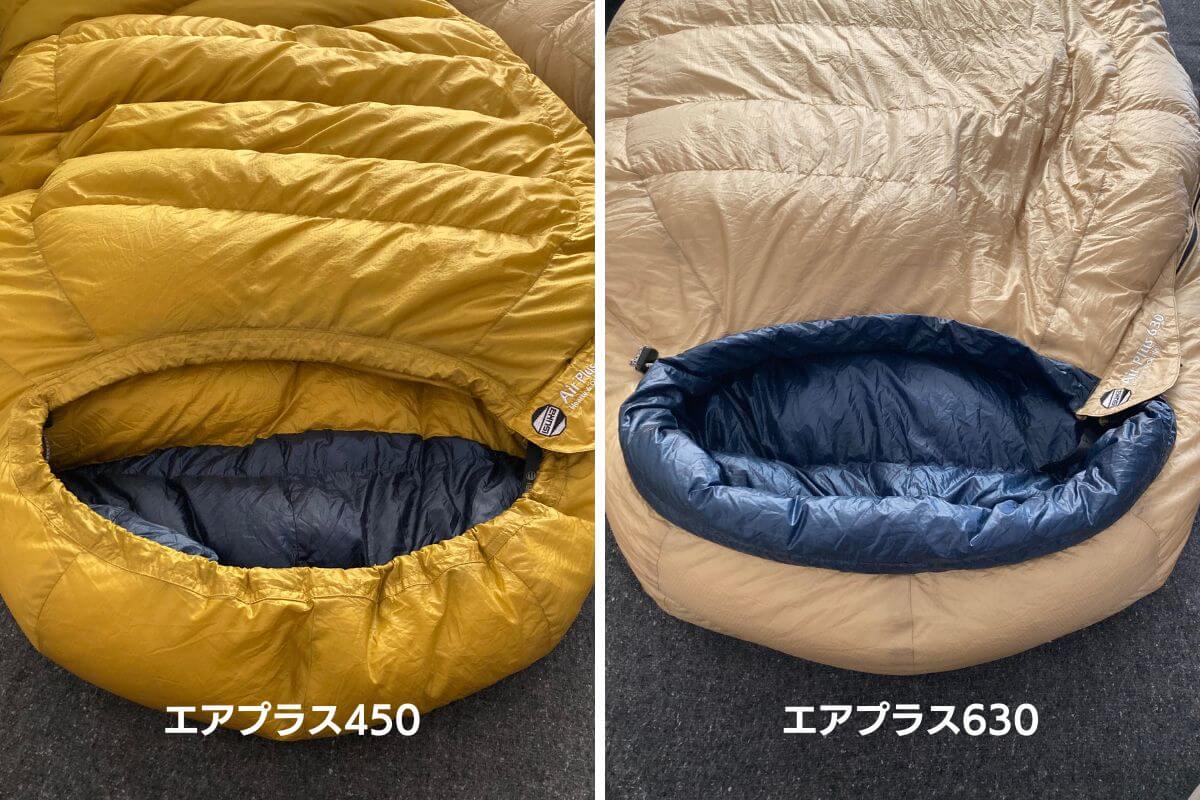
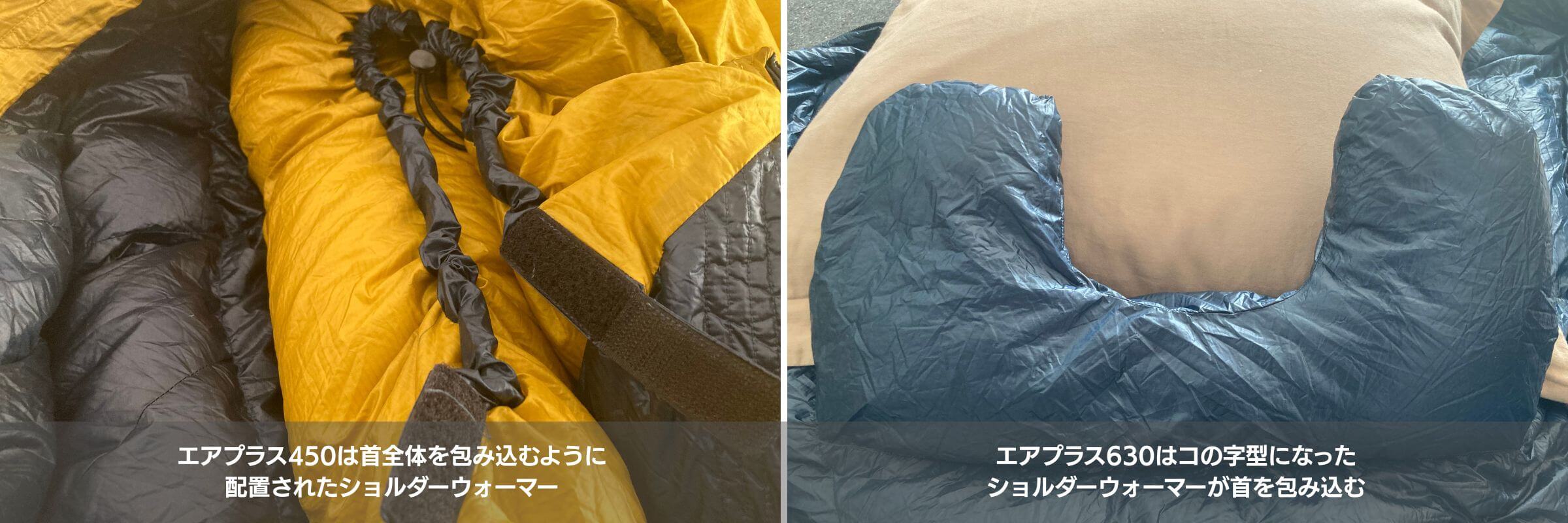
Not only that, the shoulder warmers and hoods also have different specifications. The Air Plus 630 features a hood tube that reduces heat loss from the head, and has distinctive "U-shaped" shoulder warmers that softly cover the area around the neck

The Air Plus 630 also has down around the hood to prevent cold air from getting in

The shoulder warmers used in the Air Plus 450 are tightened with a drawstring, which can feel a bit restrictive, but the ``L-shaped'' shoulder warmers on the Air Plus 630 do not feel restrictive and wrap around the neck
Opinions differ regarding the structure of shoulder warmers, but I personally find the Air Plus 630 easier to use because I don't have to tighten the drawcord every time I get in or out
Point 5: A simple zipper with a smooth, non-binding slider
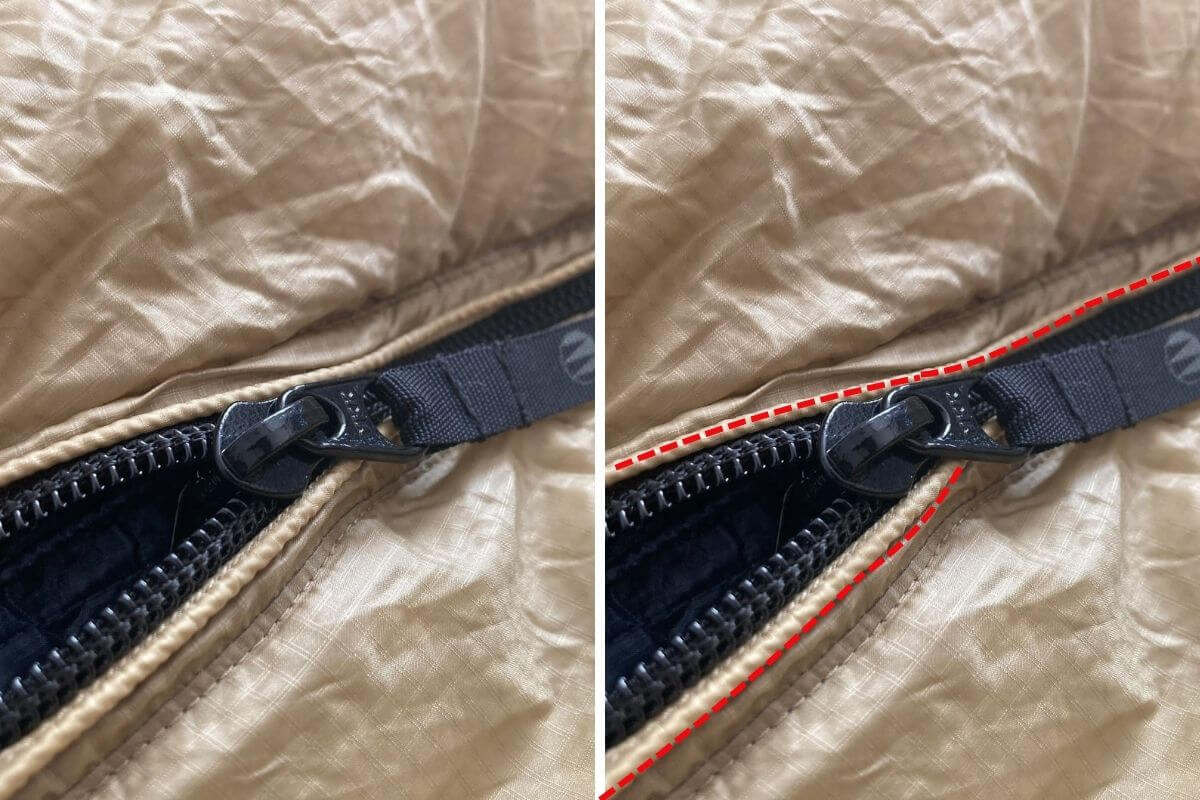
It's frustrating when a zipper gets caught in the fabric when getting in and out. Isuka's sleeping bag zipper doesn't get caught in the fabric and opens and closes very smoothly. It looked like a simple zipper with no particular design, so I asked Isuka about it. They told me that the zipper doesn't get caught in the fabric because they run a thread along the zipper to prevent it from getting caught in the fabric

The thread is threaded through the red dotted lines to prevent the fabric from getting caught
I hadn't noticed it at all until I heard about it, but if you look closely, you can see that there is indeed a thread running along both sides of the zipper. This is an ingenious design that is not visible to the naked eye, making it easier for the user to use
It's so smooth that it opens up by itself while you're sleeping, which is a bit annoying
The zipper opens and closes smoothly without any stress, but it's so smooth that it tends to open up when you move around while sleeping. Make sure to fasten it all the way up and make sure to fasten the Velcro on the zipper garage securely each time, otherwise gaps will appear before you know it
What I learned from actually using it: the "minimum operating temperature" set by Iska
Many sleeping bags currently on the market have a reference temperature range based on the same standard set by a third-party organization called European Norm (EN) 13537. This test involves placing a thermal manikin inside the sleeping bag in an environment maintained at a temperature of 20°C, humidity of 64%, and a wind speed of 0.35m/s, and calculating three indices: "comfortable temperature," "lower limit temperature," and "limit temperature."
Rather than publishing the European Norm (EN) 13537 test results in their catalogs, Iska calculates and publishes their own minimum operating temperature based on accumulated data and experience. However, this makes it difficult to accurately compare their products with other manufacturers that display European Norm test results. When I asked why, I was told that the mannequins used for testing sleeping bags are those with a typical European skeletal structure, which differs from the Japanese body type, making test results insufficient. Another example: even when using the same amount and quality of down filling, the fabric material can sometimes produce significant differences in test results. As an example, I was told that a sleeping bag with high waterproofing will have a higher test result for heat retention. However, when a person actually gets inside a sleeping bag, they don't feel the increased heat retention, and the test results don't account for the discomfort caused by increased waterproofing. Therefore, Iska conducts its own tests in addition to European Norm testing to calculate the minimum operating temperature
Rather than just displaying the test results of European standards, they conduct their own tests to suit the Japanese environment and calculate the results based on accumulated data and experience, which shows their commitment as a manufacturer
However, please understand that neither the European Norm test results nor the independently calculated figures are guaranteed, and I think it is best to use them as reference values to help you choose a sleeping bag with a certain degree of leeway
Isuka's minimum operating temperature as seen from field experience

Although these figures are calculated from accumulated data and experience, it's tempting to wonder how they actually perform. To find out, I used the Air Plus 450 & 630 and tried sleeping in a variety of environments. Here's my own conclusion: using them alone at the manufacturer's minimum recommended temperature was tough
I felt that the minimum temperature range published by Iska was close to the "lower limit temperature" defined in European Norm (EN) 13537. I have used two other Iska sleeping bags in addition to the Air Plus series introduced here, and they felt roughly the same
If you're unsure which model to choose
The Air Plus series comes in four different types depending on the temperature range in which it is used
Since everyone's tolerance for cold is different, please use this conclusion as a reference only, but in both cases, I felt cold even when inside the sleeping bag in environments close to the minimum use temperature, and it was not possible to say that I could sleep comfortably. However, that does not mean that they cannot be used in environments at or below the minimum use temperature. It is entirely possible to stay comfortable by taking measures such as wearing warm clothing, covers, and innerwear depending on the situation. I used them in an environment below the minimum use temperature to confirm the limits of use, but if you are actually going to use them, it is safer to choose a sleeping bag with a little leeway based on the minimum use temperature
In terms of the Air Plus 450 and 630, the Air Plus 450, which has a minimum operating temperature of -7°C, can be used comfortably up to around -3 to -5°C, while the Air Plus 630, which has a minimum operating temperature of -15°C, can be used comfortably up to around -10°C
Conclusion and Summary: The Air Plus is an all-around sleeping bag that can be used by anyone
As the UL (ultralight) culture spreads across the world of mountaineering and hiking, there is a fierce competition to create lightweight gear. There are models that eliminate hoods and sleeping bags with cut-out backs to make them even lighter, but these are items that can only be used by experienced experts who know their own "comfort zone" inside and out
When it comes to sleeping, sacrificing comfort is not the answer. In harsh environments, "warmth" is essential. We do not recommend lowering the specifications of your sleeping bag in order to reduce weight. (I myself have made the wrong choice of sleeping bag in my quest to reduce weight, resulting in countless cold nights.)
Even as a UL-oriented writer, I agree that "lightness is great," but it's also true that there aren't many sleeping bags that are both "light and comfortable." I recommend the Air Plus sleeping bag made by Isuka, which can be used easily and safely by people of all experience levels
Please consider a paid membership to support the website while enjoying exclusive articles and events!
Yosuke C

A person who travels around with just one backpack, with the motto of "as light as possible" without causing inconvenience
From spring to autumn, I go fishing in mountain streams in pursuit of char deep in the mountains. I hike the mountains in search of spectacular views that cannot be seen from the ground. I camp to be soothed by a bonfire. I snowboard to experience the feeling of floating in the silvery white mountains. I have been an outdoor enthusiast for over 20 years and am a freelance writer who enjoys the outdoors in my own way all year round. Drawing on my experience writing articles for over a dozen outdoor web publications, I will be sharing my own experiences and the gear I have found to be great

"Let's start a tent hiking trip with NEMO" Camping items that will be available at the tent hiking event in May
Comparison Review: Winter Down Sleeping Bags - Which one will keep you warm and sound asleep even in the freezing cold of the winter mountains?
Stay warm from the inside out with the perfect sleeping bag – How to choose and 8 recommendations
How to choose a winter sleeping bag for a comfortable winter tent stay in the mountains and our top 8 recommendations