



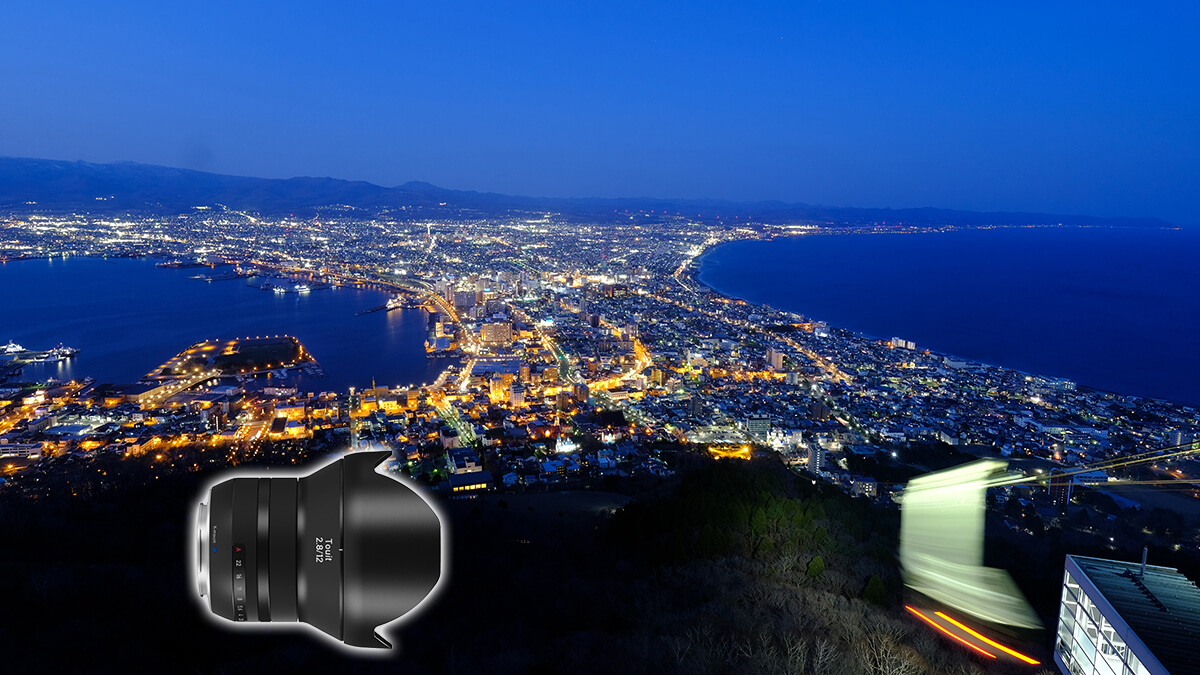
[You can actually enjoy it for free!] The spectacular view from Mt. Hakodate, which even locals don't know about, is a double treat!

Written by Saito Titoce
I'm a bit of an oddball, but when I try out a new lens, I feel like taking photos of charts. So, I had the opportunity to try out the Zeiss wide-angle prime lens, the ZEISS Touit 2.8/12. It happened to be during a period when the night view of Mt. Hakodate, which even locals don't know about, is free to view, so I went out to take some photos. I'd like to share what I experienced
table of contents
- What is the Zeiss "ZEISS Touit 2.8/12"?
- Night view of Mt. Hakodate
- When can you enjoy the night view of Mt. Hakodate, a Michelin Guide ★★★-rated spot, for free?
- Even in April, it can get so cold that puddles on the summit freeze, so be careful
- Prepare a tripod and take the photo at a time when the sky is still blue and the city lights are bright enough
- The ZEISS Touit 2.8/12 offers high resolution from the widest aperture, with peak resolution at around F5.6
- Mt. Hakodate sunrise
- Summary: Enjoy the spectacular view from Mt. Hakodate during the free night view period and at sunrise
- For more information and to purchase the ZEISS Touit 2.8/12
What is the Zeiss "ZEISS Touit 2.8/12"?
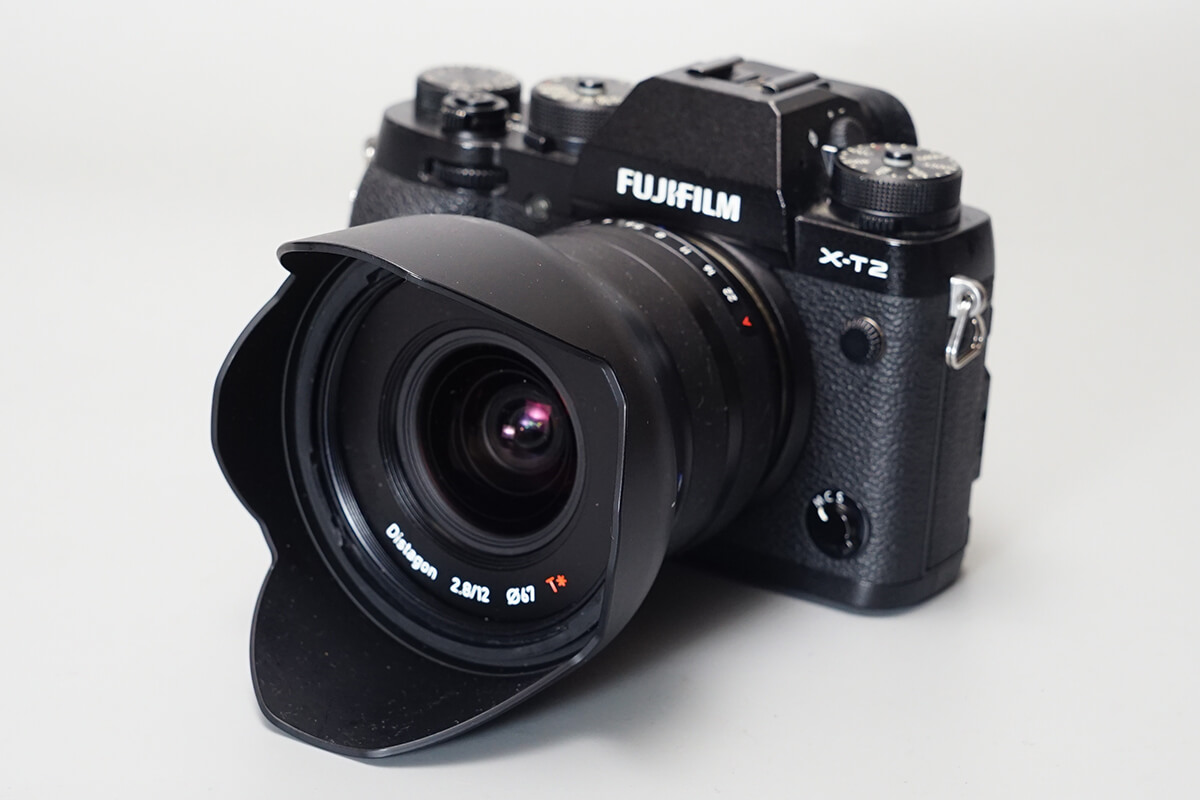
The ZEISS Touit 2.8/12 mounted on the FUJIFILM X-mount X-T2. Compact and well-balanced with the body, it's a lens you'll want to take with you wherever you go
Wide-angle prime lens from the Zeiss Touit series, also available for the Fujifilm X mount
The author originally worked as an editor for a monthly camera magazine, and is actually a liberal arts camera and lens geek. He has written many articles about cameras and lenses for camera and gadget websites, but his love of lenses has led him to publish e-books on Amazon Kindle, such as "Lens Database" and "Lens Lab," which feature the results of shooting with original lens analysis charts, together with his lens review mentor, Soji Koyama
I started taking lens charts because I couldn't really understand the evaluation criteria used in many lens reviews, such as resolution and bokeh beauty. I wanted to understand the differences in lens depiction, but I didn't have any guidelines to use as a standard, so I created the current evaluation criteria with Soji Koyama, based on actual photo charts
In fact, we have already completed chart analysis for the "Batis" and "Loxia" lenses for 35mm full-frame Sony E-mount cameras, which are currently sold in Japan as ZEISS lenses, and published them as part of the "Lens Lab" series. However, we have not had the opportunity to test the "Touit" series, which is available for FUJIFILM X-mount and Sony E-mount cameras for APS-C cameras, and have not been able to conduct chart analysis. However, we have finally had the opportunity to test the "ZEISS Touit 2.8/12," "ZEISS Touit 1.8/32," and "ZEISS Touit 2.8/50M" in various outdoor situations, and we plan to share the results with you
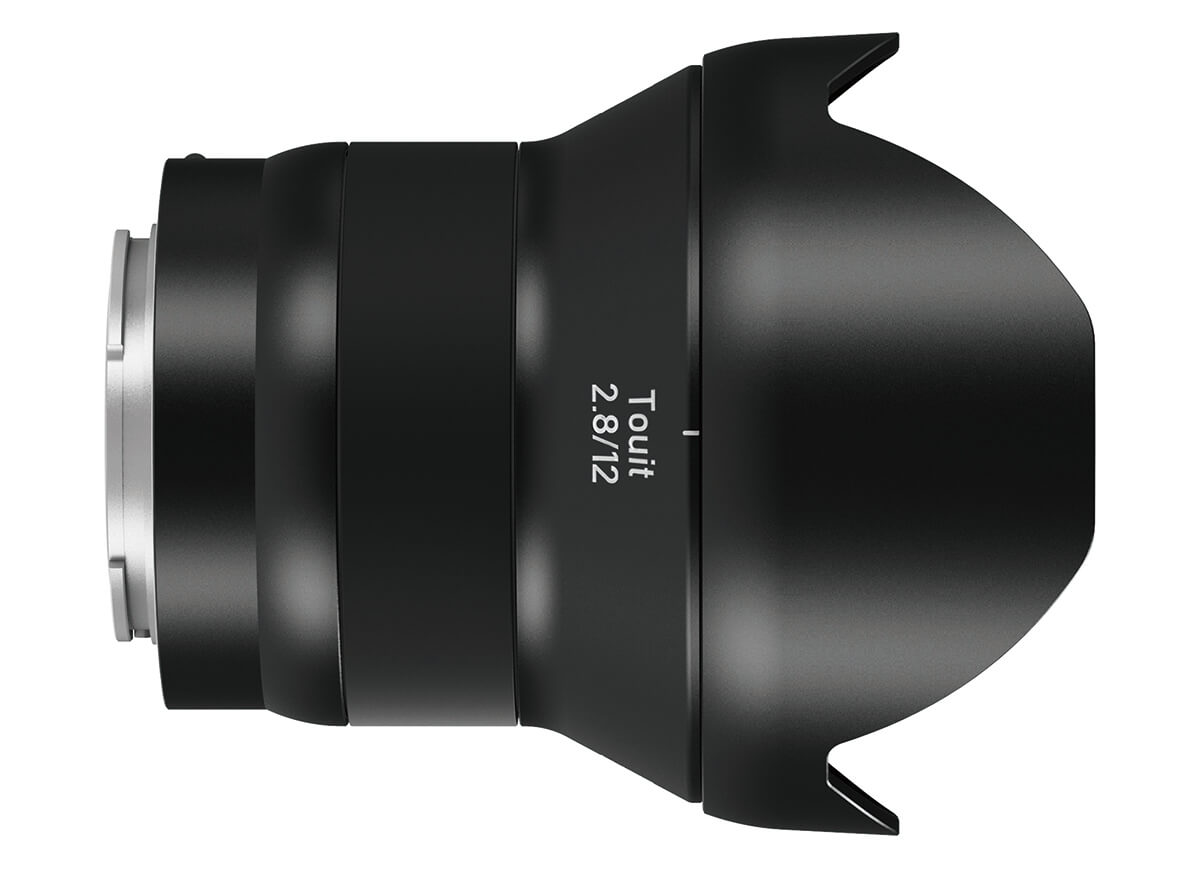
As an additional bit of nerdy information, as you can see in the photo above, the "ZEISS Touit 2.8/12" for Sony E-mount does not have an aperture ring
This time, we are introducing the first of these, the wide-angle prime lens "ZEISS Touit 2.8/12." Zeiss, which currently produces the ZEISS brand, is one of the two legendary companies in the lens optics industry. In the camera lens industry, Zeiss and Leica are in a completely different league, and are highly coveted brands. In the outdoor industry, Zeiss also has an unshakable position as an ultra-luxury brand of binoculars
The ZEISS Touit 2.8/12 is a wide-angle prime lens for APS-C mirrorless cameras. Its market price is around 120,000 yen. As mentioned above, it's available for both FUJIFILM X-mount and Sony E-mount cameras. The focal length of the lens is 12mm, but since it's mounted on an APS-C camera, the actual angle of view is equivalent to 18mm. The lens's brightness is also f/2.8
The ZEISS Touit 2.8/12 lens, with its 11 elements in 8 groups, is lightweight and compact, measuring approximately 82mm in diameter and 81mm in length (including the cap), weighing just 260g for the Sony E and 270g for the FUJIFILM X. The integrated lens hood is a beautiful design that will give you the joy of owning it
The ZEISS Touit 2.8/12 has a minimum focusing distance of just 18cm, and boasts a luxurious 10-blade aperture, which is rare for a wide-angle lens. I took the ZEISS Touit 2.8/12 to photograph the night view of Mount Hakodate, one of Hokkaido's most famous tourist spots
Recommended points
- Zeiss-like delicate and detailed depiction
- Lightweight, compact and beautifully designed to satisfy your desire to own it
- Beautiful bokeh with 10 blades, rare for a wide-angle lens
- Low aberrations such as axial chromatic aberration, lateral chromatic aberration, and distortion
- The coveted T* coating that is highly effective against flare and ghosting
Points of interest
- The price seems high considering the specs
Main specifications and evaluation
| item | ZEISS Touit 2.8/12 |
|---|---|
| focal length | 12mm |
| Aperture range | F2.8-F22 |
| Lens construction | 11 elements in 8 groups |
| Minimum focusing distance | 0.18m |
| Angle of view (diagonal/horizontal/vertical) | 99° / 39° / 66° |
| Shooting magnification | 1:7.2 |
| Aperture blades | 10 sheets |
| Filter diameter | 67mm |
| Maximum diameter | 82mm |
| full length | Sony E: 81mm / FUJIFILM X: 86mm (both including caps) |
| weight | Sony E: 260g/FUJIFILM X: 270g |
| design | ★★★★☆ |
| Resolution | ★★★★☆ |
| Portability | ★★★★☆ |
| The beauty of bokeh | ★★★★☆ |
| Low aberration | ★★★★☆ |
| Cost performance | ★★★☆☆ |
Night view of Mt. Hakodate
When can you enjoy the night view of Mt. Hakodate, a Michelin Guide ★★★-rated spot, for free?
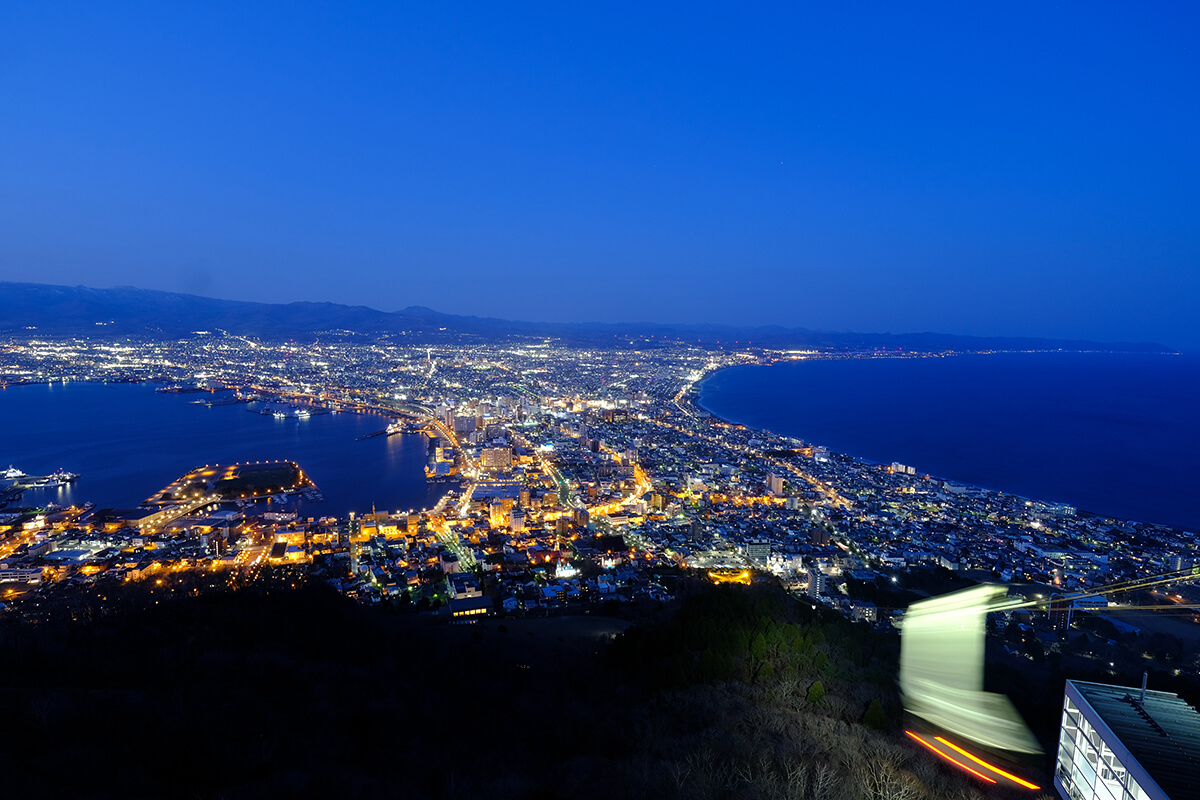
ZEISS Touit 2.8/12 / FUJIFILM X-T2 / 18mm equivalent / Aperture-priority AE (F5.6, 5 seconds) / ISO 200 / Exposure compensation: +0.67EV / WB: Sunny / Film Simulation: Velvia / Tripod: SLIK Light Carbon E84 II Mt. Hakodate is a world-famous spot for its night views. The sky still retains its blue hue, and the time when the city lights are fully lit is very short. I wanted to capture this moment
Mount Hakodate is famous as a tourist destination in Hokkaido and as a famous spot for night views in Japan. The night view from Mount Hakodate is an exquisite sight, earning it three stars in the Michelin Guide. However, since it is generally not possible to climb to the summit in your own car or a rental car during the hours when the night view is at its most beautiful, you will generally have to use the ropeway, bus, or taxi to enjoy the night view, which requires a fee
Furthermore, from November to early April, when the mountain trails are closed due to snow, the only option is the ropeway. The round-trip fare for this ropeway is 1,800 yen for adults (middle school students and above) and 900 yen for children. Therefore, a round-trip fare for a family of two, including a couple with a middle school student and an elementary school student, would be around 6,300 yen
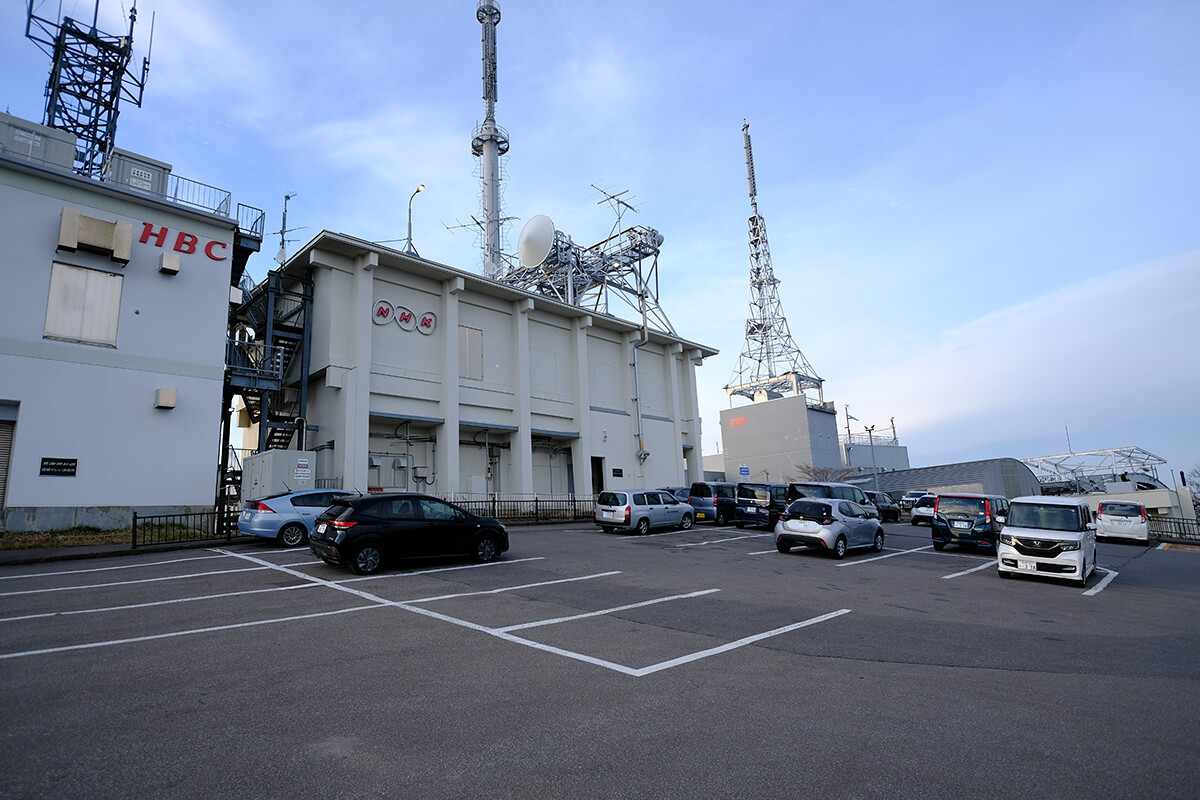
There is a parking space for regular cars at the top of Mt. Hakodate. There aren't many spaces reserved, so it's best to arrive early
If you're only going once for sightseeing, it's probably fine, but for someone like me who visits Mount Hakodate several times a year to take photos, it's a bit pricey. If you're not careful, you might end up climbing for two days in a row, as I did this time, so the recommended time for such people is from early to mid-April, for about 10 days
Even after the snow melts on the mountain trails, traffic restrictions are in place for private cars and rental cars from 5pm to 10pm from late April to September, and from 4pm to 9pm from October to mid-November, when the night view is at its best. However, for about 10 days from early to mid-April, there will be no traffic restrictions for private cars or rental cars. For more details, the Hakodate City Official Tourism Site, Hakobura, to find detailed dates. In 2024, there will be an 11-day period without traffic restrictions, from April 8th to April 18th.
Even in April, it can get so cold that puddles on the summit freeze, so be careful
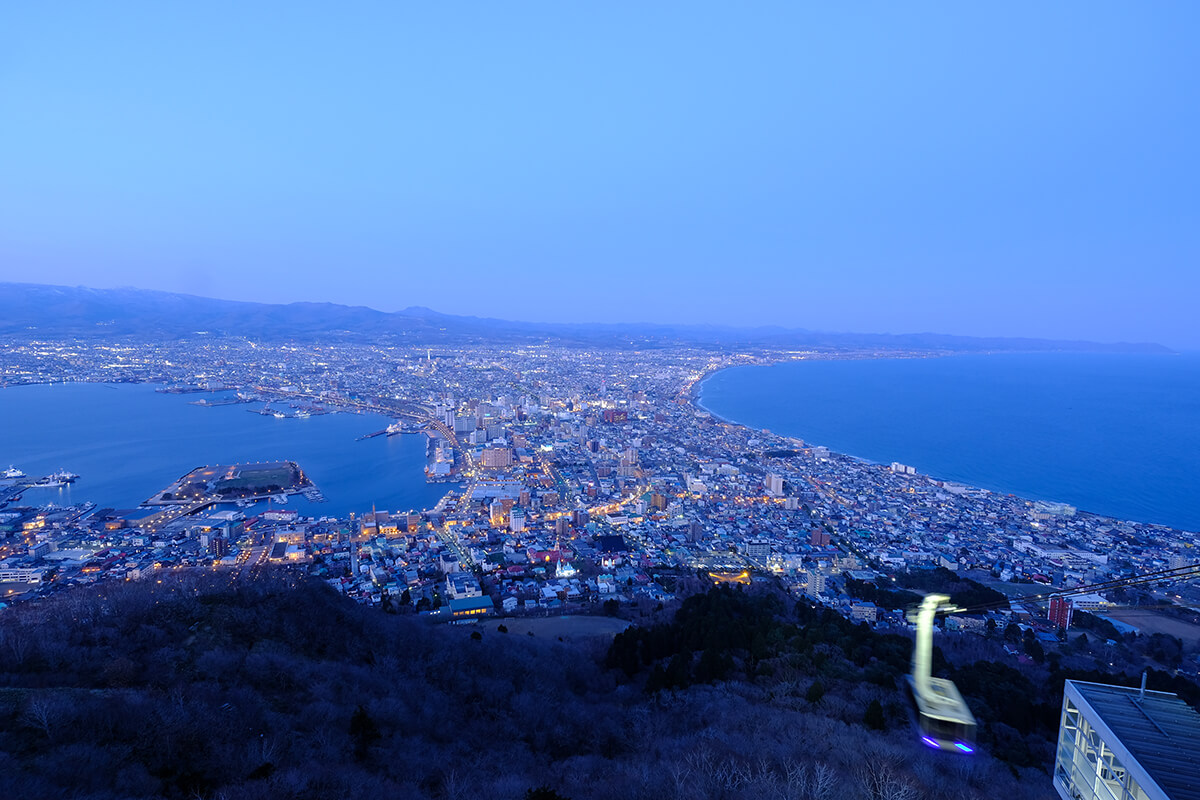
ZEISS Touit 2.8/12 / FUJIFILM X-T2 / 18mm equivalent / Aperture-priority AE (F5.6, 1.2 seconds) / ISO 200 / Exposure compensation: +0.67EV / WB: Sunny / Film Simulation: Velvia / Tripod: SLIK Light Carbon E84 IIThis is
a test shot taken about 10 minutes before the previous photo. The shooting settings were almost the same, so the impression of the photo is completely different even with a shooting time difference of just 10 minutes.
In 2024, on April 9th and 10th, I took my ZEISS Touit 2.8/12 to the observation deck at the top of Mount Hakodate in my car to photograph the night view, after traffic restrictions on private cars and rental cars had been lifted. There are two things to keep in mind when doing this
One is that, although it depends on the weather, the summit of Mt. Hakodate in April can be as cold as mid-winter.
The other is that if you want to avoid the crowds, make sure to secure a parking spot before sunset.
Many people seem to underestimate the cold of Hakodate in April, when the snow has melted, and are surprisingly lightly dressed as they wait for the night view. However, when I went on April 9th, the summit of Mount Hakodate was so windy that the ropeway was stopped. The temperature was 2.2°C during the night view time, but the puddles I found near the summit after photographing the sunrise the following day were solidly frozen. The strong winds on the exposed summit and temperatures that can drop below zero even in April require mid-winter gear
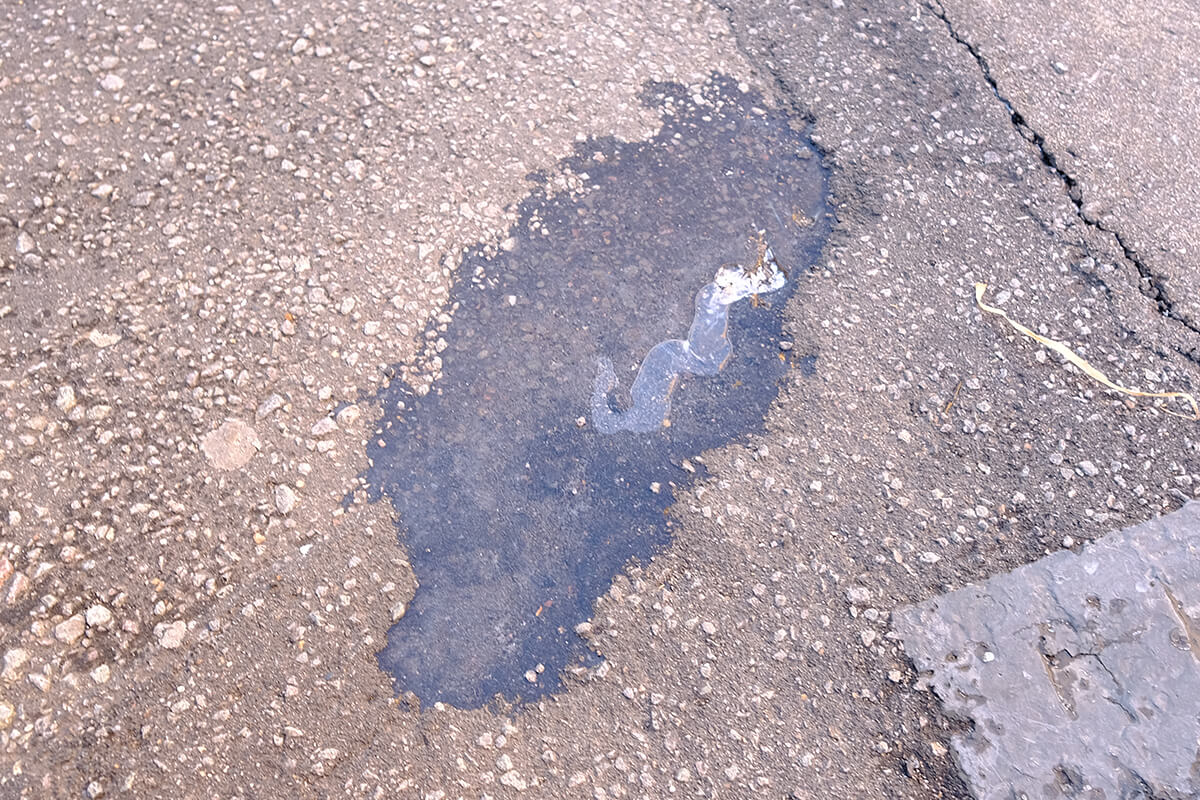
Even though it was April 10th, when I finished taking photos during the morning sun, the puddles on the summit of Mt. Hakodate were frozen solid, as you can see in the photo. You should expect it to be this cold
I had expected it to be quite cold, so I wore a long winter down coat over a thin down jacket, but it was still so cold that my hands went numb even in my thin gloves. Tourists dressed in spring clothes were really shivering. If you're going to see the night view of Mt. Hakodate, I recommend bringing proper winter gear
Also, with it being this cold, you'll probably want to keep your time at the summit as short as possible, but we recommend arriving at the observation deck at the summit before sunset and securing a parking spot. The summit of Mt. Hakodate is generally subject to traffic restrictions for private cars and rental cars almost all year round during the night view hours, so there isn't much parking space. Therefore, if you arrive at the summit at the peak of the night view hours, there may not be any parking spaces available
We recommend that you bring warm clothing and arrive at the summit early in the day
Prepare a tripod and take the photo at a time when the sky is still blue and the city lights are bright enough
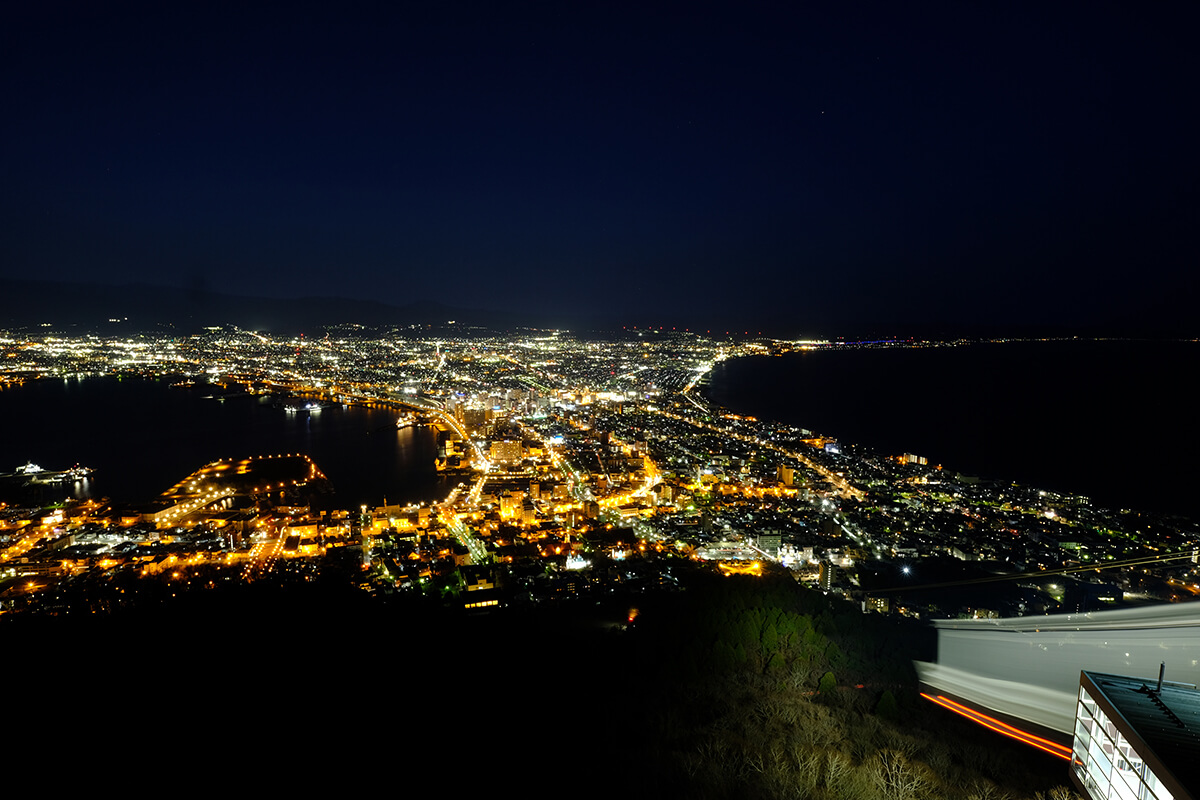
ZEISS Touit 2.8/12 / FUJIFILM X-T2 / 18mm equivalent / Aperture-priority AE (F8.0, 14 seconds) / ISO 200 / Exposure compensation: +0.67EV / WB: Sunny / Film Simulation: Velvia / Tripod: SLIK Light Carbon E84 IIYou
might find it hard to believe, but this photo was taken about 15 minutes after the first night view photo. Unfortunately, you can see that the blue of the sky has disappeared.
When I visited Mt. Hakodate in early April, the sun set around 6:10 p.m., and it gradually got darker from there. The lights came on in the houses and buildings around town, and the best time to photograph the night view, with its characteristic brightness and the blue of the sky, was from around 7 p.m. for about 20 minutes. Of course, this varies depending on the season and weather, so I set my camera on a tripod and waited for this moment to start shooting from around sunset. Incidentally, I changed my tripod this season to SLIK's new "SLIK Light Carbon E84 II," and I was looking forward to using it
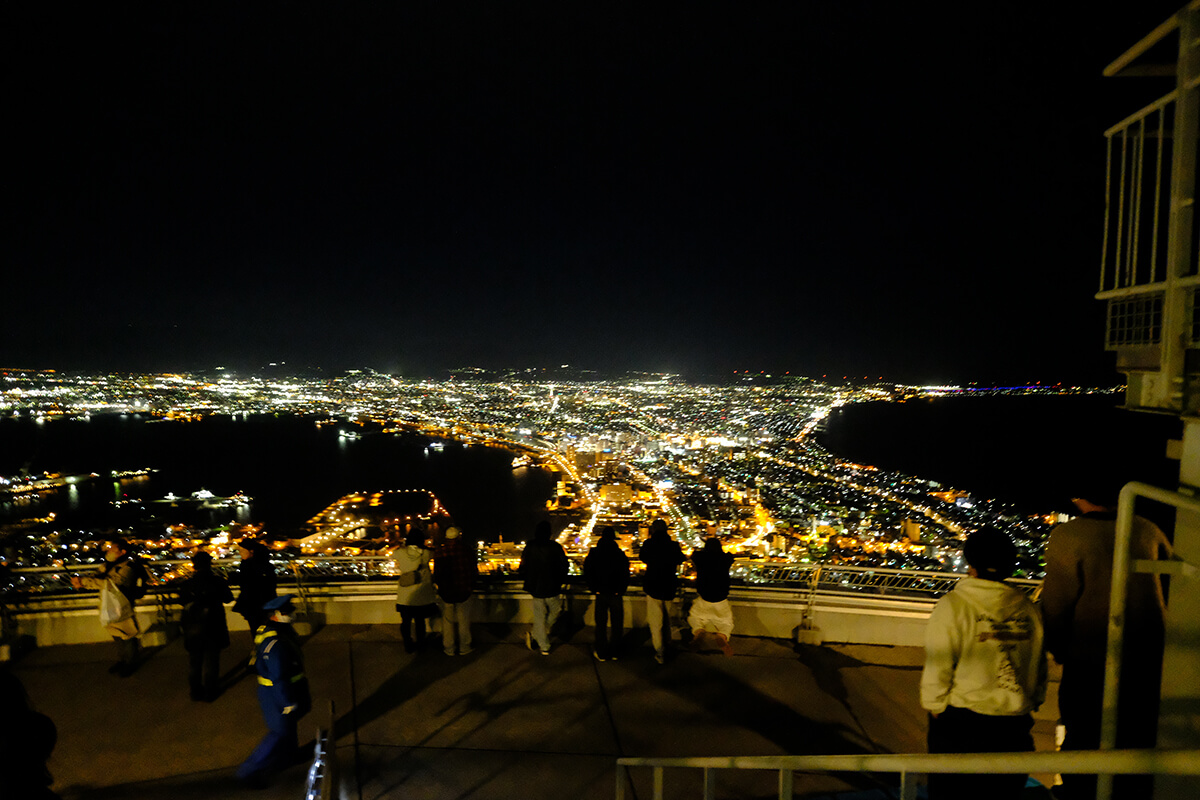
Even though the ropeway was stopped due to strong winds, many tourists were at the observation deck at the summit of Mt. Hakodate during the night view time. The photo shows it being quite empty
To briefly explain the shooting settings, the shooting mode is aperture-priority AE, and the aperture, in the case of the ZEISS Touit 2.8/12, is either the brightest aperture of F2.8 or F5.6, which maximizes overall resolution. The white balance is set to sunny, the color mode is set to vivid, and in the case of the FUJIFILM X-T2 used this time, the film simulation is set to Velvia, preferably at a base ISO of 200, while varying the exposure compensation between -1.0EV and +1.0EV. Naturally, a tripod is essential when shooting night scenes at low ISO. I use a sturdy tripod with a pipe diameter of around 28mm, such as the SLIK Light Carbon E84 II
Ideally, you'd want to shoot at a low sensitivity such as ISO 200, which reduces noise, but the summit of Mt. Hakodate is often windy, and a low ISO sensitivity and slow shutter speed can result in blurring, even if you're using a tripod, so we recommend changing the ISO sensitivity and shooting at a faster shutter speed
The ZEISS Touit 2.8/12 offers high resolution from the widest aperture, with peak resolution at around F5.6
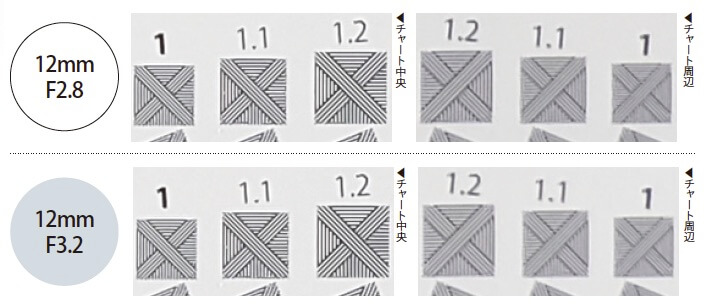
Shooting results for the ZEISS Touit 2.8/12 lens using the resolution chart. The reference chart is somewhere between 1 and 1.1. The center is very finely resolved even at the maximum aperture of F2.8
Whenever I have the chance to try out a new lens, I check its basic performance by taking photos of the resolution chart shown above, as well as a disc chart for bokeh, vignetting, minimum focusing distance (macro), axial chromatic aberration, and, for wide-angle lenses, actual-action charts for sagittal coma flare. I have published a collection of data that compiles this information in the "Lens Database" e-book series, and for the "ZEISS Touit 2.8/12" that I took to Mt. Hakodate this time, I have published a collection of data called the " ZEISS Touit 2.8/12 Lens Database ," some of which I have reproduced in this article.
Since I had completed these tests before shooting the night view at Mt. Hakodate, I decided that if I were to shoot with the ZEISS Touit 2.8/12, I would either shoot at F5.6, which maximizes overall resolution, or at the maximum aperture of F2.8, which maintains sufficient brightness while still providing high resolution. Because the ZEISS Touit 2.8/12 tends to suffer from resolution loss due to stopping down too much, as well as diffraction and small aperture blur, at smaller apertures, I decided that there was no need to stop down to F8.0, which is often considered the peak resolution for most lenses (although this is often not the case)
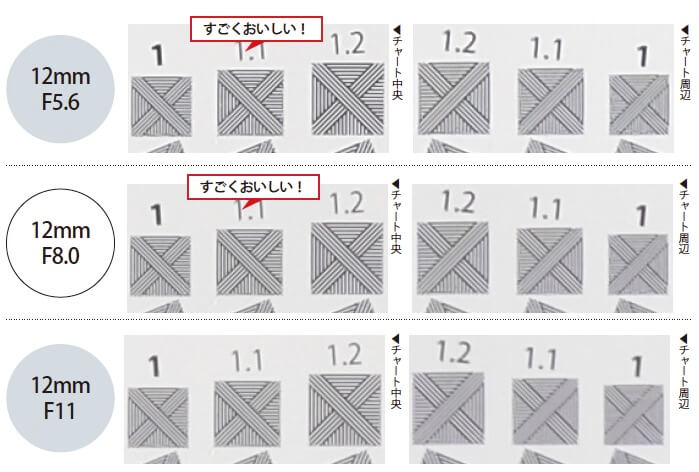
The ZEISS Touit 2.8/12's overall resolution peaks between f/5.6 and f/8.0. Resolution starts to drop off around f/11, so I prefer to use f/5.6
We have also included the results of a resolution chart taken at aperture values of F5.6, F8.0, and F11, which are the peak resolution values. At F11, there is a clear tendency for resolution to decrease due to stopping down too much, so we can conclude that stopping down to around F5.6 is sufficient for the ZEISS Touit 2.8/12
By the way, the ZEISS Touit 2.8/12 produces a delicate yet sharp depiction in the center at around f/2.8, but while maintaining delicate resolution, the periphery appears to have a slightly weaker contrast. As the aperture is narrowed, the periphery also becomes more delicate and detailed, with a tendency for the depiction to become higher in contrast, and I believe that the peak of resolution across the entire image is between f/5.6 and f/8.0. At f/11, there is a tendency for resolution to decrease slightly due to being stopped down too far, so I personally prefer f/5.6 to f/8.0
This resolution chart also examines the amount of distortion and lateral chromatic aberration that occur based on overall distortion, and the ZEISS Touit 2.8/12 has minimal aberrations, making it a testament to the quality of a ZEISS lens
Mt. Hakodate sunrise
Free for the morning glow! We also recommend renting a car and visiting the day after seeing the night view
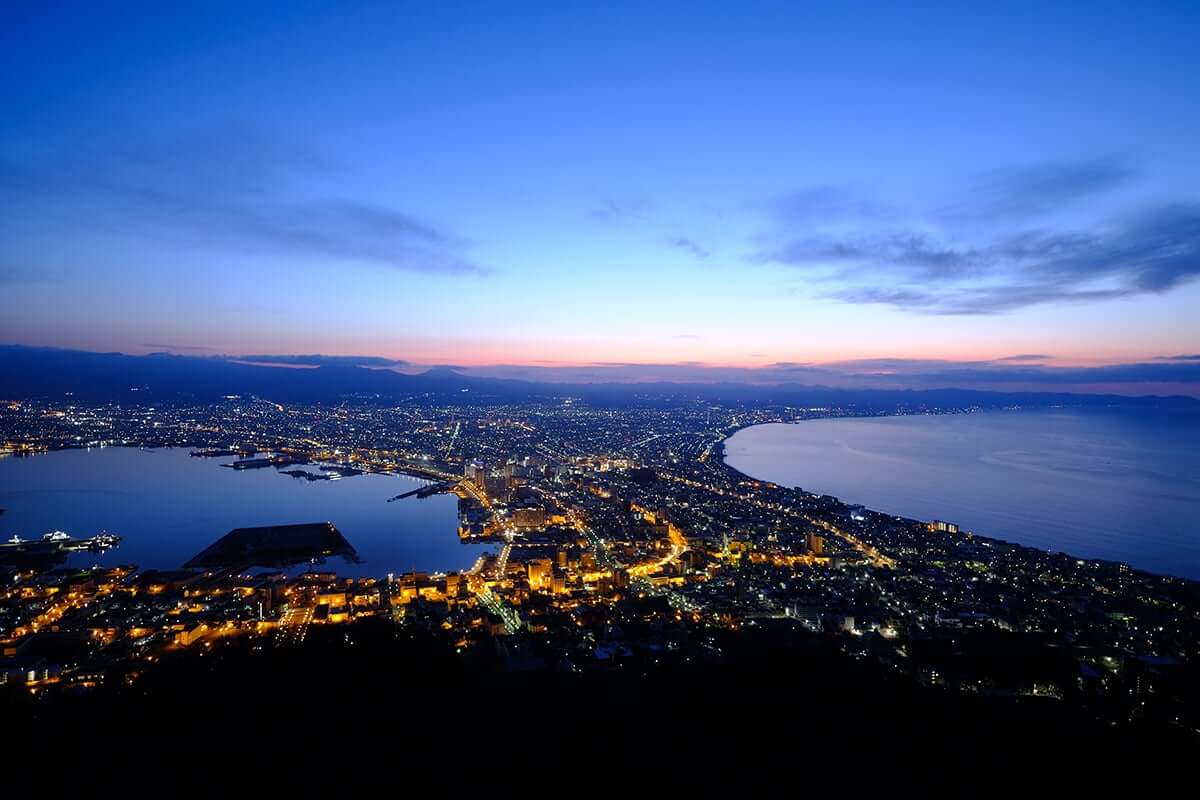
ZEISS Touit 2.8/12 / FUJIFILM X-T2 / 18mm equivalent / Aperture-priority AE (F2.8, 1.2 seconds) / ISO 200 / Exposure compensation: +1.0EV / WB: Sunny / Film Simulation: Velvia / Tripod: SLIK Light Carbon E84 IIThis
photo was taken just before dawn. It's a shame that the city lights are less prominent compared to the peak of the night view, but the red of the morning glow in the background sky is beautiful and to my liking.
There are only about 10 days a year when you can enjoy the night view of Mt. Hakodate for free, whether in your own car or a rental car, and the free period for 2024 ended on April 18th. So, you might be wondering, what should you do if you want to go see the spectacular view of Mt. Hakodate from now on?
If you're visiting Hakodate, you should definitely see the beautiful night view after sunset, so I recommend using the ropeway or bus.However, as a frequent visitor to Hakodate, I often climb to the top of Mt. Hakodate in my own car or a rental car, except during the free period, to see the sunrise.The photo above is actually not a night view, but a photo taken just before dawn
The traffic restrictions on Mt. Hakodate are in place to avoid congestion during the night view hours, so they are in place from 5pm to 10pm from late April to September, and from 4pm to 9pm from October to mid-November. There are no traffic restrictions during the day, midnight, or early morning. Please note that the hiking trails are closed due to snow from late November to early April
The night view from Mt. Hakodate is viewed from the summit overlooking the city area that spreads out to the northeast. Therefore, the sunset sets in the opposite direction from the direction you are viewing the night view, but the sunrise, although it changes depending on the season, rises from behind Hakodate city. In fact, the observation deck at the summit of Mt. Hakodate is a world-famous spot for night views and is also a beautiful viewpoint for the sunrise
So, even if you're visiting during a period when you can't go up to the summit of Mt. Hakodate for free during the night view period by personal or rental car, you can still save money by heading to the summit during sunrise. While we would love to see the night view as well... it has a different kind of beauty from the night view, so we also recommend starting your Hakodate sightseeing tour with the sunrise over Mt. Hakodate the day after seeing the night view
Delicate and precise depiction produced by minimal aberrations and the coveted T* coating
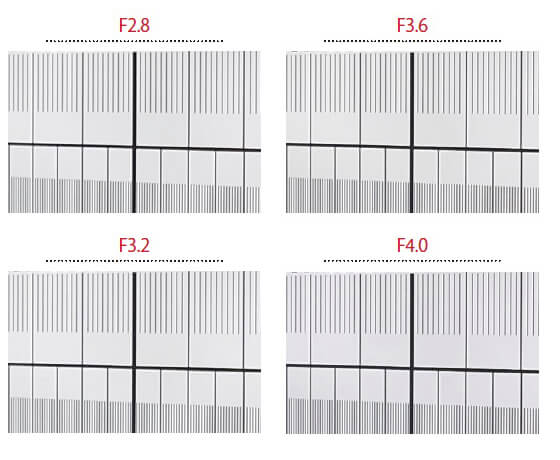
We checked the axial chromatic aberration of the ZEISS Touit 2.8/12. There is absolutely no red or blue color that doesn't exist before or after the focal point. It's excellent
This time, I shot a night view and a sunrise scene from Mt. Hakodate as a real-life test of the ZEISS Touit 2.8/12. My impression of the ZEISS Touit 2.8/12 is that, like the Batis and Loxia lenses, it's not high contrast or exceptionally sharp, but rather a detailed depiction that's the result of a collection of delicate points and lines. It's this delicate, detailed depiction that has many users becoming hooked on Zeiss lenses once they've used them
Like many users, I am strongly drawn to the image quality of Zeiss lenses, including the ZEISS Touit 2.8/12, but what is the difference? Looking at the actual image charts once again, I was struck by the fact that there are very few aberrations. As can be seen in the actual image chart of axial chromatic aberration shown above, the distortion and lateral chromatic aberration observed in the resolution chart are also very low. The result of steadily eliminating the various aberrations that impede lens image quality appears to be the reason for the delicate and detailed image quality that captivates so many users
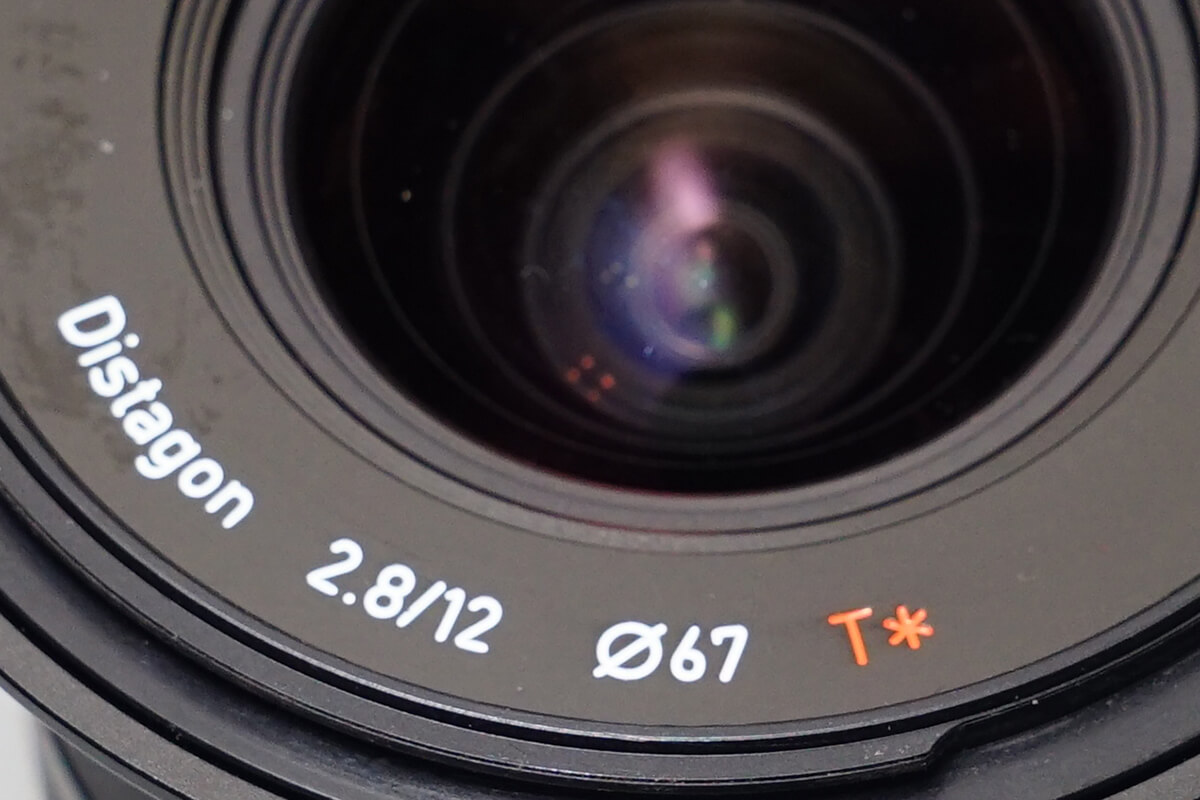
The letters "T* (T-star)" are engraved in red on the front of the lens, indicating that this is a coating that is coveted by many camera enthusiasts
Additionally, shooting sunrises and sunsets in completely backlit conditions is a scene that tests the performance of lens coatings, as flare and ghosting are likely to occur. The ZEISS Touit 2.8/12, which is coated with ZEISS's traditional multi-layer coating "T* (T-Star) Coating," showed almost no degradation in image quality, allowing for confident shooting. This is a typical result for ZEISS lenses, which lavishly use high-quality multi-layer coatings that can often increase costs
Summary: Enjoy the spectacular view from Mt. Hakodate during the free night view period and at sunrise
The ZEISS Touit 2.8/12 is a compact, high-performance wide-angle prime lens perfect for travel
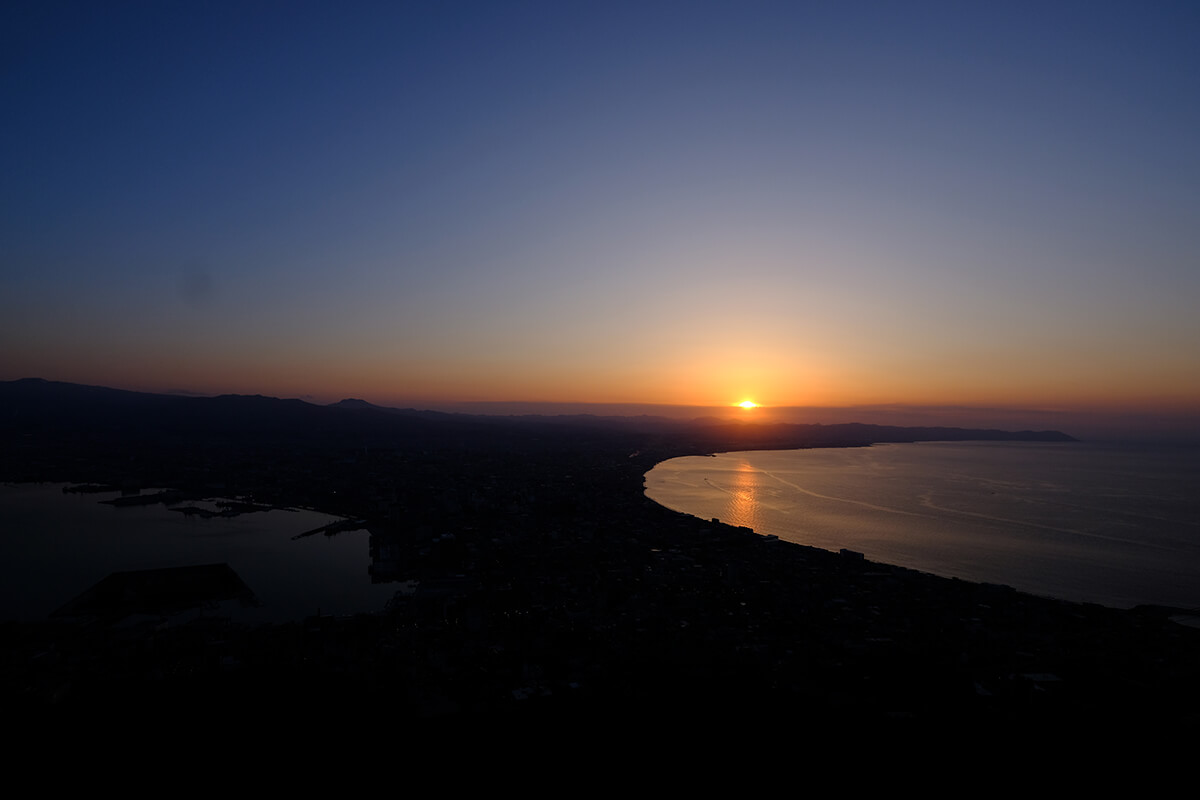
ZEISS Touit 2.8/12 / FUJIFILM X-T2 / 18mm equivalent / Aperture-priority AE (F5.6, 1/750 sec) / ISO 200 / Exposure compensation: -1.3EV / White balance: Sunny / Film simulation: Velvia / Tripod: SLIK Light Carbon E84 II
. This is a sunrise view of Mt. Hakodate. While the morning glow is a majestic sight, photographically it looks better before dawn. I recommend setting off so you arrive at the location before dawn.
Many people probably thought that the mountain trails on Mt. Hakodate are subject to traffic restrictions during night view hours, so it's impossible to reach the summit observation deck in a private or rental car. I spent part of my kindergarten, elementary school, and junior high school years in Hakodate, and my mother still lives there, but until recently I didn't know that there was a period during night view hours when you could climb the mountain for free. I think a surprising number of locals are unaware of this
If you happen to visit Hakodate during the free period, be sure to take advantage of it. Also, as we've included a photo, we highly recommend the sunrise time, which could be considered Mt. Hakodate's secret menu. You can enjoy climbing to the summit of Mt. Hakodate for free at any time except during the winter when the hiking trail is closed, so be sure to give it a try
I also visited Mount Hakodate to see the spectacular views of the ZEISS Touit 2.8/12, a compact and lightweight wide-angle lens weighing just 270g even for the Fujifilm X-mount, making it ideal for travel. While I didn't mention it in the sample image from the summit of Mount Hakodate, the ZEISS Touit 2.8/12 produces beautiful bokeh thanks to its generous 10-blade aperture. While many may find the numerical specifications of a prime lens with an effective focal length of 18mm and an aperture of f/2.8 unassuming, this is in a way a Zeiss signature. Experience it for yourself and you'll see that its understated yet delicate and detailed depictions captivate many photography enthusiasts
Scenery from mountaintops, night views, and sunrises are scenes that are relatively common when traveling, hiking, or outdoors, and a high-performance wide-angle lens like the ZEISS Touit 2.8/12 will help you record your memories even more beautifully. It's also a reasonably priced lens for a Zeiss camera, so if you're a FUJIFILM X-mount or Sony E-mount user, it's definitely worth considering

For more information and to purchase the ZEISS Touit 2.8/12
For more product details, please visit the Kenko Tokina official website
Chitose Saito
 A former editor of a monthly camera magazine, he became immersed in the outdoor lifestyle of campervans and car camping while pursuing Hokkaido's spectacular scenery and wildlife. He is currently a photographer and writer who travels all over Hokkaido with his wife and two-year-old son, capturing and writing about everything he experiences, from cameras and lenses to outdoor activities, camping, child-rearing, PC gadgets, cooking, and even dieting. For OUTDOOR GEARZINE, he plans to write a variety of articles, primarily for the "QOCL (Quality of camping life) Improvement Committee," which aims to improve the quality of life while camping and in a campervan
Related reading
 High-performance, lightweight, compact, and bright! Five reasons why the ZEISS Touit 1.8/32 is a premium standard prime lens recommended for outdoor travel
 [Makes forest walks three times more fun!] Why the high-performance ZEISS Touit 2.8/50M is recommended for both macro and portrait photography
 [You can drive to the summit!] I photographed the sunrise over a sea of clouds from the summit of Mt. Kamui with the Tokina atx-m 11-18mm F2.8 E
 A beautiful driving route loved by Hokkaido residents! A must-know for bad weather: the Ororon Line, explored with the OM System Big Three lenses