



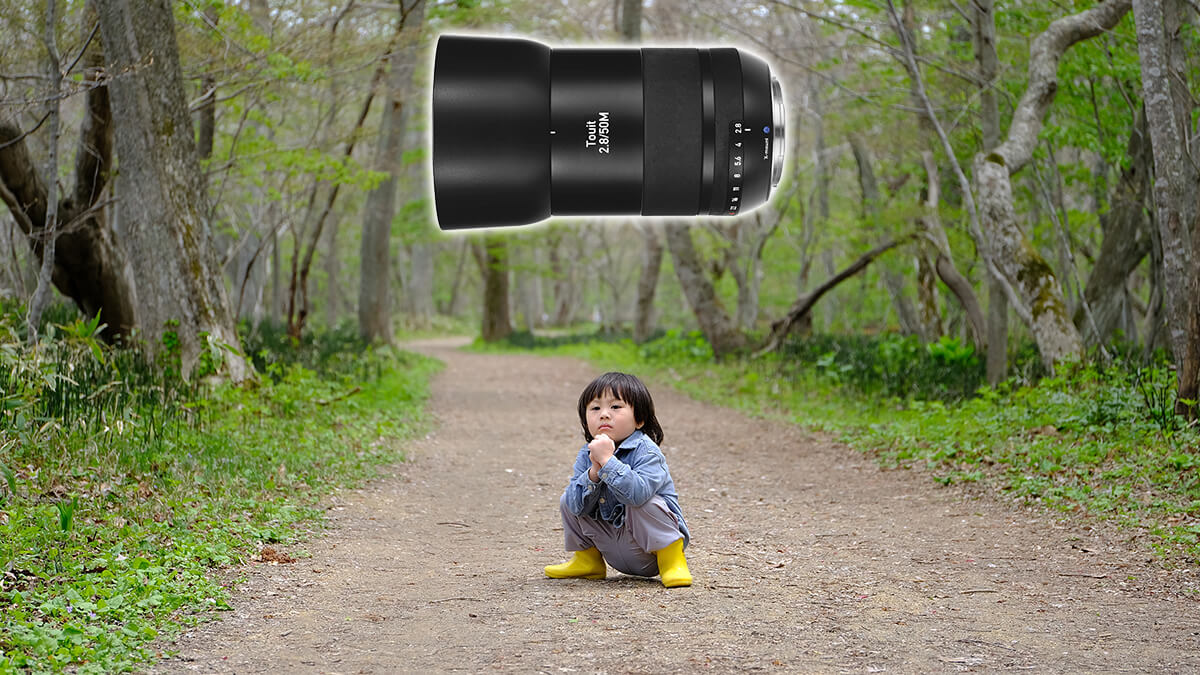
[Makes forest walks three times more fun!] Why the high-performance ZEISS Touit 2.8/50M is recommended for both macro and portrait photography

Written by Saito Titoce
I make it my life's work to chart camera lenses and analyze their performance before using them to photograph Hokkaido's natural landscapes and wildlife. After testing the ZEISS Touit 2.8/50M, I was convinced that it would make forest walks with my son three times more enjoyable. I'd like to explain why
table of contents
- What is the Zeiss "ZEISS Touit 2.8/50M"?
- Why walking in the forest with my son is three times more fun with the ZEISS Touit 2.8/50M
- The overwhelming portrayal of the protagonist, who transcends logic, is striking
- 1:1 macro for close-up shots of small flowers and animals on forest paths
- Even when checking the chart, high resolution is apparent across the entire image from the maximum aperture
- The large blur that occurs is surprisingly hard compared to what I expected
- Summary: A lens perfect for high-level forest walks, both for macro and portrait photography
- For more information and to purchase the ZEISS Touit 2.8/50M
What is the Zeiss "ZEISS Touit 2.8/50M"?
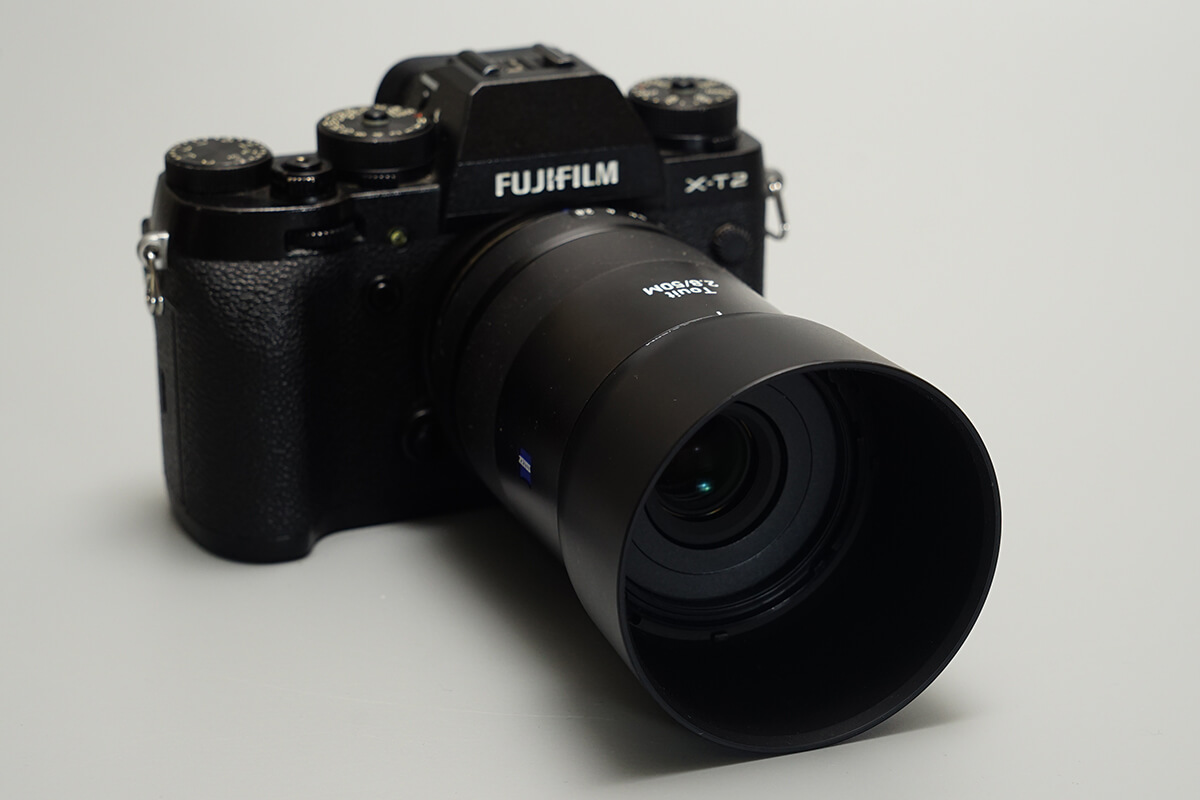
The ZEISS Touit 2.8/50M attached to the FUJIFILM X-T2. This 50mm macro lens for APS-C cameras is capable of life-size photography, yet weighs just 290g
ZEISS 50mm prime lens for APS-C cameras capable of life-size macro photography
Touit is a ZEISS camera lens series for APS-C cameras sold by Kenko Tokina in Japan. We've introduced the Touit 2.8/50M (market price: around 133,000 yen) in three OUTDOOR GEARZINE articles, including this one about the ZEISS Touit 2.8/50M. While other ZEISS lenses, also sold by Kenko Tokina, like the Batis and Loxia series for 35mm full-frame cameras, are only available for Sony E-mount cameras, the Touit series for APS-C cameras is unique in that it's available for both Sony E-mount and FUJIFILM X-mount cameras. Another key advantage is that it's smaller and lighter than 35mm full-frame lenses
The lens with the longest focal length in the Touit series is the ZEISS Touit 2.8/50M, which we'll be introducing today. Compared to the ultra-wide-angle ZEISS Touit 2.8/12 and the standard ZEISS Touit 1.8/32, the ZEISS Touit 2.8/50M is a lens with a focal length known as a long focal length or medium telephoto. When attached to an APS-C camera, it has an angle of view equivalent to 75mm, making it a focal length generally suited to portrait photography. However, the only thing that concerns me is the "M" at the end of the camera's name. This "M" stands for macro lens, and the ZEISS Touit 2.8/50M is a true macro lens with a maximum magnification of 1x (1.0x)
This raises the question, "What is a 1:1 macro lens?" This point is a little tricky. It's the ability to capture a 36mm x 24mm area at its original size (= 1.0x, 1:1) on a 35mm full-frame imaging surface (film or sensor), measuring 36mm x 24mm. Camera lenses have published specifications for their minimum focusing distance and maximum magnification, and in many cases, the maximum magnification is the range of the subject captured at the minimum focusing distance (the shortest distance at which focus can be achieved). For example, a lens with a maximum magnification of 0.1x (1:10) can capture a 360mm x 240mm area at its minimum focusing distance. For a 1:1 macro lens, this range is 36mm x 24mm
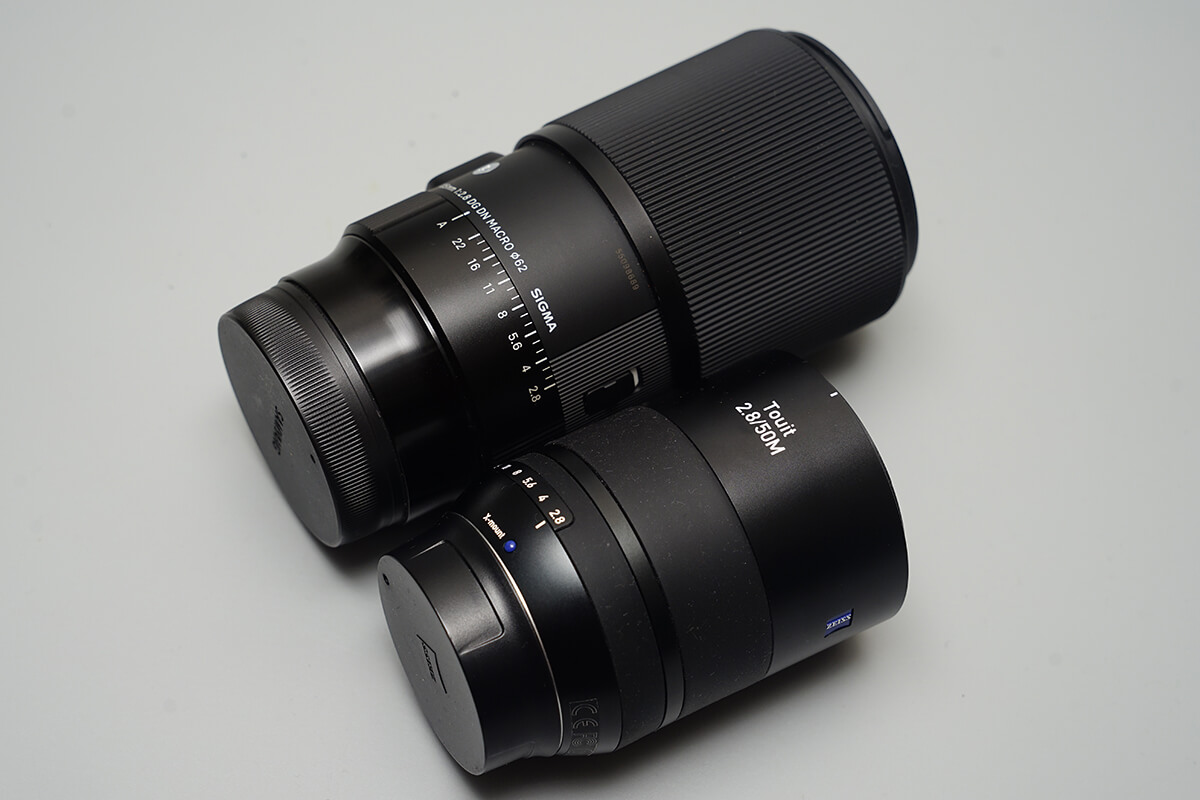
When placed next to the 100mm 1:1 macro lens for 35mm full-frame cameras that I normally use, you can clearly see that the ZEISS Touit 2.8/50M is quite small
How large can you get close-ups with this life-size macro lens? Since a 10-yen coin has a diameter of 23.5mm, you can capture roughly a 10-yen coin filling the short edge of the screen. Furthermore, this maximum magnification is in 35mm full-frame equivalent, so a 35mm life-size macro lens for APS-C cameras can theoretically capture an area of 24mm x 16mm, filling the entire screen. However, the ZEISS Touit 2.8/50M is said to be capable of capturing an area of 23mm x 15mm according to the manufacturer's published figures, making it a high-performance macro lens that exceeds life-size in 35mm equivalent. It's capable of macro photography so large that a 10-yen coin would extend beyond the long edge of the frame
The ZEISS Touit 2.8/50M for the FUJIFILM X-mount lens I used this time has a maximum diameter of 75mm, a total length including the cap of 108mm, and a weight of 290g. The Sony E-mount version is 4mm shorter in length, but has the same maximum diameter and weight. With an aperture of f/2.8, it can be thought of as a lightweight, compact portrait lens that can get as close as possible, with an angle of view equivalent to 75mm when attached to the camera
The lens design is Makro Planar, which has produced many of ZEISS's finest lenses. The author, who created the e-book "ZEISS Touit 2.8/50M Lens Database" (https://www.amazon.co.jp/dp/B0D4HYHNB5/), which compiles various charts for resolution, bokeh, axial chromatic aberration, and peripheral light falloff using the "ZEISS Touit 2.8/50M," actually took the lens outdoors for some photography and was surprised to find that it was a perfect fit for a forest walk with his three-year-old son. I'd like to share the results of the lens charts with you
Recommended points
- The magic of ZEISS Planar makes the main subject stand out in a stunning way
- High resolution from the maximum aperture of F2.8 to the periphery of the image
- Macro performance that can zoom in to 23mm x 15mm, exceeding life-size
- The short minimum focusing distance causes a large amount of blur
- Compact and lightweight, yet with ZEISS lenses for a satisfying ownership experience
Points of interest
- In a sense, it can't be helped, but the actual price is a bit high at over 130,000 yen
- The minimum focusing distance is so short that the lens hood comes into contact with the subject
Main specifications and evaluation
| item | ZEISS Touit 1.8/32 |
|---|---|
| focal length | 50mm |
| Aperture range | F2.8-F22 |
| Lens construction | 14 elements in 11 groups |
| Minimum focusing distance | 0.15m |
| Angle of view (diagonal/horizontal/vertical) | 31° / 26° / 18° |
| Shooting magnification | 1:1 |
| Aperture blades | 10 sheets |
| Filter diameter | 52mm |
| Maximum diameter | Sony E: 75mm/FUJIFILM X: 75mm |
| full length | Sony E: 104mm / FUJIFILM X: 108mm (both including caps) |
| weight | Sony E: 290g/FUJIFILM X: 290g |
| design | ★★★★☆ |
| Resolution | ★★★★☆ |
| Portability | ★★★★☆ |
| The beauty of bokeh | ★★★☆☆ |
| High expressiveness | ★★★★☆ |
| Cost performance | ★★★☆☆ |
Why walking in the forest with my son is three times more fun with the ZEISS Touit 2.8/50M
The overwhelming portrayal of the protagonist, who transcends logic, is striking
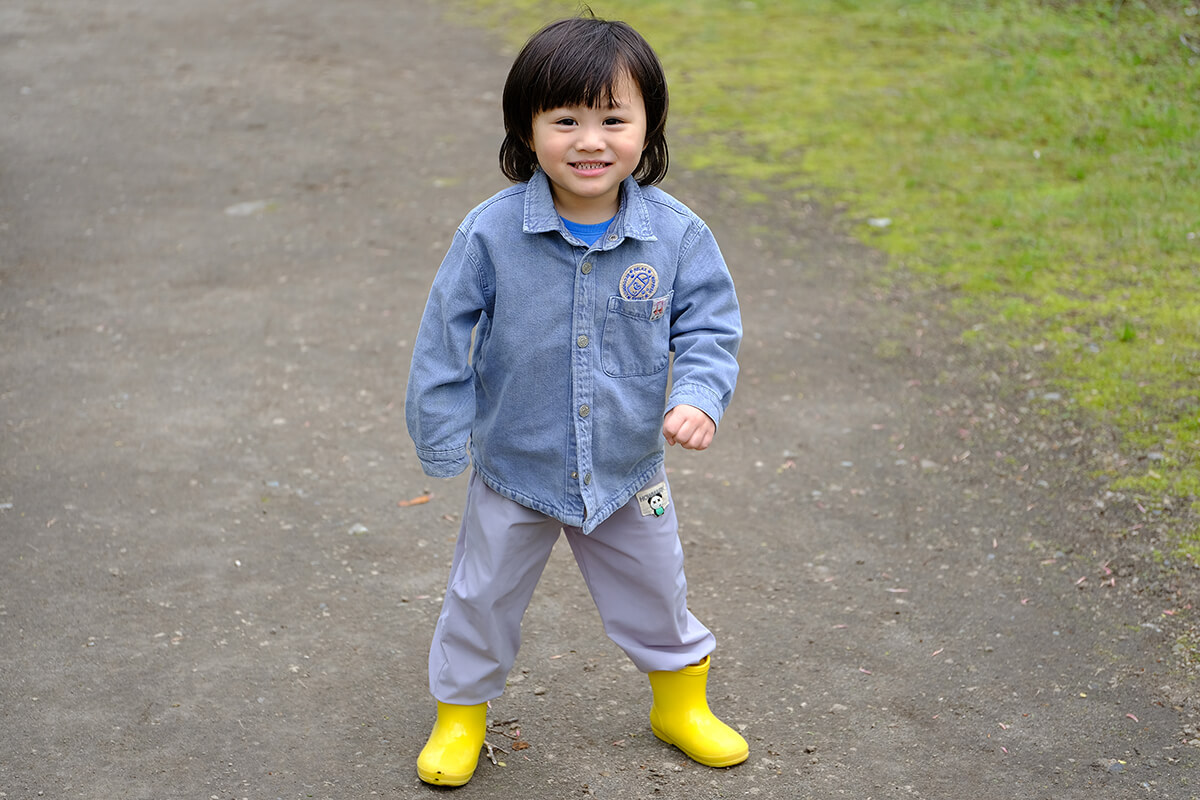
ZEISS Touit 2.8/50M / FUJIFILM X-T2 / 75mm equivalent / Aperture-priority AE (F2.8, 1/640 sec) / ISO 250 / Exposure compensation: +0.7EV / WB: Auto / Film Simulation: Velvia /
Even when shooting at the maximum aperture of F2.8 with an actual focal length of 50mm, the main subject stands out from the background to a degree that is simply unachievable with other lenses, which is frightening.
It may seem strange for me to say this, as I make it my life's work to photograph and compile various charts with a camera lens, but when I shoot with the ZEISS Touit 2.8/50M, the main subject, which is in focus much more than you would expect, stands out as if it were floating out from the blurred background. It's a bit strange, in a good way
In theory, if you shoot with the same APS-C lens at 75mm equivalent and F2.8 maximum aperture, the depth of field that appears in focus will be the same, and the amount of blur that occurs should also be the same. If that's the case, then if the specs are the same, the degree to which the focused subject stands out due to the effect of background blur will also be roughly the same
I've been testing Touit's Planar lenses recently, with the last one being the ZEISS Touit 1.8/32, which was a Planar design, and this time with the ZEISS Touit 2.8/50M, which is a Makro Planar. I've found that the subject appears much more clearly in focus than I would expect from the numerical specifications of aperture and focal length
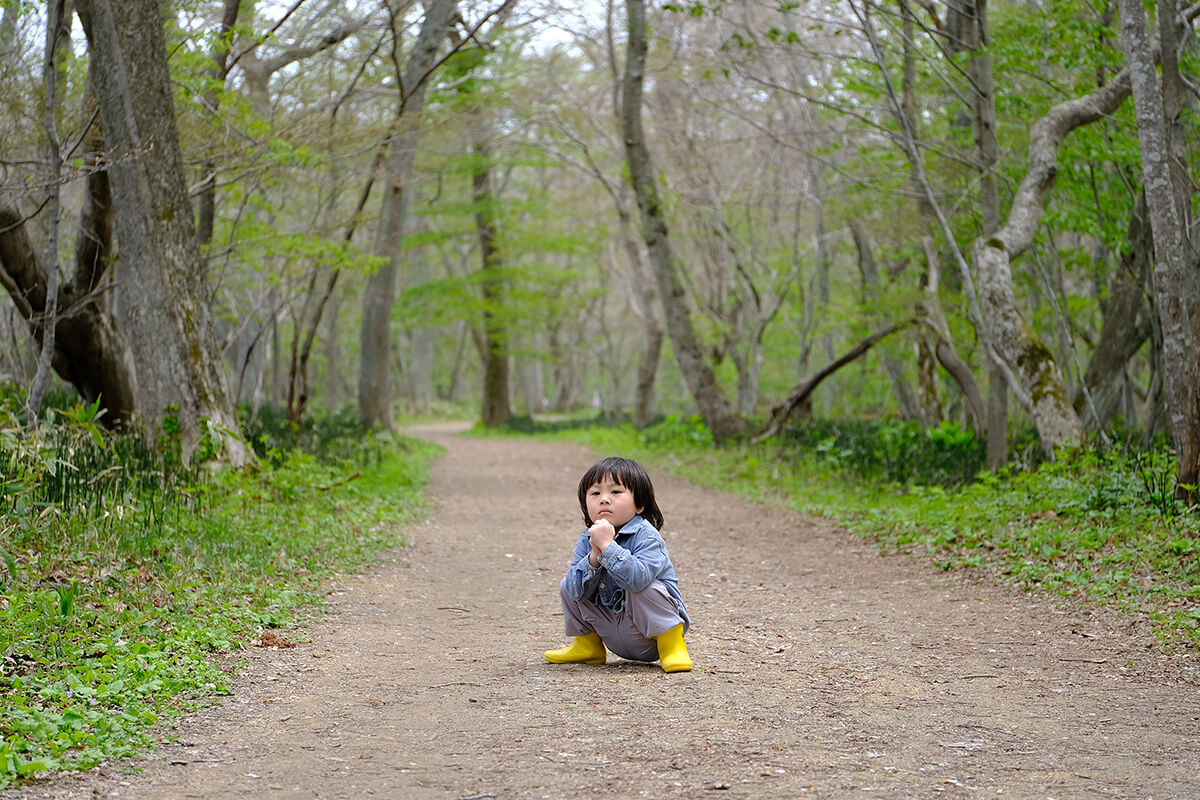
ZEISS Touit 2.8/50M / FUJIFILM X-T2 / 75mm equivalent / Aperture-priority AE (F2.8, 1/900 sec) / ISO 250 / Exposure compensation: +0.7EV / WB: Auto / Film Simulation: Velvia /
It's amazing how the main subject stands out so much that you'd almost believe it if someone told you that the crouching child was actually cut out and pasted in later in Photoshop.
This tendency was apparent when I spoke with my lens evaluation mentor, Soji Koyama, who oversees the e-book series "Lens Database" and "Lens Lab," and he said, "ZEISS must know what they're doing and are doing something about it, but I don't know what. But it certainly makes the main subject stand out incredibly." The resulting image is truly something that can only be described as the magic of ZEISS Planar
This makes shooting portraits at full aperture a joy. You can try this out in-store at a camera store, so if you have the chance, I highly recommend giving it a try. Once you experience this for yourself, you'll soon find yourself unable to let go of the ZEISS Touit 2.8/50M or ZEISS Touit 1.8/32
1:1 macro for close-up shots of small flowers and animals on forest paths
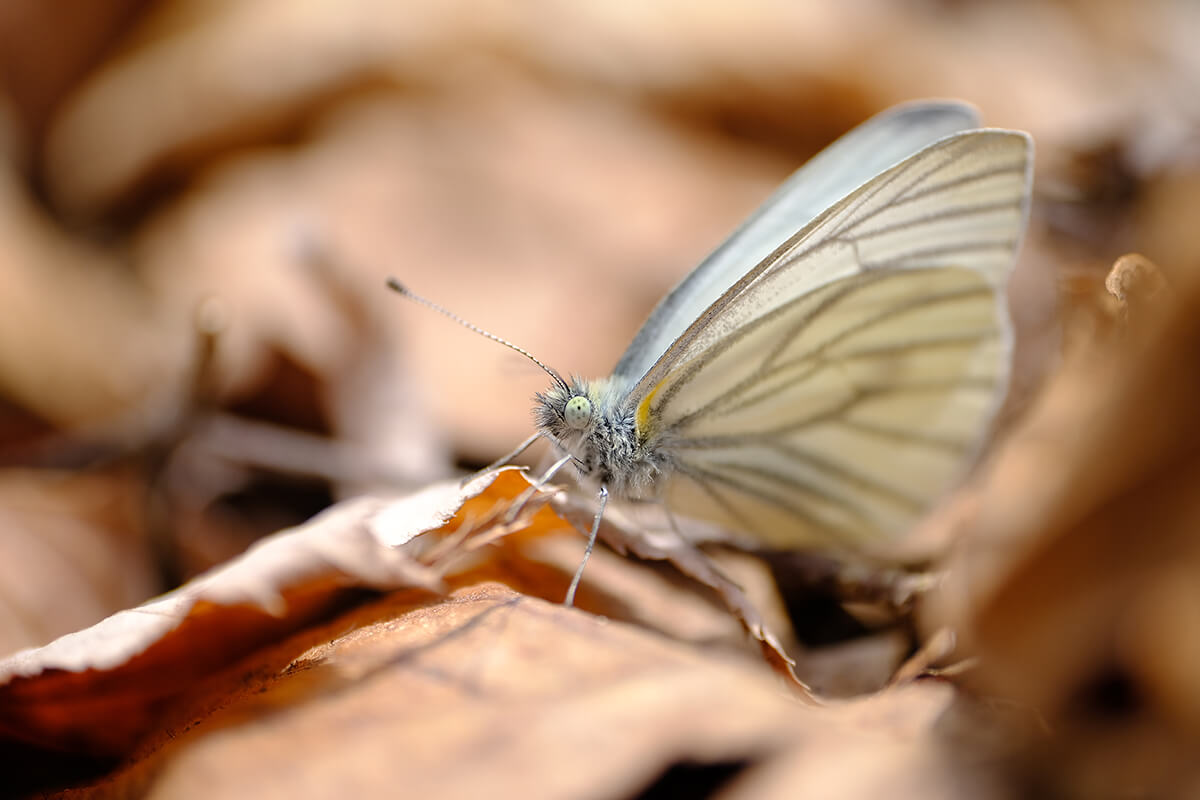
ZEISS Touit 2.8/50M / FUJIFILM X-T2 / 75mm equivalent / Aperture-priority AE (F2.8, 1/750 sec) / ISO 200 / Exposure compensation: +1.0EV / WB: Auto / Film Simulation: Velvia /
I came across a butterfly while walking through the forest. I took this photo with the intention of finding its name later on in Google Image Search so I could tell my son.
Many people enjoy walking or strolling through the woods of their local parks as a hobby or a way to relax. I think many of them walk alone. I myself often walk alone, and when I do, I often bring a super telephoto lens with me, as I walk through forests where, depending on the season, you can see long-tailed tits, Hokkaido squirrels, Hokkaido deer, and white-tailed eagles
However, when I walk with my three-year-old son or family, I carry a macro lens like the ZEISS Touit 2.8/50M because I walk with my son looking for small flowers blooming on forest paths and tiny insects that I would normally miss
My son walks around saying things like "It's pretty!" or "It's cute!" whenever he finds a small flower, and when he finds an insect he's never seen before, he pokes it with a twig or touches it directly, making a big fuss. I take pictures of my son doing this, and also take as close-up shots as possible of the flowers and insects he finds
I take photos of my son to record his growth, but I also take photos of flowers and insects so that I can use Google Image Search after our walks to check their names and ecology. I don't know any of the types of flowers or insects, so I look them up on the Internet with my son, which is also fun
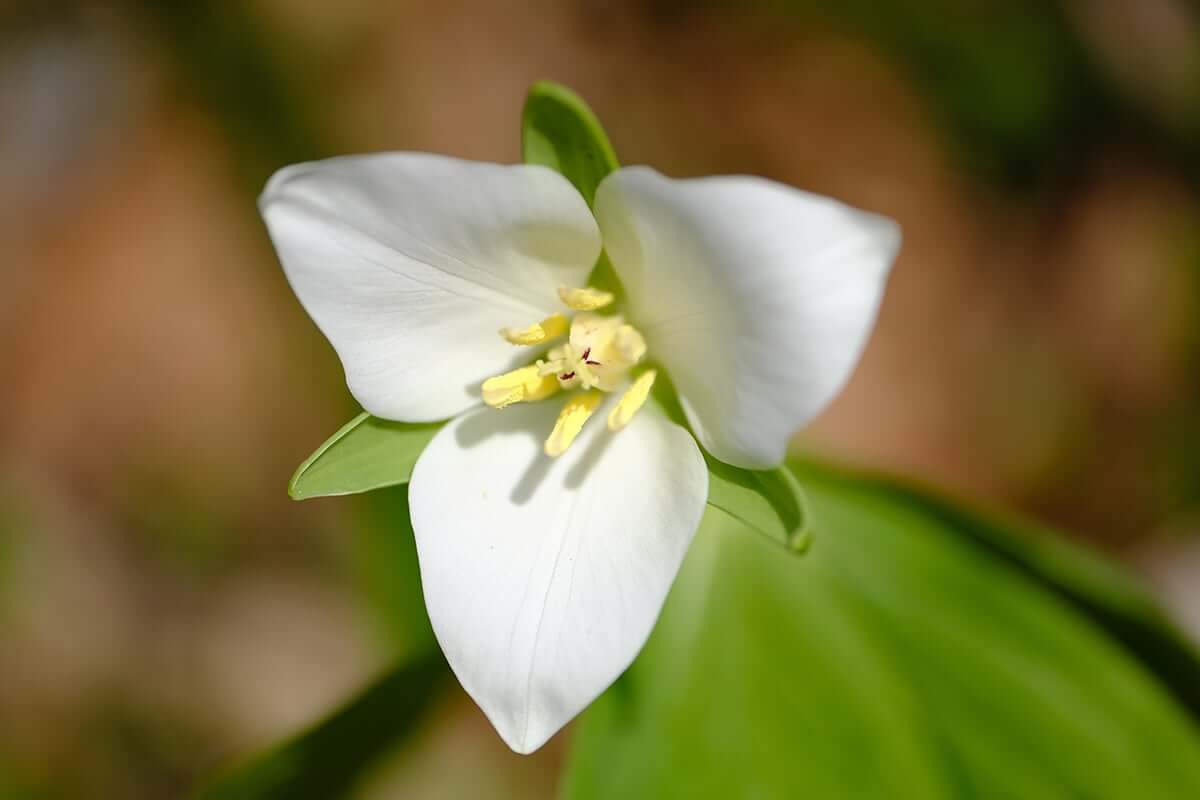
ZEISS Touit 2.8/50M / FUJIFILM X-T2 / 75mm equivalent / Aperture-priority AE (F2.8, 1/2,200 sec) / ISO 200 / Exposure compensation: +0.7EV / WB: Auto / Film Simulation: Velvia /
A white flower blooming beside a forest path. This is a relatively large flower, but a macro lens that can shoot at 1:1 magnification is convenient for capturing close-up shots of flowers smaller than the tip of your little finger.
When I actually did an image search for the butterfly and white flower I posted, the results of Google Image Search were "Striped White Butterfly" or "Striped White Butterfly" and "Large-flowered Trillium." With my limited knowledge, I wouldn't be able to tell my son the names of these flowers even if he asked, so this is really convenient
With the ZEISS Touit 2.8/50M, you can capture an area of 23mm x 15mm filling the entire frame, so if you get as close as 15cm, you can capture an insect or flower that is about 2cm in size filling the frame. This means that you can capture close-ups of most insects and flowers that you would normally notice while walking through the forest. This is a performance that can only be achieved with a life-size class macro lens
When actually photographing insects and flowers, I found myself worrying about the minimum focusing distance, which is a rather indulgent problem. The ZEISS Touit 2.8/50M attached to the FUJIFILM X-T2 with the lens hood attached measures approximately 14cm from the image plane to the tip of the lens hood, so if I want to shoot at 1:1 magnification in 35mm format, I need to bring the subject approximately 1cm from the lens hood. Since the lens and subject are almost touching each other, I often find myself wondering how close I can get to the subject
Even when checking the chart, high resolution is apparent across the entire image from the maximum aperture
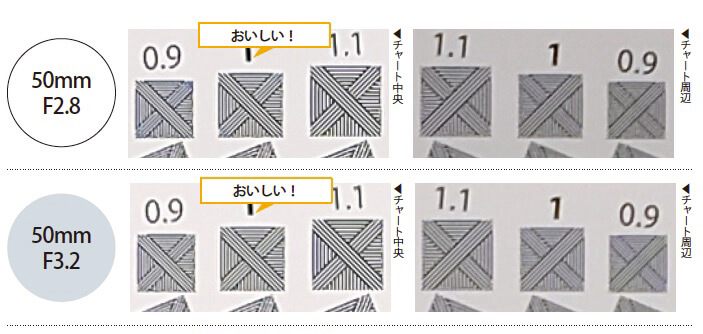
Original resolution chart by Soji Koyama. Due to the number of effective pixels, the standard value is 1 to 1.1 on the chart, but most of that is resolved from the maximum aperture of F2.8
Whenever I have the opportunity to test a new lens, I shoot the various charts I created with my mentor, Soji Koyama, such as the ones shown above for resolution, bokeh disc, axial chromatic aberration, sagittal coma flare, vignetting, and macro
Among them, the resolution chart shown above calculates the line thickness that corresponds to the width of one pixel when shooting at full screen using the camera's effective pixel count. Since the image sensor in a typical digital camera is a Bayer array (RGGB), it is unable to resolve lines the same width as one pixel, so the resolution is checked based on a chart with lines 1.4 times thicker. This original resolution chart also allows you to check lateral chromatic aberration and distortion
In this test of the ZEISS Touit 2.8/50M, a FUJIFILM X-T2 camera body with approximately 24.3 effective megapixels was used, so the reference value for the resolution chart is 1 to 1.1. The captured image of the resolution chart shown above is a close-up crop of the center and periphery of an A1-sized resolution chart. We can see that the ZEISS Touit 2.8/50M combined with the FUJIFILM X-T2 almost perfectly resolves the 1 on the chart from the widest aperture of F2.8 in the center, and firmly resolves 1.1 even at the periphery
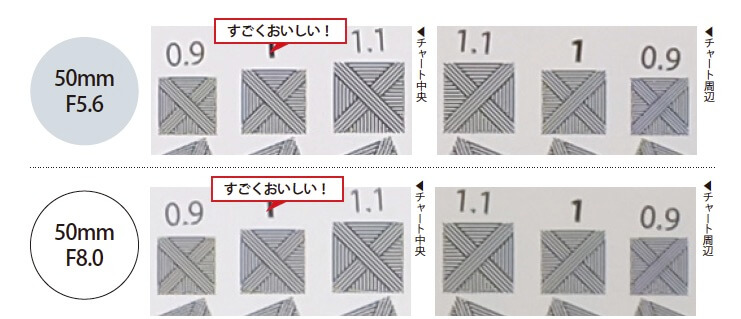
This is the result of a resolution chart taken with the lens aperture set to F5.6 and F8.0. You can see that the resolution is higher than the data taken with the aperture set to around F2.8
We've also included the results of shooting with charts at larger aperture values of F5.6 and F8.0. Compared to the results of the resolution chart at around the maximum aperture of F2.8, the resolution at the periphery has increased, with higher contrast and a sharper appearance. I believe the peak resolution of the entire screen for the ZEISS Touit 2.8/50M is around F4.0 to F8.0
However, when shooting under the same conditions at maximum aperture, F2.8 and F8.0, the shutter speed will be three stops slower. To be more specific, if the brightness allows shooting at a shutter speed of 1/100 second at F2.8, then at F8.0 it would be 1/25 second. With a normal camera position, there's a good chance that 1/25 second will cause camera shake. Also, photographing insects or small flowers swaying in the wind in a dimly lit forest will likely result in subject blur
For this reason, I often use the F2.8 aperture of the ZEISS Touit 2.8/50M, which I know has high resolution from wide open to the edges. Naturally, wide open apertures result in a large amount of blur, which makes it even more enjoyable to capture the main subject standing out from the background, a major attraction of the ZEISS Touit 2.8/50M. That's why I use the F2.8 aperture to photograph not only small insects and flowers, but also my son when we go for walks together
The ZEISS Touit 2.8/50M is a high-performance lens that can be used to shoot anything at the maximum aperture of F2.8, so it's important to be able to choose the maximum aperture with confidence
The large blur that occurs is surprisingly hard compared to what I expected
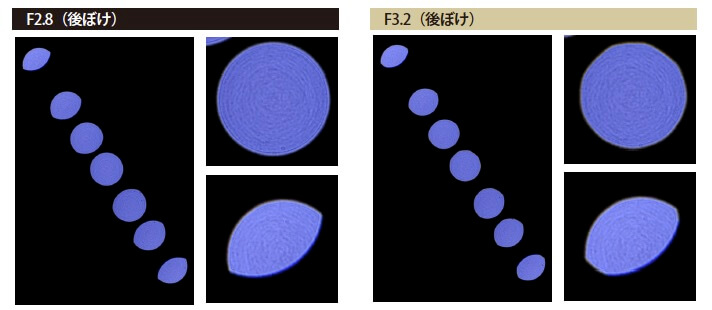
There are no large edges or discolorations, and there is little roughness inside the ball blur, but there seems to be a slight tendency for onion blur, where concentric wrinkles appear
Many people have probably heard that the smaller the maximum aperture of a lens, the brighter it is, and the greater the focal length, the more blurred the image will be. In addition to this, there is also a rule that the shorter the distance to the subject you are focusing on, the more blurred the image will be
Therefore, when shooting with a macro lens that can focus on close objects, the conditions are ripe for large amounts of blur to occur. In the case of the ZEISS Touit 2.8/50M, the minimum focusing distance is 15cm. For this reason, many lenses prioritize the beauty of large amounts of blur, but judging from the results of the chart using spherical bokeh shown above, the ZEISS Touit 2.8/50M appears to be a lens that prioritizes overall resolution from wide open aperture
The shape of the bokeh, which is affected by the size of the bokeh and the number of aperture blades, is impeccable, but in many cases there is a strong tendency for onion bokeh, where concentric wrinkles appear within the spherical bokeh, which is said to be the effect of aspherical lenses. In fact, the "ZEISS Touit 2.8/50M" uses two aspherical lenses, but here too there seems to be a tendency to prioritize the resolution of the entire image from wide open aperture rather than the quality of the bokeh
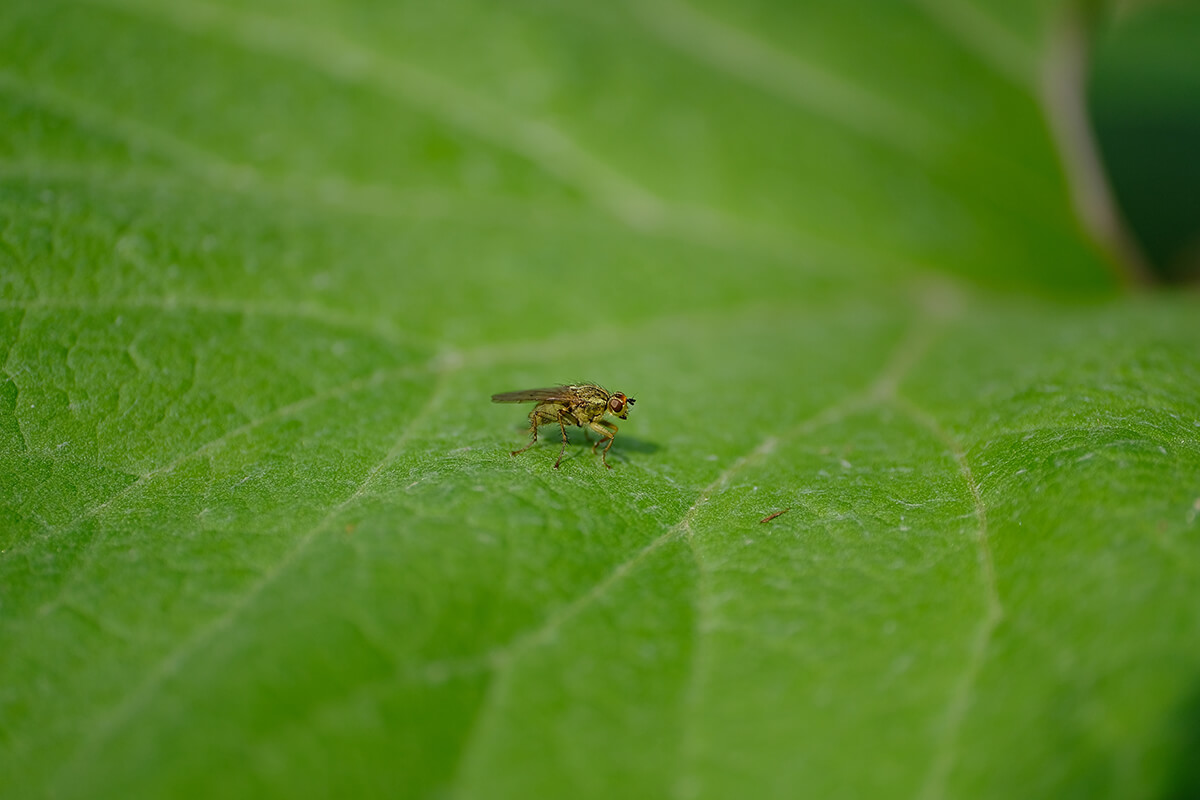
ZEISS Touit 2.8/50M / FUJIFILM X-T2 / 75mm equivalent / Aperture-priority AE (F2.8, 1/1,700 sec) / ISO 200 / Exposure compensation: +0.7EV / WB: Auto / Film Simulation: Velvia /
A tiny insect no bigger than the tip of your little finger resting on a butterbur leaf. Because it was a close-up shot, the background is blurred more, but the blur appears somewhat hard.
Judging from the results of the actual photos I took and posted above, the tendency towards onion bokeh isn't particularly noticeable, but the bokeh seems a little hard. Since this is a fixed-focal macro lens, which is designed to produce a large amount of bokeh, the bokeh feels a little sharp and hard
However, this seems to be largely influenced by the positioning of the ZEISS Touit 2.8/50M within the ZEISS Touit series as a whole. In fact, the ZEISS Touit 1.8/32 is a lens that emphasizes the quality of bokeh rather than overall resolution at full aperture. In that sense, the ZEISS Touit 1.8/32, with an effective angle of view equivalent to 48mm when attached to an APS-C camera, and the ZEISS Touit 2.8/50M, with an effective angle of view equivalent to 75mm, are both focal lengths that make them ideal for portrait photography. The ZEISS Touit 1.8/32 prioritizes bokeh over overall resolution, while the ZEISS Touit 2.8/50M prioritizes overall resolution from full aperture rather than the quality of bokeh. As an aside, these two lenses share the same lens hood, so they can be used interchangeably. This is probably a consideration on the part of the designers, as it allows the devices to be carried around and used together
It seems that if you understand the lens designer's intentions based on the results of actual photographs taken with the chart, you can enjoy using the ZEISS Touit series even more
Summary: A lens perfect for high-level forest walks, both for macro and portrait photography
It's light and small, and allows you to enjoy nature around you more, and take better photos of your family and friends
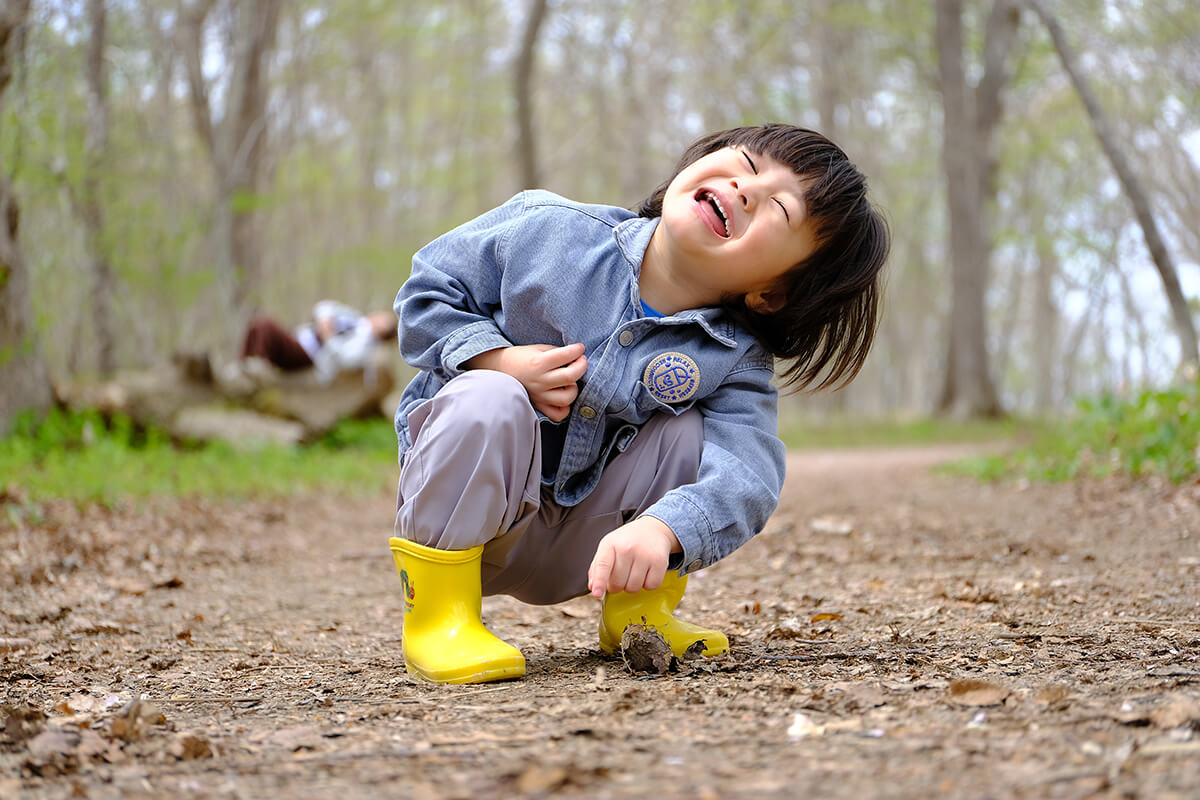
ZEISS Touit 2.8/50M / FUJIFILM X-T2 / 75mm equivalent / Aperture-priority AE (F2.8, 1/550 sec) / ISO 200 / Exposure compensation: +0.7EV / WB: Auto / Film Simulation: Velvia /
My son was so excited digging out a bug hiding in some fallen leaves. The ZEISS Touit 2.8/50M has a focal length equivalent to 75mm, which makes it easy to take pictures within reach.
When it comes to the cameras and lenses you carry when walking in the park or a nearby forest, many people imagine an ultra-telephoto zoom lens for photographing wild birds, etc. In fact, I often carry an ultra-telephoto zoom lens when I'm alone or depending on the season
However, if you're a beginner photographer or forest walker, or if you're walking in the forest with your family or children, I recommend a macro lens like the ZEISS Touit 2.8/50M. This is because it's lighter, more compact, and more affordable than a super telephoto zoom lens. The ZEISS Touit 2.8/50M is a high-end ZEISS lens, but its market price is still around 133,000 yen. A simple telephoto zoom lens can easily cost over 100,000 yen, so this is a much more affordable option
Weight is also a major issue. The ZEISS Touit 2.8/50M weighs just 290g, but most super telephoto lenses weigh at least 2kg, and it's not uncommon for them to weigh over 3kg. For some people, walking around for several hours carrying one of these super telephoto zoom lenses and a camera can be quite tiring
The first special lens I ever got was a macro lens that could take life-size photos, and when you look at the nature around you through a macro lens, the scenery you see changes completely. Small insects and flowers that you had never considered as subjects before become fascinating subjects that are worthy of being the main focus. If you happen to come across a lizard, you can take a photo of it with the same impact as a giant monster. In fact, just carrying a macro lens can make your forest walks twice as fun
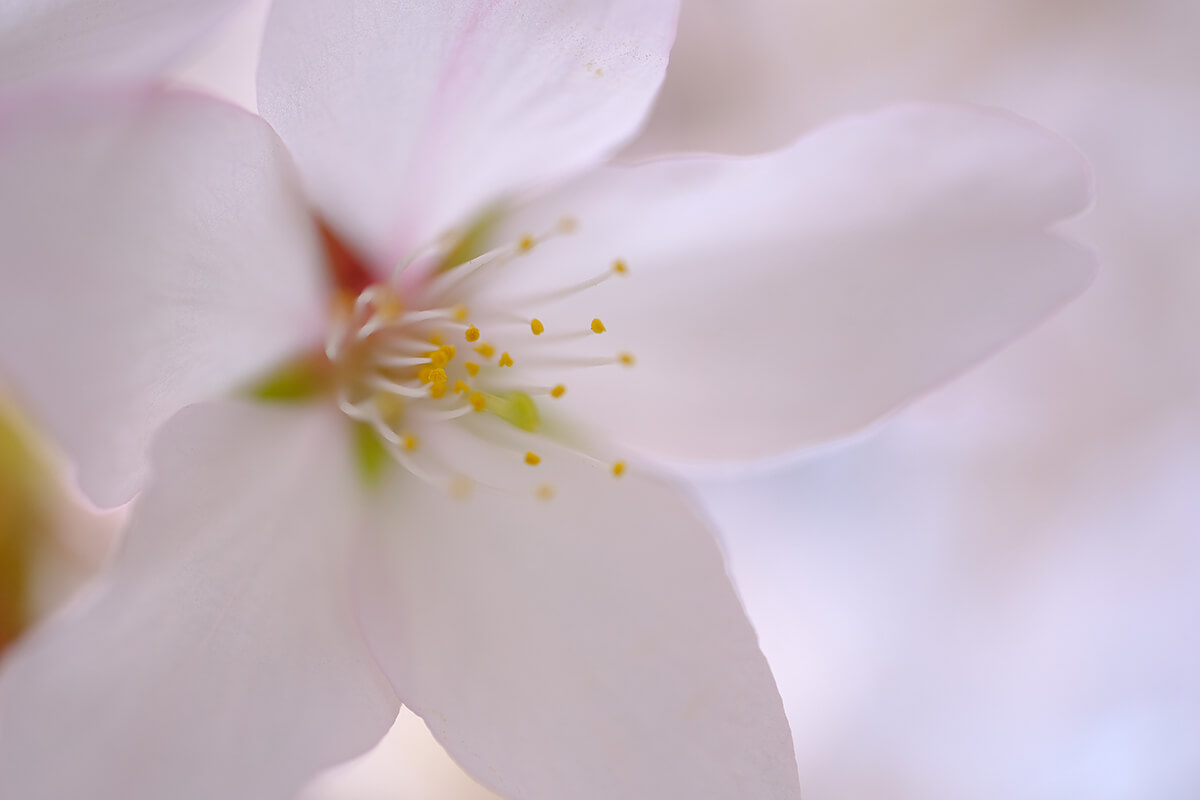
ZEISS Touit 2.8/50M / FUJIFILM X-T2 / 75mm equivalent / Aperture-priority AE (F2.8, 1/400 sec) / ISO 200 / Exposure compensation: +1.0EV / WB: Auto / Film Simulation: Velvia / A
photo of cherry blossoms just beginning to fall. Macro lenses allow you to re-examine the nature around you from a microscopic perspective, making it fun to photograph anything. The sharp depiction is satisfying.
What's even more amazing about the ZEISS Touit 2.8/50M is that when attached to the camera, it achieves a 75mm equivalent angle of view, perfect for photographing people. I love 100mm macro lenses and have tested and photographed with numerous lenses, but the 100mm angle of view is actually a bit too long for photographing companions. The ZEISS Touit 2.8/50M, on the other hand, has a 75mm equivalent focal length, making it the perfect focal length for photographing my son when we go out together on holidays. Not only does this macro lens make the local forest twice as fun with its microscopic perspective, it also captures captivating images of children, family, and friends, making forest walks three times more enjoyable just by taking the ZEISS Touit 2.8/50M with me
What's more, if I take large photos of insects or flowers that interest my son, he can use Google Image Search to find out their names and ecology, which makes it even more fun. The greatest appeal of the ZEISS Touit 2.8/50M is its high expressive power, which could be called ZEISS's Planar magic, making the focused subject appear to emerge from a blurred background. The image quality, which has been so captivating for me and my lens review mentor, Soji Koyama, is also recognized by many lens enthusiasts
Therefore, just by using the ZEISS Touit 2.8/50M, many lens enthusiasts will think, "I know what I'm doing," and this will greatly increase their satisfaction with owning it. In a sense, the ZEISS Touit 2.8/50M can be said to be the ultimate macro lens for forest walks, and it is a sharp lens that outdoor enthusiasts will want to try

For more information and to purchase the ZEISS Touit 2.8/50M
For more product details, please visit the Kenko Tokina official website
Data source
"ZEISS Touit 2.8/50M Lens Database"
Please consider a paid membership to support the site while enjoying exclusive offers and content!
Chitose Saito
 A former editor of a monthly camera magazine, he became immersed in the outdoor lifestyle of campervans and car camping while pursuing Hokkaido's spectacular scenery and wildlife. He is currently a photographer and writer who travels all over Hokkaido with his wife and two-year-old son, capturing and writing about everything he experiences, from cameras and lenses to outdoor activities, camping, child-rearing, PC gadgets, cooking, and even dieting. For OUTDOOR GEARZINE, he plans to write a variety of articles, primarily for the "QOCL (Quality of camping life) Improvement Committee," which aims to improve the quality of life while camping and in a campervan
Related reading
 High-performance, lightweight, compact, and bright! Five reasons why the ZEISS Touit 1.8/32 is a premium standard prime lens recommended for outdoor travel
 [You can actually enjoy it for free!] The spectacular view from Mt. Hakodate, which even locals don't know about, is a double treat!
 A beautiful driving route loved by Hokkaido residents! A must-know for bad weather: the Ororon Line, explored with the OM System Big Three lenses
 [You can drive to the summit!] I photographed the sunrise over a sea of clouds from the summit of Mt. Kamui with the Tokina atx-m 11-18mm F2.8 E