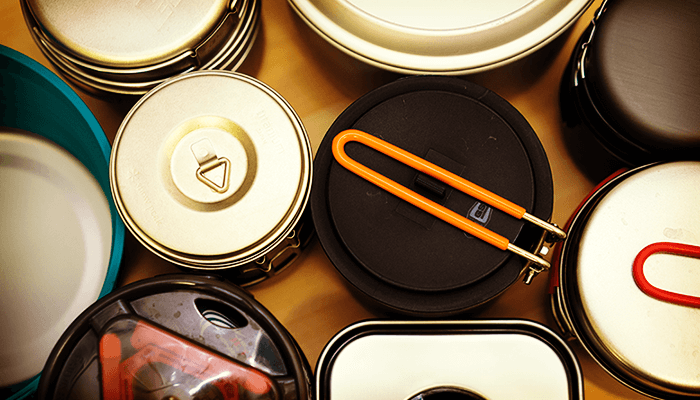
A must-see for those who don't want to compromise on food! How to choose a cooker/cochel for mountain climbing
table of contents
- Choosing the right cooker or pot that's easy to use can lead to burns if you choose half-heartedly
- table of contents
- What are the performance requirements for a good cooker?
- Checkpoint 1: Size
- Checkpoint 2: Shape and form
- Checkpoint 3: Materials
- Checkpoint 4: Storage
- Checkpoint 5: Other functions and ease of use
- Summary: What do you recommend in the end?
Choosing the right cooker or pot that's easy to use can lead to burns if you choose half-heartedly
It seems like more and more people are cooking for themselves in the mountains, even on day trips to low mountains. Compared to the past, there are a lot more books about mountain cooking in bookstores, and just recently, a web manga on the topic has even started. Of course, one reason is that advances in tools and ingredients have made cooking in the mountains easier. But once you experience the deliciousness of a warm meal in the mountains, or rather the feeling of "happiness that money can't buy," it's easy to see why more and more people can't stop. Today, I'd like to focus on one of the essential items for cooking for yourself in the mountains: a cooker (also known in Japan as the German word "kochel" for a long time)
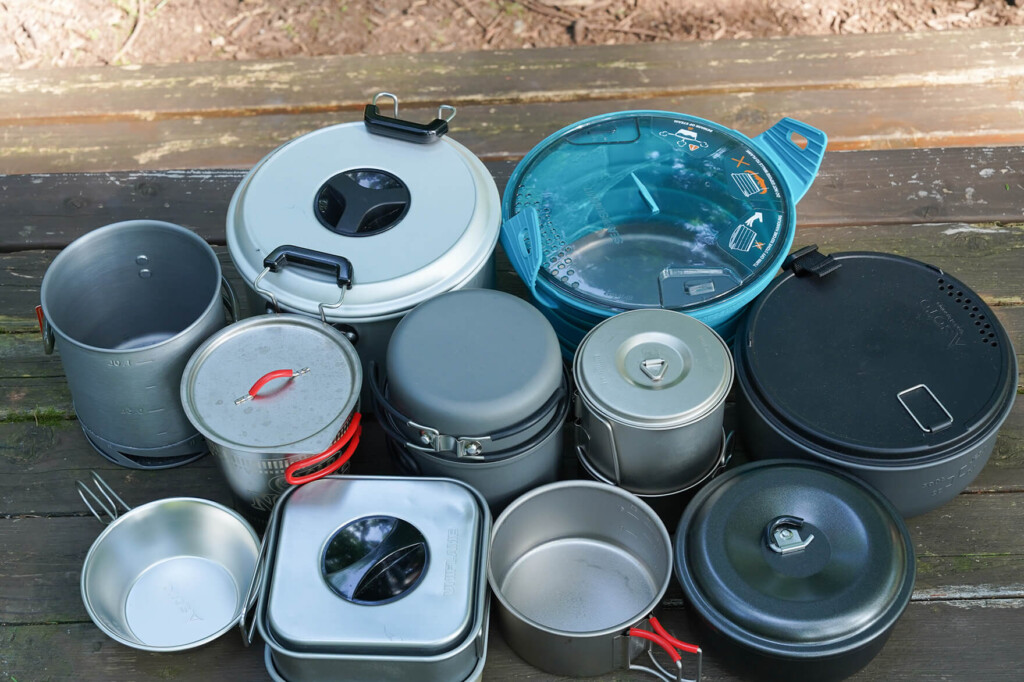
Cookers, which have their roots in the metal cooking utensils used by military forces around the world and have long been popular in Japan as mess kits, have in recent years been optimized for a variety of uses and purposes, including mountain climbing and camping. As a result, there are now a wide variety of models to choose from, ranging in material, shape, size, and design. However, it is also true that the criteria for choosing and how to use them are becoming more complex. I, too, once saw the emergence of extremely lightweight titanium cooktops, and I half-heartedly assumed that "titanium = light = good (and expensive)." However, the titanium cooktop I bought didn't cook well at all, burning the food in an instant. It wasn't until much later that I realized that titanium's true potential can only be realized when used in the right situations, and I ended up paying a steep price. To avoid such regrets, I would like to clearly explain how to choose a cooktop that is truly easy to use. Let's get started!

Japan is a rare country with such a wide variety of models, and it's no wonder that people are so particular about food
[Related article] A thorough comparison of popular cookers ↓↓
table of contents
- What are the performance requirements for a good cooker?
- Checkpoint 1: Size
- Checkpoint 2: Shape and form
- Checkpoint 3: Materials
- Checkpoint 4: Storage
- Checkpoint 5: Other functions and ease of use
- Summary: What do you recommend in the end?
What are the performance requirements for a good cooker?
If a cooker is simply a dish for serving food, weight and size are all that matters (in fact, wooden or resin bowls are perfectly suitable for use in the mountains). However, when it comes to cooking over a fire, as in this case, various factors become important, including the cookware's performance and ease of use. Here are a few of them
- Durable and long-lasting
- Boils and cooks quickly (good thermal efficiency)
- Lightweight and easy to pack
- It is easy to use overall, as it does not burn and is easy to cook with
- Can be used efficiently regardless of the number of people or the situation (expandable and versatile)
- Good design
- Low price
I have yet to come across a cooker that is perfect in all of the above aspects. Therefore, it is important to understand the differences in the various characteristics of each piece of gear and then choose the model that best suits your preferred use scenarios, goals, and preferences. Here are five points to check when choosing the perfect cooker
Checkpoint 1: Size
Cooktops come in a wide variety of sizes, from models large enough for a single cup of coffee to pots large enough for making curry for a large party. Therefore, it's important to first consider the size based on what you'll be cooking and the number of people eating. Another important consideration for efficient packing is whether the gas cartridge can fit inside the cooktop (see checkpoint 4). To avoid choosing a size that's too small, the table below summarizes the approximate capacity and size needed for each purpose. Naturally, if you plan to add a lot of ingredients to the cooktop in addition to hot water, the required capacity will more than double. In any case, try to roughly imagine the scenarios you'll use it in and use this as a reference for determining the size you need
Tips for choosing
- If you only need to boil water for one person, a 700ml size will suffice. However, in that case, you will have to give up on full-scale cooking, so if you plan to cook, we recommend bringing around 1.0L even for one person .
- If you plan to cook for two people, we recommend a size of at least about 1.5L. Furthermore, if you have multiple cookers, you can cook rice and the main dish separately, and if you have multiple stoves, you can cook in parallel, which is efficient.
- If you are with three or more people, I think it is essential to have a cooker set of different sizes, including a pot of 1.5L or more, to suit the number of people and meal plans .
Checkpoint 2: Shape and form
Even if the cooker is the same size, you can choose from three main shapes to suit your preferences and ease of use. Each has its own advantages and disadvantages, so let's start by comparing their features in the table below
| material | Deep | Shallow | Square |
|---|---|---|---|
| image | ![]() | ![]() | ![]() |
| merit |
|
|
|
| Disadvantages |
|
|
|
Tips for choosing
- If you are thinking about ease of use on-site (ease of cooking), we recommend a shallow or square type。
- Deep pots sacrifice many other features for the sake of storage and portability. If you prioritize portability and only intend to use it for boiling water, we recommend the deep pot.
- The square model is a shallow model that adds a little convenience for solo hikes. (Not considering a large group) Recommended for solo hikes where you want to do some cooking .
Checkpoint 3: Materials
The materials generally used for cookers have traditionally been aluminum and stainless steel, with titanium becoming increasingly popular in recent years. Of these, stainless steel is too heavy to be practical for mountain climbing, so you will usually choose either aluminum or titanium
Of course, these are different metals, so they have different characteristics, and beginners tend to think that titanium is more expensive and somehow better. I've been there myself, of course, but in the end, there are pros and cons to each, and it's impossible to clearly say which is better. However, titanium (unless it's specially coated) will easily burn and warp at the bottom if the heat is even slightly too strong, so even after spending a lot of money to get it, you'll have to put up with this inconvenience. Is it really worth going to such lengths to stick with titanium? As usual, I've summarized the pros and cons in the table below, so please take a look at it again.
| material | aluminum | titanium | Stainless steel (reference) |
|---|---|---|---|
| image | ![]() | ![]() | ![]() |
| merit |
|
|
|
| Disadvantages |
|
|
|
| remarks |
|
|
Tips for choosing
- Recent aluminum products have been steadily improving in durability and ease of use. If you are unfamiliar with cooking in the mountains and want to enjoy cooking in addition to boiling water, we recommend an aluminum cooker .
- If you plan to only use it for boiling water, are hiking with a small group, or .
Checkpoint 4: Storage
Cookers are one of the most difficult pieces of gear to pack because they are hollow and cannot be compressed. To make them as compact as possible, they are generally designed to be stacked like Matryoshka dolls, with containers of slightly different sizes.
Even if one small cooker for one person is enough now, it would be very smart to be able to buy more without waste when your party grows to two or three people.
For this reason, the first thing you want to check is whether the brand and model you've chosen has sets of different sizes that can be stacked in the future. If possible, it's best to choose the sizes you need now from a model that allows for such expansion and then purchase them accordingly. Of course, it's also perfectly fine to buy a model that comes in a set of large and small pans from the start (the photo on the left is the Montbell Alpine Cooker 18+20 Pan Set ). In that sense, it's efficient to standardize on deep, shallow, and square pans (...I know this in my head, but the reality is that when you consider various situations, it's not always possible to do so...).
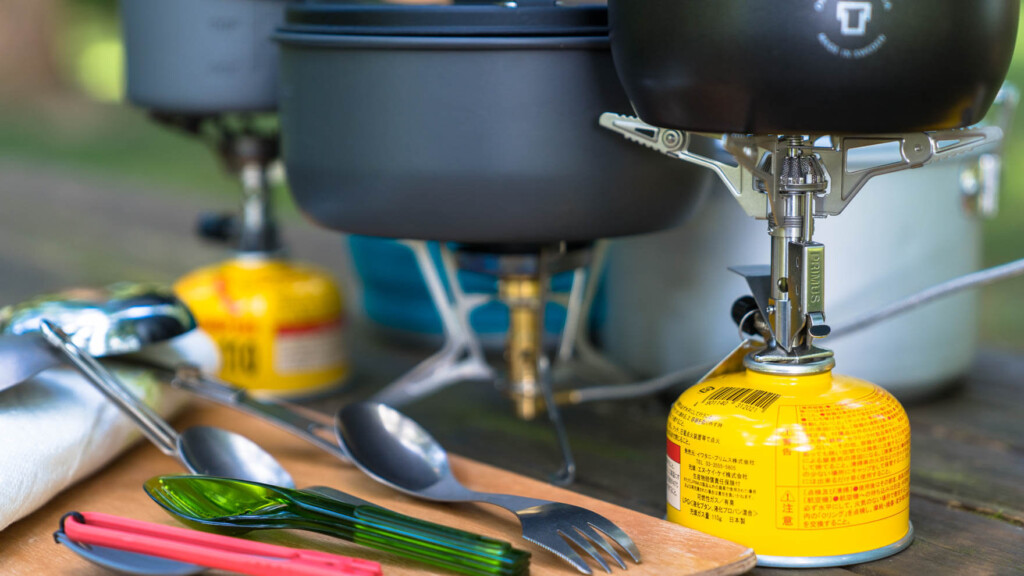
Also, while the first gear that comes to mind when thinking about filling the cavity inside a cooker is gas cartridges, one of the conditions for an ideal cooker is that it the GSI Pinnacle Dualist (photo on the right).
In terms of storage, SEA TO SUMMIT, which has previously developed foldable silicone tableware, has come up with a new product called X-POT that is quite impressive. With an aluminum base and foldable silicone sides, this amazing cooker (photo on the left) combines incredible storage with the convenience of a cooking utensil. The heat output is limited, as the heat needs to be adjusted to prevent the flame from spreading to the sides, but it will be interesting to see how it evolves in the future
Checkpoint 5: Other functions and ease of use
Handle
If the protruding part of the cooker gets in the way of packing, it's difficult to use, but if it bends easily, cooking becomes extremely difficult. Each manufacturer has been trying to combine the two opposing functions of convenience and storage with the handle part, and they have been coming up with creative ideas. Personally, I look for the following three points
- Easy to grip and hard to come off or bend
- Does not get hot during cooking
- Folds beautifully without wobbling
It's difficult to find a handle that is just right in every way, but personally I think the MSR QUICK SOLO SYSTEM is pretty close to ideal, with a stable grip and easy folding. However, its weakness is that it's complicated to make, so I'm worried about what might happen if it breaks
coating
As mentioned in the material section, various processing techniques (see below) are now being incorporated into both aluminum and titanium to compensate for their weaknesses, and the overall quality is steadily improving. When choosing a cooker, it is very important to check for models that properly incorporate these techniques, rather than just looking for one that is aluminum or titanium
| Uses | Capacity guide |
|---|---|
| Anodized hard anodized | Anodizing is one of the surface treatment techniques used to improve the weak points of aluminum . This process makes the material harder and stronger, and improves corrosion and wear resistance. Furthermore, a processing method that further increases hardness and durability is called " hard anodizing . " |
| Non-stick Teflon coating Ceramic coating | Both of these are anti-stick coatings applied to the inside surface of a cooktop. Non-stick coating is a general term, and it is not possible to know the specific type of processing used from it, but it is generally a coating made from fluororesin ( Teflon is a brand name for fluororesin). In any case, the non-stick coating is prone to melting and peeling, so be careful as it will quickly become unusable if not handled carefully |
| ATS processing | This technology is applied to EPI's titanium cooktops . Originally used for coating the bottom of boats, spraying aluminum onto the bottom of the pot overcomes titanium's weakness of poor thermal conductivity, and the fine irregularities on the bottom of the pot also increase its stability on the trivet. |
| Anti-slip spiral processing on the bottom | Deep cookers are inevitably tall and therefore less stable, so to improve this, the bottom of the container is modified. Typically, fine grooves are made on the bottom to prevent it from slipping on the stove top |
Summary: What do you recommend in the end?
Again, you might be wondering what we recommend after going into so much detail, so we'll conclude with our editorial team's picks, based on the above. Depending on your requirements and preferences, other choices are certainly possible, but we'll report on that in detail in a comparison test at a later date, so please look forward to it. First, we'll introduce the following solid models that everyone can choose without making a mistake
Of all the outdoor gear available, cookers are an area where each person's taste and preferences are most clearly displayed. For this reason, there is no definitive brand or model, and I think it's not surprising that the best choice for each person varies more than with other gear. That's why I'm sure I'm not the only one who thinks that pursuing "your own ideal kitchen" in the mountains has an indescribable alluring quality as one way to enjoy the outdoors. If you feel the same way, I recommend you take a look at the "Kochel Swamp"!


![[Milled Rice] Uonuma Koshihikari Rice, 5kg (Domestic)](https://images-fe.ssl-images-amazon.com/images/I/51cubPGWSgL._SS150_.jpg)

![PRIMUS High Power Gas Cartridge (Small) IP-250T [HTRC 2.1]](https://images-fe.ssl-images-amazon.com/images/I/51wprgIlu4L._SS150_.jpg)


Comparison review: I tried using all the cooker Kochel for mountain climbing.
Surprisingly, don't you know? How to choose the best trekking pants
5 tips to choose the right trekking shoes for your feet
Lighter, safer, smarter. A list of cooking tools to take to climb a tent and how to choose one (basic)