



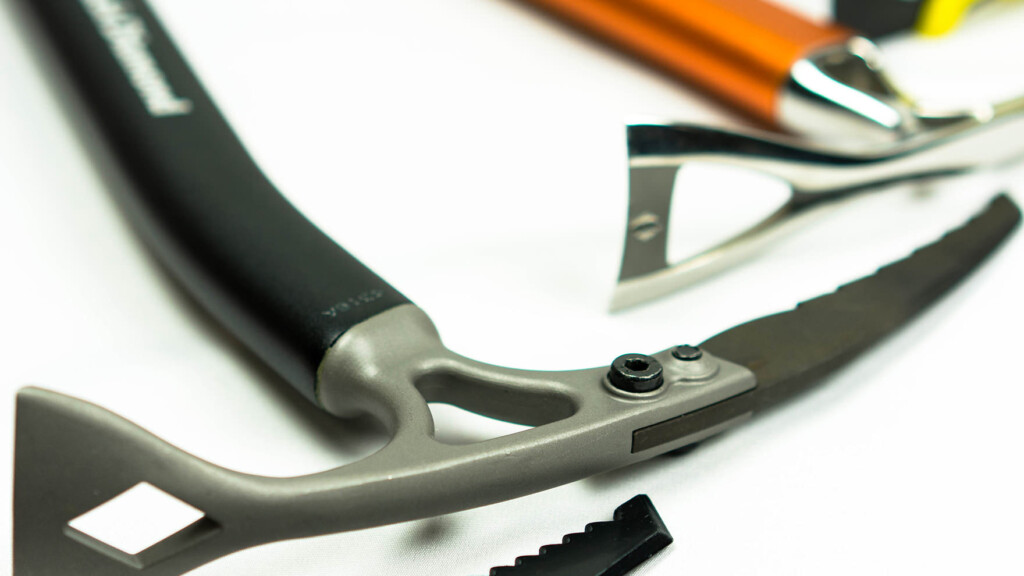
Reconsidering how to choose the best ice axe for hiking in the snow

Written by Yasushi Hisatomi
table of contents
Point 3: Weight and strength – Choose according to your purpose
The lighter the better? - About weight -
The common belief in the mountaineering world that "lightness is justice" requires some caution when it comes to choosing an ice axe. Lightweight ice axes, such as those made with aluminum shafts and heads, are naturally highly portable and ideal for activities where speed is crucial for safety, such as backcountry skiing and snowfield walking. However, lightweight ice axes are less strong, and even if you drive them into hard-packed ice and snow, the blade may not even make an impact. For this reason, light models are dangerous if you plan to actively drive the pick into the snow. If you're considering general traverses or technical routes, it's best to choose a durable model with a certain weight
T type? B type? ~About strength~
Most climbing equipment, which we entrust our lives to, has global standards for safety (durability), and these certifications guarantee that the products are consistent and reliable. Ice axes are no exception, and are guaranteed to be strong enough through testing in accordance with CEN (European Committee for Standardization) and UIAA (International Mountaineering Federation) standards
The CEN standard classifies ice axes into the following two strength levels based on their strength:
- T-type: The stronger axe is the technical axe, marked with a "T". It has a 50 cm shaft and must withstand a load of 3.5 kN. Petzl Charle technical axes are designed to withstand up to 4 kN
- Type B: Axes marked with a "B" are basic axes and are less strong than technical axes. They must be able to withstand a load of 2.5 kN on a 50 cm shaft
In short, the B type is primarily used to maintain balance while walking and to stop falls on slopes, while the T type is strong enough to be used as an anchor or belay when climbing, withstanding loads such as putting your entire body weight on it or even greater impacts
High strength is always better, but for general snow mountain climbing, it is difficult to imagine situations where such high loads will be applied, so Type B is sufficient. At the very least, you should make sure that the product is certified to CEN standards or similar. Rather than that, you should be concerned about the risk of choosing a heavy model that is unnecessarily strong, resulting in poor maneuverability. Of course, if you are aiming for serious winter mountain climbing, it is perfectly reasonable to choose Type T from the start
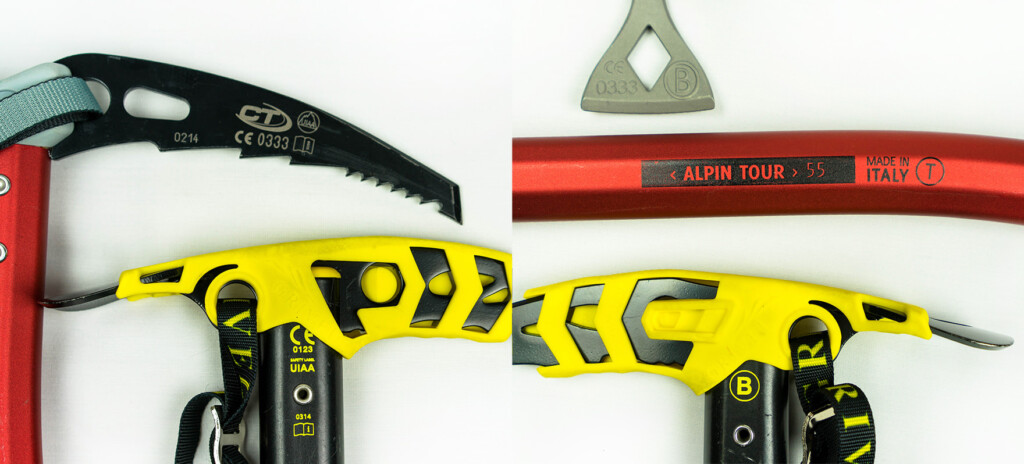
Almost all models from major brands have this certification mark or either the "B" or "T" mark clearly displayed somewhere
Points to consider when choosing:
- If you are considering taking on routes with a lot of climbing in the future, you should not go for an extremely lightweight model
- If the ice axe has been certified to international standards such as CEN, it is sufficient for it to be at a basic (B) level
Point 4: Ease of use – Don't take it lightly –
It may seem like a small thing, but one thing you shouldn't forget is the maneuverability of your ice axe. The head and shaft, which you always hold, are particularly important in terms of how quickly and safely you can change your grip. Furthermore, speed is crucial when it comes to stopping a fall, so even a little ease of use can mean the difference between life and death
These may not be a big deal for people with normal or large hands, but they can make a big difference for people with smaller hands or women. From my experience, if the grip is too big and puts pressure on your fingers, it can lead to poor circulation and make your hands more likely to get cold
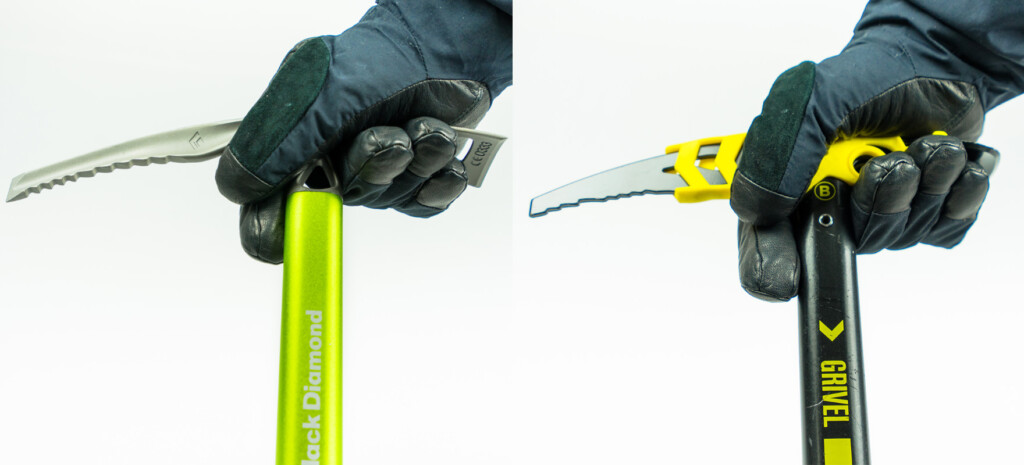
The Black Diamond Raven (left) has a slimmer head that makes it easier to grip, while the Grivel G Zero comes with a head protector to prevent your hands from getting cold
Points to consider when choosing:
- , you should also keep in mind the ease of use and handling in real-life situations , such as how easy it is to grip the head, how smooth it is, and how well it stays cool
Point 5: Other accessories that you should prepare
cover
Picks, blades, and spitzes are sharper than you might imagine, and wandering around the ground with them exposed is extremely dangerous and can be used as a powerful weapon against others. Also, if you handle them carelessly without covering them, many people have probably had the experience of accidentally tearing off important clothing when lifting or lowering a backpack. You can purchase a commercially available cover, make your own cylindrical cover, or wrap it around something with duct tape. Whatever method you use, be sure to use a cover
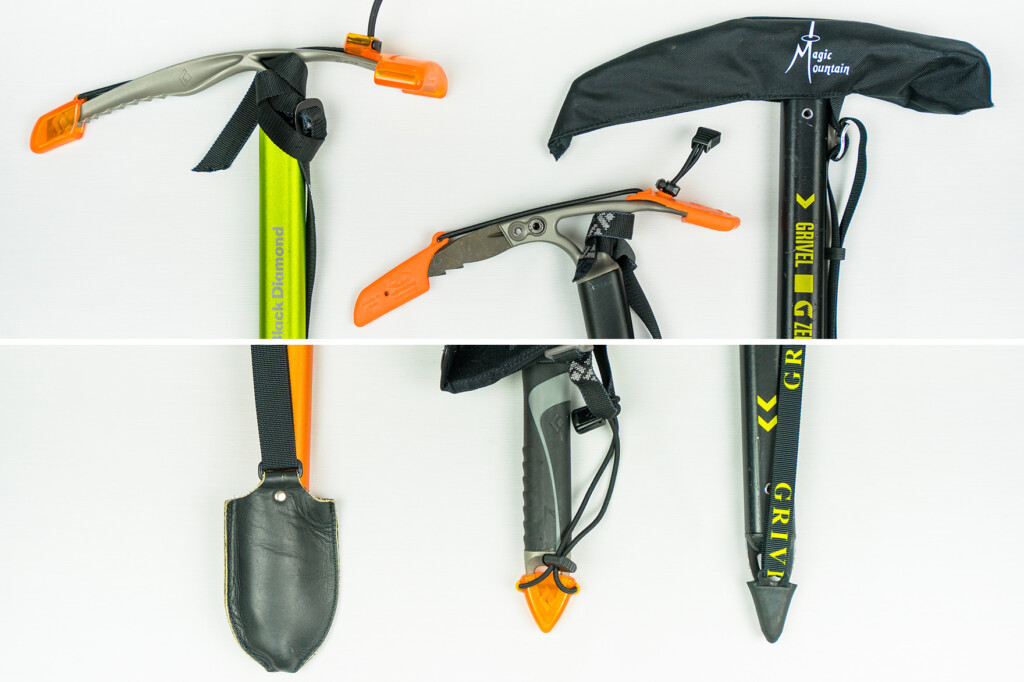
Leash (ice axe band)
A leash is a band that connects you to your ice axe. It is used to keep you connected to your ice axe at all times, not only on slopes where you never know when you might fall, but also in any other situation to prevent you from dropping it if you let your guard down. It can also be used to ensure safety when taking a break on the slope, by burying the shaft in the snow as an anchor. It is wise to always wear one unless you are an extremely skilled professional guide
leashes shoulder type and wrist type I will introduce combined type that the instructor taught me
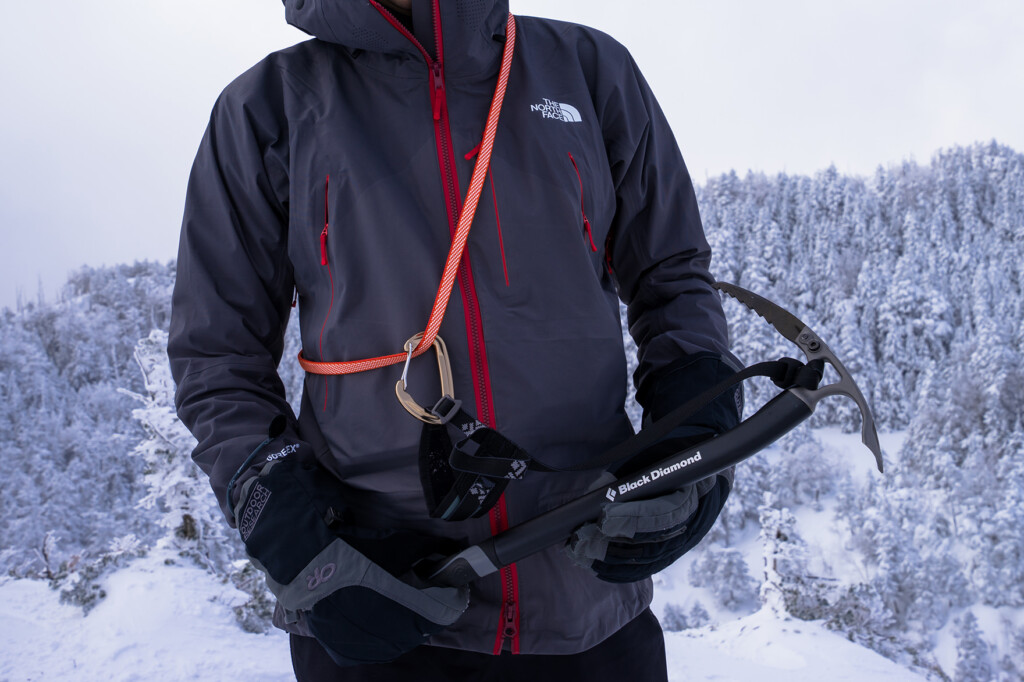
The combined type involves wearing a 60cm tape sling over your shoulder, attaching a carabiner to it, and then connecting a wrist leash to it. It's a great product that can be used either as a shoulder sling for everyday use, or as a wrist leash when climbing, detaching it from the carabiner
| Types of leashes | Shoulder type | List type | Complex type |
|---|---|---|---|
| advantage |
|
|
|
| Disadvantages |
|
|
summary
I've written at length so far, but to finally say the obvious, in my experience, when it comes to ice axes, as long as they are within the scope of what I've covered here, whether they're straight or curved, or whether they're a few centimeters longer (shorter), is not such a fatal issue. What's more important is how freely you can use the tool you've been given (chosen). In other words, once you've decided on one, the most important thing is to first become proficient in using it so that you can handle it as if it were a part of your body. Based on what I've written here, I think it's best to honestly not worry too much about the details and just pick up something that's affordable and easy to use. I'll list some recommended models later
Finally, just to be clear, even after going through all of this, due to the fundamental nature of mountaineering equipment, the conclusions written here may not apply to everyone in all situations. I have tried to focus as much as possible on the way of thinking, but please do not blindly accept the conclusions written here. Climbing snowy mountains in particular is a dangerous activity that can put your life at risk if you do not have sufficient knowledge and skills, so I recommend that anyone who is actually considering taking up winter mountaineering should always be accompanied and guided by a reputable organization such as a mountaineering club, or by an experienced person
[References]
- "Yama to Keikoku May Issue" Yama to Keikokusha, 1965
- Kazuyuki Takahashi, "Research on Mountaineering Equipment: Complete Guide to Choosing, Buying, and Using It," Uni Publishing, 1979
- Akira Hashiya, "How to Choose Mountain Gear Without Making a Mistake," Yama-to-Keikokusha, 1989
- Hiroshi Hotta, "Challenging the Mountains: What Climbing Equipment Says," Iwanami Shinsho, 1990
- "Yama to Keikoku April Issue" Yama to Keikokusha, 1990
- Snow Mountain Climbing (Yamakei Technical Book - Complete Guide to Mountaineering Techniques) Yama-to-Keikokusha, 2006
- "Mountaineering Equipment Encyclopedia" Yama to Keikokusha, 2010
- Yoshiki Kasahara, "Experiences of Mountaineering Gear," Yamakei Shinsho, 2014
- "PEAKS Special Edition: Latest Snow Mountain Gear Guide" Ei Publishing, 2015
- “Trampin vol.25 Introduction to Snowy Mountains (CHIKYU-MARU MOOK)” Chikyumaru, 2015