



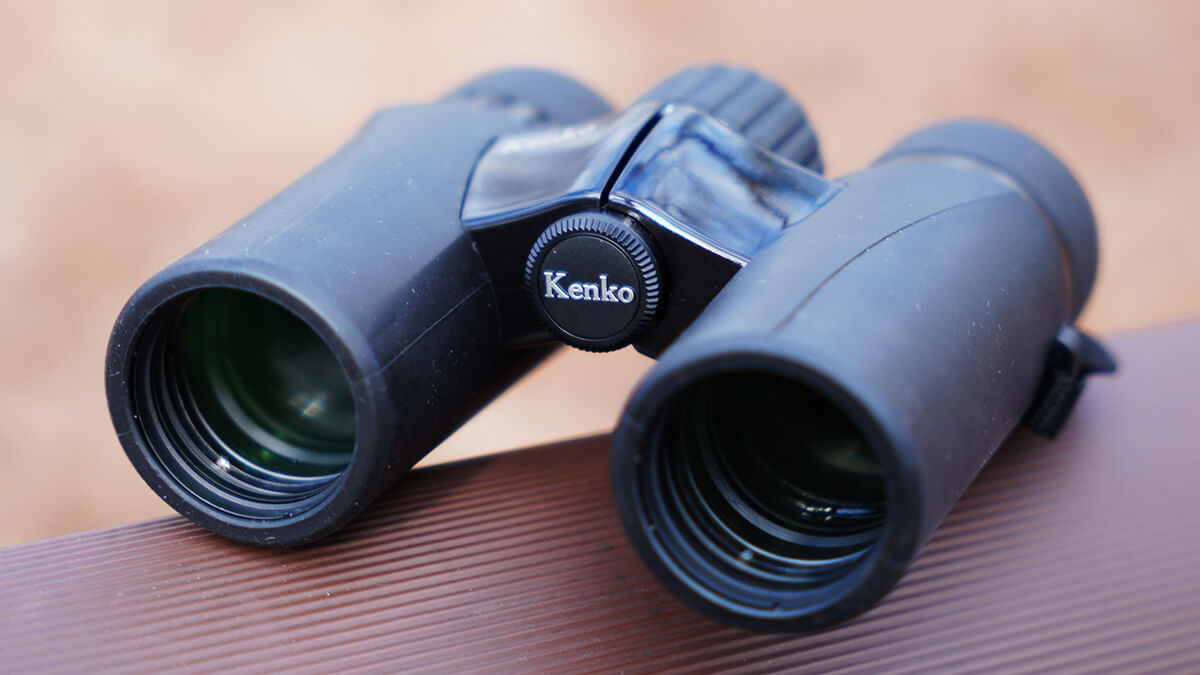
[Recommended by a binoculars-hating author] The lightweight, high-performance mid-range Kenko "Ultra View EX Compact 8x32" is amazing, with an amazing optical performance difference from entry-level models

Written by Saito Titoce
Binoculars are a convenient item to have when enjoying outdoor activities like observing wildlife and natural scenery. However, many people have them but find them difficult to use and rarely use them. In fact, I was one of them. However, once I started using the Kenko Ultra View EX Compact 8x32, a mid-range model, my impression changed completely. I will introduce them, including the differences between them and typical entry-level binoculars
table of contents
- What is Kenko's "Ultra View EX Compact 8x32"?
- Detailed Review
- I was surprised at the difference in realism, resolution, and texture compared to entry-level models
- The large diameter and brightness make it easy to see even in dimly lit places
- In fact, I think it's better to have something that isn't too compact to get a more immersive experience
- Kenko's "Ultra View EX Compact 8x32" is easy to focus, waterproof, and antibacterial
- Summary: Kenko's "Ultra View EX Compact 8x32" is shockingly different from the entry-level model
- Kenko "Ultra View EX Compact 8x32" details and purchase information
What is Kenko's "Ultra View EX Compact 8x32"?
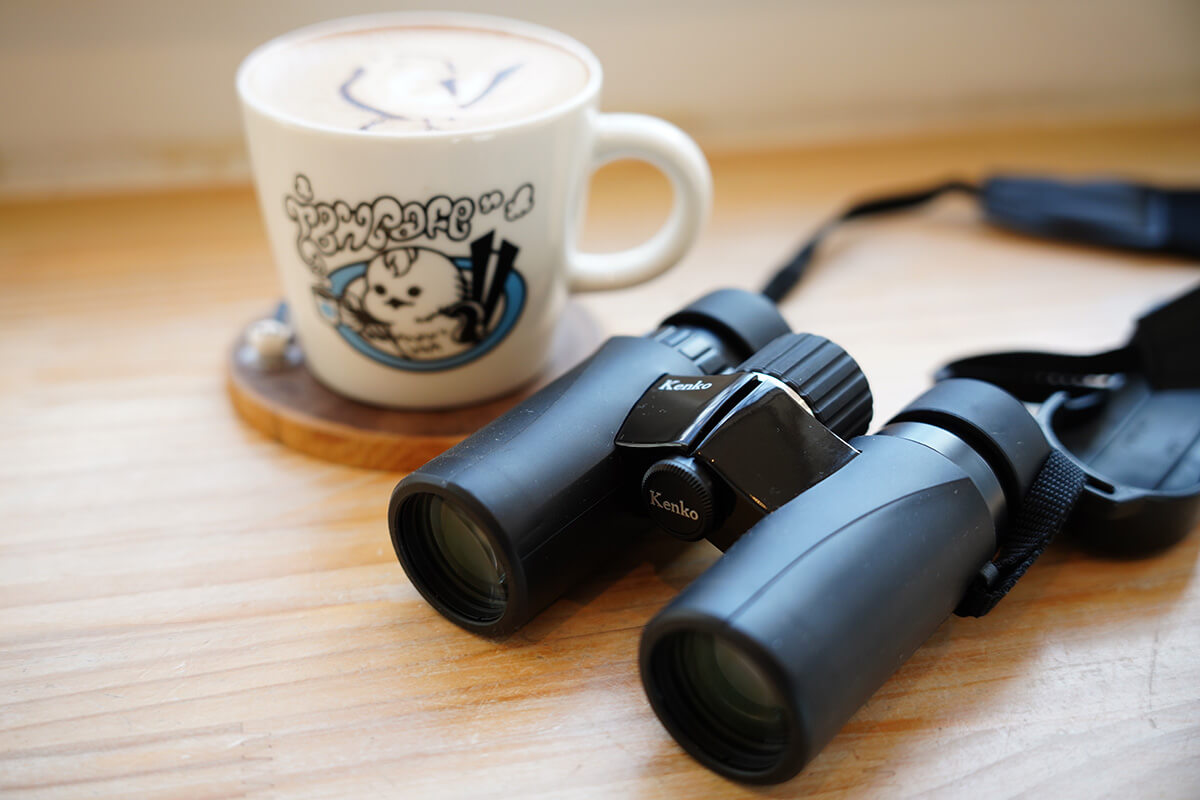
I borrowed the Kenko Ultra View EX Compact 8x32 from Kenko Tokina. The market price is around 30,000 yen
A talented product that was ranked number one in the middle-class recommendations of "Home Appliance Criticism"
I know it may seem odd to start an article about binoculars off with this, but I've always found binoculars difficult to use. Perhaps because I normally use expensive telephoto lenses for my SLR cameras, I felt that the clarity, sharpness, and resolution were low, it was difficult to focus, and my eyes felt tired
When photographing wild animals or birds, I think it's cool to see them use binoculars to check the situation before taking the photo, but that's the reason why I don't usually carry binoculars with me when photographing wild animals
However, the other day, I was talking with an employee at Kenko Tokina, a company that handles not only camera lenses and accessories, but also binoculars and telescopes, and the topic turned to me: "You do detailed reviews of camera lenses, but you don't do reviews of binoculars." Indeed, I have made it my life's work to publish e-books such as Lens Database and Lens Lab on Amazon Kindle. My latest publication is " SIGMA 14mm F1.4 DG DN | Art Lens Database ." If you're interested, please take a look.
When I confessed, "The truth is, I don't like binoculars because I find them difficult to see through," I was asked, "Are you perhaps using an entry-level model?" I didn't know this myself, but entry-level models with a market price of less than 10,000 yen account for the majority of sales in the binoculars industry. Unfortunately, it seems that due to the price, there are some areas where the optical performance cannot be said to be sufficient
"There are various technical reasons why a mid-range or higher binoculars are recommended for viewing comfort, but I'll lend them to you, since it's quicker to see them for yourself," he said, offering me a test run of the Kenko Ultra View EX Compact 8x32 (market price: around ¥30,000). While a mid-range binocular with a market price of over ¥20,000, this in the "Binoculars for Live Viewing No. 1 Competition!!" in the August issue of Kaden Hyoron. While boasting sufficient optical performance, it's lightweight at approximately 375g, making it a recommended binoculars for outdoor use like this author's, as well as for live music and other activities. This time, I'll review the Kenko Ultra View EX Compact 8x32.
Recommended points
- The difference in realism, like going from DVD to Blu-ray
- Brightness level of 16 makes it easy to see even in dimly lit areas
- Highly immersive with a telescope tube over 3cm in diameter and twist-up eyepiece
- Large, smooth focus adjustment dial for ease of use
- Lightweight at approximately 375g despite an objective lens effective diameter of 32mm
- IPX7 equivalent waterproof and antibacterial body
Points of interest
- It's a shame that the body color is only black
Main specifications and evaluation
| item | Kenko Ultra View EX Compact 8x32 |
|---|---|
| magnification | 8 times |
| Objective lens effective diameter | 32mm |
| coating | Fully multi-coated |
| Actual field of view | 8.3° |
| Exit pupil | 4mm |
| Brightness | 16 |
| 1000m field of view | 145.1m |
| Eye relief | 15.2mm |
| Interpupillary distance | 56 to 73 mm |
| Minimum focusing distance | 2m |
| Size (maximum eye width) | 108.5×49.5×124mm |
| mass | 375g |
| Material | Main body: PPS resin Main body rubber / Roller rubber / Eyepiece rubber: EPDM (contains antibacterial agent) |
| accessories | Pouch, strap |
| Resolution | ★★★★☆ |
| Easy to read | ★★★★☆ |
| Brightness | ★★★★☆ |
| Carry-around | ★★★★☆ |
| Cost performance | ★★★★☆ |
| Satisfaction | ★★★★★ |
Detailed Review
I was surprised at the difference in realism, resolution, and texture compared to entry-level models
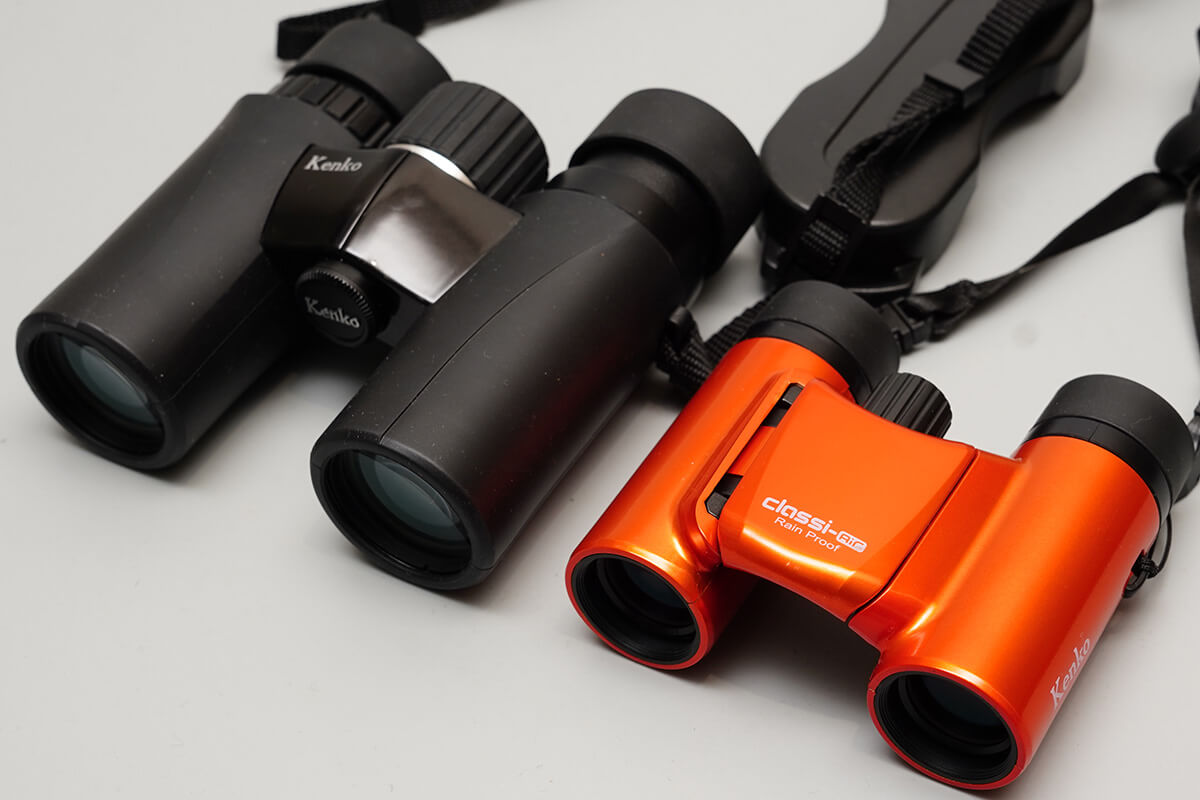
The Kenko Classi-air 8X21DH (photo: right) that I borrowed for comparison, and the mid-range Kenko Ultra View EX Compact 8x32 (photo: left)
The majority of binoculars sold in Japan are entry-level models priced at under 10,000 yen, and many people use these without even thinking about it. I probably used these entry-level binoculars without even thinking about it, and thought, "They're kind of hard to see, I don't like binoculars."
Therefore, to make it easier to compare with the mid-range Kenko Ultra View EX Compact 8x32, I was also loaned the Kenko Classi-air 8X21DH. Its market price is around 6,000 yen. It's a powerful entry-level model that was ranked second in the "Binoculars for Live Viewing No. 1 Showdown!!" in the August issue of Kaden Hyoh (Home Appliance Review)
Since I was told that I'd understand the difference just by looking, I took a look at the Kenko Ultra View EX Compact 8x32 and the Kenko Classi-air 8X21DH alternately. While I'll discuss the finer details separately, the Kenko Ultra View EX Compact 8x32 is by far the easiest to see. Not only is it easy to see, but the difference in resolution and realism is so great that it's as if a movie you're watching on DVD has been converted to Blu-ray, and you can even see the texture of the parts that are in sharp focus
Many people have probably had the experience of watching a movie on DVD without any particular complaints, but then watching it on Blu-ray and then going back to DVD only to be bothered by the indescribable lack of depth and the cheap-looking color gradations. That's the difference between the Kenko "Ultra View EX Compact 8x32" and the Kenko "Classi-air 8X21DH."
When asked why they are so different, they said the main factors are the lens diameter, lens coating, and prism performance. The Kenko Ultra View EX Compact 8x32 has an effective objective lens diameter of 32mm, and all lens and prism surfaces are fully multi-coated to minimize light transmission loss. It also features a phase coat and a prism made from a high-quality glass material with a high refractive index called Bak4, a dielectric multilayer film
In contrast, the Kenko "Classi-air 8X21DH" has an effective objective lens diameter of 21mm, and the lens is multi-coated with a multi-layer coating on at least one surface that comes into contact with the air, reducing light transmission loss.The prism is also made of a glass material called BK7 with an aluminum vapor deposition coating, so the overall optical system is inferior to that of mid-range models such as the Kenko "Ultra View EX Compact 8x32."
In fact, even for camera lenses, glass material and coating are important factors that determine the optical performance of the lens. The larger the aperture, the higher the performance of the lens, as higher-performance glass materials are used and coatings are applied to multiple lens surfaces, but this inevitably leads to the problem of higher prices. For this reason, mid-range binoculars, which can use glass materials and coatings that cannot be used in low-cost entry-level models, seem to offer dramatically improved visibility and resolution compared to entry-level models. In fact, I was surprised by the difference
The large diameter and brightness make it easy to see even in dimly lit places
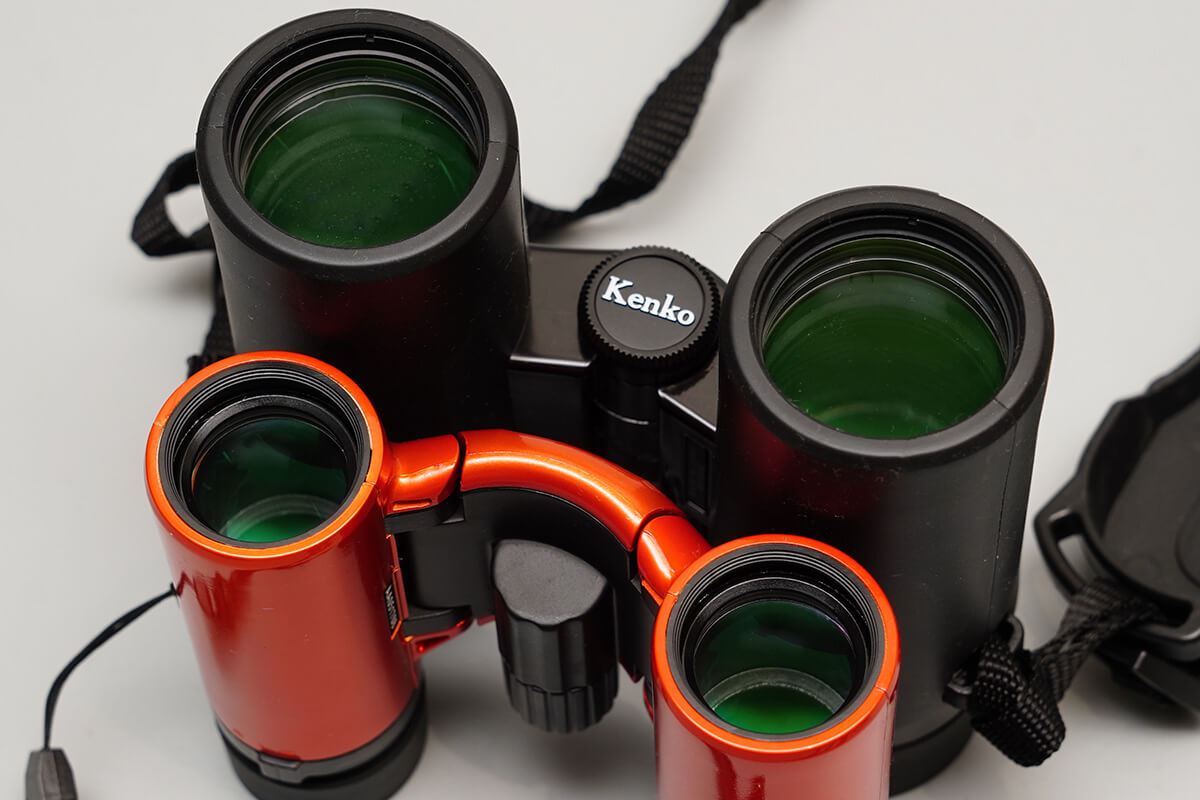
The Kenko "Classi-air 8X21DH" with an effective objective lens diameter of 21mm and the Kenko "Ultra View EX Compact 8x32" with an effective objective lens diameter of 32mm are placed side by side
Brightness is a very important factor in optical lenses. For camera lenses, which I am familiar with, brightness is expressed in units such as F○○. In contrast, the brightness of binocular lenses is expressed simply as brightness, with the Kenko Ultra View EX Compact 8x32 having a brightness of 16. By comparison, the Kenko Classi-air 8X21DH has a brightness of 6.8. In fact, the calculation is very simple: "(effective diameter of objective lens / magnification) squared."
The Kenko Ultra View EX Compact 8x32 has a brightness of (32/8) squared, which is 16, while the Kenko Classi-air 8X21DH has a brightness of (21/8) squared, which is 6.8. However, the actual brightness is affected by the number of lens elements and coating, so the actual difference should be even greater
However, when you compare binoculars in a well-lit store before purchasing, you often find that the difference in brightness is less noticeable than the image quality. This is influenced by the exit pupil, another factor that determines the brightness of binoculars. The exit pupil is the diameter of the bright circle you see when looking through the eyepiece from about 30 cm away, and the larger this diameter, the better the binoculars will be for observations in dimly lit places and astronomical observations
This exit pupil can be calculated by dividing the objective lens' effective diameter by the magnification, with the Kenko Ultra View EX Compact 8x32 having a 4.0mm exit pupil and the Kenko Classi-air 8X21DH having a 2.6mm exit pupil. Naturally, a lens with a larger exit pupil is brighter, but when the human pupil (pupil) is smaller than the binoculars' exit pupil, the human pupil blocks the light, making it difficult to see the difference in brightness. Generally, in bright conditions, the human pupil is about 2mm in diameter, so in bright conditions, it's difficult to see the difference in brightness between the 4.0mm exit pupil of the Kenko Ultra View EX Compact 8x32 and the 2.6mm exit pupil of the Kenko Classi-air 8X21DH
In my case, I noticed a difference in brightness in dimly lit forests and at dusk, but if you're planning on using them for live performances and concerts, I recommend carefully checking the brightness and exit pupil diameter. A rough guide for binoculars suitable for viewing in dimly lit places is a brightness of 9 or higher and an exit pupil diameter of around 3-5mm. Even with these criteria as a guide, it goes without saying that the Kenko Ultra View EX Compact 8x32 has an advantage over the entry-level Kenko Classi-air 8x21DH
Also, when actually looking through the binoculars in slightly dark conditions, the bright Kenko Ultra View EX Compact 8x32 is clearly easier to see. Wondering if this was just me, I asked a friend to try them out, and he also said that the bright Kenko Ultra View EX Compact 8x32 seemed less tiring to look through for long periods of time than the entry-level Kenko Classi-air 8X21DH
In fact, I think it's better to have something that isn't too compact to get a more immersive experience
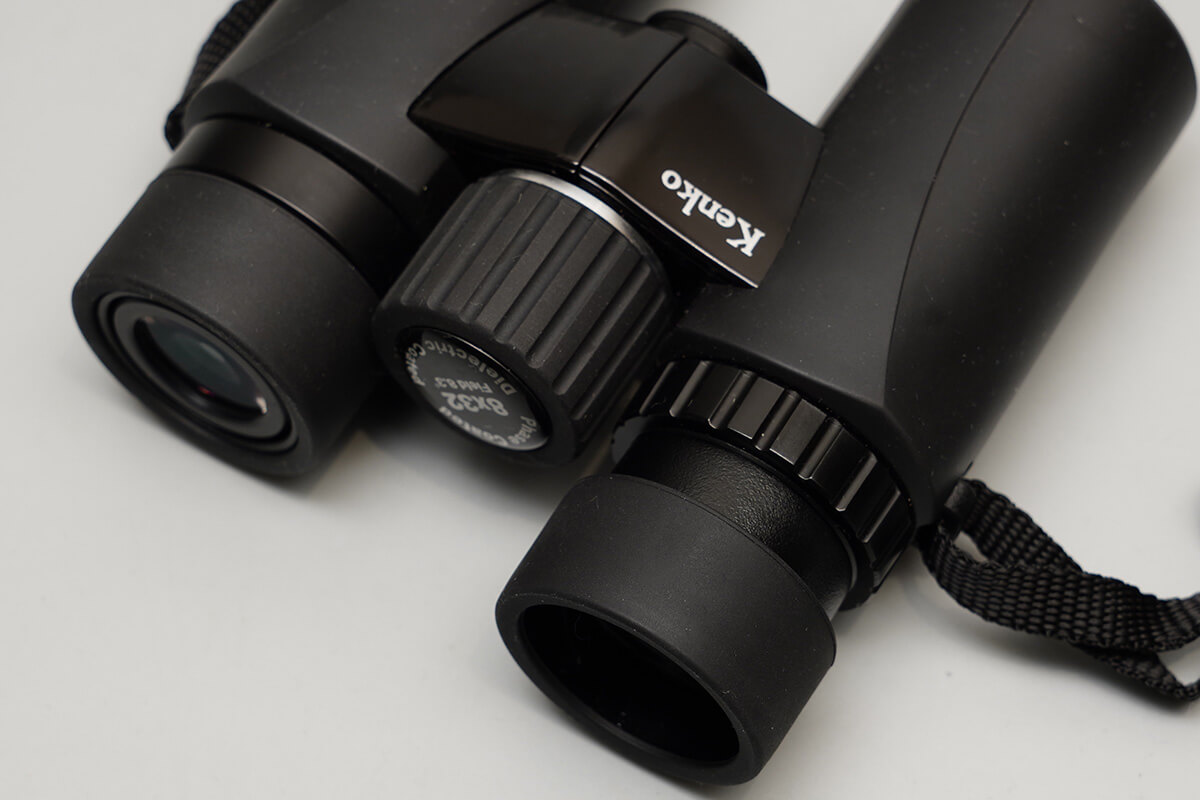
The Kenko Ultra View EX Compact 8x32 features a twist-up eyepiece that allows you to easily adjust the distance from your eye to the eyepiece
It was easy to understand why the Kenko Ultra View EX Compact 8x32, a mid-range model costing over 20,000 yen, was superior in terms of realism, brightness, and optical performance and ease of viewing compared to the entry-level model costing under 10,000 yen.However, what I actually felt was an even bigger difference was the sense of immersion when actually using it, or the ease of viewing
The Kenko Classi-air 8X21DH used for comparison has an effective objective lens diameter of 21mm, a compact 32mm diameter telescope tube, and weighs only 170g. In comparison, the Kenko Ultra View EX Compact 8x32 has an effective objective lens diameter of 32mm and a 42mm diameter telescope tube. As a result, the inner diameter of the eyepiece is approximately 35mm for the Kenko Ultra View EX Compact 8x32 and approximately 25mm for the Kenko Classi-air 8X21DH
Although it is only a difference of 1cm, when looking through the binoculars, the Kenko Ultra View EX Compact 8x32, which has an inner diameter of the eyepiece of approximately 35mm, fits firmly into the eyes of the binoculars, providing a high level of immersion, whereas the Kenko Classi-air 8X21DH, which has an inner diameter of the eyepiece of approximately 25mm, gives the impression that you are peering into the binoculars, and does not provide a high level of immersion
The diameter of the eyepiece seems smaller than my eyes, so it feels like the eyepiece doesn't cover my entire eye. So I looked up the size of human eyes and found that the average Japanese eye is about 2.7-3cm wide and 1cm tall. Even if my eyes are the average size for Japanese people, the Kenko Classi-air 8X21DH, with an inner diameter of about 25mm, probably doesn't cover my entire eye. Perhaps that's why I don't feel like I get a high level of immersion. In contrast, the Kenko Ultra View EX Compact 8x32 has an inner diameter of about 35mm, so for average-sized Japanese people, the entire eye is covered, providing a tight, close fit and a high level of immersion
When it comes to binoculars, lightweight and compact are important, but I felt that binoculars with an eyepiece inner diameter larger than the size of my eyes provided a better sense of immersion and easier viewing. My friend who tested them with me said the same thing, so it seems this isn't just my opinion. In that sense, the Kenko Ultra View EX Compact 8x32 is an excellent mid-range binocular, weighing just 375g while maintaining a large objective lens effective diameter of 32mm and a sufficiently large eyepiece inner diameter
Furthermore, the Kenko Ultra View EX Compact 8x32 uses a twist-up eyepiece that allows you to adjust the eyepoint by twisting it. Its eye relief is 15.2mm, a high eyepoint exceeding 15mm, making it comfortable for people who wear glasses like me to use without vignetting, which causes parts of the image to be cut off during observation. The entry-level model, the Kenko Classi-air 8X21DH, has an eye relief of 11.1mm. It seems that these points also make a difference between entry-level models and mid-range models, which typically cost over 20,000 yen
Kenko's "Ultra View EX Compact 8x32" is easy to focus, waterproof, and antibacterial
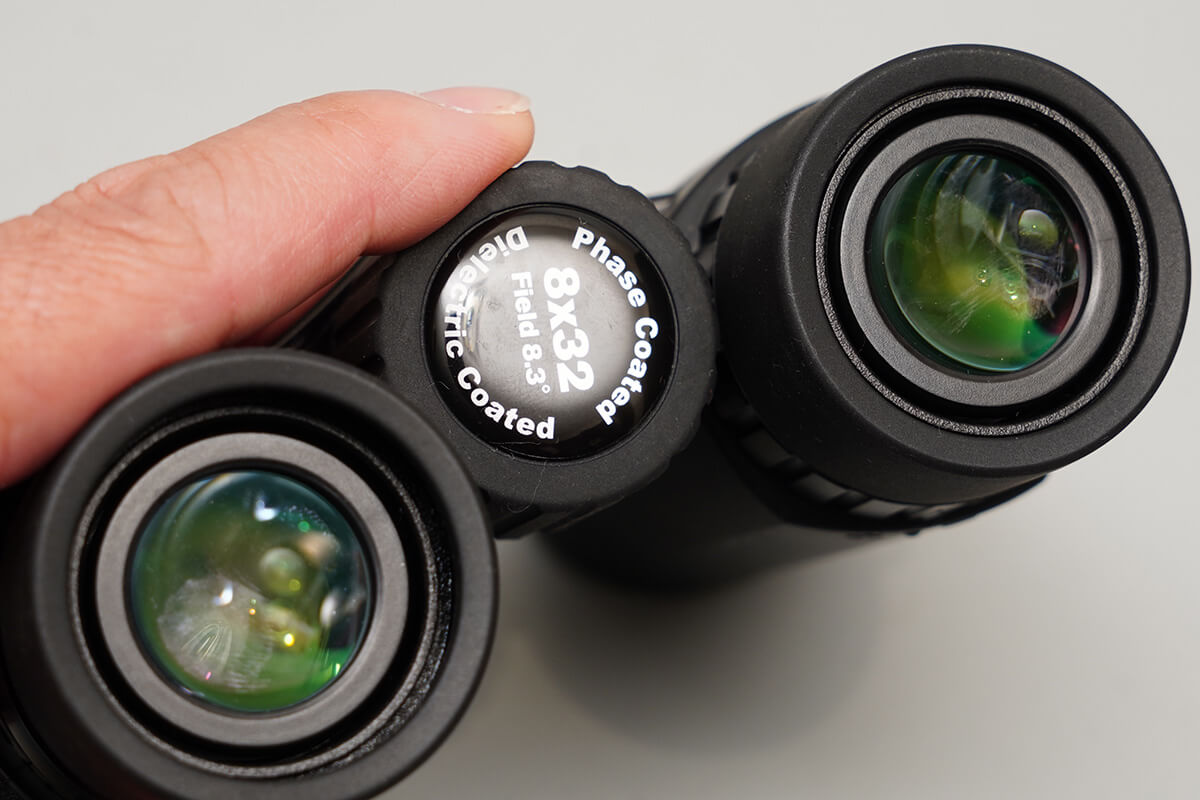
The focus adjustment dial, which is approximately 32mm in diameter, moves very smoothly and is easy to use. As this is a dial that is used frequently, ease of use is very important
This is a bit of a novelty for me, as I'm used to still camera lenses, where autofocus (AF) is now the norm, but manual focus (MF), which allows you to adjust the focus manually, is common for binoculars
For this reason, you turn the focus adjustment dial to adjust the focus according to the distance to the subject, but in environments where the subjects are moving, such as wild animals and birds, or at live shows and concerts, you need to constantly adjust the focus, so how easy it is to use the focus adjustment dial is very important
You can easily try it out at a retailer, so be sure to check it out. The mid-range Kenko "Ultra View EX Compact 8x32" has a large focus adjustment dial with a diameter of about 32mm, a textured rubber finish to prevent slipping during operation, and a very smooth feel and consistent force required for operation. In contrast, the entry-level Kenko "Classi-air 8X21DH" has a small focus adjustment dial with a diameter of about 16mm, and although it has a textured surface to prevent slipping, the dial itself is made of plastic, and it is difficult to say that it moves smoothly with a consistent force
The only dial you need to operate while using the binoculars is the focus adjustment dial, so in a sense, this control determines their operability. Unfortunately, this is also where the difference between mid-range and entry-level models becomes apparent.
Furthermore, for those like me who primarily observe birds and wildlife, as well as those who spend their time outdoors, the Kenko Ultra View EX Compact 8x32 is waterproof to a depth of 1m (10 minutes) in accordance with JIS B7261 (ISO9022-8) and has an IP rating of IPX7 (equivalent to 10 minutes). Furthermore, the interior of the binoculars is filled with nitrogen gas to prevent lens fogging. Furthermore, the exterior, covered with EPDM (ethylene propylene diene rubber), is antibacterial, preventing bacterial growth and keeping the binoculars clean.
One thing I found a little disappointing was that the entry-level model, the Kenko Classi-air 8X21DH, is available in a wide range of colors, including orange, deep gray, blue, and white, while the Kenko Ultra View EX Compact 8x32 only comes in black. While it's a matter of personal preference, it would be nice to have more body color options
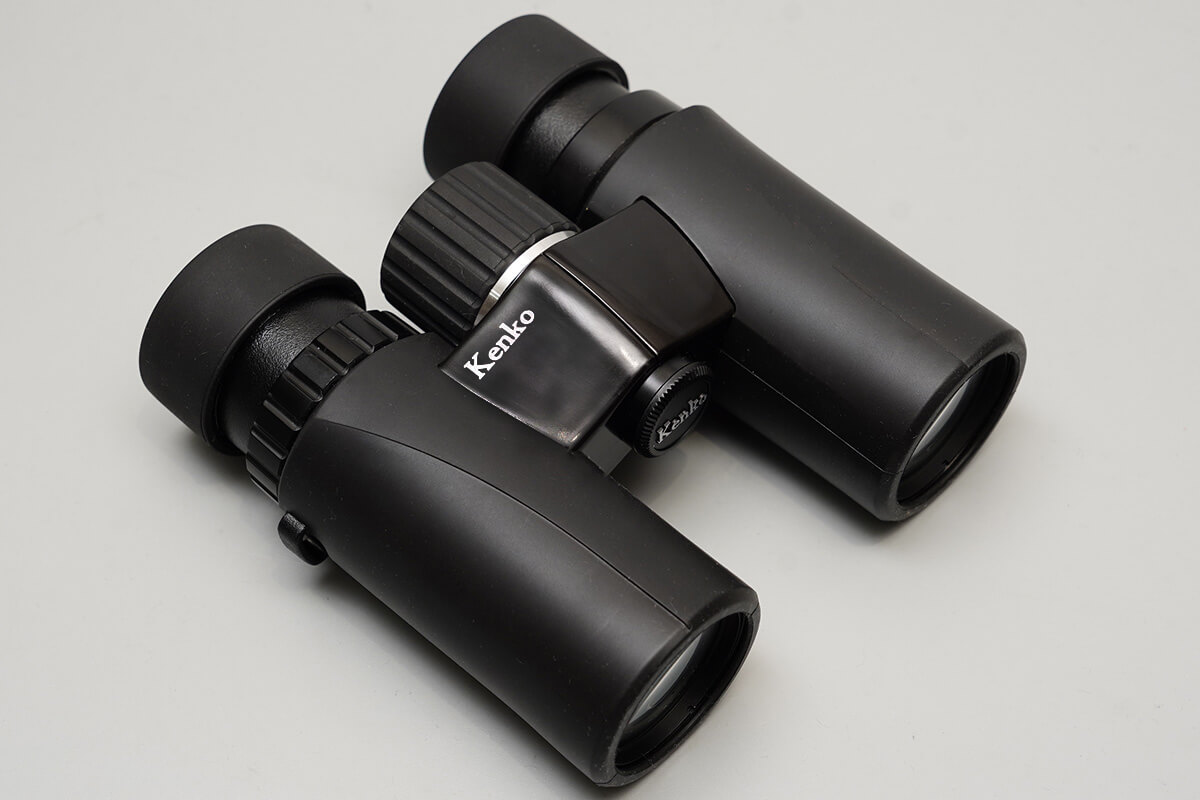
Kenko's Ultra View EX Compact 8x32 is covered in most parts with EPDM (ethylene propylene diene rubber) containing an antibacterial agent
Summary: Kenko's "Ultra View EX Compact 8x32" is shockingly different from the entry-level model
If you're going to buy binoculars, you'll want to compare them thoroughly before choosing a mid-range model

When I look at the Hokkaido squirrels I see every day through binoculars, I find it interesting to realize that I am looking at them from a different perspective than when I look at them through a camera lens to take a photo
"I don't like binoculars because I find them difficult to see through," the author said, prompting me to borrow the Kenko Ultra View EX Compact 8x32 from Kenko Tokina. While reviewing numerous interchangeable lenses for cameras, it's safe to say that I hadn't considered the differences in optical performance between binoculars at all
In fact, the Kenko Ultra View EX Compact 8x32 is a lightweight, compact mid-range binocular that boasts solid optical performance, and is clearly easier to see and use than entry-level models costing under ¥10,000. When considering purchasing binoculars, you might be tempted to choose a cheaper entry-level model with the same magnification, but because binoculars are unlikely to be replaced once purchased, we recommend carefully comparing the optical performance of mid-range models costing over ¥20,000, which are recommended by manufacturers, before making a purchase
Whenever I go to a field where there are wild animals and birds, I can't resist the urge to take photos and I immediately click the shutter on my camera. However, when I put the camera down and look at wild birds, animals, Hokkaido squirrels, etc. with the Kenko Ultra View EX Compact 8x32, I can view the subject from a different perspective than when I'm taking a photo, which is a lot of fun
I had received advice from my seniors that when you see a subject, it's important not just to take a picture, but to look closely as well, but perhaps because I was using entry-level binoculars, I felt that they were difficult to see, had poor resolution, and strained my eyes, so I avoided them. However, when I tried using the compact and easy-to-use mid-range Kenko Ultra View EX Compact 8x32, I realized that observing wild birds and animals with binoculars offers a different kind of enjoyment from photographing them
Whether you plan to use them outdoors like I did, or for live shows, concerts, or other activities like supporting your favorite idol, I recommend trying out a mid-range pair of binoculars like the Kenko Ultra View EX Compact 8x32 before purchasing. I think many people will be surprised by the difference in performance, which outweighs the price difference

Kenko "Ultra View EX Compact 8x32" details and purchase information
For more product details, please see Kenko's "Ultra View EX Compact 8x32."
Chitose Saito
 A former editor of a monthly camera magazine, he became immersed in the outdoor lifestyle of campervans and car camping while pursuing Hokkaido's spectacular scenery and wildlife. He is currently a photographer and writer who travels all over Hokkaido with his wife and two-year-old son, capturing and writing about everything he experiences, from cameras and lenses to outdoor activities, camping, child-rearing, PC gadgets, cooking, and even dieting. For OUTDOOR GEARZINE, he plans to write a variety of articles, primarily for the "QOCL (Quality of camping life) Improvement Committee," which aims to improve the quality of life while camping and in a campervan
Related reading
 [Binoculars haters try it!] I walked through the Hokkaido forest in early spring with the waterproof Kenko VC Smart 14x30WP vibration-proof binoculars
 SOTO Tri-Trail & Trail Table Review: A mountain-ready gas stove and table set that offers high performance, great value, light weight, and compactness
 Review: ZPacks Duplex Tent - A two-person tent weighing just 550g! This ultralight tent is super lightweight, compact, and durable
 [Is it easier to see than a camera and telephoto lens for about 500,000 yen?] I went to see pikas with the latest vibration-proof binoculars, the VC Smart 10x30 Cellarto WP