



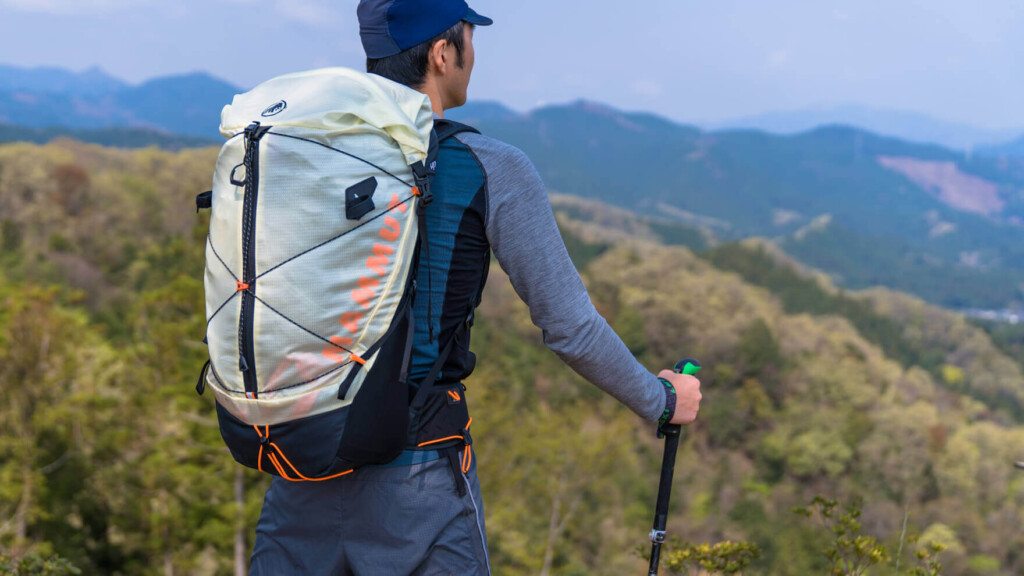
Review: MAMMUT Ducan Spine 28-35: No wobble, no stuffiness, no tact. A backpack for safe and enjoyable fast packing

Written by Yasushi Hisatomi
"Fastpacking" satisfies both the desire to hike a long course with the ease of trail running and the need to stay overnight, like a traverse mountain climb. It goes without saying that "fastpacking" is a style of mountain climbing that has become extremely popular in recent years
One of the main reasons for its growing popularity is, of course, the evolution of technology and the widespread availability of suitable equipment. The emergence of lightweight, highly functional equipment, whether good or bad, has opened the door to an activity that was previously only available to the able-bodied to many more people
The Ducan Spine backpack released by Mammut this season features a newly developed back system as well as a variety of storage and attachment options packed with intricate gimmicks, making it a new backpack that clearly demonstrates the power of technology.
Recently, climbing gear brands have released many excellent backpacks for fastpacking and speed hiking, such as the Black Diamond Distance 15 from last year
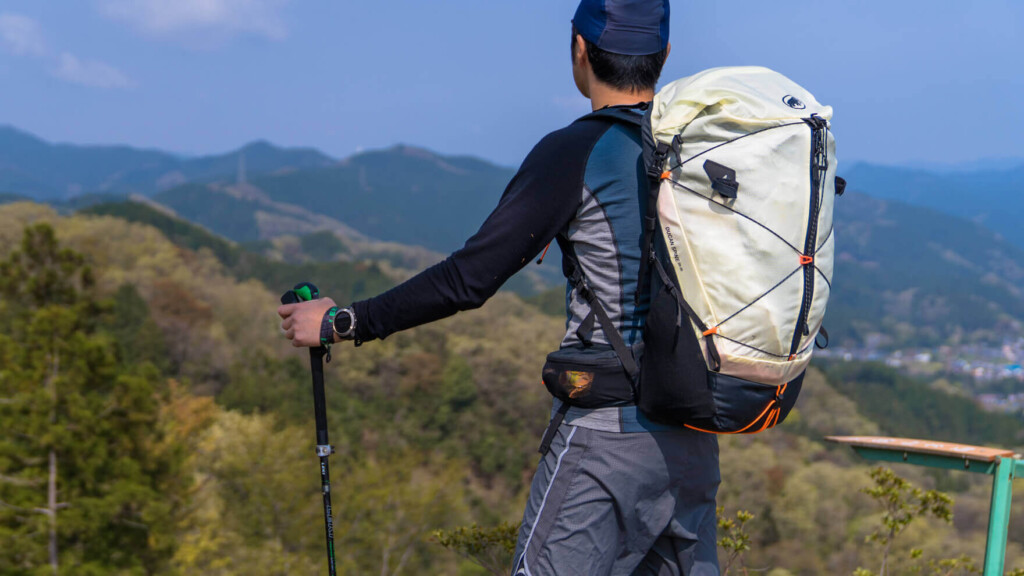
table of contents
Key Features
The Ducan Spine (28-35/50-60) is a hiking backpack that combines comfort, stability, and practical storage and usability. The patented "Active Spine Technology" back system evenly distributes the load and absorbs upper body movement while walking, allowing for unrestricted shoulder and hip movement, allowing for a more natural gait. The spacious back allows for excellent ventilation, keeping you comfortable even when sweating heavily. This lightweight, multi-functional backpack is packed with versatile storage and attachment options, including a front zipper for direct access to the main compartment, shoulder straps for storing drinks and small items, a pocket that can be attached to either the backpack's shoulder or hip belt, and a side pocket designed for easy access to a bottle while walking.
Here is ◎
- The back system provides excellent stability, preventing the center of gravity from shifting side to side even when walking (or running) with a heavy load
- Excellent breathability and ample cushioning for fatigue-free back, hips, and shoulders
- Roll-top main compartment with front zipper access for quick access to the luggage compartment
- A wide variety of storage and attachments designed with practicality in mind
This is what I'm curious about
- The cushioning is concentrated in the center of the back, so it doesn't feel like the whole back is fitted, so it feels strange until you get used to it
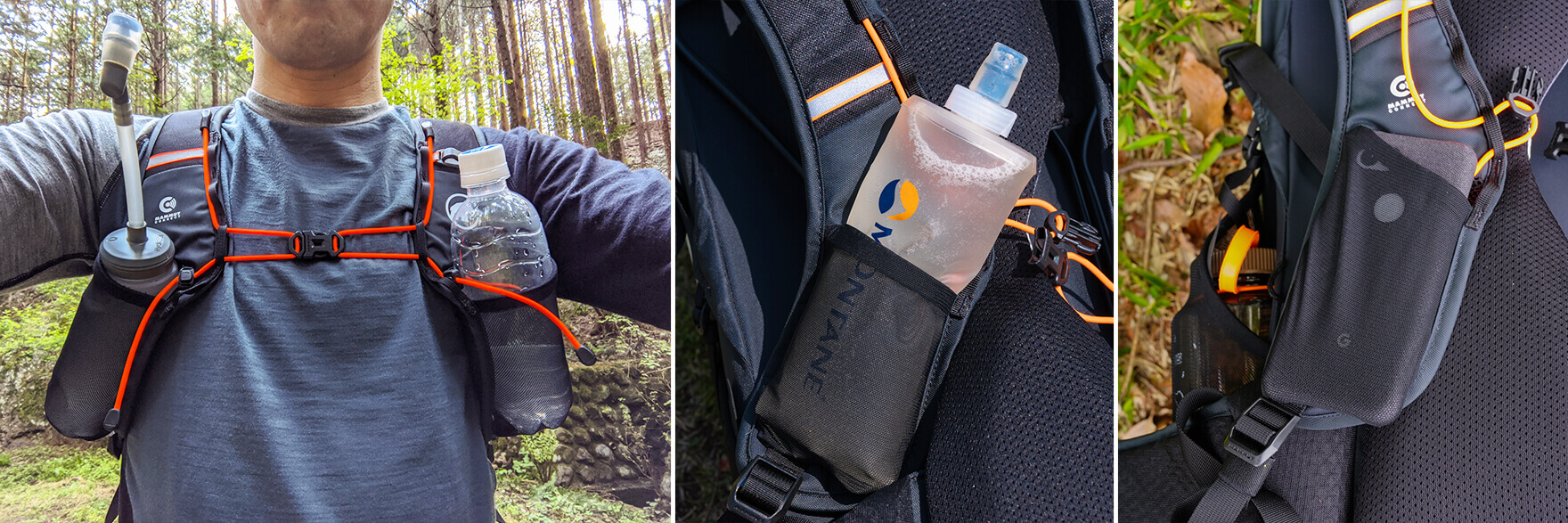
- The mesh pockets on the left and right sides of the shoulder strap are shallow and small (I wish they were large enough to hold a 500ml flask)
- The included water-repellent pocket is convenient, but I would prefer it to be a little larger
Main specifications and evaluation
| item | Specifications and reviews |
|---|---|
| material |
|
| color |
|
| Size/Back Length |
|
| capacity | 28-35 liters / 50-60 liters |
| weight | 1290 g (excluding rain cover 72 g and water-repellent pocket 34 g) |
| Women's model | can be |
| Main Access | Roll-top front zipper |
| Hydration sleeve | ◯ |
| Rain cover | ◯ (standard accessory) |
| Pocket Attachment |
|
| Comfort | ★★★★☆ |
| stability | ★★★★★ |
| mobility | ★★★★★ |
| Storage capacity | ★★★★☆ |
| Functionality | ★★★★★ |
| durability | ★★★★☆ |
| weight | ★★★☆☆ |
Detailed Review
Exterior features
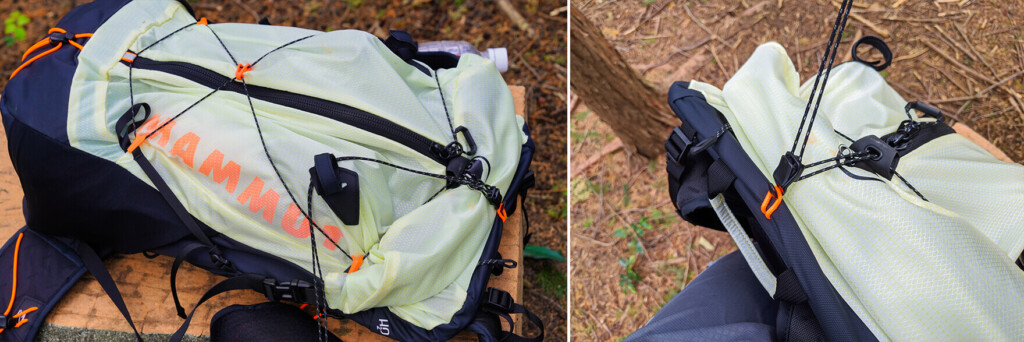
Looking at the outside, the only visible features are the zipper to the main compartment, compression straps for compressing the pack, and pole attachments, and there's no canopy or anything else. The exterior is very simple. While the lack of pockets and other storage may seem a bit off-putting compared to typical hiking and trekking backpacks, these are cleverly made up for by the convenient storage options (see below)
Although it is made as lightweight as possible, it weighs 1290g, which is by no means light for a backpack of this capacity. While the bag has been stripped of all unnecessary parts, the weight is offset by the voluminous back system. However, it is not extremely heavy, and comfort and fatigue are not determined solely by weight, so there is no need to worry too much about this at present
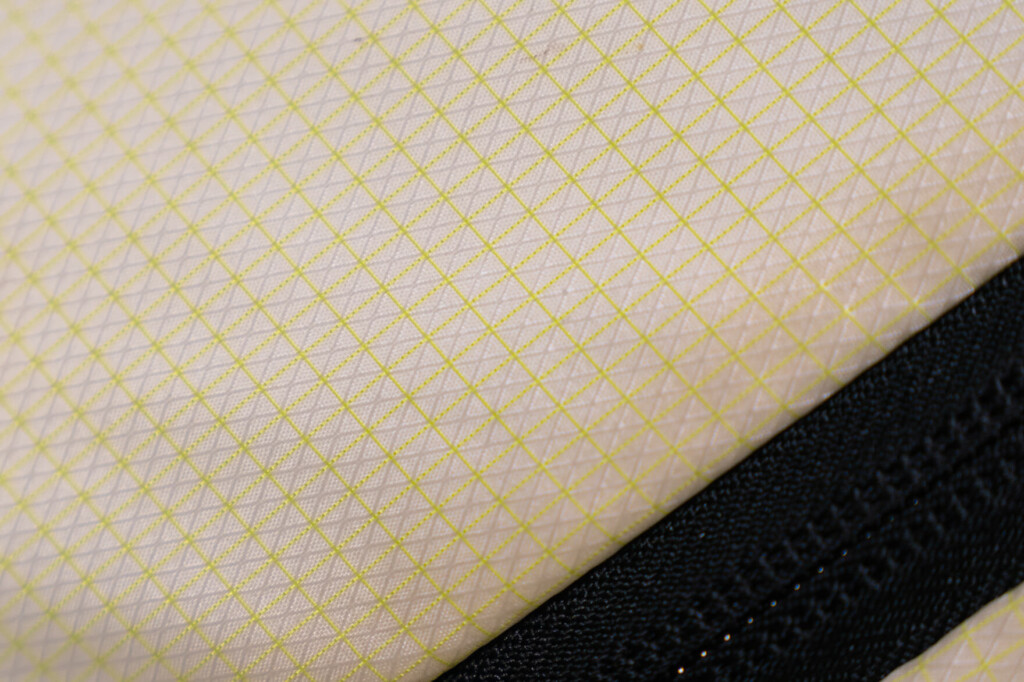
The main fabric is made of lightweight, highly tear-resistant ripstop nylon (100 denier) in a stylish color scheme (see photo below), and the bottom is reinforced with even more durable 210 denier fabric, so there's no need to worry about durability
An innovative back system that provides both stability and breathability
The Active Spine Technology, a back system featured on the Ducan Spine the Trion Spine model last season. I first experienced the ingenuity of this back system, and now I often use it on spring and other snow-covered mountain climbs.
However, last season's Trion Spine was a four-season backpack with a slightly stronger alpine orientation, so frankly it was a bit too much for mainstream hiking. It's safe to say that the Ducan Spine is a model that has been adjusted to better suit hiking needs, while retaining the revolutionary back structure as its base, in order to meet the needs of the market.
Enough of the introduction, let's get straight to the basics of how it works
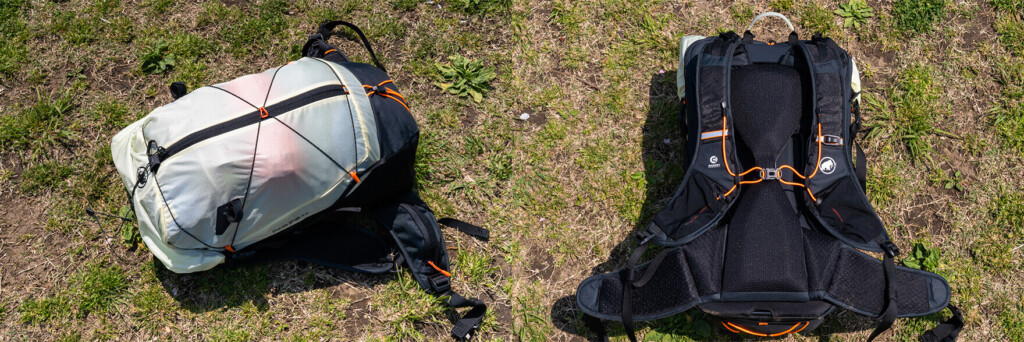
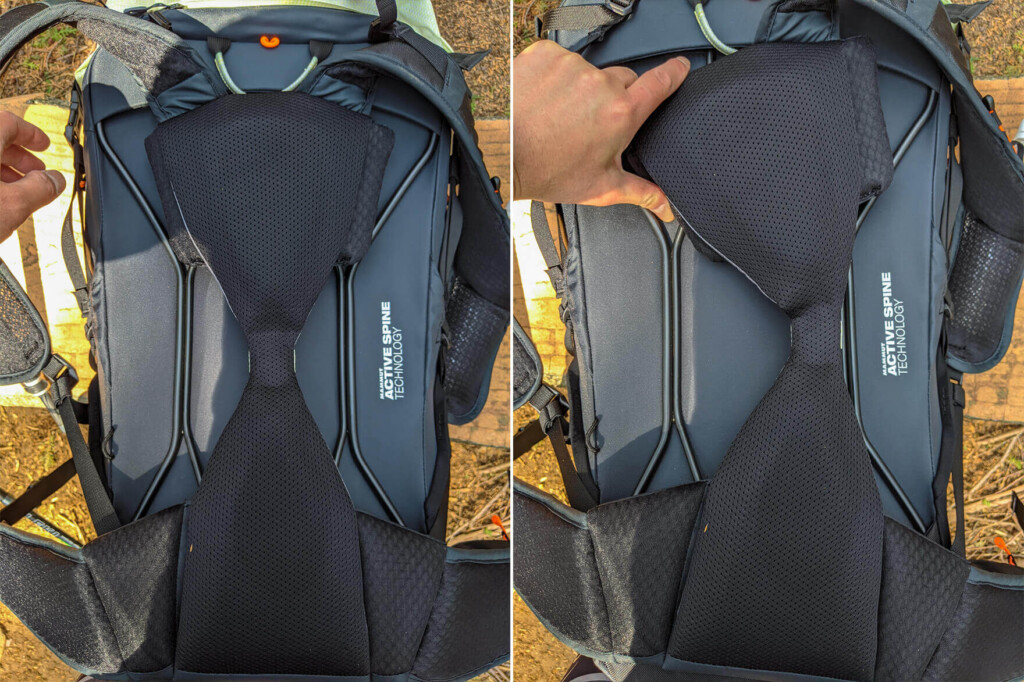
First of all, the entire back is covered by a slightly concave, trampoline-shaped, extremely rigid metal frame (see photo below)
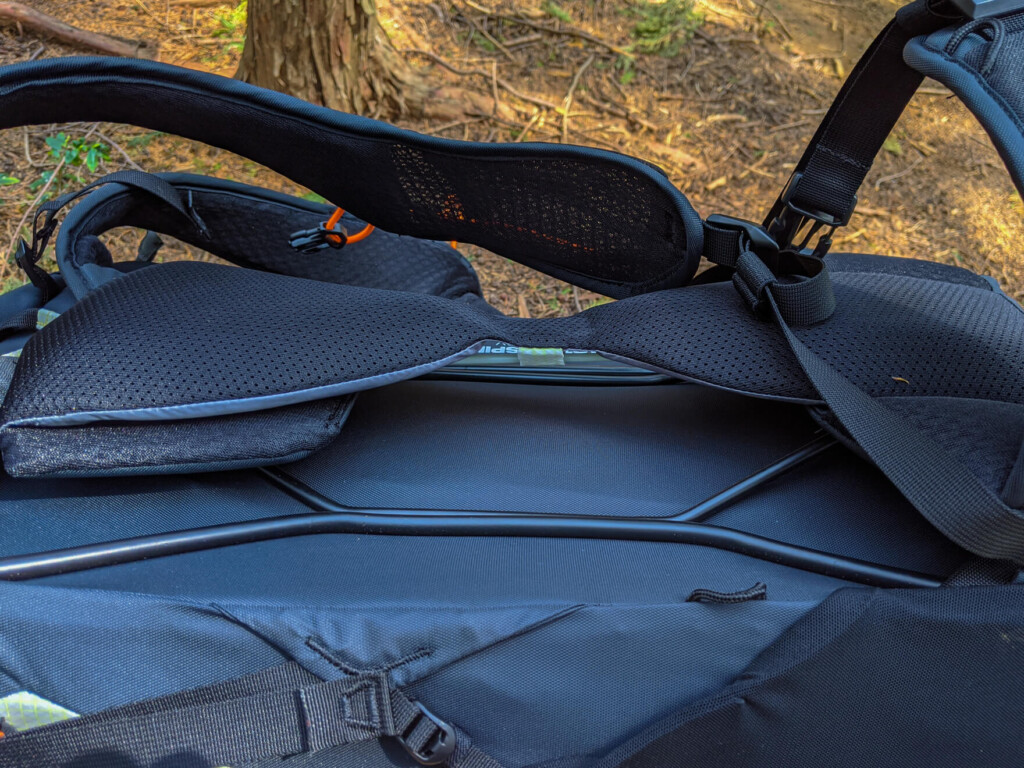
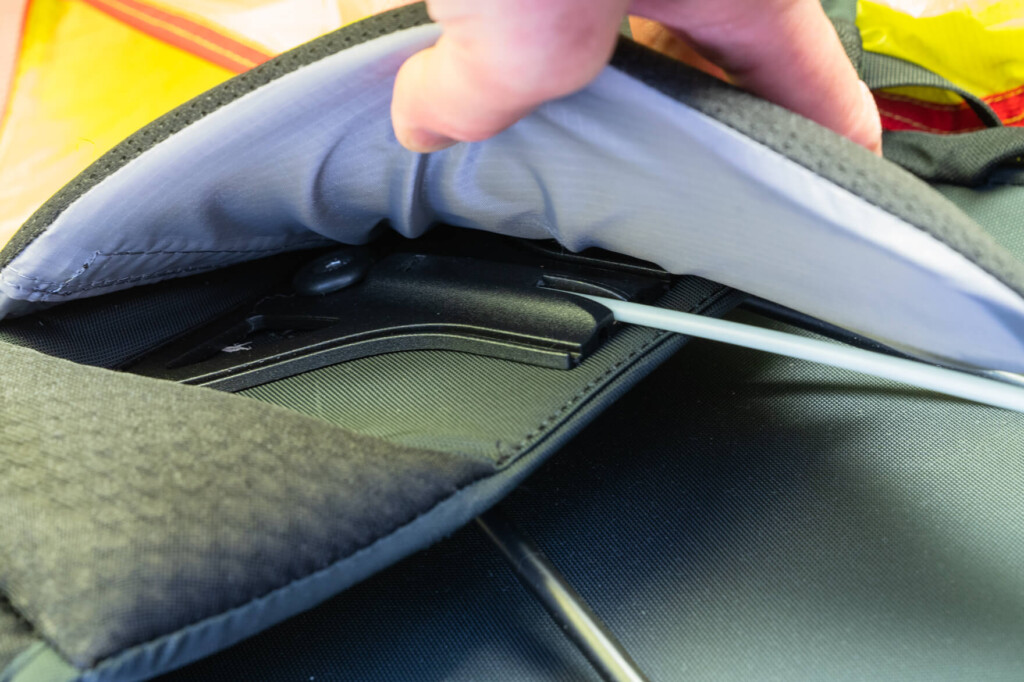
The shoulder and lower back areas are covered with thick cushions, and behind these is a flexible fiberglass support pole running through the center. Furthermore, both the top and bottom ends of the support pole (shoulders and lower back) are rotatable and fixed (see photo below)
This single support bends like a spine to match the tilt of your upper body, absorbing the swaying that occurs when you walk, keeping the backpack upright at all times and preventing the center of gravity from shifting (see photo below)
The introductory video below is from last season's Trion Spine, but the basic structure is the same, so we've included it here for reference
Up until now, there have been backpacks with hip belts that rotate around the waist to stabilize the center of gravity while walking, but most of those only had mechanisms for rotating or bending the hip belt, and I can hardly recall any that fully linked the entire back. What's new about "Active Spine Technology" is that it not only stabilizes the center of gravity at the waist, but also cleverly links this with the shoulder load of the upper body, contributing to ease of movement of the upper body and distribution of the load across the entire back
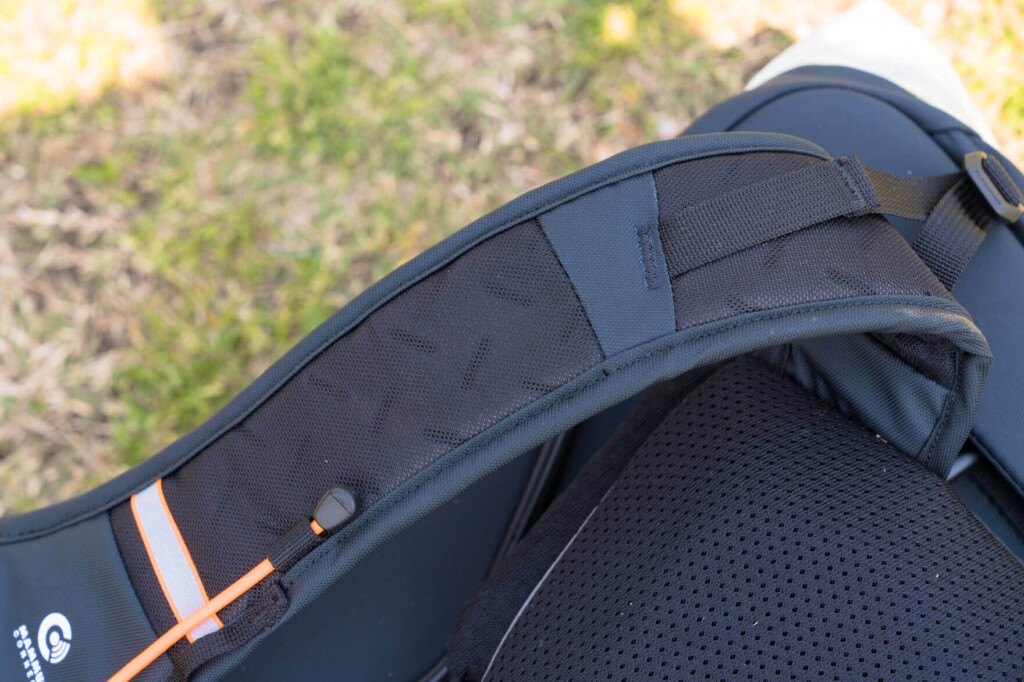
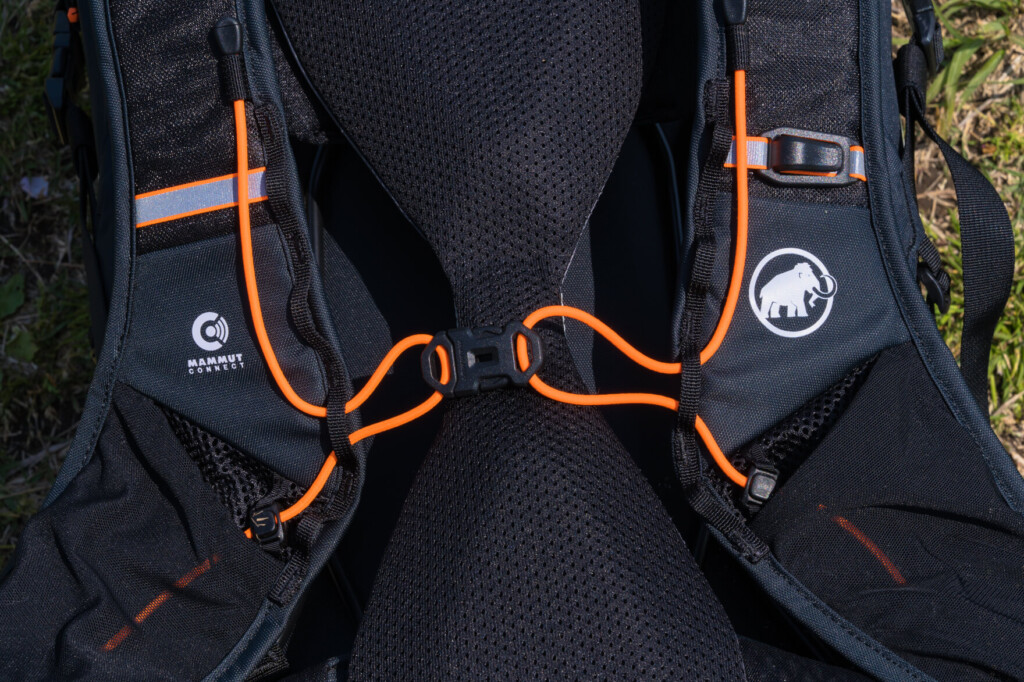
Furthermore, the trampoline-shaped back frame allows excellent ventilation for the back. Air flows freely across the back, allowing even large amounts of sweat to dry quickly. The shoulder and hip belts are also made with breathable materials, so you won't feel uncomfortable even in Japan, where the weather is often humid (see photo below). This system not only provides stability but also perfectly meets the demands of intense movement and sweating, making it an ideal system for speed hiking
The sternum strap, which I've never seen before, is made of elastic rubber so it doesn't dangle, is lightweight with minimal parts, and is easy to adjust the position. It's impressively efficient (see photo below). However, I'm a little worried about its strength when carrying a maximum load
It has a unique feel, but it's incredibly easy to walk in and doesn't tire you out
My impression when I actually tried wearing it was that it felt a bit strange at first. The cushion that comes into contact with your back has a pleasant bounce and isn't uncomfortable at all, but because it's concentrated in two places along the line of your spine (shoulders and waist), it doesn't feel like it fits your back evenly; to put it bluntly, it feels like it's touching your back at a "point." This is the complete opposite of a back that fits your entire back evenly, and honestly, people may either love it or hate it
However, once you put it on and start walking, you'll quickly realize that the discomfort is only minor. That's because, more than anything, the ease of walking, comfort, and stability provided by "Active Spine Technology" will give you unprecedented comfort
For example, I regularly use trekking poles, and I try to use my upper body as much as possible when walking to minimize damage to my lower body, but the resistance when I raise and lower my shoulders to operate the poles has become so smooth that I wonder if it's really okay. What's more, despite the up and down movement of my arms, the backpack barely moves or shakes at all.
This is, of course, thanks to the back system. When you raise one shoulder, the shoulder strap on that side rises with the movement of your shoulder, while the hip belt remains horizontal without being dragged by the movement of your upper body
Also, when walking quickly downhill, the impact of each step is strong, and as you gain speed, the force that swings the backpack from side to side also increases. However, even in that case, the backpack only moves up and down, and I was able to run down the mountain surprisingly smoothly. Regardless of how violently I moved with the backpack, it felt like the entire back absorbed the impact evenly, and there was no "swaying" sensation that you get with a normal backpack. There was never any pressure on any one part of the harness, such as the shoulders, back, or hips, and it always maintained a stable position.
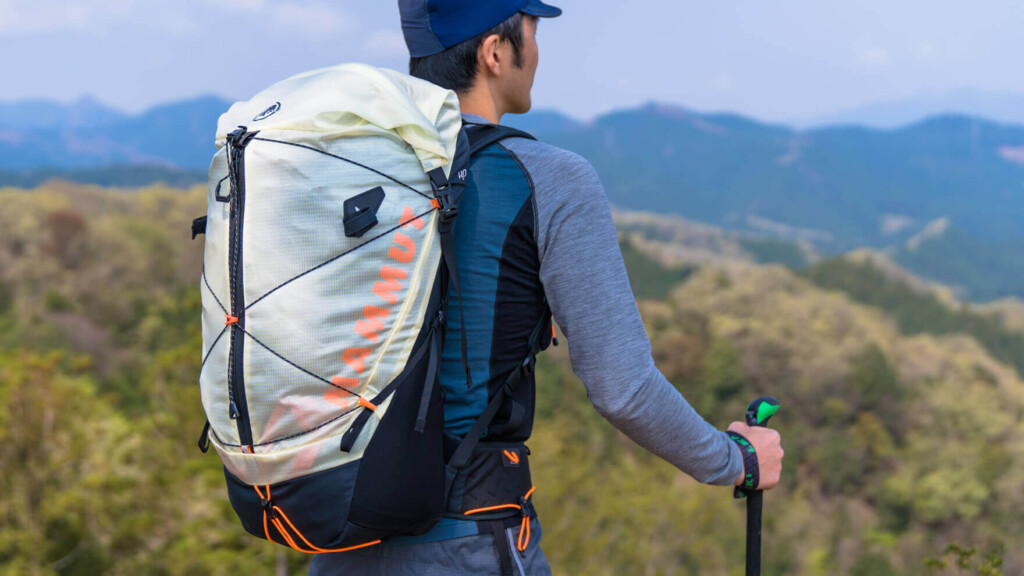
A wide variety of storage and attachments designed with practicality in mind
Roll-top main compartment
The main compartment is a roll-top type, which has become quite common recently. Not only is it easy to open and close, but it also has the advantage of being able to adjust the capacity from 28 to 35 liters by folding it up. The buckle can be fastened on the top or on the side
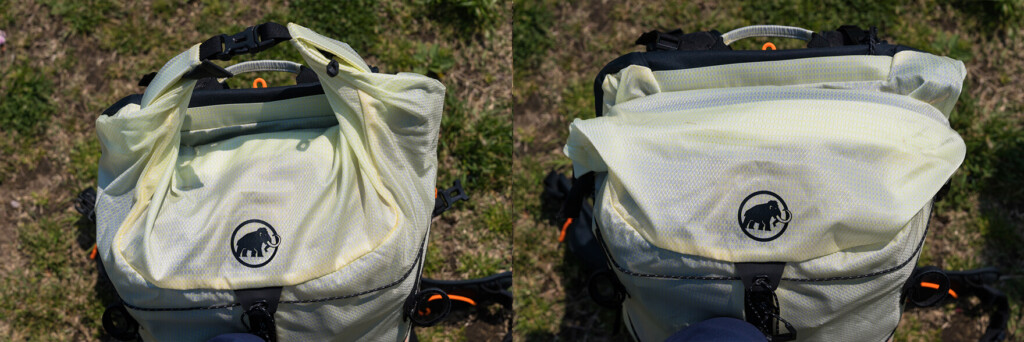
The main compartment has a zippered entrance, making it easy to use
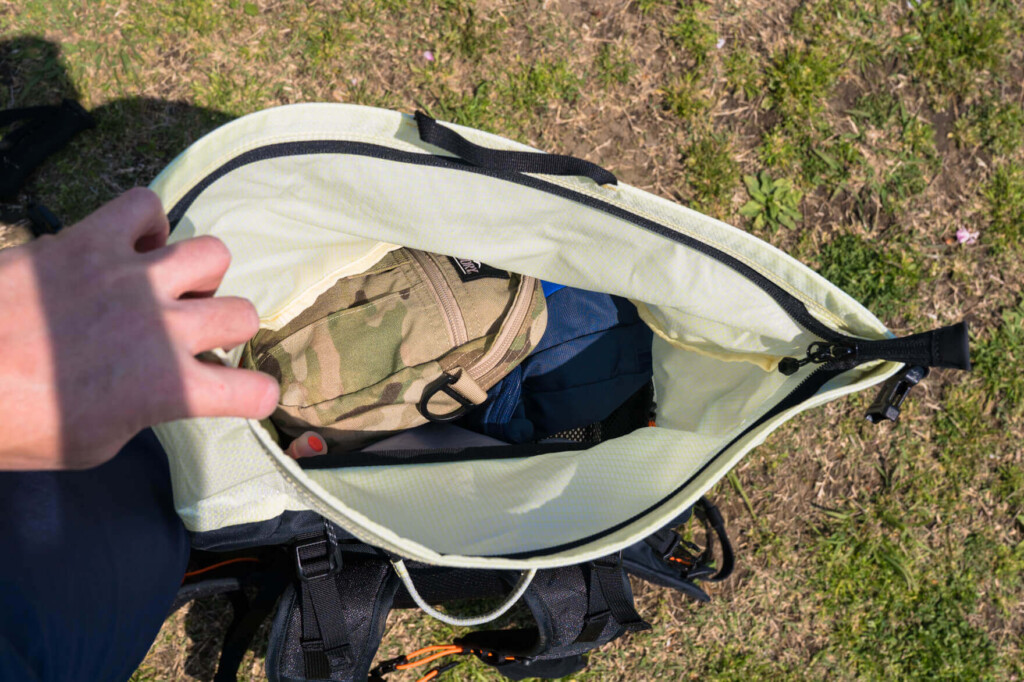
Direct access from the front
When it comes to hiking backpacks, many people think of large exterior pockets for storing snacks, warm clothing, rain gear, and other items. This model doesn't have such an exterior pocket on the front, but instead has a nearly full-length zipper, which is unusual for a backpack of this capacity, making it easy to access the contents inside. The zipper is made by YKK, is large and sturdy, and has a strong pull tab. It's also clever that it's made on the inside, perhaps to maintain a clean appearance
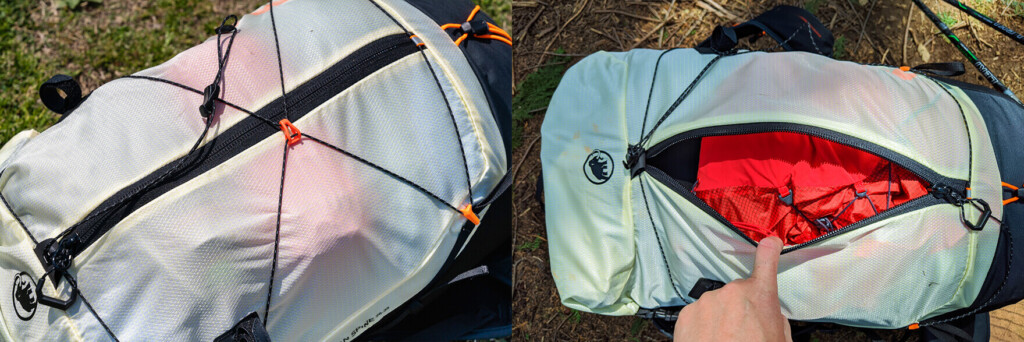
By the way, the entire backpack is equipped with a compression cord, so even if you only have a small amount of luggage, you can compress the entire backpack by simply pulling one point at the top of the cord. This design ensures that the backpack's appealing stability is not lost, regardless of the capacity
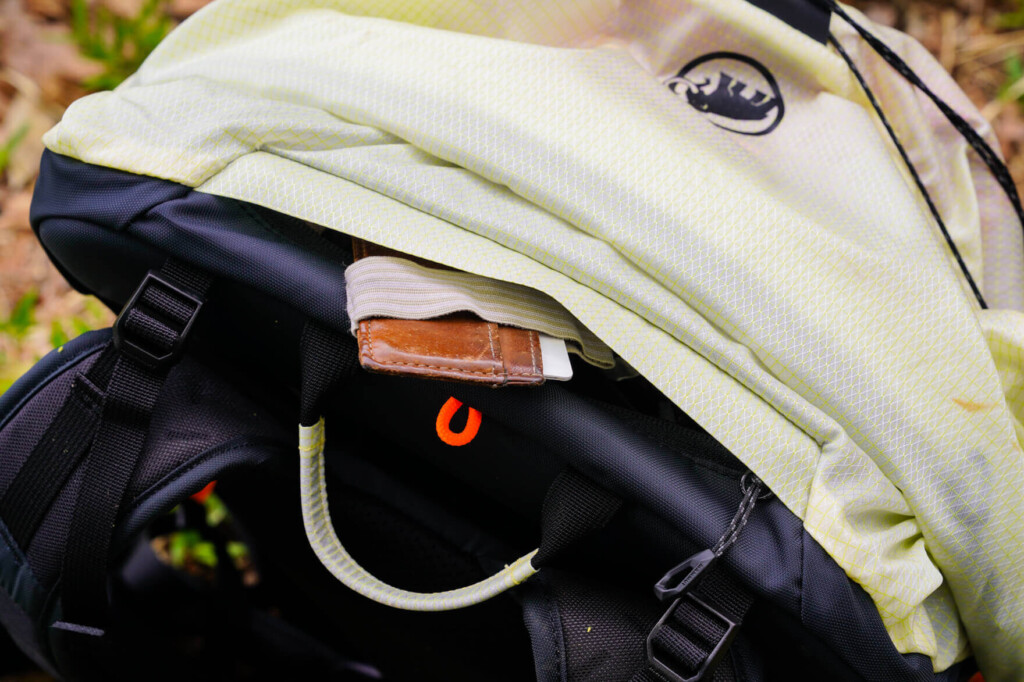
Top zipper pocket for small items
The top of the backpack has a narrow opening that makes it difficult to put things in and take them out, but it does have a zipper pocket that can hold valuables such as wallets, keys, cards, and smartphones, so you can safely organize your small items
Water-repellent pocket that can be attached to your preferred position
One interesting innovation that you might not have thought of, is that the backpack comes with a water-repellent sub-pocket that can be attached to various positions on the backpack. This is extremely practical as you can place it wherever you like
However, the bag has almost no gusset, so it only holds a map, compass, smartphone, and handkerchief, which is less than I expected considering its size, so I hope this will be improved in the next model.However, you can actually attach pouches you already own here, so in that sense it's worth customizing, and I'm happy with it as it is
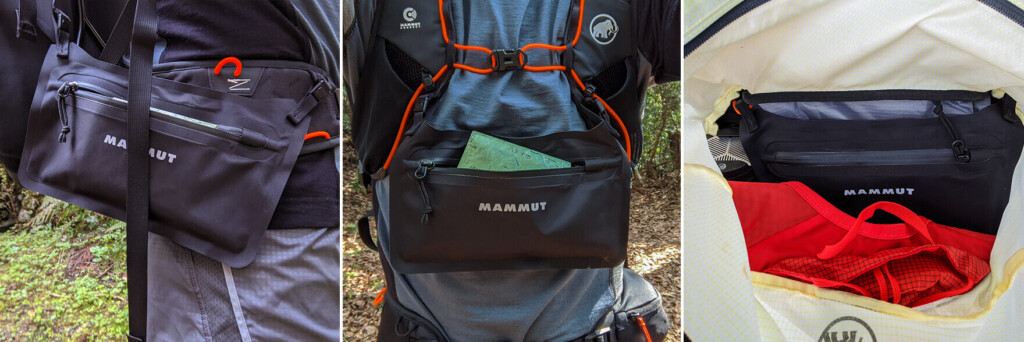
The included water-repellent pocket has attachment loops on the right hip belt, shoulder strap, and top of the main storage, so you can attach it anywhere you like
Left and right shoulder mesh pockets
The shoulder harness has mesh pockets on both sides. In the past, these were only found on vest-style backpacks for trail running, but in recent years they have started to appear on many lightweight backpacks
I personally want to put a drink in here, but unfortunately bottles and flasks with a capacity of over 500ml are a little too shallow and unstable, so a 355ml soft flask is just about the right size (see photos below, left and center). Also, smartphones and other items can be stored stably, rather than bottles (see photo below, right). Incidentally, it's compatible with hydration packs, of course, for hydration
Side hipbelt pockets perfect for bottles and snacks
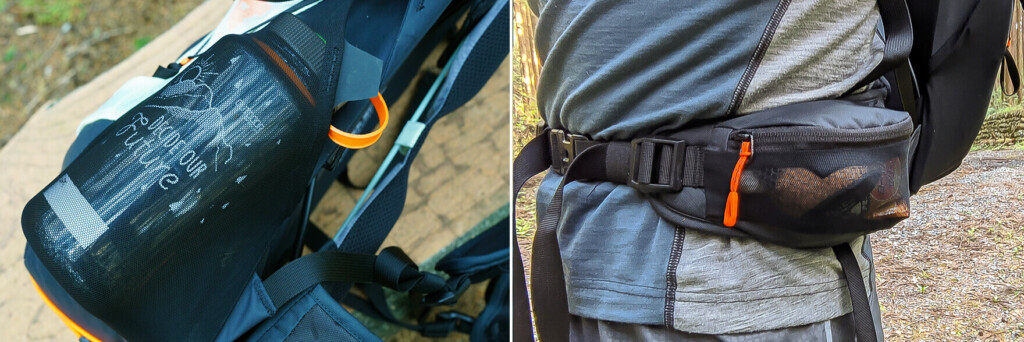
The left and right side mesh pockets can securely hold a 1-liter Nalgene bottle, and the angled openings make it easy to access the contents while walking (see photo below, left). There are also straps to secure the bottle in place, so you can secure longer items as well
There is also a fairly large mesh zipper pocket on the left side of the hip belt where you can store your smartphone, handkerchief, snacks, etc. (see right photo below)
Pole attachments for both approach and action
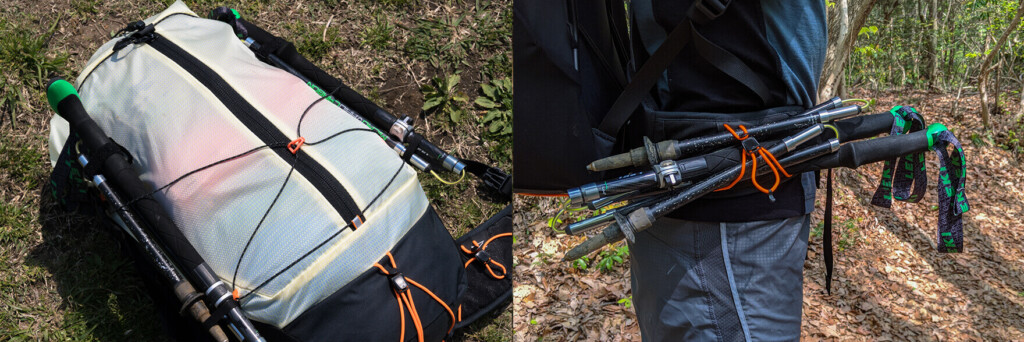
In addition to the usual attachment points on the front left and right (see photo below, left), the trekking poles can also be attached like a samurai on the right side of the hip belt (see photo below, right). This clever design allows you to do almost everything while walking without having to take off the backpack, which is really appreciated
Bottom attachment for securing small items
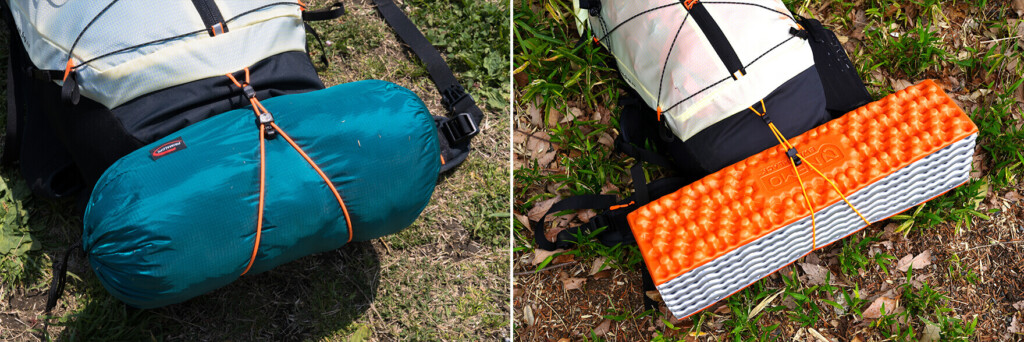
So far, the pack has more than enough clever storage options, but the real highlight is the bottom attachment at the bottom of the pack. The adjustable elastic drawcord allows you to secure various items. Unfortunately, the elastic material only provides a limited amount of hold, and while it was able to secure a summer sleeping bag, it was wobbly and unsafe when using a full-sized sleeping pad. This is the only thing that lacks stability
The included rain cover is securely stored at the bottom. It really does feel incredibly stable

Summary: What activities is it recommended for?
The high-tech back system not only prevents the backpack from swaying sideways even when carrying a heavy load or moving at high speed, providing a stable and comfortable fit, but also includes a number of other intricate features that fully meet the many (sometimes demanding) demands of fastpacking and speed hiking, from packing to support while on the move, making this a backpack that is perfectly suited to the latest, more light-footed mountaineering styles, as well as regular, leisurely mountain hikes. While there are some flaws here and there, they're not critical and can be easily addressed with your own ingenuity
The 28-35 liter models are just the right size for fastpacking trips, from day trips to overnight stays. The slightly larger 50-60 liter models are suitable for longer trips. The perfect time to use them is the hot summer. Spring 2020 is still a tough time for mountain lovers, but this backpack is perfect for welcoming the new morning as the night ends

Related reading
 Review: MAMMUT Ducan Knit High GTX: Is this really a high-tech hiking boot? These durable trekking boots offer exceptional lightness and a perfect fit
 [A genuine, self-funded review] These are now "wearable" hiking boots. A review of the next-generation trekking shoe, the MAMMUT Ducan BOA® High GTX
 Review: OSPREY Kestrel 38 This impeccable, all-purpose mountaineering backpack goes from "perfect" to "mature."
 [An honest, self-funded comparison review] Perfect for those just starting out in mountain climbing. A summary of recommended medium-sized backpacks for outdoor activities, classified by scene and purpose