



The best rainwear to wear right now and how to choose new and smart outdoor rainwear

Written by Yasushi Hisatomi
What do you need: comfort? Lightweight? Waterproof? Choose the perfect rainwear for you from a wide range of models to suit your needs
Rainwear is considered an essential piece of outdoor gear, and until recently, while it was categorized by price range, there didn't seem to be much difference in the way it was made. However, in recent years, even within the same category of mountaineering, it has been divided into more specific categories such as "day hiking," "fastpacking," "trail running," "serious trekking," and "alpine climbing," with a wide variety of models competing with each other. This is the epitome of the outdoor industry, which continues to expand worldwide, the maturing culture, and the resulting accelerating technological evolution and competition
Well, as a shopper, it's great to have more options, but we can't be too happy about it. Everyone wants to avoid regretting their purchase. That said, it's not easy to constantly keep up with cutting-edge technology, distinguish subtle differences among the dazzling array of the latest models, and choose the perfect piece that satisfies you
So, in light of the complexity of today's rainwear market, I, a mountaineering writer who has been at the forefront of rainwear with this site for seven years, will select some great rainwear from a user's perspective that you're sure to be very satisfied with.In the second half of the article, I'll also summarize how to choose the latest, smart rainwear that takes into account recent technological advances, so that even beginners will be sure to find the perfect model
However, rainwear, even among outdoor gear, is a category that requires particularly complex knowledge. Trying to explain everything from start to finish would quickly become so long it would put you to sleep. The purpose of this guide is to provide outdoor enthusiasts with useful information about choosing a rain jacket, not to provide the most detailed knowledge on rainwear. In that sense, this guide aims to bridge the gap between those who need to choose rainwear for the first time and those who want to be more specific. While touching on unavoidable technical topics, I will try to keep things as simple as possible. The tricky thing about rainwear is that it can get long. Whether you've never chosen rainwear before or want to keep up with the latest developments, this guide is a little long, but please enjoy
table of contents
- This season's amazing outdoor rainwear
- Best All-Around: Arc'teryx Beta LT Hadron Jacket / The North Face Panmar Jacket
- Best Hiking: Patagonia Storm 10 Jacket / Patagonia Calcite Jacket (and other PaclitePlus products)
- Best Fastpacking: Montane Minimus Stretch Ultra Jacket
- Best Running: The North Face Strike Trail Hoody / Patagonia Storm Racer Jacket
- Best Cost Performance: MIZUNO Berg Tech EX Storm Saber VI Rain Suit
- Best Trekking: Mont-Bell Storm Cruiser Jacket
- Best High Output Activity: Goldwin Fast Shell Light Jacket / Teton Bros. Yari Jacket
- Best Ultralight: Rab Phantom Pull-On
- Honorable Mention (Personal Favorite): Arc'teryx Alpha SL Anorak
- How to Choose: 7 Things to Check When Choosing the Best Rainwear
- Point 1: Two basics for outdoor rainwear
- Point 2: Choose the fabric structure (layers) – Know the strengths and weaknesses and use them appropriately –
- Point 3: Waterproof performance - Check the overall construction of the jacket rather than the numbers -
- Point 4: Breathability – Beware of the new trend of breathable jackets
- Point 5: Fit and ease of movement - Try it on and move around in it -
- Point 6: Weight – Consider the balance with durability –
- Point 7: Pockets and other usability
- summary
This season's amazing outdoor rainwear
Best All-Around: Arc'teryx Beta LT Hadron Jacket / The North Face Panmar Jacket
Arc'teryx Beta LT Hadron Jacket
- Weight: 255g
- Waterproof and breathable material: Hadron™ 3L Gore-Tex fabric
The jacket's unique Hadron™ LCP (liquid crystal polymer) outer fabric offers unprecedented lightness and durability. Its refined silhouette and ease of movement combine for a comfortable, stable fit. High-quality details, minimalist design, and handwarmer pockets make it versatile enough for anyone. It's perfect for mountaineering, climbing, trail running, cycling, and everyday use
The latest model in Arc's Beta series, designed for general mountain use, is incredibly flawless. In that sense, it's safe to say that this year's No. 1 in the all-around category is unquestionable. The price is a bit surprising, but it's probably within reasonable limits if you consider it a piece of clothing you'll own for the rest of your life
THE NORTH FACE Pummer Jacket
- Weight: Approx. 250g (Large size)
- Waterproof and breathable material: GORE-TEX Active C-Knit Backer (3 layers)
This all-around lightweight and comfortable rainwear combines lightness, comfort, and protection, while also offering attention to detail for ease of use. The waterproof and breathable GORE-TEX Active™ C-Knit Backer is a high-end material that provides high waterproofness and outstanding breathability while minimizing weight. This premium material has been tailored to be thin, supple, and comfortable to wear, with a pleasant feel and freedom of movement. The outer fabric is also high-spec, and its water-repellent properties are astounding, even when exposed to prolonged, strong showers
The front zipper is smooth and waterproof, and the double zippers at the top and bottom also function as ventilation. The hood is large enough to fit a helmet, and the brim is made of hard material to keep out the rain. This jacket is versatile and versatile, from strenuous activities to regular hiking. It's a product that demonstrates The North Face's commitment to safety, comfort, and convenience, while eliminating unnecessary elements
Best Hiking: Patagonia Storm 10 Jacket / Patagonia Calcite Jacket (and other PaclitePlus products)
Patagonia Storm 10 Jacket

- Weight: 235g
- Waterproof and breathable material: 3L H2No Performance Standard Shell
The fabric is so thin, soft, and supple that it's hard to believe it's a 3-layer fabric. The sophisticated silhouette and comfortable patterning combine to create a comfortable fit, making it incredibly comfortable to put on and take off. The detailed draping and slight stretch ensure comfort even while you're active, and the unique "H2No Performance Standard" material provides ample waterproofing and sweat-wicking performance
Despite its light weight, the jacket has ample pockets on the chest, left and right, and is packable so you can roll it up and store it in the chest pocket, making it a great choice for those who are new to outdoor wear. It combines looks, comfort, and ease of use, and the cohesiveness that is unique to Patagonia makes it a great choice for those who are new to outdoor wear
Patagonia Calcite Jacket

- Weight: 411g
- Waterproof and breathable material: GORE-TEX PACLITE Plus
Next up is the rain jacket made with GORE-TEX PACLITE Plus material. This new 2.5-layer (2-layer according to G's opinion) waterproof and breathable fabric is perfect for light hiking due to its light weight, high waterproofness, and reliable breathability. The lining has been improved to keep the fabric away from the skin, providing an incredibly dry and comfortable feel
Many outdoor manufacturers use this material to produce rainwear, so you can choose a specific model based on your preferences. However, I personally like the Calcite Jacket overall. It's comfortable and stylish, but the biggest reasons are the abundance of pockets and the underarm pit zips (ventilation). In humid environments like Japan, the breathability of the fabric alone is often insufficient, so the ventilation function is extremely useful. However, it is a little heavy, so if that's not to your liking, I recommend the lighter PACLITE Plus model
Best Fastpacking: Montane Minimus Stretch Ultra Jacket
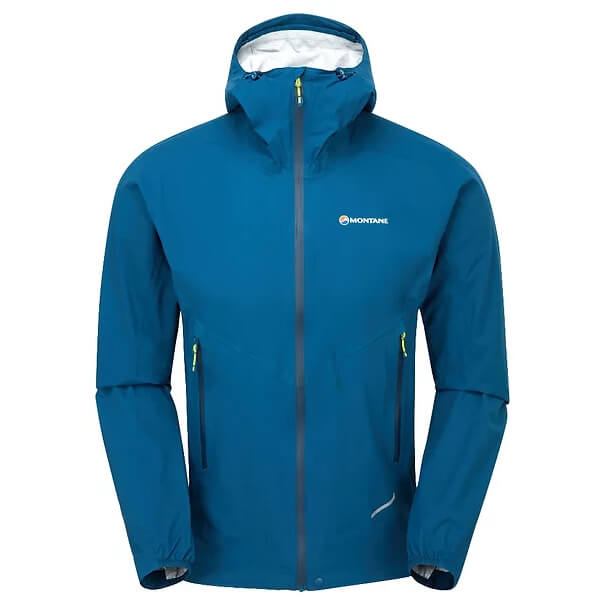
- Weight: 192g
- Waterproof and breathable material: PERTEX® SHIELD + Stretch
MONTANE, an up-and-coming outdoor brand from the UK, specializes in products for high-tempo mountain activities like fastpacking and trail running. This model also features a tight-fitting silhouette and stretchy fabric, achieving excellent breathability and ease of movement at a high level
It also has two pockets (including a hole for earphone cords), making it suitable not only for serious running but also for hiking with a lot of luggage. It's perfect for fastpacking. The attention to detail, such as the snap buttons that allow you to fasten the front without having to zip it up, and the reflectors placed on the front and back for night use, is as impressive as ever
Best Running: The North Face Strike Trail Hoody / Patagonia Storm Racer Jacket
THE NORTH FACE Strike Trail Hoodie
- Weight: Approx. 115g (Large size)
- Waterproof and breathable material: HYVENT Flyweight (3 layers)
This ultra-lightweight rain jacket is designed for racing. Its ultra-thin 10-denier proprietary HYVENT Flyweight (3-layer) fabric boasts incredible specifications: 20,000mm water resistance and 40,000g breathability. Its 115g weight and clear color, stripped down to the bare minimum—no pockets, only elastic at the cuffs, hem, and hood—make it perfect for trail running, especially in races where you're trying to shave off every second. That said, the 3-layer lining is comfortable and smooth, making it extremely comfortable. Overall, this is a jacket that will satisfy anyone looking for rainwear for mountain running
Patagonia Storm Racer Jacket

- Weight: 198g
- Waterproof and breathable material: 3L H2No Performance Standard Shell
Trail runners will immediately appreciate the unique design, which looks almost like an apron. The unique cut allows you to put it on over a thin trail running pack without feeling too tight. What's more, by opening the zippers placed diagonally on both sides, you can easily access the pockets for bottles and small items on the front of the pack. It can be quickly put on and taken off while wearing a backpack, keeps the pack dry while you're on the move, and even allows you to replenish water and food while wearing it - truly a feature that is perfect for trail runners
This zipper structure is not only convenient, but also allows for more dynamic ventilation by opening it wide. Opening both zippers down to the chest allows for a lot of fresh air to enter. Despite its slim fit, it's well-made and comfortable, as you'd expect from Patagonia. I also like the packable design that can be stored in the mesh pocket on the back of the neck, and while the Strike Trail Hoody above is the standard in the running category, this one may not be recommended for everyone, but its uniqueness makes it a must-have model
Best Cost Performance: MIZUNO Berg Tech EX Storm Saber VI Rain Suit

- Weight: Approx. 550g (M size)
- Waterproof and breathable material: Berg Tech EX
We live in a world where affordable rainwear, including rainwear for everyday use, is readily available at hardware stores and other stores. However, among them, this model is a must-have, boasting material performance on par with top mountaineering brands, the reliable mobility of a top sports brand, and above all, a top and bottom set at an exceptional price. Of course, there are factors you shouldn't be greedy for, such as weight and fabric durability, but for beginners, this is more than enough. The wide range of colors is also a plus
Best Trekking: Mont-Bell Storm Cruiser Jacket
- Weight: 254g
- Waterproof and breathable material: Gore-Tex 3-layer fabric with Gore C-Knit Backer technology
Mont-bell's Storm Cruiser Jacket is a masterpiece among the countless products they produce, a benchmark for outdoor rainwear in Japan, and an undisputed long-selling favorite. The reason it has remained so popular for so many years is undoubtedly the functional beauty pursued to the utmost by a manufacturer with deep knowledge of Japanese mountaineering. There's no greater feeling of security when venturing deep into the mountains and covering long distances over multiple days or long-term mountain trails
The 20-denier GORE-TEX 3-layer fabric boasts exceptional water resistance, and the supple, highly breathable GORE® C-Knit™ Backer technology lining ensures lightweight durability, waterproof breathability, and comfort. Furthermore, the unique K-Mono Cut™ cutting pattern enhances functionality in many ways. The adjustable sleeves, hem, and hood are also excellent, providing reliable protection and comfort even in heavy or prolonged rain, making this one of the most reliable rainwear for mountaineering in general. My only concern is the slightly loose silhouette. Preferences regarding the look are divided, and this is a perpetually troubling issue
Best High Output Activity: Goldwin Fast Shell Light Jacket / Teton Bros. Yari Jacket
Goldwin Fast Shell Light Jacket
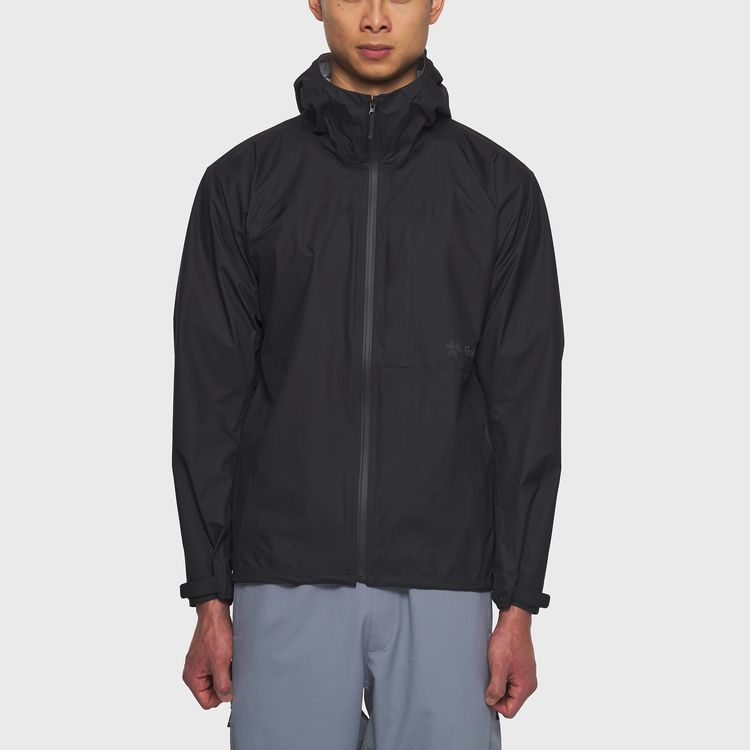
- Weight: 163g (measured in size L)
- Waterproof and breathable material: PERTEX® SHIELD AIR
Goldwin , the distributor of The North Face in Japan, has released the first rainwear made with PERTEX SHIELD AIR, one of the new waterproof and breathable materials that have been appearing one after another over the past few years. This ultra-lightweight jacket, weighing just 163g in size L, is thin, flexible, and quiet, with a smooth and comfortable tricot lining, making it extremely comfortable to wear. Its breathability also allows for excellent ventilation, making it a better fit than ever for activities that produce a lot of sweat, such as running and speed hiking (it's so breathable that you might worry about getting too cold).
Because it can be used as both rainwear and a windshell, it may be a new type of rainwear that you can wear all day, rain or shine. There are some compromises to be made in terms of durability, water resistance, and usability, but there's no doubt that this jacket has more than enough appeal to make up for that, making it a fun piece to wear for high-intensity activities like short runs or fastpacking, where you can make the most of it
Teton Bros. Yari Jacket

- Weight: 335g (Size M)
- Waterproof and breathable material: Täsmä
The Yari Jacket is one of the rainwear items that uses Täsmä, the latest waterproof and breathable membrane jointly developed by Toray and Teton Bros., which first appeared in the 2021-2022 Fall/Winter series. I had the opportunity to try out Täsmä before the hard shell jacket (TB JACKET) that was released in the winter, and as soon as I started using it, I fell in love with its comfort, supple feel, and high water repellency
This piece has been tailored for spring and summer rainwear, becoming thinner and lighter for even greater comfort. The zippered pockets on both sides open wide for ventilation, further enhancing ventilation. The sophisticated design and color variations are also wonderful. From the materials to the construction, this is a thoroughly breathable piece that is sure to become a staple this summer
Best Ultralight: Rab Phantom Pull-On

- Weight: 90g
- Waterproof and breathable material: Pertex® Shield 2.5 layer
Among the many British outdoor brands known for their superior functionality and design, Rab continues to cultivate a loyal fanbase with its consistently stoic philosophy. The Phantom Pull-On is a garment that embodies the brand's extensive development and engineering expertise. It weighs just 90g. Though constructed from ultra-thin 7-denier nylon, the 2.5-layer Pertex® Shield fabric provides ample water resistance and breathability of 20,000mm/20,000g
To reduce weight, it has no pockets and is a pullover type with a half-zip front. It has a slim fit that hugs the body perfectly, while the excellent three-dimensional cutting allows for excellent mobility. However, it is not resistant to abrasion or snagging, and its durability cannot be guaranteed. In that sense, it is not recommended for everyone, but for those who want a lightweight, compact, and truly waterproof shell with outstanding functionality, it is an excellent choice
Honorable Mention (Personal Favorite): Arc'teryx Alpha SL Anorak
- Weight: 209g
- Waterproof and breathable material: Hadron™ 3L Gore-Tex
I personally feel that it's okay to cut back on things like zippers and pockets, but still have the durability to withstand intense activities. This rainwear model meets my personal needs, and I've the Arc'teryx Alpha SL Anorak as a special prize winner. The anorak style allows me to take it on and off with ease, but experience is what takes care of that. Pockets aren't necessary because I carry a separate bag. The Hadron ripstop fabric is thin, lightweight, and highly breathable, yet durable enough to withstand bushwhacking. And above all, Arc'teryx's signature three-dimensional cut allows for ease of movement. It's a bit pricey, but its performance is immeasurable.
How to Choose: 7 Things to Check When Choosing the Best Rainwear
Point 1: Two basics for outdoor rainwear
Basics 1: "Waterproof jacket, not water-repellent"
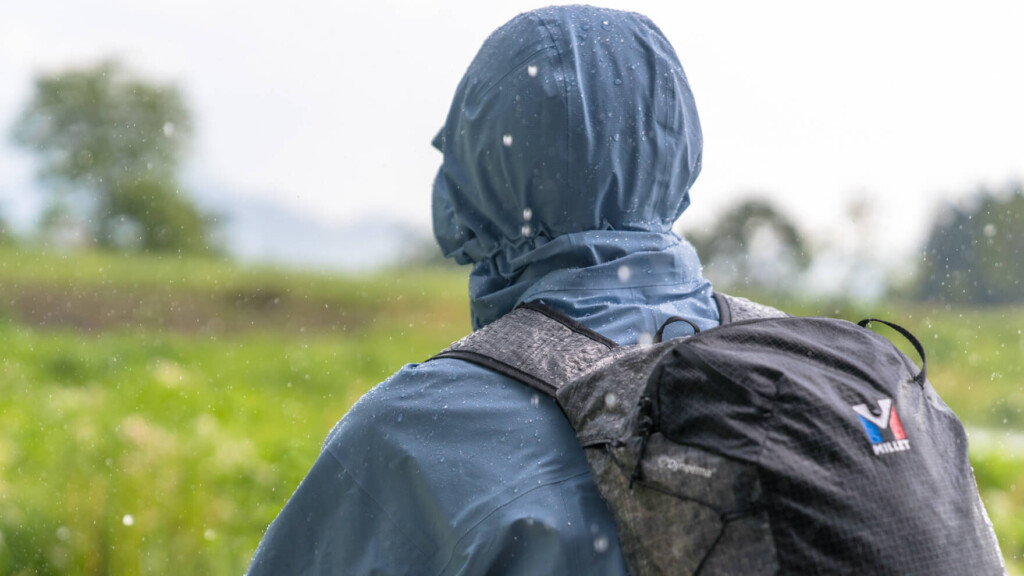
the "rule of three" in the survival world , if a person cannot maintain an appropriate body temperature, their life will be in danger within three hours. This refers to the so-called "hypothermia" state, but it doesn't have to be freezing cold to cause hypothermia. Anyone can develop hypothermia even in the middle of summer if their skin is wet from rain or sweat for an extended period of time. This is why it's said that rain-resistant outerwear is essential for outdoor activities in unpredictable weather (especially in Japan).
However, when it comes to protection from wind and rain, there are several types depending on the degree and function, and even if a jacket looks similar to rainwear at first glance, there are some jackets that do not adequately protect against rain. These are jackets with "water-repellent" functionality, not waterproof jackets (rainwear). Typical examples are outerwear called windbreakers and soft shells
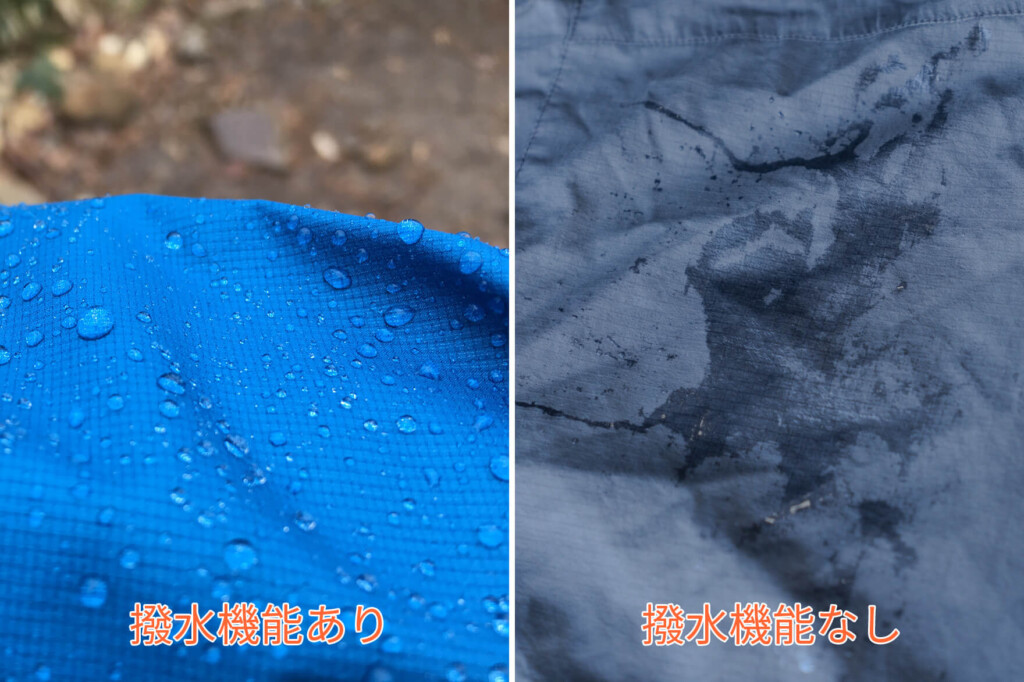
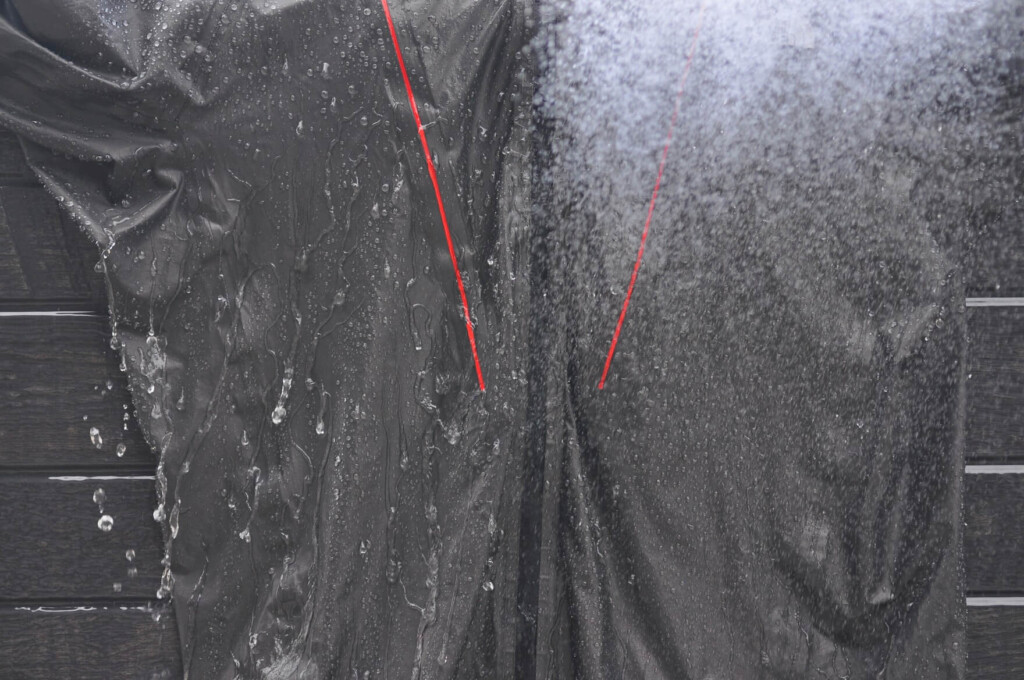
This water-repellent function is achieved by applying a water-repellent agent such as fluororesin to each individual fiber, making the outer fabric hydrophobic and water-resistant, causing water droplets that adhere to the surface to bead up like wax and repel them (see photo below, right). At first glance, it may seem like a solid waterproof garment, as water simply slides off the fabric, but in reality, there are gaps in the weave of the fabric that allow water droplets to pass through. This means that while it will repel light rain for a short period of time, if it is exposed to water for a long period of time or even slightly strong rain, the water will eventually seep into the fabric and it will no longer function as rain gear
By the way, this water-repellent treatment is called DWR (durable water-repellent), and it plays an important role in ensuring that rainwear performs at 100% for a long period of time. However, repeated use and washing will inevitably cause gradual deterioration (see photo below, left). Once this happens, the jacket becomes completely useless against rain. Once the water-repellent properties are lost, the outer fabric becomes wet and loses its breathability. To restore its original performance, you should regularly maintain it with water-repellent sprays or materials
On the other hand, waterproof jackets (rainwear) not only have a water-repellent surface, but also use fabric that is impervious to heavy rain, so they always effectively prevent water from getting in from outside
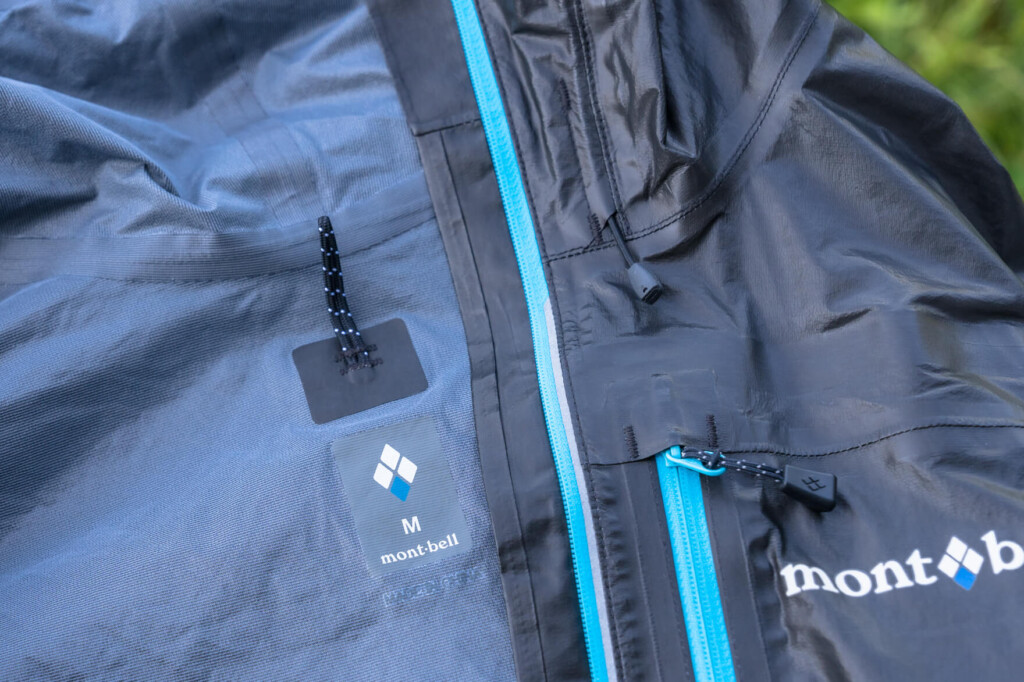
The zippers on the front and pockets are also designed to prevent water from getting in, and the jacket's seams are also waterproof taped from the inside using a method called "seam tape" (see photo below)
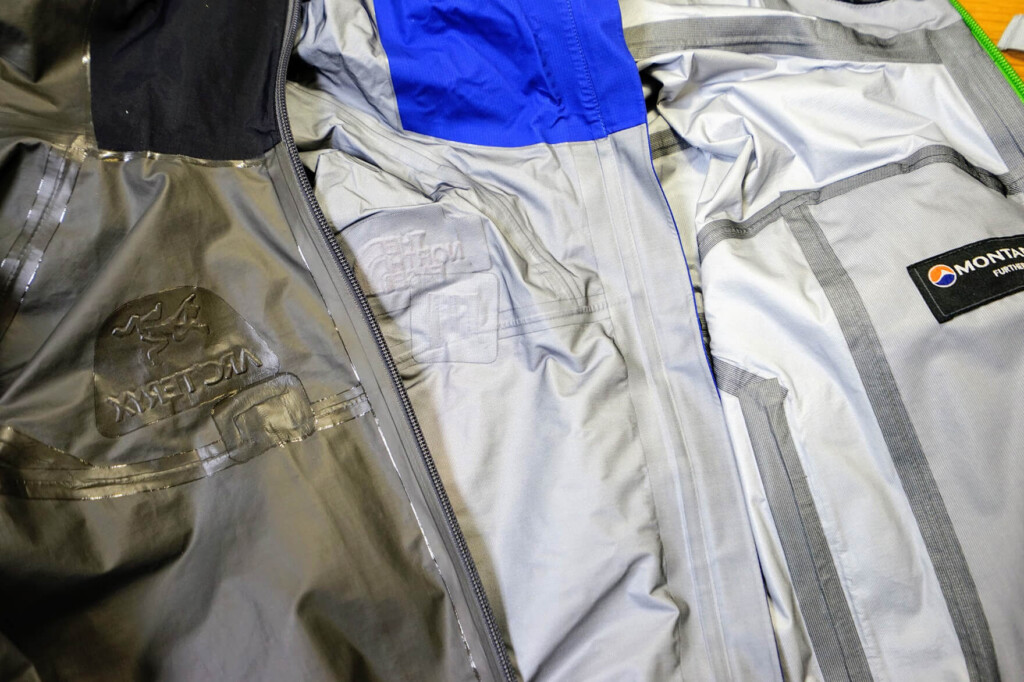
Each company has made detailed improvements to the seam tape applied to the seams of the lining, not only in terms of width and thickness, but also in terms of whether the tape itself is breathable
The first important thing when choosing rainwear is to choose genuine rainwear, not a water-repellent jacket. Incidentally, a hard shell is a rain jacket that has been adapted for use on snowy mountains (the boundary is a bit vague). Both can protect you from rain in the same way, but the functions and features required are different, so we won't discuss them here
Related articles
Comparison of typical waterproof (water-repellent) outer shell layers
| kinds | Rain jacket | hard shell | soft shell | Wind Shell |
|---|---|---|---|---|
| image |  | 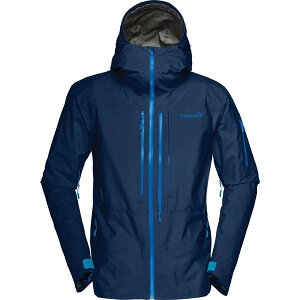 |  |  |
| Waterproof or water-repellent | waterproof | waterproof | Water repellent | Water repellent |
| Features | This completely waterproof outerwear is made from waterproof fabric and has sealed seams. It comes in two types: a jacket with a full front zipper and a pullover type, and is generally worn as a set with pants | This outerwear is designed to be worn in harsh environments such as winter mountains. It is basically made in the same way as a rain jacket, but it is designed with safety and comfort in mind for winter activities | This jacket combines the functionality of a mid-layer and a shell layer, with water-repellent properties that repel a certain amount of rain, wind resistance, heat retention, and ease of movement | An ultra-lightweight outer layer that is windproof, breathable, and water-repellent to some extent |
| merit |
|
|
|
|
| Disadvantages |
|
|
|
|
Basics 2: Waterproof and breathable fabrics, not waterproof fabrics
In the old days, rainwear simply repelled water. It wasn't that difficult to prevent water from getting inside a body wrap like the 500 yen raincoats sold at convenience stores. However, old-fashioned raincoats made of rubberized cloth or PVC (polyvinyl chloride) had almost no breathability, so even if they protected you from the pouring rain, the sweat you gave off would quickly make you soaked. Mountaineers continued to face a dilemma: they wanted to keep out the rain, but also wanted to keep out the sweat
GORE-TEX was the magical solution to this problem. Invented by Robert Gore in the 1970s, this material is a membrane made of expanded polytetrafluoroethylene (ePTFE), a type of fluoropolymer, containing over 1.4 billion microscopic pores per square centimeter. These pores are 20,000 times smaller than a water droplet, yet approximately 700 times larger than a water vapor molecule. This allows the material to achieve waterproof and breathable properties, blocking water and wind from the outside while allowing water vapor from the inside to pass through. With the advent of GORE-TEX, waterproof and breathable materials quickly became the mainstream for outdoor rainwear. Then, after the main patent expired in the late 1990s, numerous manufacturers began competing to develop their own unique waterproof and breathable materials, a trend that continues to this day
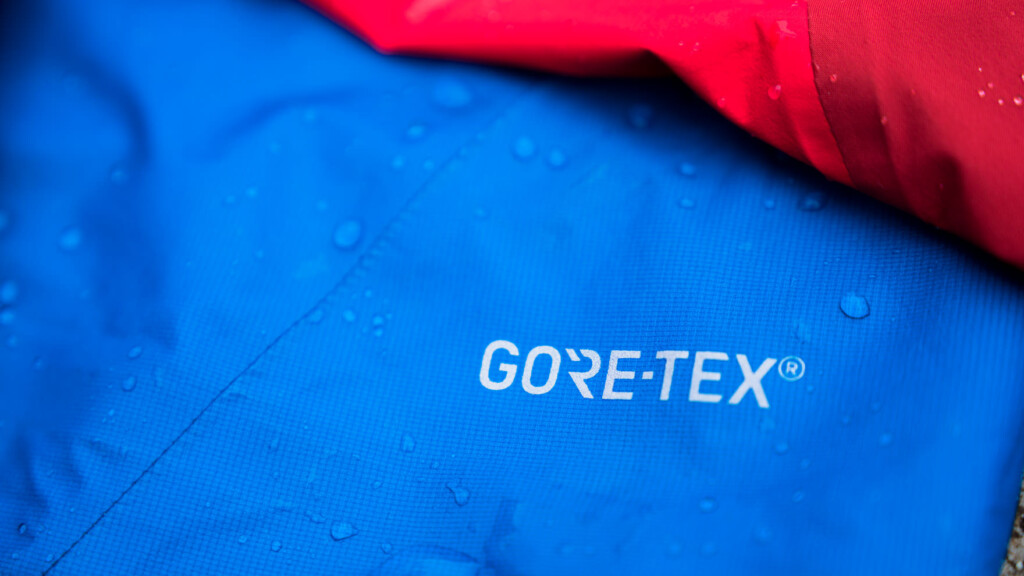
For more information on GORE-TEX, please refer to the article below, in which we asked the people at this site about it in detail
Related articles
Materials from other manufacturers that have appeared since are generally made in the same way, using membrane laminations or coatings that achieve similar functionality, and although there are minor differences, their functions are designed to block rain from outside while helping to efficiently release moisture (water vapor) (the exact materials and processing methods used by each brand are kept top secret, so we cannot know them.) The second major premise of outdoor rain gear is to choose an outer layer made from this type of waterproof and breathable fabric
For your information, below we have listed the main waterproof and breathable fabric brands and their basic characteristics. However, please note that the structure of rainwear is not simple, so not all rainwear made from these materials will have these characteristics. Also, since not all products are compared uniformly, an objective performance comparison cannot be made. Please use this list only to get a general understanding of the characteristics of each material, and as a reference when considering a purchase
| kinds | Features |
|---|---|
| GORE-TEX |
|
| Pertex Shield |
|
| eVent |
|
| Polartec NeoShell |
|
Point 2: Choose the fabric structure (layers) – Know the strengths and weaknesses and use them appropriately –
When choosing rainwear, it is important to choose not only the type of waterproof and breathable membrane, but also the type based on the structure of the fabric
Waterproof and breathable materials are simply membranes in themselves, so they do not constitute clothing. By laminating or coating fabric on the front, back, or both of the membrane, durability, comfort, ease of movement, and other factors are added, resulting in a completed jacket. Currently, the combination of these layers can be roughly thought of as falling into three types: 2L (layer), 2.5L, and 3L. Rainwear can be optimized for a variety of activities and purposes not only by the type and thickness of fabric, but also by the different layers
Below we will explain the advantages and disadvantages of each
3 layers

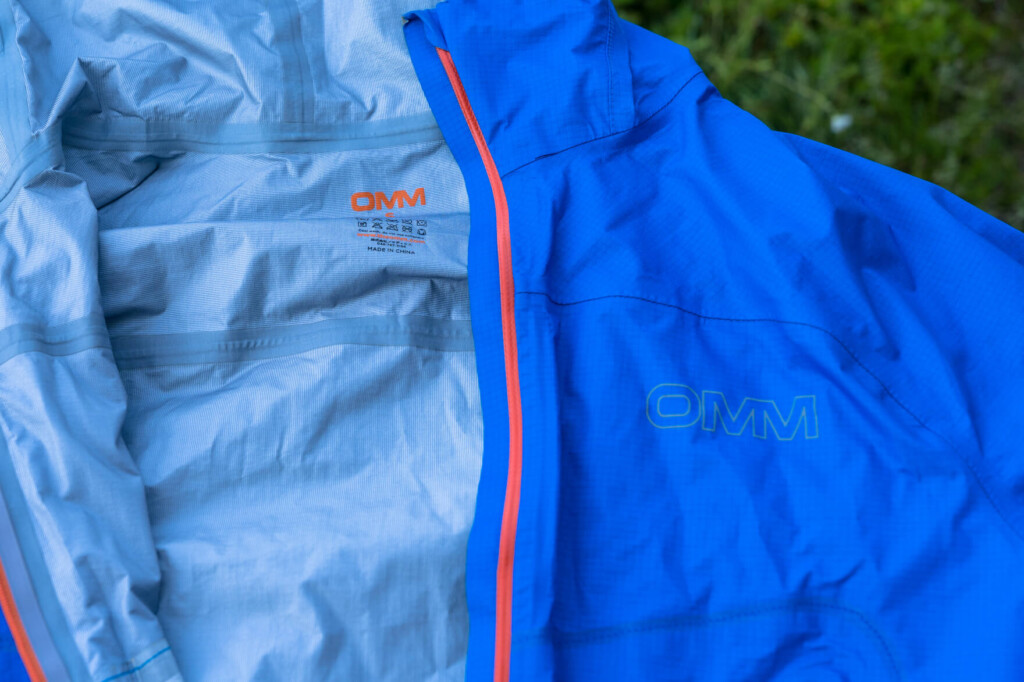
3-layer construction has a waterproof, breathable membrane sandwiched between two separate layers of fabric. As you'd expect, it's the most durable. The lining fabric also offers the benefits of moisture wicking and a pleasant feel against the skin. Fabrics that were once considered stiff and stiff have become much more flexible, making 3-layer construction the most comfortable. However, they tend to be bulkier than other constructions. They're also relatively expensive. Conversely, if a 3-layer construction is thin, lightweight, or reasonably priced, it's likely to be of very high quality. As proof, it's worth noting that most of the top-tier models introduced here are 3-layer constructions
2.5 Layers

A 2.5-layer jacket has a waterproof, breathable outer layer (face) and a very thin protective coating on the inside (lining) to prevent dirt and sweat from damaging the inner layer. It's too thin to be called a 1 layer, hence the "0.5 layer*."
*Depending on the manufacturer's perspective, some brands may describe the same structure as "two layers," so this can get quite confusing
The advantage of 2.5-layer construction is that it can be made lighter and more compact than a 3-layer construction, making it a popular option for hikers and climbers looking for lighter rainwear. However, the protective film on the liner is often not as flexible as a 3-layer construction and can feel sticky and uncomfortable against the skin, so the obvious drawback is that it's less comfortable (though some models have recently improved this)
2 layers (membrane + outer layer)

Two-layer rainwear, which simply has a protective outer layer glued on top of the membrane, is the most basic type of rainwear. However, even though it's called two-layer, it usually requires a mesh liner to protect the membrane layer inside the jacket. For this reason, even though it's two-layer, it can't be made very light, and is generally seen in entry-level rainwear or padded winter waterproof and cold-weather jackets
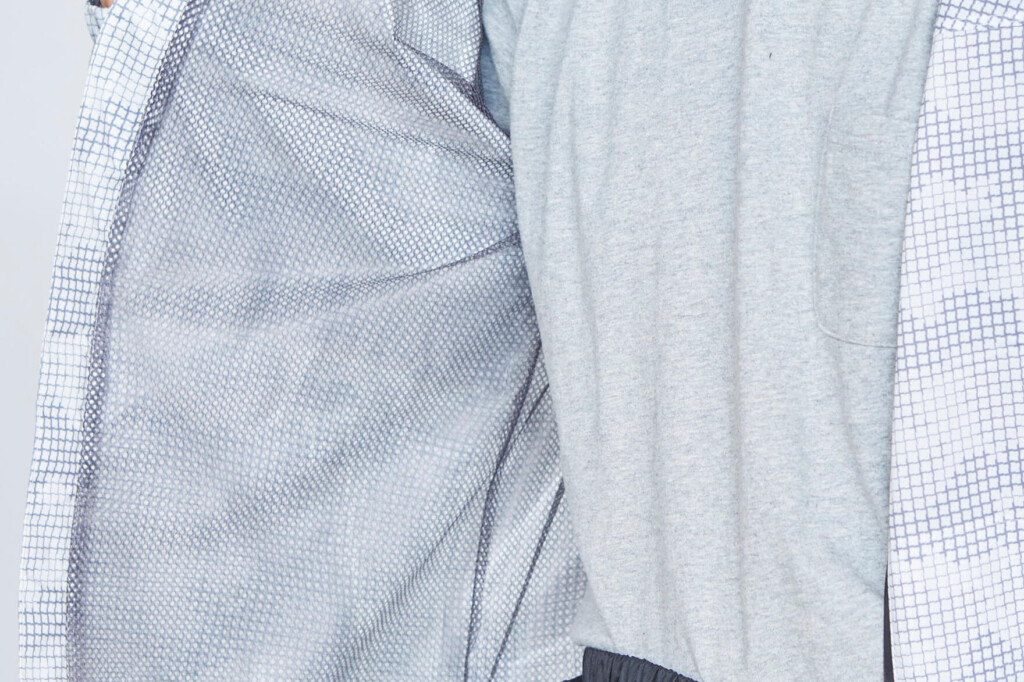
2 layers (membrane + lining)

The only fabric that can be considered a two-layer fabric is the new GORE-TEX "SHAKEDRY," which has a special structure. A two-layer fabric is two layers, but it has no outer layer, meaning the membrane is almost completely exposed. Instead, it has a tricot lining that improves comfort, durability, and moisture-wicking properties. Its advantages include its lightness and high breathability due to the lack of an outer layer, and the durable water-repellent properties of the outer layer, which fully utilize the hydrophobic properties of the membrane. On the other hand, the exposed membrane means that it is clearly less durable. This type of fabric is suitable for mountain sports and athletes who require the highest performance even in short periods of time
Comparison of characteristics based on fabric structure (layers)
| kinds | 3 layers | 2.5 Layers | 2 layers (membrane + outer layer) | 2 layers (membrane + lining) |
|---|---|---|---|---|
| waterproof | ◎ | ◯ | ◯ | ◯ |
| Breathability | ◎ | ◎ | ◯ | ◎ |
| Comfort | ◎ | ◯ | ◯ | ◎ |
| weight | ◯ | ◎ | △ | ◎ |
| durability | ◎ | ◯ | ◯ | △ |
| Price range | △ | ◯ | ◎ | △ |
Point 3: Waterproof performance - Check the overall construction of the jacket rather than the numbers -
We explained earlier that waterproof jackets are not just water-repellent but also provide excellent protection from the rain, but in reality, there are differences in waterproof performance between waterproof jacket models
One of the standards for performance is the fabric's "water resistance," which is expressed as a number such as "10,000mm" or "20,000mm or more" and is published for some models. This is measured by testing how much water pressure the fabric can withstand against water trying to soak in, and the value represents how high the fabric can withstand (without soaking in) when water is poured into a pillar with a diameter of 1cm
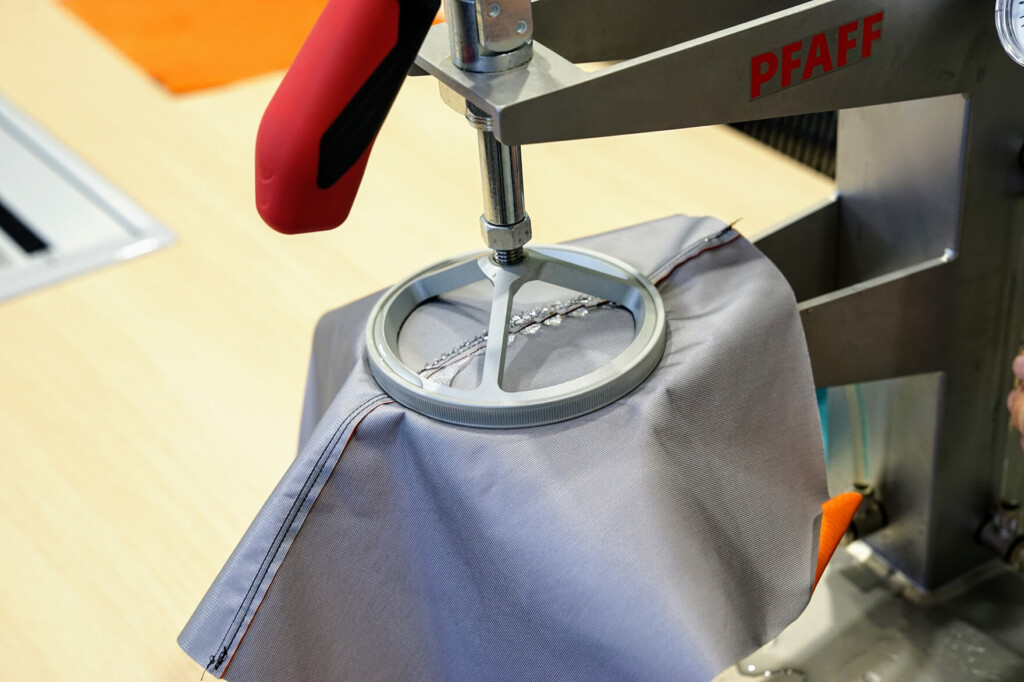
However, it's important to remember that this number only indicates the water resistance of the garment, and does not determine the overall waterproof performance of the garment. High water resistance is of course advantageous, but various factors affect the waterproofness of rainwear, such as the thickness of the outer and inner fabrics, water repellency, construction of the zippers, cuffs, and hood, and the quality of the seam tape
Therefore, on this site, we recommend that you use water resistance only as a guideline when evaluating waterproof performance, and that it "indicates whether or not the minimum standard is met."
For example, if the water resistance value is 10,000mm or more, it passes for outdoor use. If it's less than that, it will be difficult to withstand heavy rain in nature. However, 10,000mm is the bare minimum for outdoor use. It's unlikely that it will be considered that reliable. If it's 20,000mm or more, it's probably safe to use even on long, tough mountain climbs (assuming the rest of the construction is solid). I think this is a good idea
The water pressure during heavy rain can be quite strong. In areas with a lot of rain or in high mountains, you should choose rainwear with high water resistance to withstand even heavier rain
When it comes to waterproofing, it's important to consider not only the water pressure resistance but also the water repellency, whether the hood fits your entire face, the height of the collar, the length of the brim, and how airtight the sleeves and hem are, and so on, so that the overall garment provides protection against rain, not just the performance of the fabric
Point 4: Breathability – Beware of the new trend of breathable jackets
As explained earlier, breathability, which eliminates stuffiness inside clothing, is an essential feature for outdoor rainwear
Fortunately, there's no need to compromise on anything (other than price) just because the rainwear is more breathable, so if you can afford it, we recommend choosing rainwear with higher breathability. It will undoubtedly improve your safety and comfort
However, it is questionable whether people who like to hike at their own pace need top-level breathability. From a cost-effectiveness perspective, it cannot be said that a highly breathable model is the best in all cases
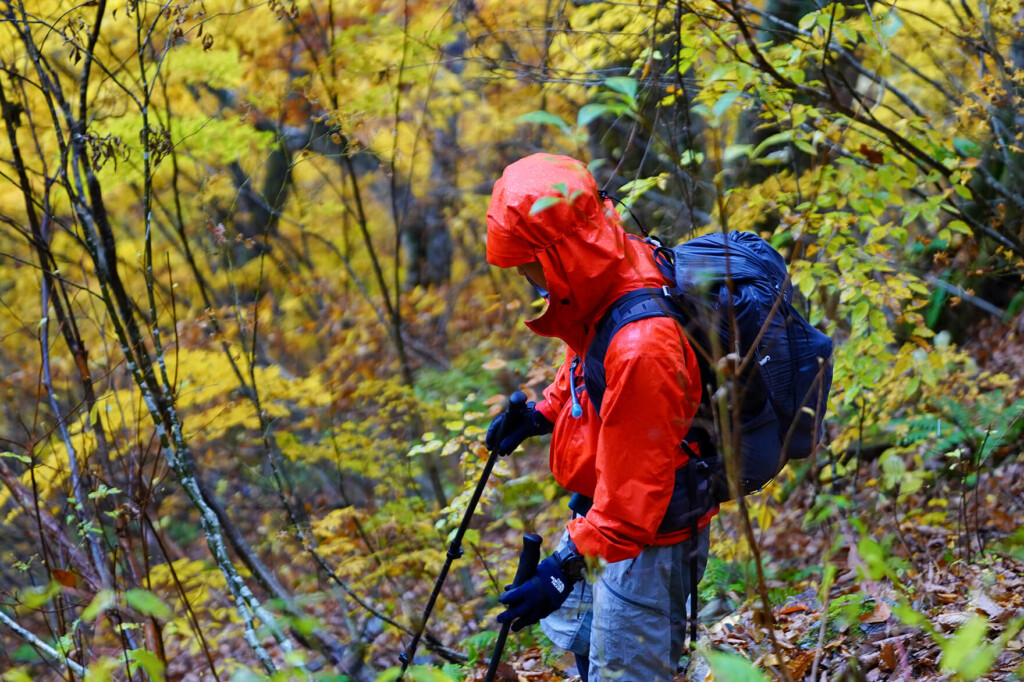
In pursuit of even greater comfort, we aim for "breathability," one step beyond "breathability."
With the spread of new activities such as trail running that involve greater activity over shorter periods of time, a variety of new materials with excellent breathability have appeared one after another. In this major trend toward "more breathability," the evolution of breathable waterproof jackets has been attracting particular attention in recent years
To make this easier to understand, let's explain how conventional waterproof and breathable clothing eliminates stuffiness. The moisture inside clothing is released to the outside by taking advantage of the property of water vapor moving from a high temperature area (inside the clothing) to a low temperature area (outside). On the other hand, when there is no temperature difference (when you are cooling down), there is no movement of water vapor, meaning that the moisture inside the clothing is hardly eliminated
In contrast, breathable rainwear allows air to pass through the walls of the garment at all times, regardless of temperature differences (see photo below)
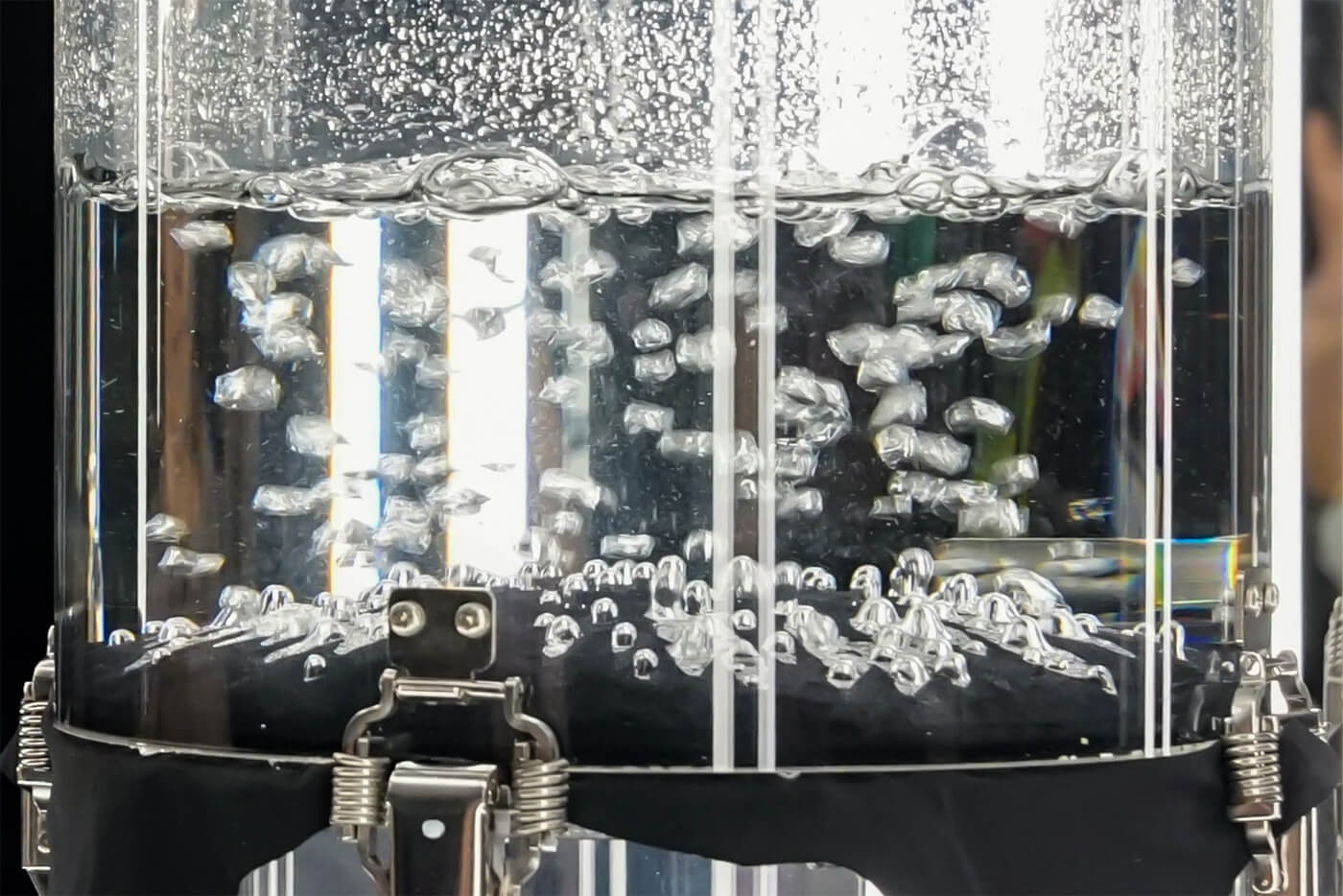
A demonstration of waterproof and breathable material. Water on top of the fabric does not soak in, while air pushed out from below passes through the fabric (from THE NORTH FACE booth at ISPO 2019)
This means that not only water vapor particles (water molecules) but also air particles (gas molecules) can move freely, which naturally means that sweat escapes more easily (easier to eliminate stuffiness) than ever before.New Polartec Neoshell , THE NORTH FACE FUTURELIGHT , Toray & Teton Bros. Täsmä , PERTEX SHIELD AIR each have their own unique methods for controlling the size of the pores in the membrane, allowing moisture to escape from inside clothing more quickly than ever before.
By the way, you might be wondering, "Does breathability mean that when the wind blows, it will be as windy as fleece?" But for now, there's no need to worry. Even though it's breathable, the wind that hits the clothing won't just pass through it with full force. In that sense, it can still be considered windproof

Important points to note when using breathable rainwear
So, is this "breathable rainwear" that is expected to be a game changer in the rainwear world going to become the "main player" of the future? The answer is not that simple. Even breathable rainwear equipped with the latest technology has its own characteristics that are hard to overlook
It's true that waterproof and breathable membranes allow more air to pass through than conventional waterproof and breathable membranes, and theoretically they're less likely to get stuffy. However, it's important to note that breathability means that air is constantly moving around regardless of the temperature difference inside the clothing (this is different from waterproof and breathable membranes, which basically only move gas from hot to cold). Therefore, while it would be fine if cool air from outside only got in when it was hot, it also gets in when it wasn't hot. In other words, waterproof and breathable clothing is prone to getting cold, for better or worse
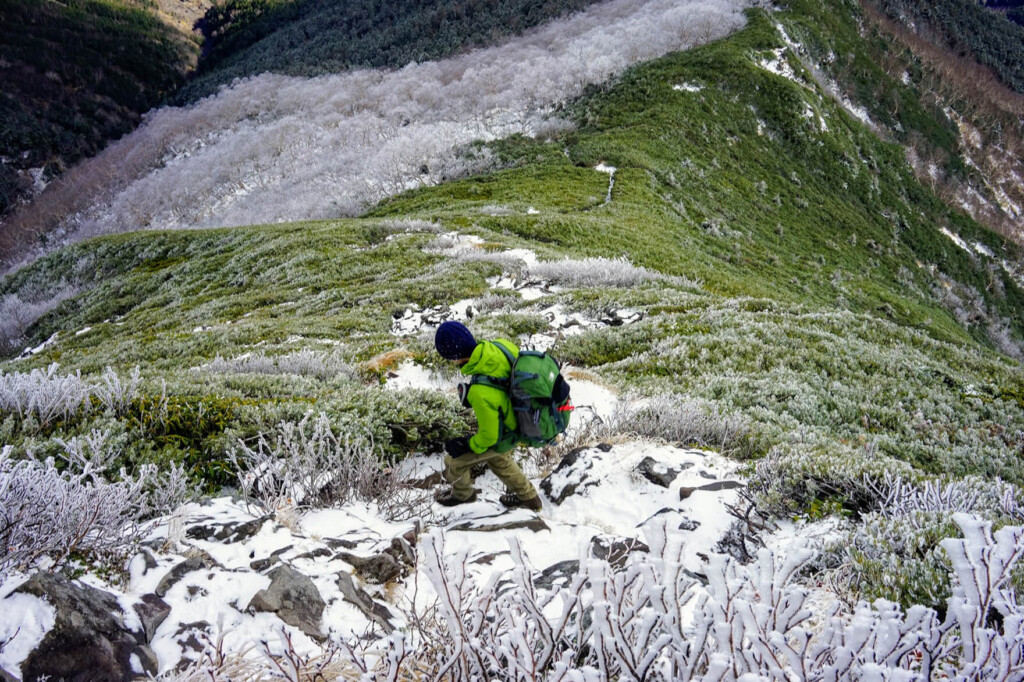
Of course, the actual feeling of hotness or coldness will vary depending on the temperature difference between the outside air and inside the clothing, the thickness of the fabric, and the properties of each individual material, so it's difficult to generalize. However, it's clearly not a good idea to blindly assume that "breathable rainwear is better just because it's newer." Breathable rainwear has great potential, but at the same time, it's important to keep in mind that it does have these properties, and when wearing breathable rainwear, consider taking measures such as bringing a warmer thermal layer than you would with a traditional waterproof and breathable shell
When it comes to sweat resistance, the overall design is more important than the numbers
There are objective indicators (tests) for evaluating breathability, such as water resistance (A-1 method, B-1 method, RET value, etc.). However, it is practically impossible to accurately measure the "actual resistance of a jacket to stuffiness when worn in the field," which changes subtly depending on factors such as external temperature, humidity, air pressure, and the wearer's body temperature. For this reason, there are multiple tests that each claim to be the most accurate, and each material manufacturer uses their own method based on their own perspective
If it is difficult to objectively compare the sweat-resistance of different garments based on specs alone, we are grateful for the numbers and will use them as a reference, but they should only be considered one of many factors in determining sweat-resistance
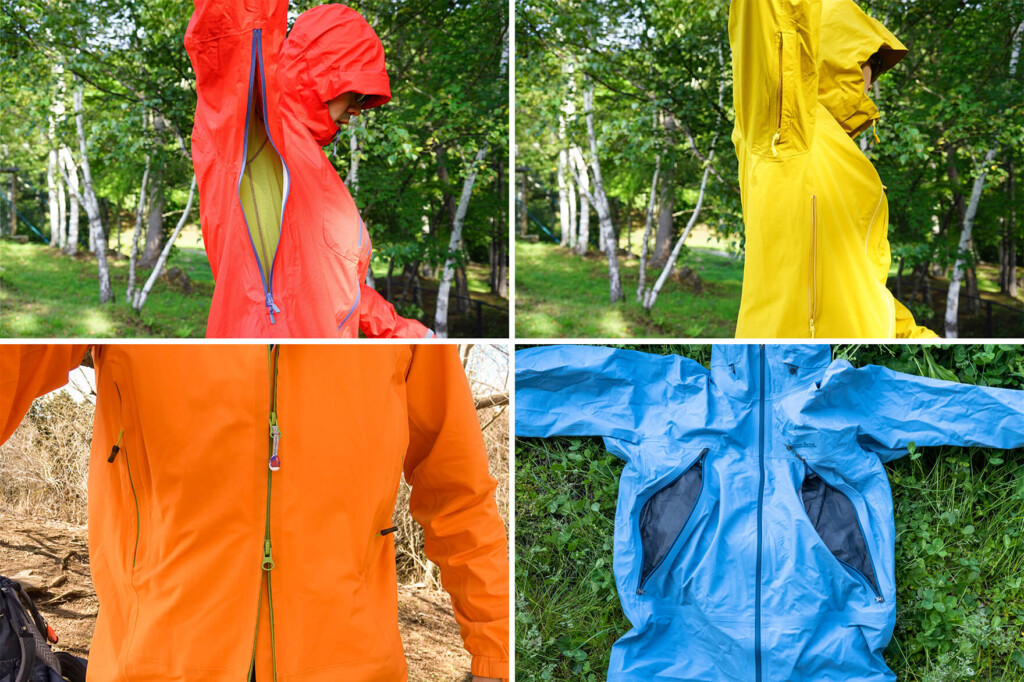
Whether or not a piece of clothing will resist getting stuffy will depend on whether it has ventilation holes that allow for ample air exchange, as well as the size of the pockets in the garment. By checking factors that we can check in addition to the breathability of the fabric itself, you should be able to find a piece of clothing that will give you the performance you're looking for
Point 5: Fit and ease of movement - Try it on and move around in it -
How does it fit, feel, and move easily when you wear it?
Not only for those who swing their arms widely on trail runs, but for anyone who may have to wear rain gear for long periods of time in heavy rain, it's important to make sure the clothing is comfortable. Top brands usually offer three-dimensional cuts that allow for easy movement and are tailored to prevent tightness when moving. Make it a habit to check the overall fit when you put your arms through the sleeves, any tightness around the shoulders, and whether the hem rides up too much when you throw your arms up in the air. In recent years, stretchy rainwear with stretchy fabrics has become more common. Models with stretch functionality are likely to be a good fit for activities that involve a lot of movement, such as speed hiking, trail running, and climbing
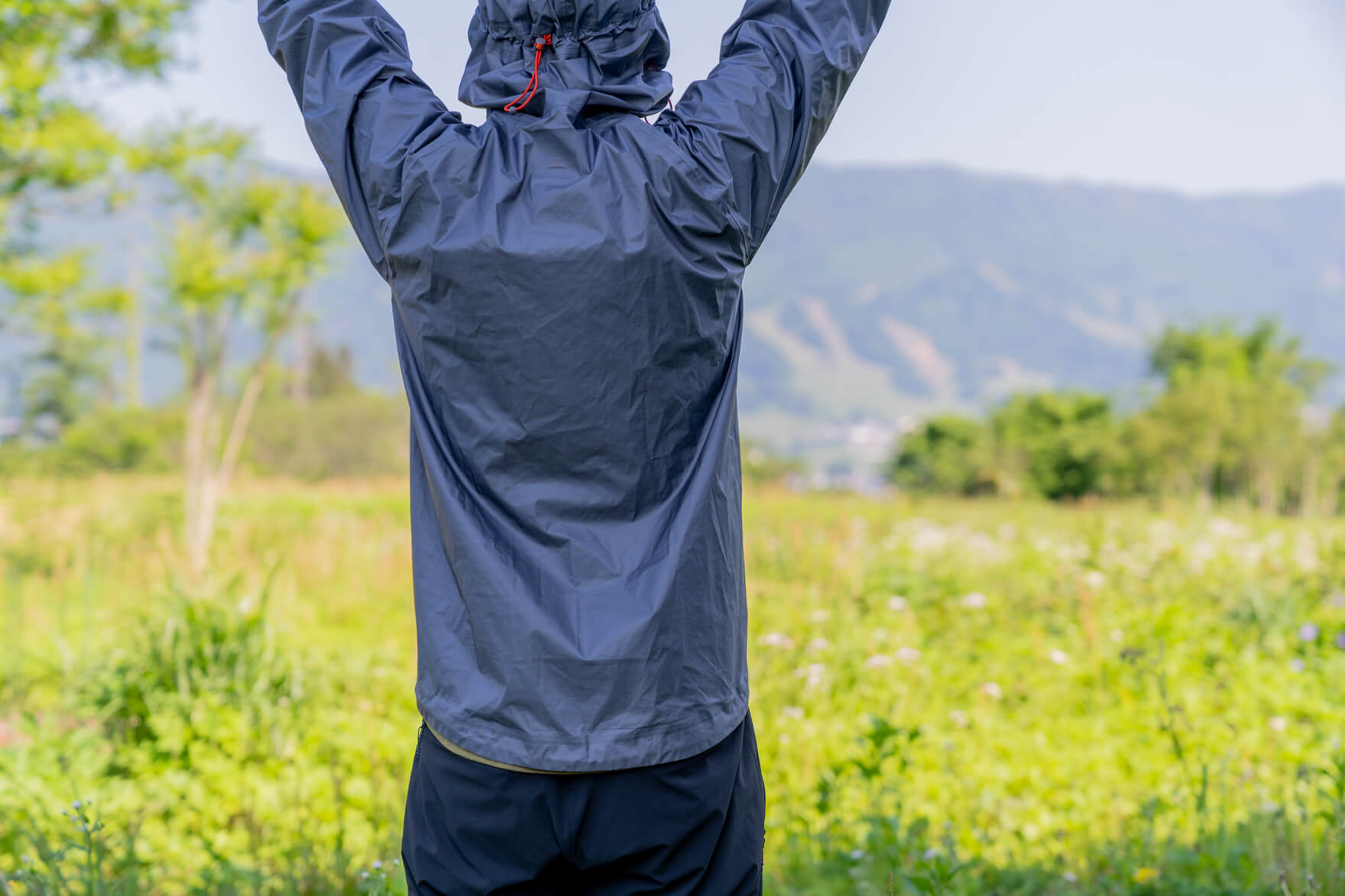
By the way, when hiking, you will often wear cold weather clothing underneath your rainwear, so the general rule of thumb is to choose a size that is a little loose, unless you are doing trail running or other activities where fit is more important than wearing cold weather clothing
Is the hood easy to adjust and fit?
The most important thing about a hood is that it provides adequate waterproofing in the rain. As mentioned above, choose one that covers the chin area well and has a brim that is large and stiff enough to withstand a storm
Related to this is the ease of fit. There are two types of hoods for outdoor rainwear: mountaineering types that are made significantly larger than the head so that they can be worn over a helmet, and smaller running types that prioritize lightness and are made to fit the head size. Even with the smaller types, you can wear a helmet over the hood, but it may not fit easily, so if you plan to wear a helmet, be sure to choose a larger hood that is helmet-compatible
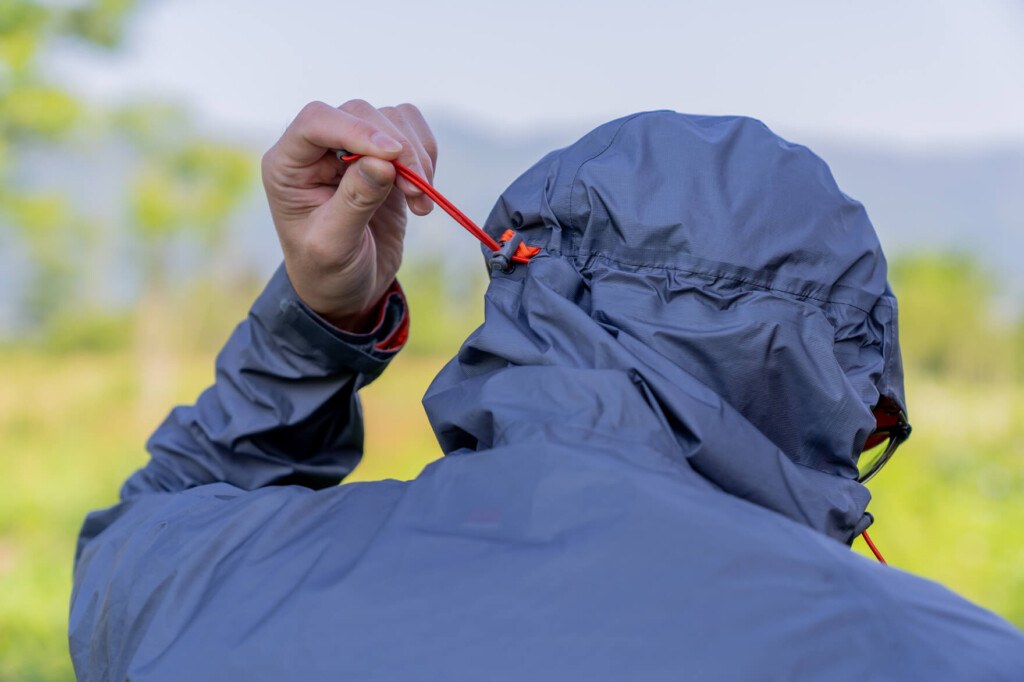
In either case, it's best if the hood can be adjusted to fit the shape of your head (helmet). Furthermore, be sure to try it on and check how easily it can be adjusted, whether it can be finely adjusted, and whether it fits your head properly by actually moving your head around
This is a surprising oversight, but in my experience, when wearing a hood over a helmet, the size doesn't fit properly and it often restricts head movement. If possible, try to test the hood with your helmet before making a selection
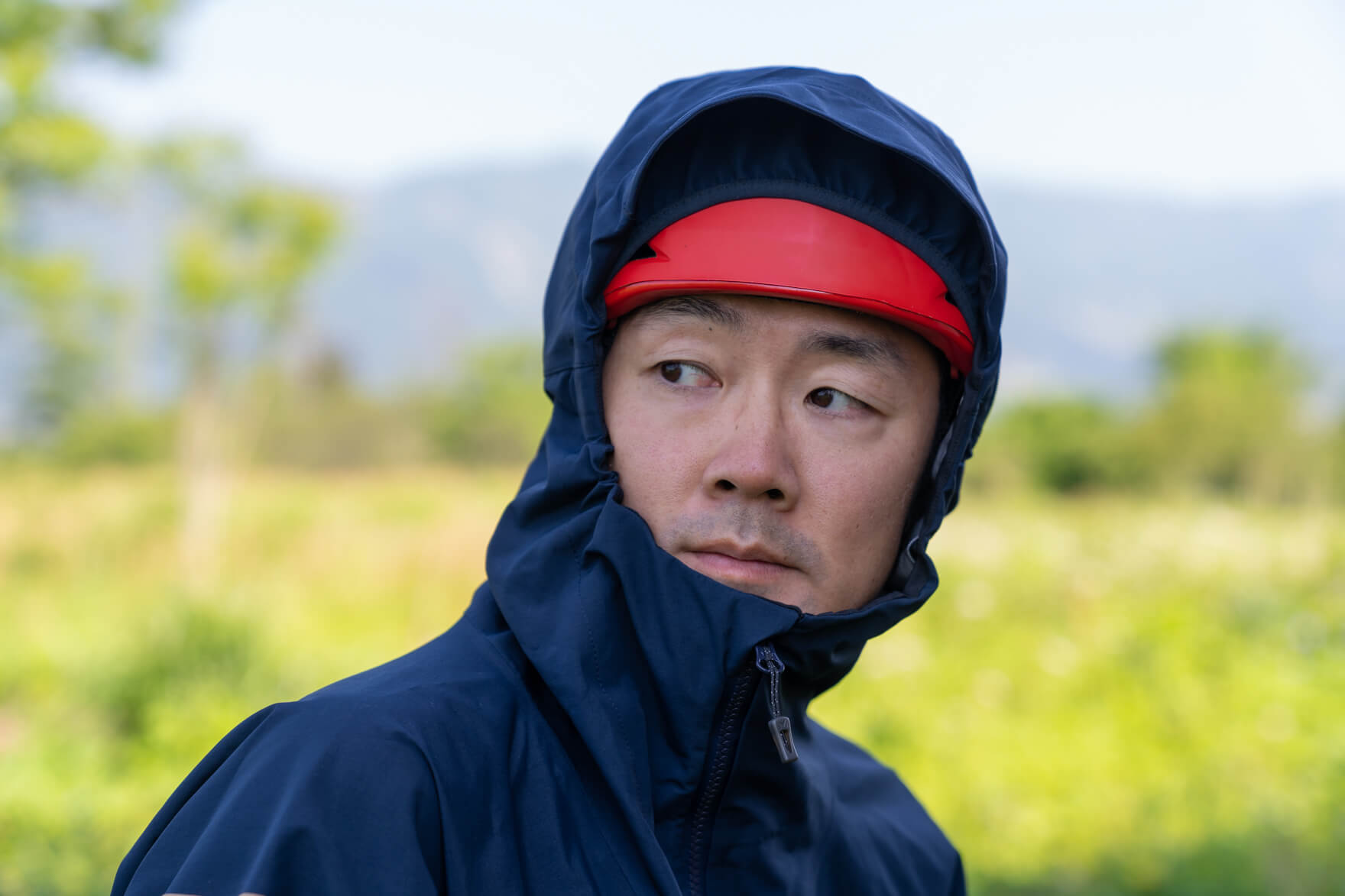
Some jackets also have hoods that can be zipped off or rolled up and stored in the collar
Point 6: Weight – Consider the balance with durability –
Since rainwear is often carried around without being worn, it's best to make it lighter. Light is justice. Starting with thinner, lighter, and more durable materials, and parts such as zippers and seam tape, each company is working tirelessly to reduce weight, even by the gram
However, generally speaking, making something lightweight and compact means sacrificing waterproofing, cold protection, durability, and convenience. Neither is better than the other, and ultimately it's important to determine how much protection and convenience you're willing to sacrifice depending on the situation, purpose, and your own ability
Point 7: Pockets and other usability
Pay attention to the position and number of pockets
No one would say that having pockets is inconvenient. If your outerwear has pockets, you can use them to store things you need to take out frequently or valuables, so the more you have, the more convenient it is
However, you need to be careful about the location and number of pockets on your rainwear
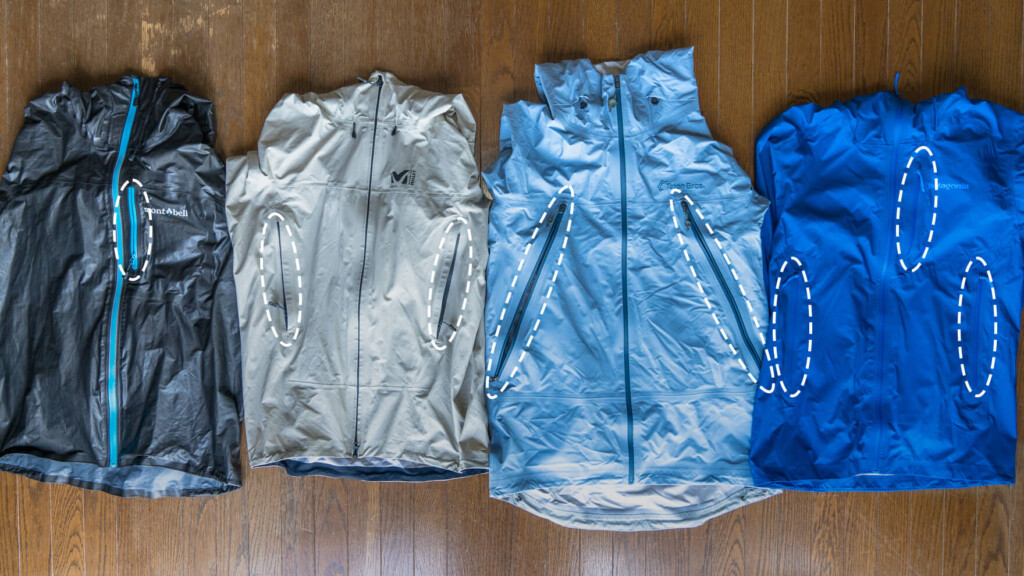
Regarding positioning, if the left and right hand pockets are positioned naturally (low) like on an everyday jacket, they are very easy to use, but they will overlap when wearing a backpack hip belt or climbing harness. To avoid this, there are models that are positioned higher, so if you are thinking of wearing them for mountain climbing, you should choose pockets that are positioned higher (however, this does not apply to people who do not use hip belts or harnesses in the first place, such as for trail running)
Next, there's the number of pockets. Rain jackets come in a variety of styles, from models that omit pockets entirely to reduce weight and improve breathability, to models with just one chest pocket, to models with only two pockets, or even models with both chest and two pockets. For intense activities, a chest pocket or no pockets at all is sufficient, but for versatile use, including everyday life, a jacket with both hand pockets is more convenient
However, the more pockets you have, the heavier your bag will be and the more difficult it will be to let sweat escape (though this can be reduced if the pockets are lined with breathable mesh). While more pockets are more convenient, it's best to avoid unnecessary pockets. Even if you don't have pockets in your clothing, you can always use other means such as a backpack or a sacoche, so it's best to keep the number of pockets to a minimum
Of course, it would be inconvenient to only have chest pockets when wearing your everyday clothes. Choose the minimum number and location of pockets necessary depending on the situation you will be using it in
Packable jacket that doesn't require a storage bag
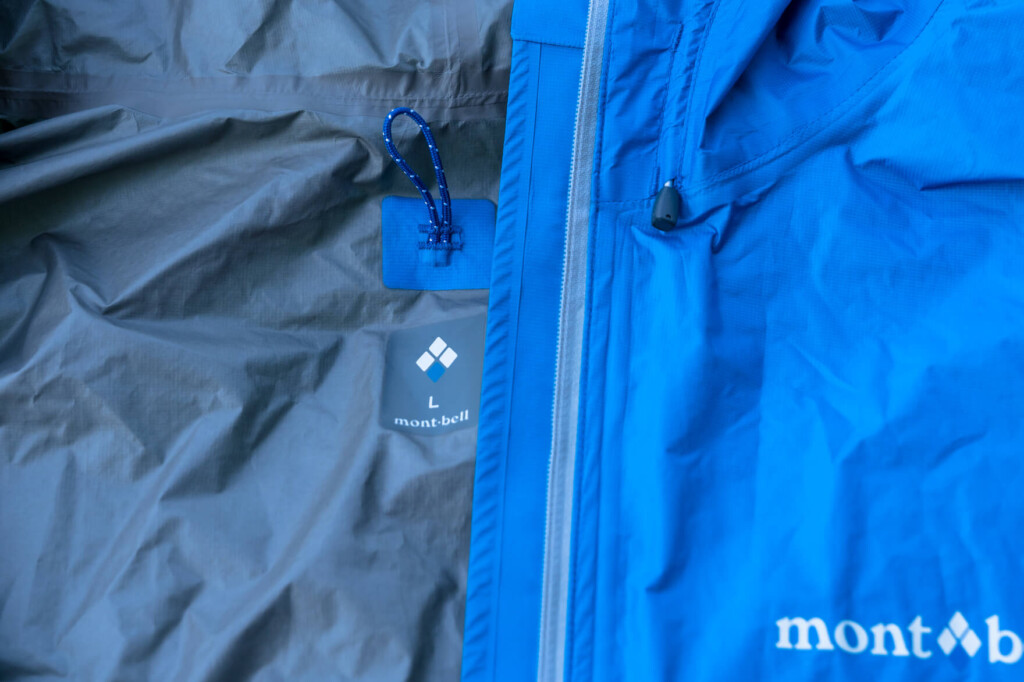
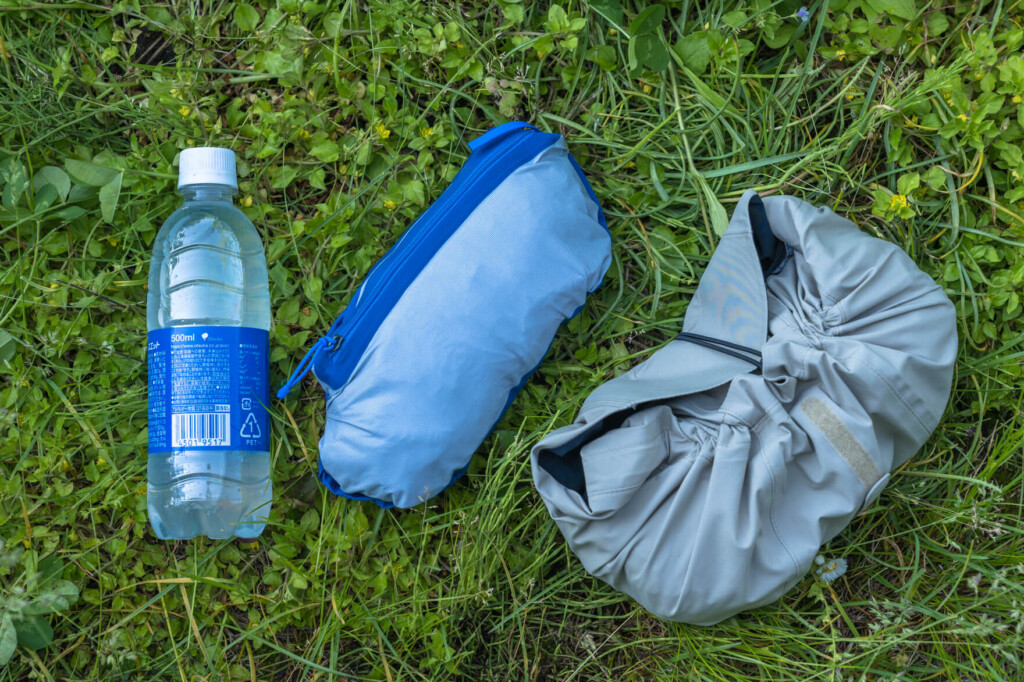
Some flexible, compact, lightweight rain jackets can be packed without a stuff sack; these types of garments are called "packable" (thanks to me, who often loses my stuff sack). There are several ways to pack them, but the two most common are turning the pockets inside out and stuffing them inside (see photo below, left), or wrapping the folded body inside the hood and tightening the drawcord (see photo below, right). Either way, these features that help reduce waste and lighten your load are very welcome
summary
I tried to explain as succinctly as possible the points to consider when choosing rainwear, but (as expected) it was impossible. Even after this lengthy discussion, I still can't say I've covered everything about the world of outdoor rainwear. Rainwear is a complex and delicate field, packed with a particularly diverse range of functions and cutting-edge materials and mechanisms, even among outdoor wear. Technology continues to evolve, and it's a hot category where manufacturers are engaged in fierce development competition. Through rainwear, packed with such high technology and craftsmanship, I discovered the profound world of mountain gear. It's a difficult world to get into, but I hope this helps you choose the perfect rainwear and inspires you to enjoy the outdoors even more. So, have fun in the rainy mountains!
 [Fall/Winter 2025] This season's best hard shell jackets, essential for the harsh snowy mountains, and tips on how to choose them safely
 Ultra-lightweight rainwear you can't miss this season 2017
 Comparison Review: Ultra-lightweight Rainwear for Mountain Climbing and Running [Spring/Summer 2016]
 [Fall/Winter 2025] We've selected the best synthetic insulation for fall/winter outdoor activities from approximately 200 models, and here are some tips on how to choose the right one