



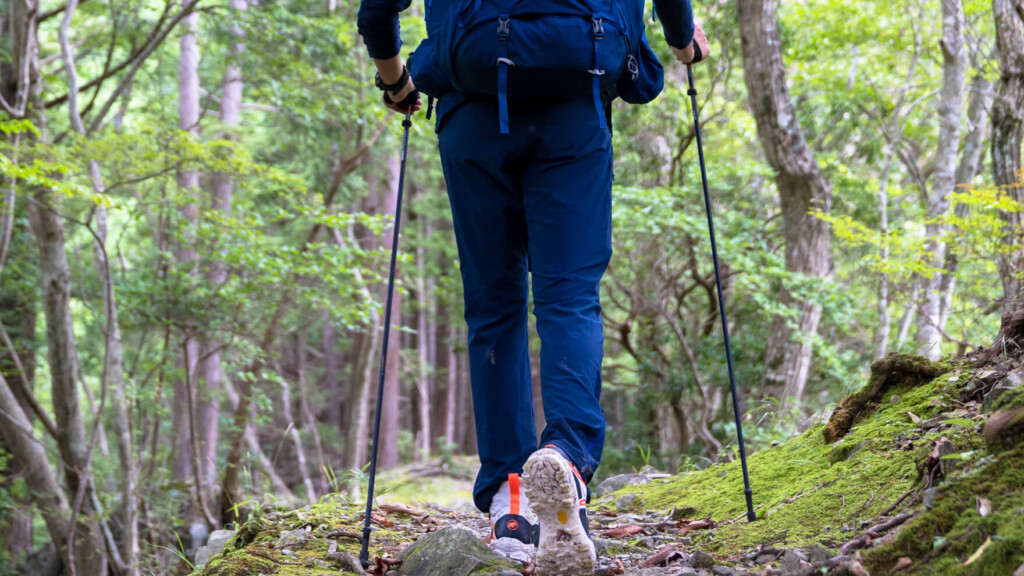
A mountain enthusiast who has compared over 50 trekking poles recommends these and how to choose them wisely [Complete Guide]

Written by Yasushi Hisatomi
They're surprisingly tricky!? The difficulty of choosing trekking poles becomes clear only after buying them
Trekking poles, known as walking sticks for hiking and trail running, are a valuable tool that any hiker who has walked a tough path knows how valuable they are. If you have never used one before, they are one of the mountain tools that I would highly recommend
Trekking poles have many benefits: they not only prevent fatal falls when walking with heavy loads on slippery ground or dangerous rocky terrain, but also reduce the load and impact on joints such as the legs, hips, knees, and ankles, preventing injuries, and helping to reduce fatigue through rhythmic walking. I myself have been carrying them with me on almost every hike or trail run for the past 10 years, and I continue to keep up with various new and classic products on this site
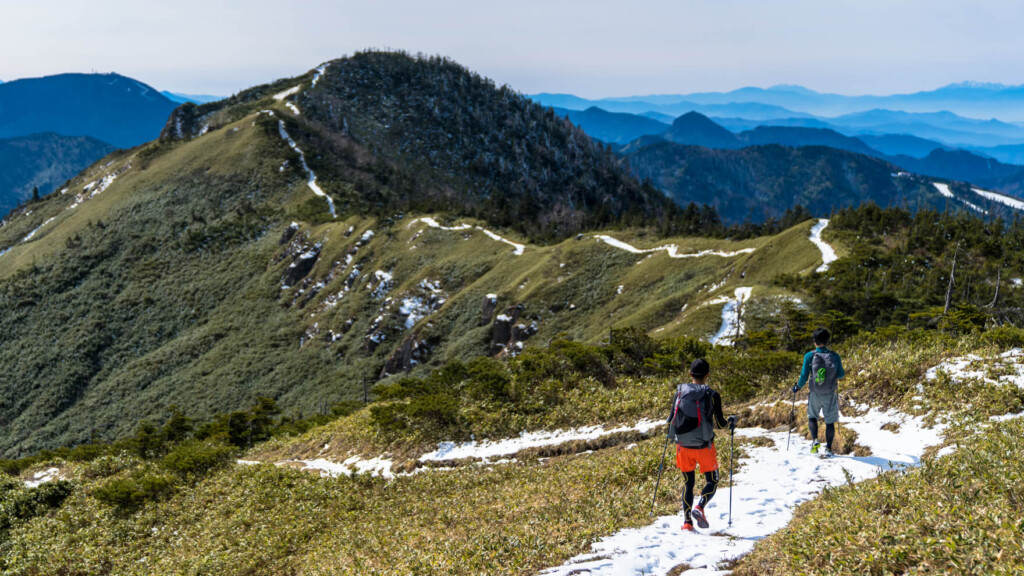
At first glance, trekking poles are simple tools, so you might think, "It doesn't really matter which one I choose, does it?" However, if you look closely, you'll see that there are many differences in the small parts and construction depending on the use, purpose, and occasion of use. Even though they're just walking sticks, there is a deep world of mountain gear out there
So this time, we've evaluated a variety of popular, classic, and noteworthy trekking poles from the multifaceted perspective that only this site can offer, and selected the best models for each purpose and type. In the second half of the article, we've also summarized some useful points to know in order to choose the trekking poles that are perfect for you
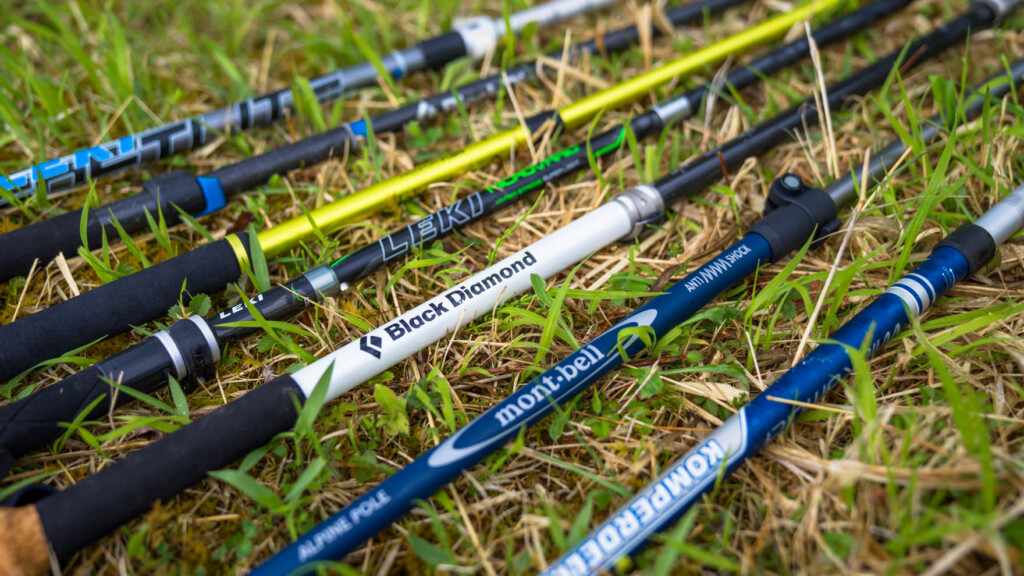
table of contents
- This season's best trekking poles [by category]
- Best Hiking (Overall): Black Diamond Distance Carbon FLZ (Men's) / LEKI Cressida FX Carbon AS (Women's)
- Best All-Season: Black Diamond Alpine FLZ/MSR Dynalock Ascent Pole
- Best Ultralight: MOUNTAIN KING Trail Blaze Skyrunner ULTRA
- Best Thru-Hike: FIZAN TREKKING COMPACT/Black Diamond Distance Carbon FLZ
- Best Fastpacking: LEKI Crosstrail FX Superlight Compact
- Best Trail Running: Black Diamond Distance Carbon/LEKI Ultra Trail FX.ONE Superlight
- Best Value for Beginners: LEKI Journey Lite
- Best Ultralight & Best Value: Heritage UL Trail Poles
- Best Comfort & Safety: LEKI Black Series FX Carbon
- Best Telescopic: Black Diamond Trail Pro Shock/SINANO FAST-130 Carbon W
- Best Aluminum Shaft: Black Diamond Distance FLZ
- How to Choose: 7 Points to Choose Trekking Poles Wisely
- Point 1: Shaft material - Understanding the characteristics of carbon and aluminum
- Point 2: Pole structure and storage type - Foldable poles with three or more sections are best
- Point 3: Length adjustment (locking) method ~ Choose the lever lock type without hesitation ~
- Point 4: Grip - The comfort of the grip has a big impact on ease of use, fatigue resistance, and attachment to the item
- Point 5: Length and weight - If it's too long, too short, too heavy, or too light, it won't function well
- Point 6: Making the basket and ferrule - Think about whether you want to use it on snowy mountains in the future
- Point 7: Other functions and optional parts - It's not always good to make it look bigger than you can
- summary
This season's best trekking poles [by category]
Best Hiking (Overall): Black Diamond Distance Carbon FLZ (Men's) / LEKI Cressida FX Carbon AS (Women's)
Black Diamond Distance Carbon FLZ
Favorite points
- Lightweight and compact, yet extremely comfortable and versatile (can also be used for snow hiking with the separately sold basket)
- High quality down to the smallest detail
While not the lightest, it is among the best. Each individual part has not simply been made lighter, but has been carefully designed down to the last detail without compromising durability or comfort, making it easy to use for hiking, mountain climbing, and running. This ease of use, combined with its light weight, makes it the undisputed No. 1 overall. For the 2022 season, the shaft diameter has been further reduced (and joints reinforced accordingly), further reducing swing resistance. Plus, it can be replaced with a basket specifically for snow hiking, further reducing any flaws
LEKI Cressida FX Carbon AS
Favorite points
- Luxurious comfort optimized for women
- A high level of balance between lightness, comfort, durability, and operability
When considering the best model for women, the Distance Carbon FLZ is of course excellent, but the latest carbon model from LEKI, a leader in the pole industry, is also hard to beat. While the FLZ boasts lightness, this model boasts unparalleled comfort. The parts are well-made down to the smallest detail, making it comfortable to use and easy to operate, as well as durable and reliable. It's packed with thoughtful touches, such as a narrow-diameter grip for women and an anti-shock mechanism that reduces impact on the wrist. While it's not particularly light, its high level of perfection makes it easy to forget about any drawbacks. Of course, it's suitable for everything from snow-free seasons to winter mountain climbing.
Best All-Season: Black Diamond Alpine FLZ/MSR Dynalock Ascent Pole
Black Diamond Alpine FLZ

Favorite points
- The sturdy aluminum shaft provides a secure grip, while the natural cork grip provides a comfortable grip
- The snow basket is standard equipment, making it suitable for snowy mountains, but it is also easy to use in spring and summer
When climbing snowy mountains, an aluminum shaft is always a reliable choice. And the cork grip is comfortable and easy to hold, with a natural warmth. On top of that, the folding design makes it easy to store and easy to use in spring and summer, meaning it can be used year-round, not just in winter. I chose it for its versatility, which is predicated on snowy mountain climbing. The Flick Lock Pro is also incredibly comfortable to use, with its compact size and excellent holding power
MSR Dynalock Ascent Pole
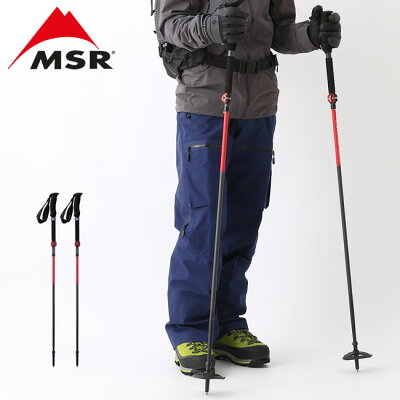
Favorite points
- Built to be strong for snow hiking and snowy mountain climbing (snow basket included as standard)
- Lightweight and compact, it also comes with a summer basket, making it useful even in snow-free seasons
This high-end model from MSR, the manufacturer of reliable snow gear, is perfect for both winter and snow-free mountain climbing. Made with high-strength carbon fiber, it's both lightweight and durable. Its lightweight and compact design won't be a burden even in spring and summer. The lever lock is designed for easy adjustment while wearing gloves. The basket-shaped design makes it easy to operate the snowshoe's climbing support, ensuring comfort in winter
Best Ultralight: MOUNTAIN KING Trail Blaze Skyrunner ULTRA
Favorite points
- Super light and compact with no unnecessary features
While retaining the core functionality of trekking poles, these poles have been dramatically lightened in other areas, achieving a level of lightness and simplicity that is second to none. Made entirely of carbon fiber, including the joints, and foldable, each pole weighs just over 100 grams, which is nothing short of impressive. The length is not adjustable, and the slightly quirky (but simple) fastening method is no problem once you get used to it, making them a great choice for trail running and any other light activity. Naturally, durability is at the very limit, so caution is advised when using them for hard mountain climbing
Best Thru-Hike: FIZAN TREKKING COMPACT/Black Diamond Distance Carbon FLZ
FIZAN TREKKING COMPACT

Favorite points
- Ultra-lightweight aluminum construction that is both light and strong
- The length can be adjusted, so it can be used safely not only when walking but also as a shelter pole when camping
FIZAN is a long-established pole manufacturer run by a family of Italian artisans. While it may not be particularly well-known, its commitment to careful and reliable craftsmanship, which has continued for over a quarter of a century, remains strong. The ultra-thin, ultra-lightweight aluminum shafts combine lightness and strength, and the adjustable length makes them a perfect match for lightweight shelters that use trekking poles as support posts. This "more than just light" feature is what made them the winner in the thru-hike category, where hiking over multi-day trails is a major challenge. The only drawback is the screw-lock fastening system, but for those who are concerned about this, the Black Diamond Distance Carbon FLZ is a runner-up.
Best Fastpacking: LEKI Crosstrail FX Superlight Compact
Favorite points
- Glove-style strap for comfortable grip and quick on/off
- Lightweight and easy to use
In addition to the basic mountaineering features, poles for fastpacking also need to be easy to swing quickly. This model not only has the perfect weight and durability for running and mountaineering, but also excels with LEKI's unique "Cross Shark Grip," which allows for easy strap attachment and detachment and a comfortable, fatigue-free grip. As a top brand in the pole industry, the overall quality is undeniable
Best Trail Running: Black Diamond Distance Carbon/LEKI Ultra Trail FX.ONE Superlight
Black Diamond Distance Carbon
Favorite points
- By eliminating joints, we have achieved an amazing weight of 190 grams (120cm, 1 pair)
If you focus solely on using it for trail running races, there's no need for the ability to fold it up and store it in your backpack. So, by eliminating all unnecessary components, we've achieved an astonishing 190 grams. It's so light you'll forget you're carrying it, and once you experience it, you might never want to go back. The ultra-thin shaft reduces wind resistance and provides excellent swing balance, making it ideal for running through the mountains empty-handed
LEKI Ultra Trail FX.ONE Super Light
Favorite points
- Best-in-class lightness and ease of use
- Glove-style strap for comfortable grip and quick on/off
Of course, this model is also incredibly light, but not by far the lightest. What makes this model so great is that it combines ultra-lightweight and excellent usability, as is typical of LEKI. The unique grip structure, "Trail Shark Grip," which doesn't require a firm grip and therefore doesn't interfere with riding, is as good as ever
Best Value for Beginners: LEKI Journey Lite

Favorite points
- It has plenty of basic, easy-to-use functions, yet is priced affordably
If you look on Amazon or Rakuten, you'll find a ton of poles in the low 1,000 yen range, but in my experience, most of them are so good you're lucky if you can use them once or twice. They may look good, but when you actually use them, they break easily or wear out after just a few uses. Of course, there are some cheap but well-made products out there, but I think it's ultimately a wiser choice to choose an entry-level model from a trusted manufacturer rather than taking such a gamble. So, while the individual parts of this LEKI Journey Lite may be basic now, thanks to the rapid pace of evolution, many of them were cutting-edge just a few years ago. If you're looking for a reliable model within a limited budget, this is my first recommendation.
Best Ultralight & Best Value: Heritage UL Trail Poles
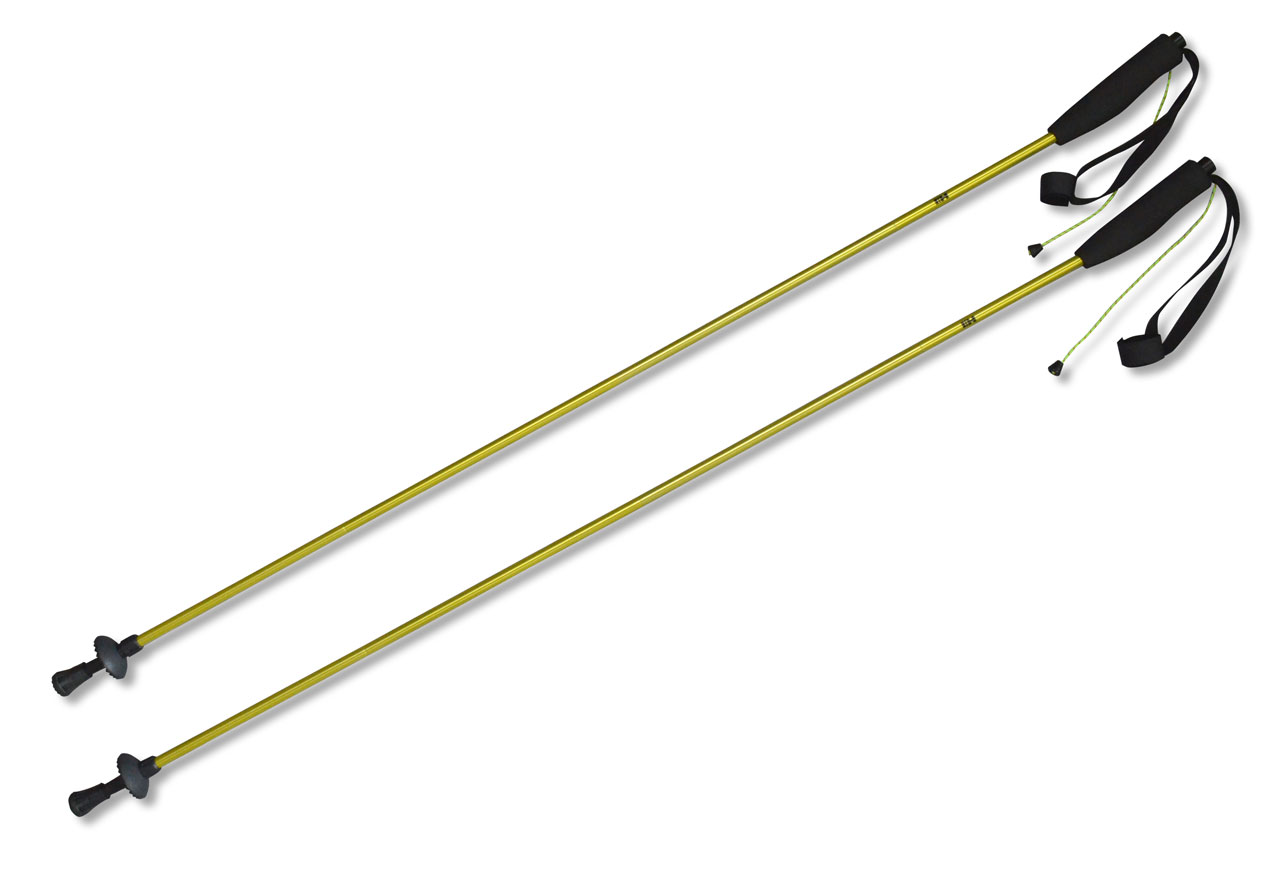
Favorite points
- Ultra-lightweight design with minimal waste and a reasonable price
This pole is also an ultra-lightweight design with no adjustable length and simple thin rope joints, eliminating unnecessary features, but thanks to various efforts (?) such as using aluminum alloy, it is still reasonably priced. Ultra-lightweight poles are often less durable than other models, so it's much more likely to accidentally break, which is why it's so great that they can be priced so low despite being one of the lightest, sharpest poles available
Best Comfort & Safety: LEKI Black Series FX Carbon
Favorite points
- High-quality HM carbon with excellent vibration damping properties
- Carefully crafted down to the smallest detail
LEKI is unrivaled in the world of trekking poles when it comes to the quality of their overall construction, which prioritizes comfort and ease of use. Their undisputed flagship model is head and shoulders above the rest in terms of overall ease of use, and it's no exaggeration to say that it's the "secret number one overall" in terms of perfection. I can recommend it without reservation to a wide range of users, from beginners to veterans
The high-precision assembly, from the overall structure to the edges of the joints, and the new cork grip for a more comfortable grip, are just some of the qualities that exude from it all and make you fall in love with it. If you want to experience not just lightness but also the ultimate comfort that no other brand can match, then this is definitely the one for you
Best Telescopic: Black Diamond Trail Pro Shock/SINANO FAST-130 Carbon W
Black Diamond Trail Pro Shock

Favorite points
- A smart locking mechanism that allows for instant setup and storage despite being telescopic
- High durability for peace of mind in any situation
We've selected two poles that we recommend for those who absolutely need a telescoping model, considering things like attaching it to a backpack and feeling safe while hiking. First up is the standard model from Black Diamond, one of the two major brands in the trekking pole world. It has a wide range of basic functions, but is not overly light, making it durable and reliable, making it suitable for everyone. On top of that, we love BD's unique locking and length adjustment mechanism, "Smash Lock." While you would normally have to operate both joints separately, this pole can be set up and stored just by operating the part at hand, making it a truly next-generation telescoping pole
SINANO FAST-130 Carbon W

Favorite points
- In addition to the basic telescopic structure, it also provides excellent swing balance for comfortable use
This telescoping model from SINANO, a Japanese pole specialist brand that delivers poles of superior quality that rival high-end models made overseas. In addition to the careful, high-quality construction and ease of use of a telescoping pole, this one boasts a more comfortable swing balance thanks to its hybrid combination of carbon and aluminum. It's a masterpiece that meets the recent demand for fast and light poles. It's perfect for general mountaineering, as well as fastpacking
Best Aluminum Shaft: Black Diamond Distance FLZ
Favorite points
- Made of aluminum, it is lightweight, compact, and highly user-friendly
This is the "best of aluminum" model, offering a high level of balance between durability, ease of use, and cost performance while minimizing the weight that inevitably comes with aluminum poles. The overall winner the Distance Carbon FLZ , but this model is just made of aluminum, offering almost the same ease of use, and you can save several thousand yen. Its high cost performance is also an attractive feature. If you want to save even a little weight, go for carbon, but if you prioritize price and versatility, this is also highly recommended.
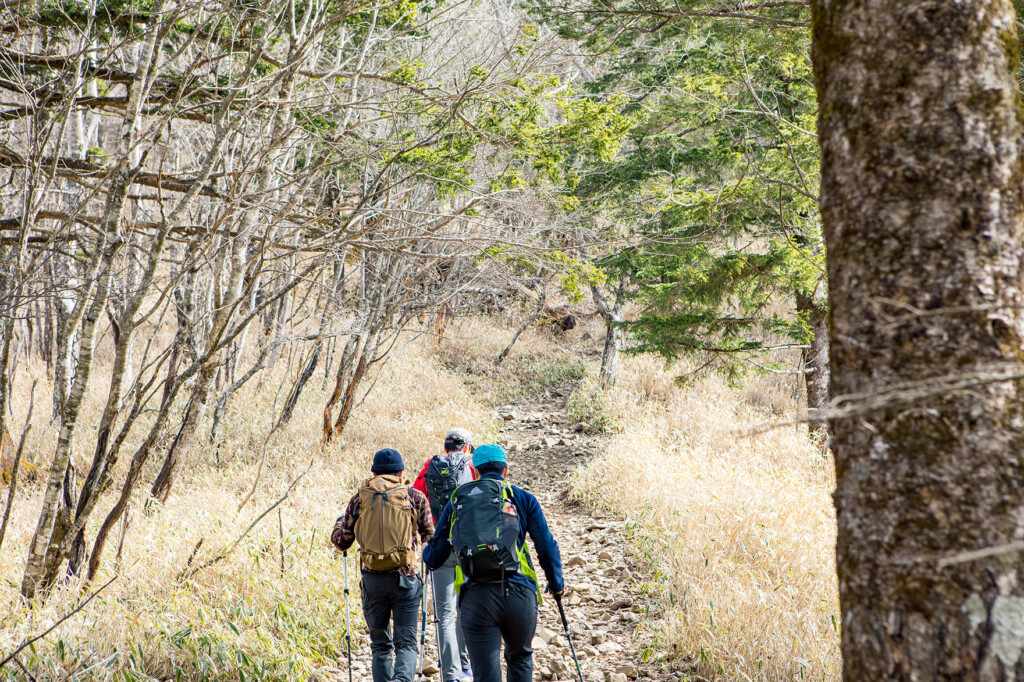
How to Choose: 7 Points to Choose Trekking Poles Wisely
Trekking poles may look simple at first glance, but there are actually many things to compare them with. However, there are seven main points to keep in mind when purchasing a pair, other than price. We will explain them in order below
Point 1: Shaft material - Understanding the characteristics of carbon and aluminum
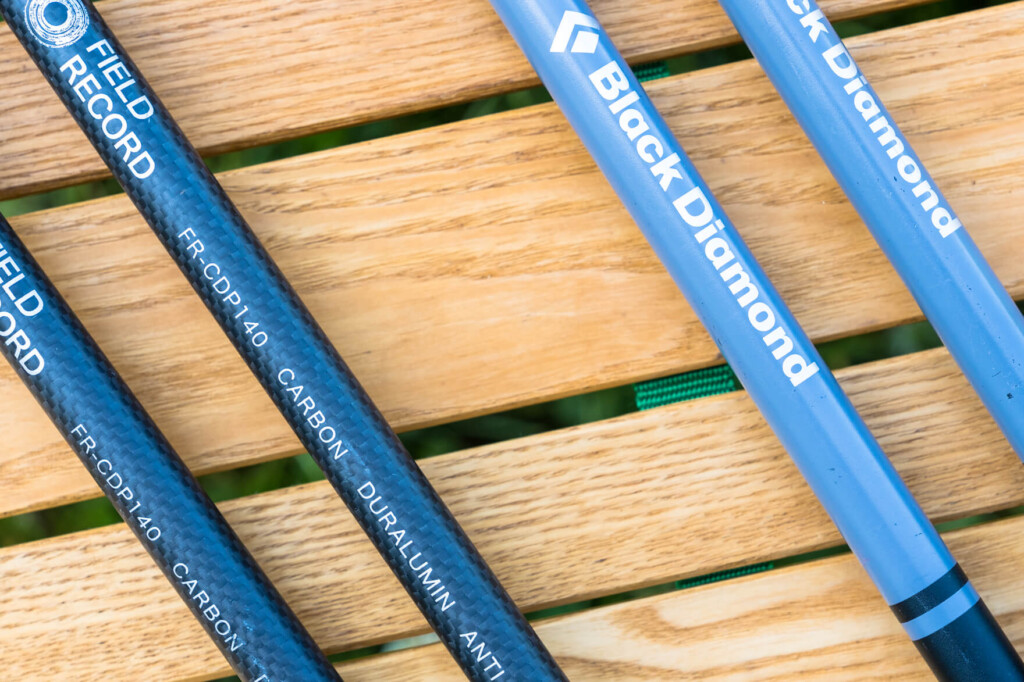
Carbon fiber (left) is expensive but light and strong, while aluminum (right) offers excellent price and overall durability
Trekking pole shafts (the rod part) are generally made from two materials: carbon or aluminum. Carbon models are generally found in more expensive, high-end products, so it's easy to assume that carbon is better, but strictly speaking, it's not that simple. There are situations in which aluminum is more suitable. For this reason, knowing the advantages and disadvantages of both carbon and aluminum poles will help you make a more accurate choice
The main advantage of carbon is that it is light and strong . This means that it is possible to make a lighter pole with the same strength. It also excellent shock absorption , so vibrations when it hits the ground are easily dampened, and it does not rust .
On the other hand, carbon expensive , and compared to aluminum, it is weaker against impacts to a single point , and is easily broken by sharp, hard rocks. In the past, I once had a carbon pole get stuck in a gap between rocks and break very easily, and I have had countless experiences where I have avoided breaking just before. Carbon has such a delicate side.
On the other hand, if there's one main reason to choose aluminum poles, it's overall durability balanced against price . Unlike carbon, aluminum tends to bend rather than snap in half under excessive impact, giving you a chance to re-bend and repair them before the damage is fatal. This peace of mind may make you happier with aluminum for longer treks or activities that involve heavier loads, even if they are heavier than carbon.
The above is summarised in the table below
| material | aluminum | carbon |
|---|---|---|
| Strong Points |
|
|
| Cons |
|
|
However, while the term "carbon" is used broadly, there are now many different grades, and stronger carbon is being developed. Similarly, when it comes to aluminum, lighter and stronger aluminum alloys, such as duralumin, have been developed and are continuing to evolve. The strength of a pole also varies greatly depending on the construction of the joints. For this reason, it's not possible to assert the strength of a product solely based on differences in material, such as "it's like this because it's carbon, or like this because it's aluminum." The above characteristics only describe some of the factors that determine strength, and it's always important to consider the overall construction of each model
Point 2: Pole structure and storage type - Foldable poles with three or more sections are best
Pole structure
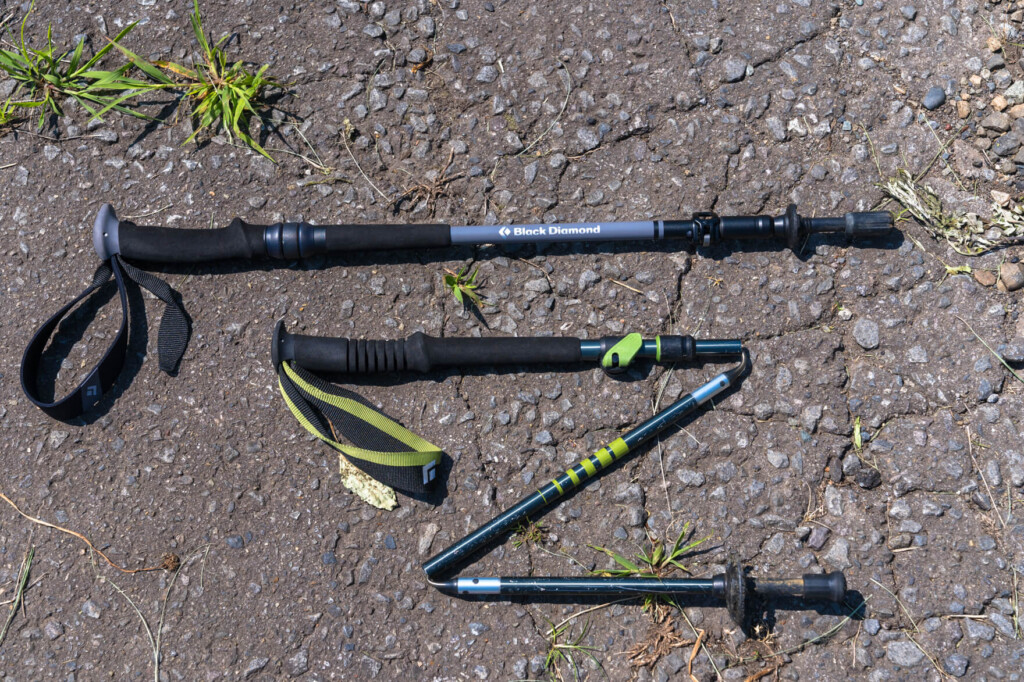
Telescoping pole (top) and folding pole (bottom)
Of course, no hiker would open their front door and immediately grab their trekking poles. Before and after going to the mountains, trekking poles need to be folded and carried, which is why most trekking poles have a split structure with multiple shafts
However, the more pieces you divide it into, the smaller it can be packed away, but the more connecting parts you have, the weaker the structure becomes and the heavier it becomes, so you have to find a balance. Three to five-piece models are typically just right, and are popular with a wide range of people, from day hikers to backpackers and mountaineers. One- and two-piece models are also available to reduce weight and maintain strength, but they are not ideal for hiking in terms of storage
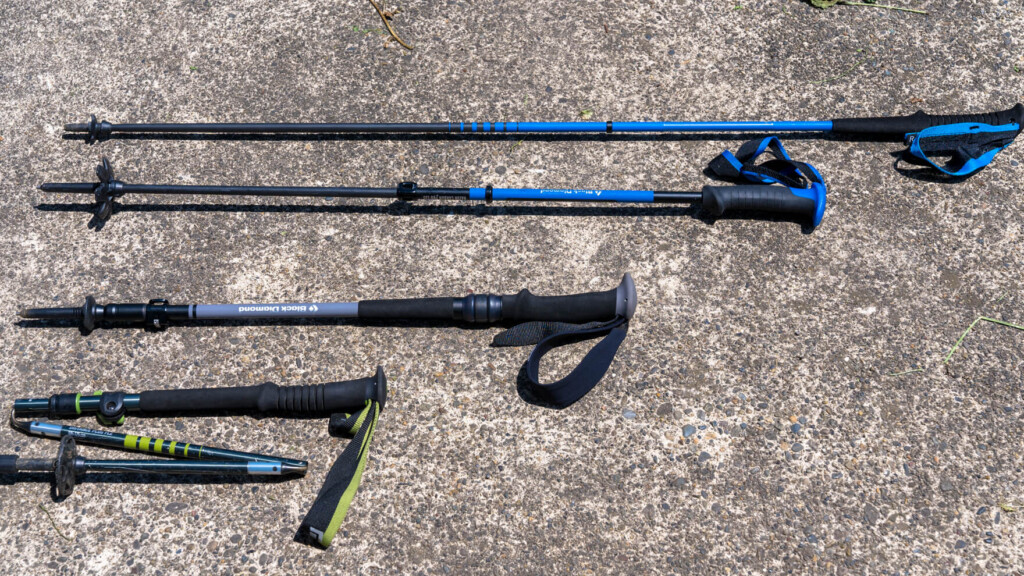
From top to bottom, there is a one-piece design for racing, a two-piece design for backcountry skiing, and a three- or four-piece design for mountaineering. Naturally, the more sections there are, the shorter the packing you can make
Next, we will look at the differences in storage types (connection methods), i.e., how the divided poles are folded up
There are two main storage types, and depending on the type, the storage size and ease of use of the poles will vary greatly. Each has its own advantages and disadvantages, so you can't go wrong by understanding them and choosing one based on the factors you want to prioritize
Telescoping type
First, there's the "telescopic" design, which has been used since the early days of trekking poles. This type uses multiple shafts of different diameters that are stacked like the tubes of a telescope for storage, and when in use, they are extended and fixed by sliding them. This is the most common type, and because it has fewer links, it is highly durable, has a wide range of length adjustment, and is reasonably priced. However, it cannot be folded up short, and is less easy to store
Foldable
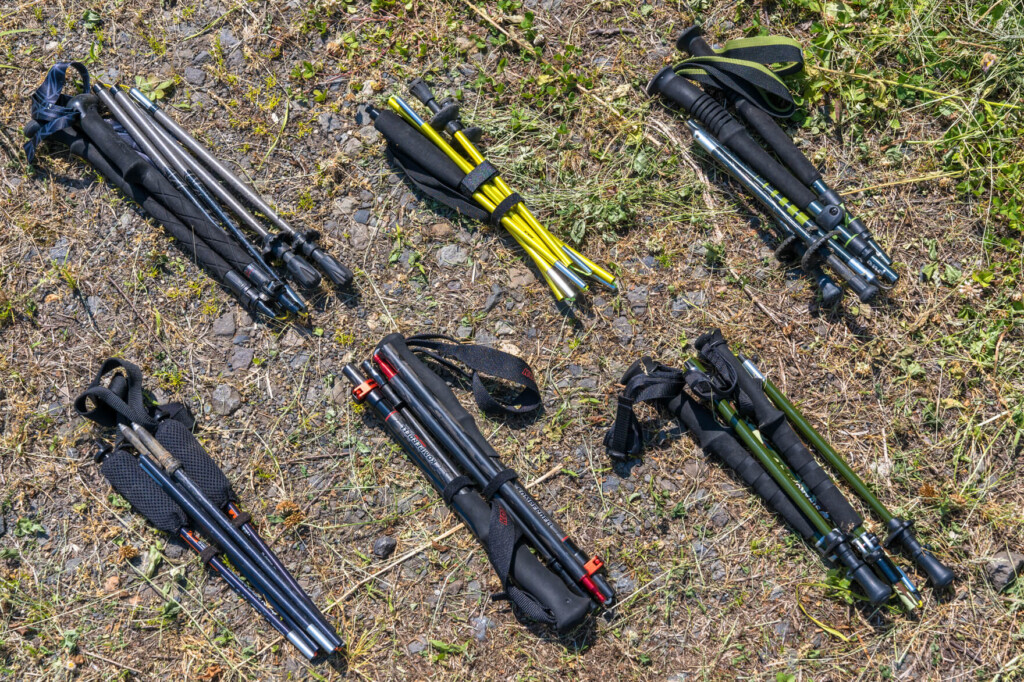
The relatively new "foldable" design consists of three or more sections of shafts. The cord is threaded through the poles, which are split like tent poles, and tension is applied to the cord when setting it up, and the cord is released and folded up when storing it
The biggest advantage of folding poles is their ease of storage. Also, because there is no need to stack the shafts like with telescopic poles, the entire pole can be thinner, resulting in a lighter and more compact design. However, since the structure does not allow for length adjustment, many models only allow for the top shaft to be telescopic, which means the length adjustment range is narrower than with telescopic poles. They are popular with trail runners, hikers who prefer lighter gear, and travelers
| Storage type | Telescoping type | Foldable |
|---|---|---|
| Strong Points |
|
|
| Cons |
|
|
Is it retractable? Is it foldable? Imagine how you will actually store it in your backpack
For some users, storability, such as the ability to pack compactly, is a very important factor. Hikers carrying backpacks of 30 liters or more can easily tie telescopic poles that are around 60cm long to the side of their backpacks, but for runners who carry small backpacks, such as those used for trail running, this length is a major drawback. In such cases, your options are inevitably limited to folding poles
On the other hand, I've found from experience that with larger backpacks, it can be surprisingly difficult to set up folding poles on the outside. Of course, with larger backpacks, it's not a big problem since you can just store them inside the pack, but this is also a matter of preference. That said, folding poles, which are more compact and can be stored more flexibly, are generally easier to use
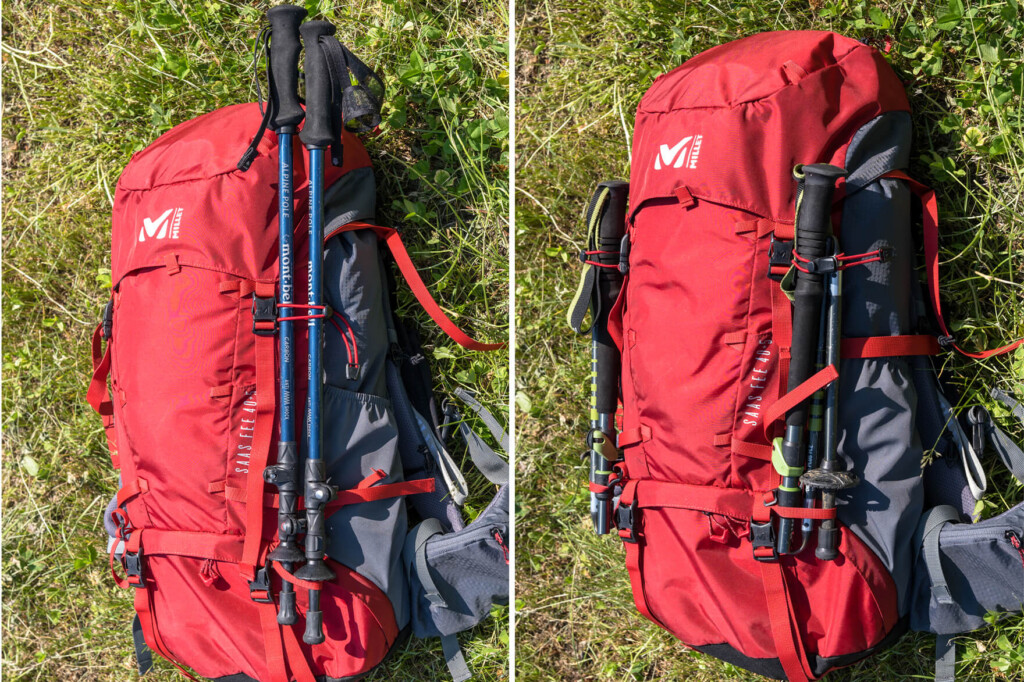
Telescoping poles fit easily on the sides of backpacks over 30 liters (left). Folding poles can also be strapped to the outside (right), but they can be difficult to attach to larger backpacks, so it's best to store them inside the pack
Point 3: Length adjustment (locking) method ~ Choose the lever lock type without hesitation ~
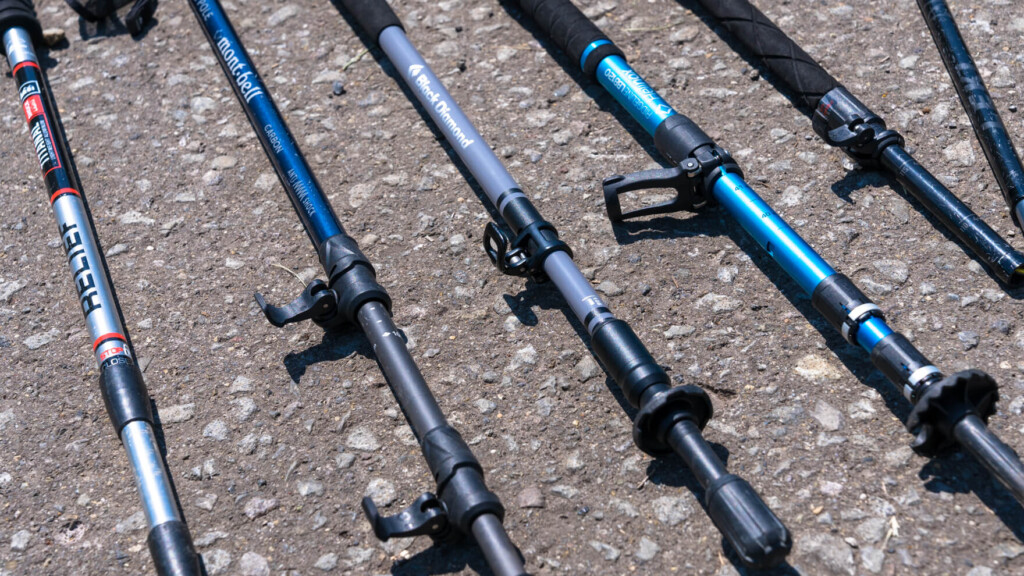
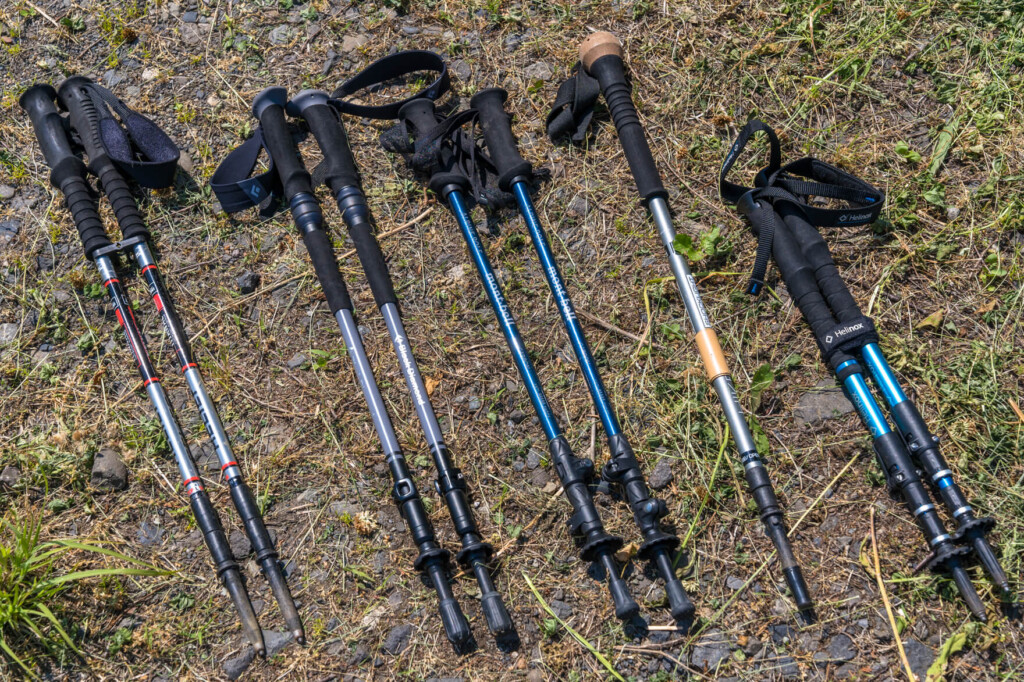
The ease of use and durability vary depending on the locking method, such as a screw lock (far left) that fastens by twisting the shaft, or a lever lock (right side)
New mechanisms for fastening connected shafts together have been developed every year, and there are now several types to choose from
Clew Lock Type
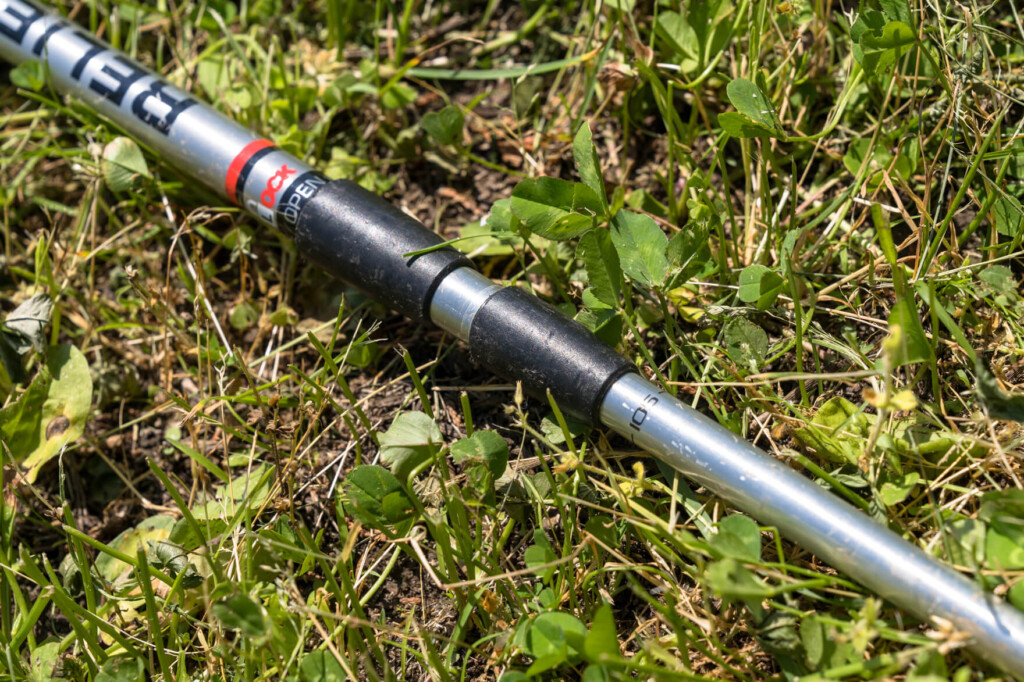
First, there's the oldest and simplest locking method: the "screw lock" type, which locks and unlocks by twisting the connected shafts together. While this method is simple and easy to use, it requires a lot of grip strength to tighten, can be inconsistent at times, sometimes too tight or too loose, and is prone to malfunctions over the years, making it a nuisance for many hikers. Aside from price, there are honestly fewer benefits to choosing this method
Lever lock type
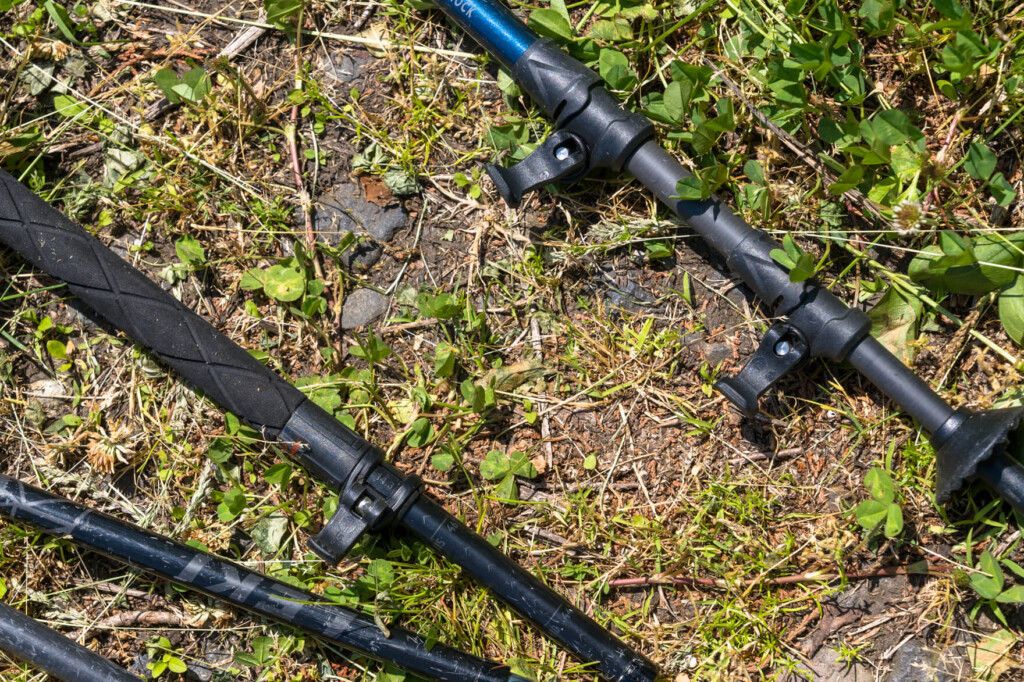
A new locking method that has become mainstream in recent years is the "lever lock (flick lock)" type
The locking and unlocking method is achieved by opening and closing the lever at the connecting part, which is not only easy to operate but also highly secure, allowing for greater peace of mind. On rare occasions, if the fastening force becomes loose, you may need to tighten it with a screwdriver, but it's not so noticeable. No matter how you look at it, this method is superior, and unless you have very specific requirements or are on a limited budget, we recommend choosing the lever lock method without hesitation
Point 4: Grip - The comfort of the grip has a big impact on ease of use, fatigue resistance, and attachment to the item
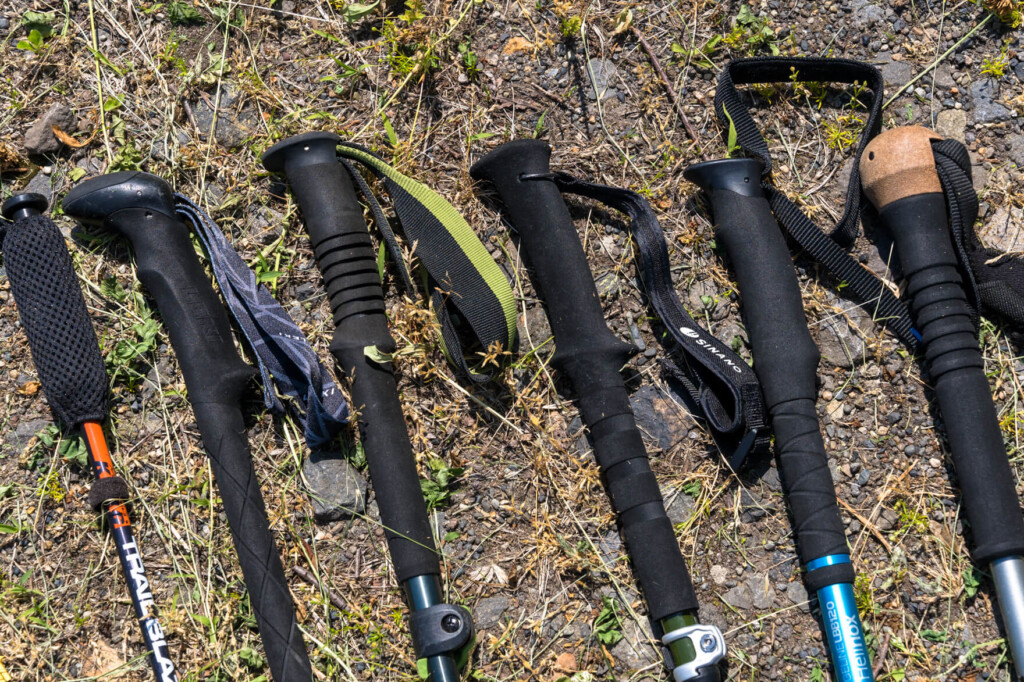
While comparing trekking poles from various manufacturers, I was surprised to find that the grip part is where I felt the difference in individuality and performance between each manufacturer. Personally, I think there is no other element that is more underrated than this. The comfort (or discomfort) that accumulates in your hand over long periods of travel is hard to forget. Looking back, all of the poles that ultimately became my favorites had just the right grip
Grip material
The factors that determine a good grip can be broken down into two main points: the grip material and the shape. Most grips are made of EVA foam or cork. Rubber grips used to be available, but apart from being cheap and freeze-resistant, they were heavy and uncomfortable to the touch, making them unsuitable for spring and summer hiking. These days, they're rarely seen except in winter models
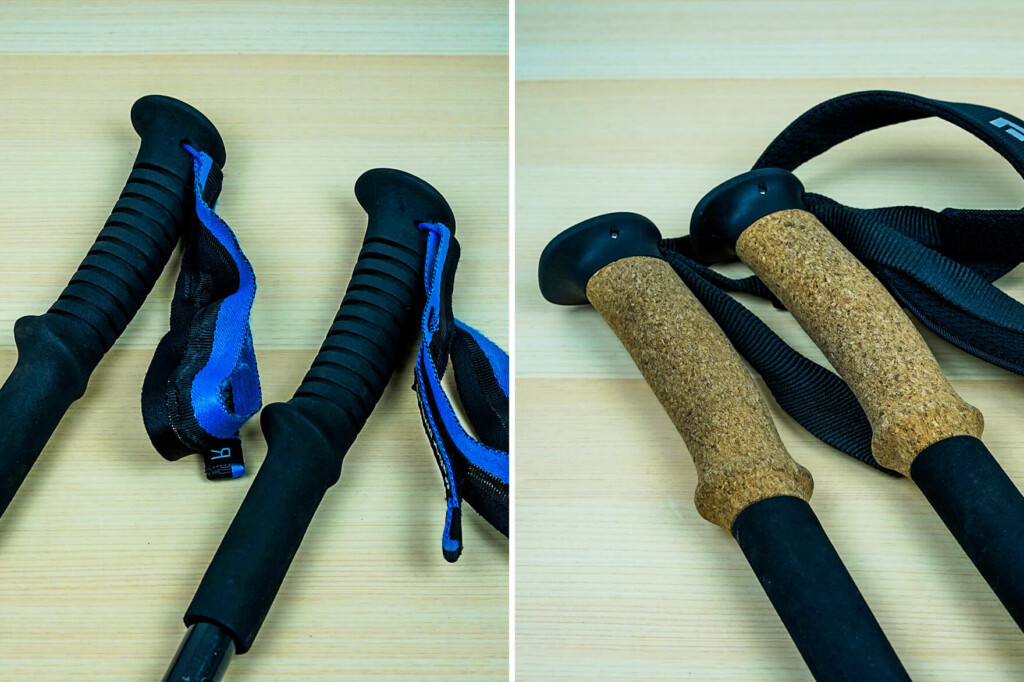
EVA foam (left) is lightweight and quick-drying, while cork (right) offers natural comfort. Both have their own irreplaceable appeal
EVA foam grips (pictured above, left) are comfortable to the touch, have moderate elasticity, absorb sweat well, dry quickly, are lightweight, and are relatively inexpensive, making them a popular material for many models. They are often used in lightweight poles for hiking and running
On the other hand, cork grips (pictured above, right) are less absorbent, but they remain popular due to their smooth, natural feel and the comfort that only natural materials can offer, as they mold to the shape of your hand over time. Of course, there are almost no cases where cork is an absolute necessity. However, if you feel something you just can't compromise on when you actually hold a cork grip, you will choose it without hesitation and will not regret it
Grip shape
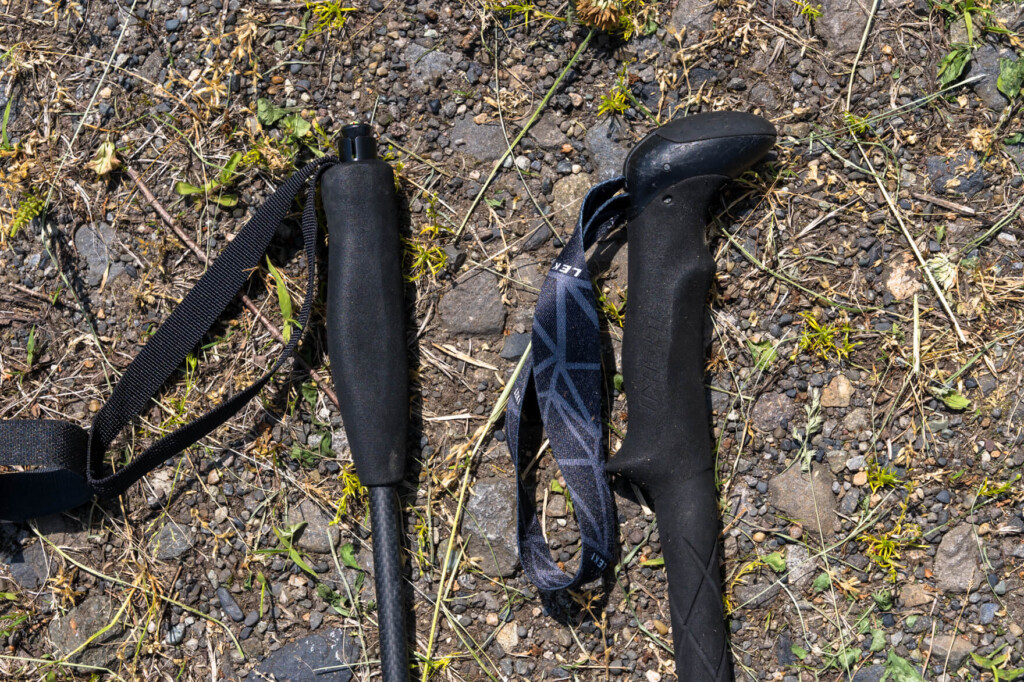
The material and shape of the grip greatly affect how easy the pole is to use
After the material, there's the shape. This is something you won't know until you actually hold it. Be sure to actually hold the pole and check it out, imagining the actual usage scenario, such as whether it fits comfortably in the palm of your hand when you swing it, and whether it's easy to swing
However, even if you don't actually grip it, if you have a form design based on ergonomics, you can imagine that it will be comfortable to grip to a certain extent, unless that's a lie. In my case, my favorite is LEKI's "Ergon Grip (right on the photo above)." The ergonomic, easy-to-grip shape makes it difficult to pull out, and when descending, the pole can be kept with little grip strength, making it less tiring and less tiring, making it captivating the moment you hold it, and it's been a favorite ever since.
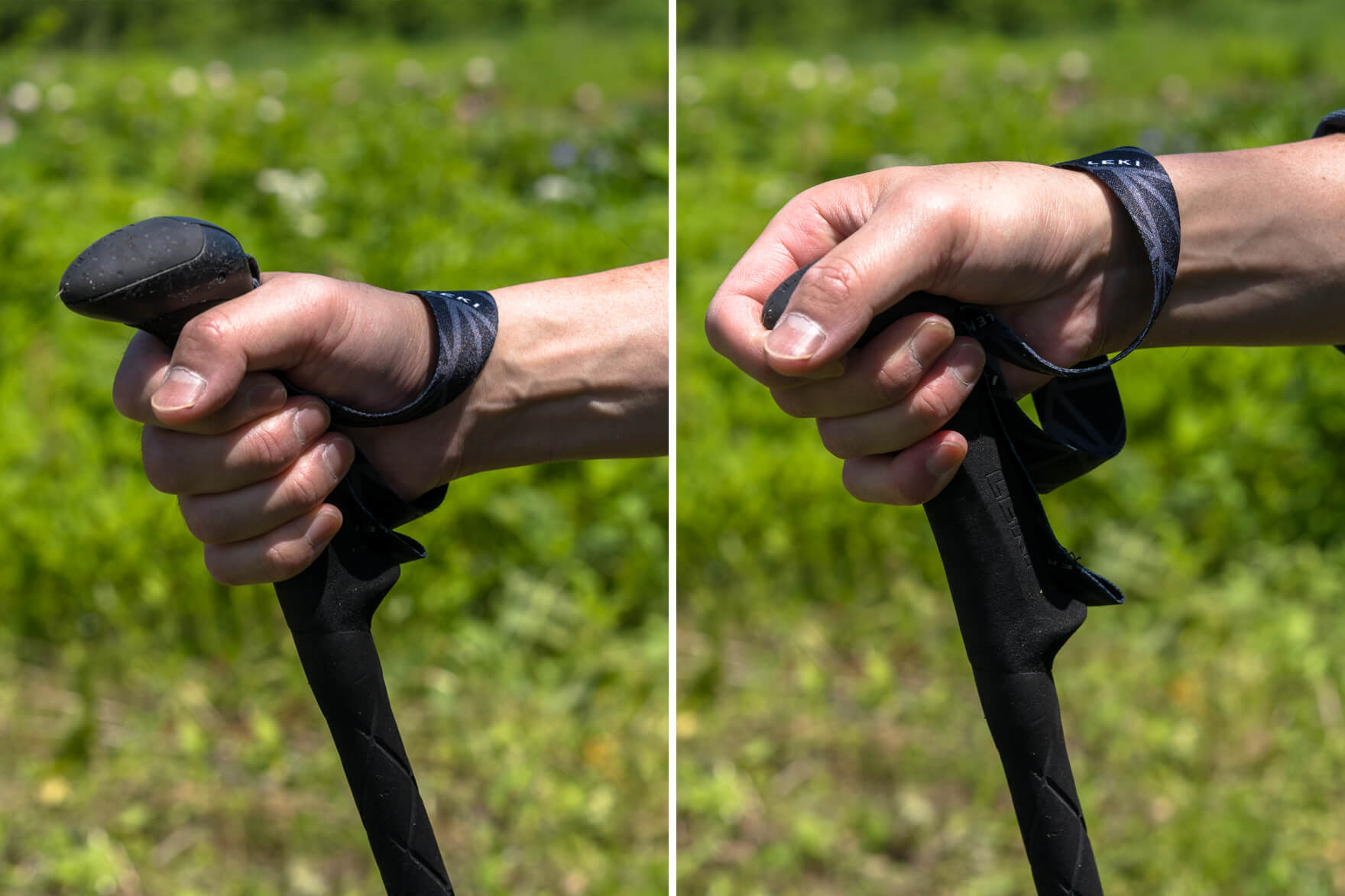
The Ergon grips not only feel comfortable when held normally, but the egg-shaped grip ends are also very convenient for gripping when going downhill
Other manufacturers also devise their own unique shapes, taking into consideration the balance between lightness and ease of grip. What one person finds "comfortable" may not be the same for another, and ultimately it's a matter of subjective feeling. For that reason, we recommend actually checking out the grip shape to see if it fits you
Extended Grip
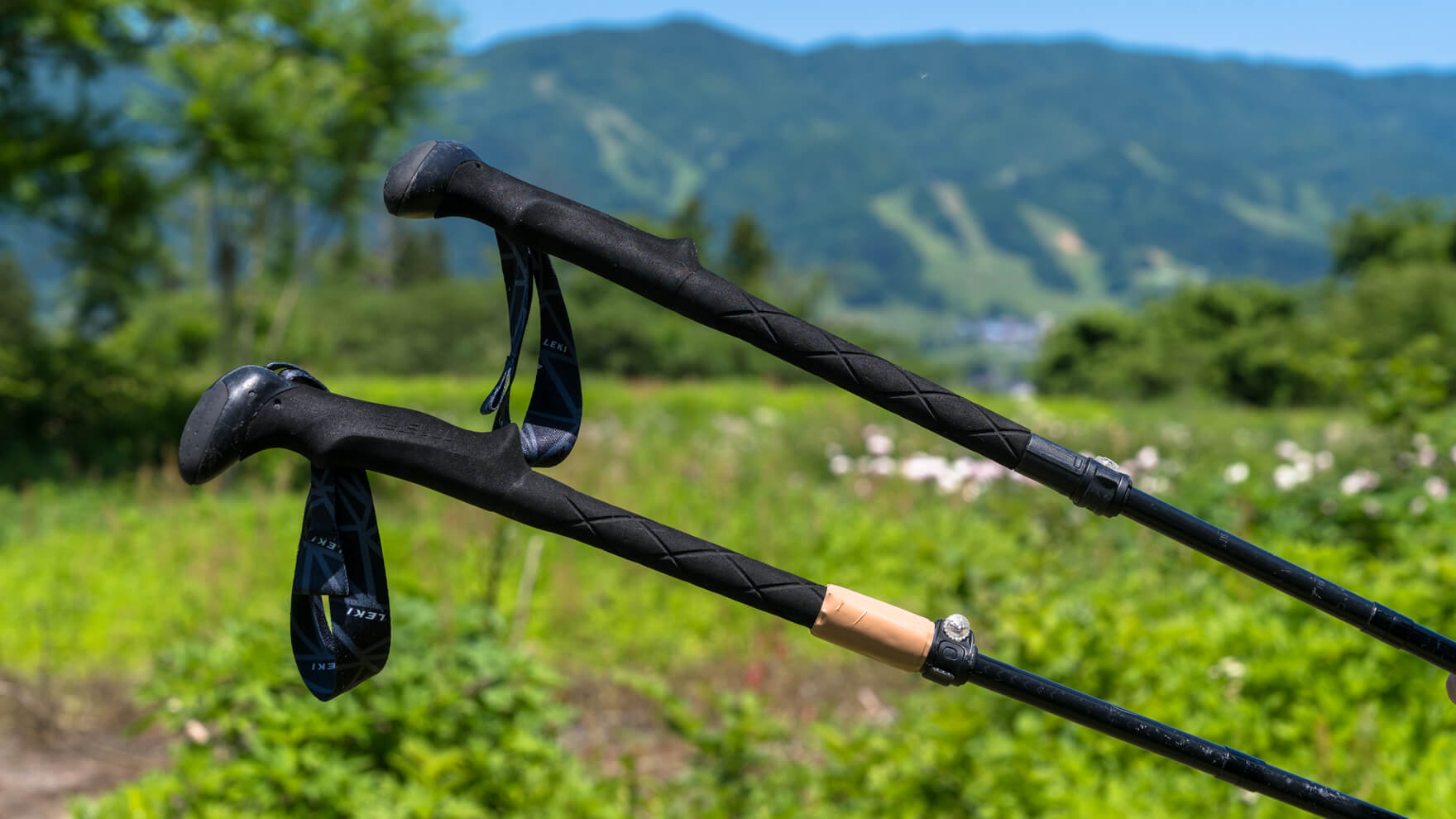
Some trekking poles have a grip that extends downwards (see photo above). This is called an extension grip, and it allows you to hold on to the pole immediately when climbing steep slopes or traversing steep inclines without having to adjust the length each time. This is a very useful part when hiking on steep slopes or technical terrain with lots of ups and downs
In my case, I recommend wrapping duct tape under the grip to create an additional grip, as this not only provides a more secure hold but also allows you to have repair tape on hand just in case (bottom of photo above)
Point 5: Length and weight - If it's too long, too short, too heavy, or too light, it won't function well
Choose the right length
Naturally, if the poles are not the right length for your height, they will not function to their full potential. When purchasing, be sure to check whether the poles are the right length (size) for you, or whether they can be adjusted to the right size
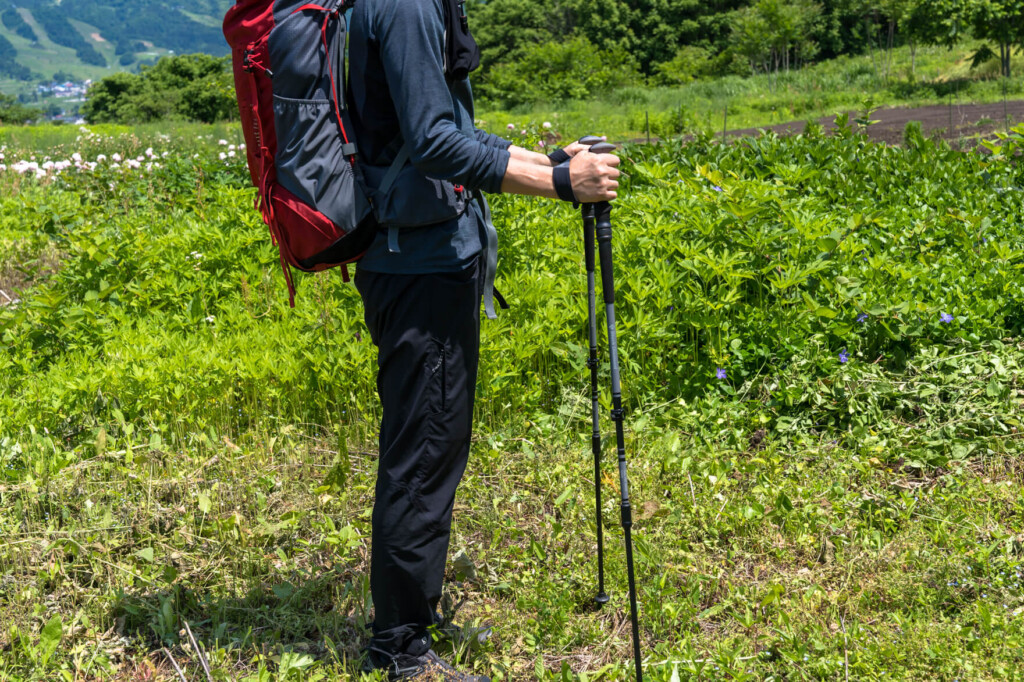
To measure the pole length that suits you, first place the tip of the pole slightly in front of your toes, then hold the grip and hold the pole up naturally.If your arms are at a 90-degree angle, this is said to be the ideal length for a position that allows you to move your arms naturally and avoids fatigue (although this may vary slightly from person to person)
However, it's important to note that this is the appropriate size when assuming a flat or gentle trail. A shorter pole is easier to use on steep climbs, while a longer pole is just right for steep descents. This means that this setting isn't correct in every location, and ideally you'd like to be able to adjust the length to suit the slope. Adjustable poles are convenient because they can be used on a variety of terrains and can be shared by users of different heights
However, poles that can be adjusted in length do add extra parts, which inevitably adds weight. It's a tough choice, but which one to choose ultimately comes down to personal preference and the activity. If you're trail running, prioritize packability and lightness, while if you're hiking, prioritize comfort. If you have a clear purpose in mind, you should prioritize the elements required for that activity. And if you want to enjoy both, we recommend choosing an adjustable pole
By the way, in my case (maybe it's just me), when I choose poles that can't be adjusted in length, I choose a size that is slightly shorter than the length that will result in a 90-degree angle (see photo below). That way, when I first set it to a length slightly shorter than 90 degrees assuming I'll be climbing, it's just the right length, and when I'm descending, I can just hold it by the grip end and hold it longer, so I can continue to hold it all day without adjusting the length
Be careful if you use trekking poles as tent poles
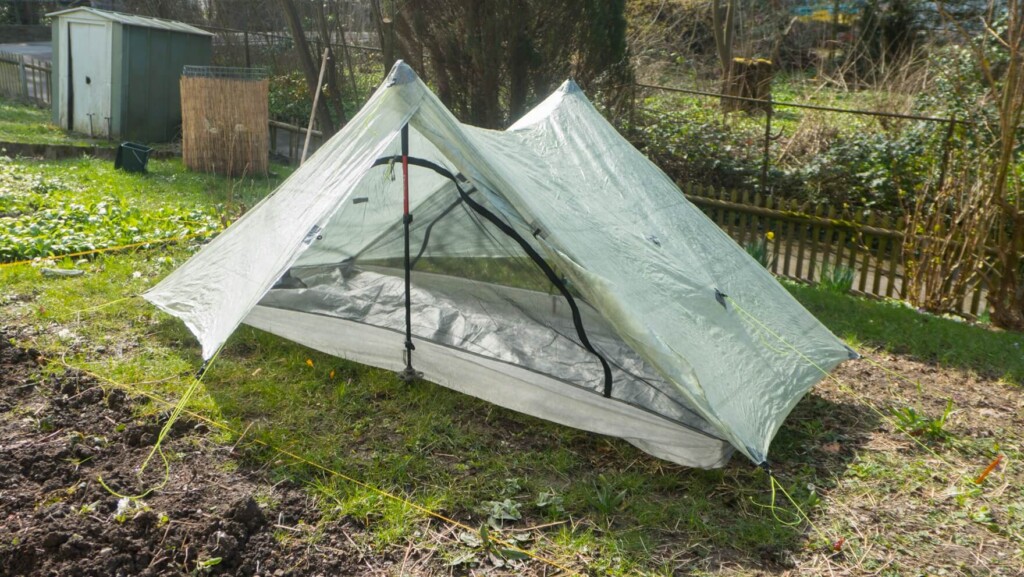
Another thing to keep in mind when considering pole length is if you plan to use the trekking poles as tent poles for a lightweight tent (shelter)
Even if you want to go with ultra-lightweight equipment, there is nothing more disappointing than choosing short, fixed-length poles that end up being too short for your tent. In that case, your trekking poles need to be the right length for both your height and the height of your tent, so it is best to choose adjustable-length poles that can be adjusted to either length
Lightness is important, but it should not exceed the limits of durability and usability
The weight of trekking poles is one of the most important factors to consider, along with comfort. Lighter poles reduce arm fatigue, which is a major advantage on long trekking trips
It's only 10 grams, but it still matters. The heaviest poles sold on the market weigh in at over 500 grams, while the lightest are around 200 grams. To put it in perspective, it's like the difference between holding a plastic bottle or a can of coffee when you walk. Even if the difference isn't that extreme, if you're swinging your arms all day, a subtle difference of just a few dozen grams can have a much bigger impact than you might imagine
Of course, if you prioritize lightness over anything else, you won't be able to maintain sufficient durability. If you're a beginner hiker and plan to use your poles for day hikes or relatively easy two-day backpacking trips, you should definitely prioritize comfort, durability, and affordability over weight. Once you've gotten a little more used to your hiking, or if you plan to do mountain running or fastpacking with a light load, prioritizing lightweight poles will make your trips more comfortable
Point 6: Making the basket and ferrule - Think about whether you want to use it on snowy mountains in the future
If you look closely at the tips of trekking poles, you will see several distinctive parts, but one thing you should pay particular attention to when purchasing is the construction of the disc-shaped plastic part (called a basket) attached to the tip. This part, which comes with most poles, acts as a stopper to prevent the pole from sinking too deep into loose terrain such as snow, sand, or mud
A special basket is required for use on snowy mountains
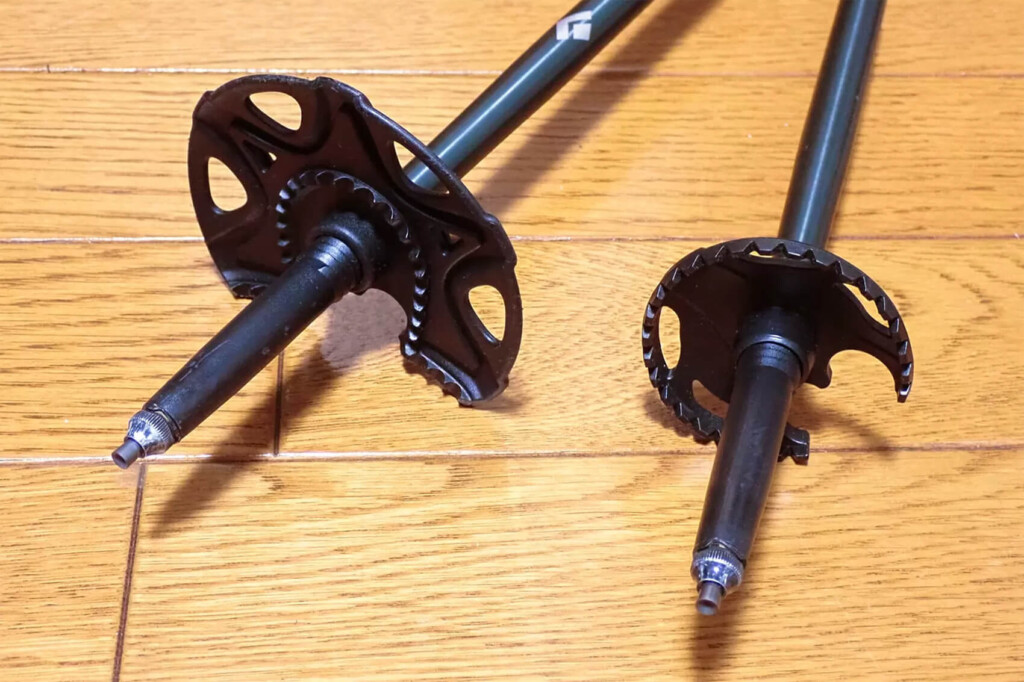
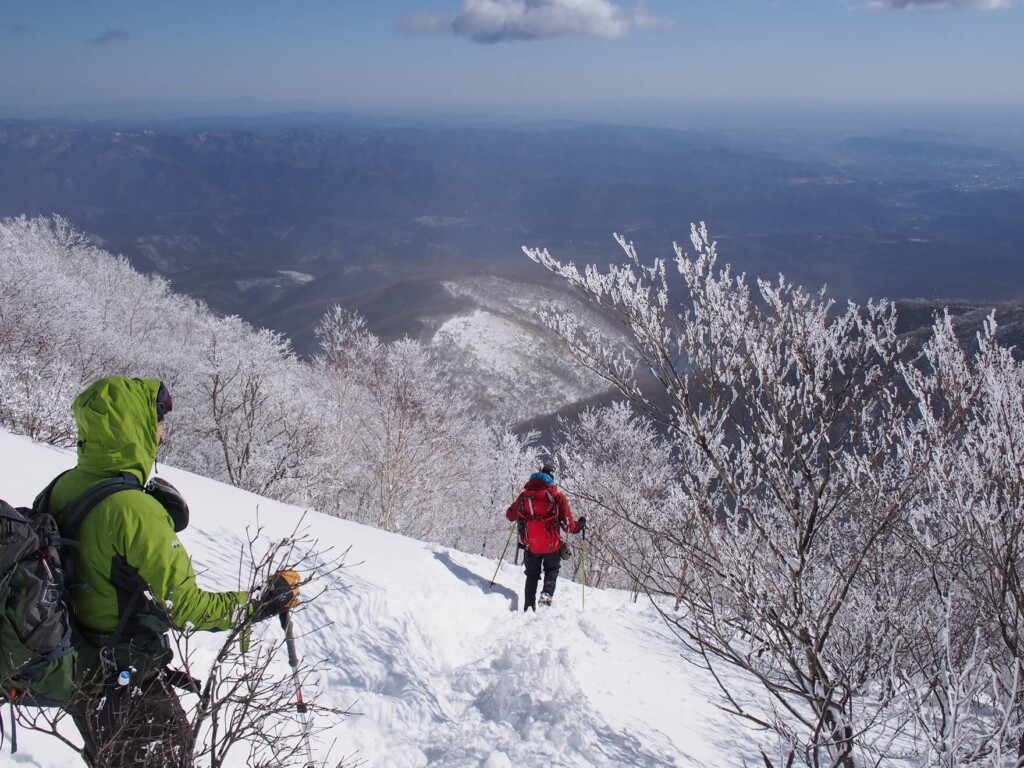
If you're going to be using it during the snow-free seasons of spring through autumn, you don't need to worry too much about the size of the basket (in fact, it's better if it's not too big, as it can get in the way), but if you plan to use it for snowshoeing, winter mountain climbing, or backcountry skiing, the basket needs to have an option to be replaced with a larger size. I remember being very disappointed when I later found out that my favorite poles (the old model Black Diamond Distance Carbon FLZ) were not compatible with the snow basket
If you're planning to use it in the winter, it needs to be durable to a certain extent, and ultra-lightweight models often don't support this, so you need to be careful as these options may not be available. On the other hand, there are also models that are designed for all-season use and come with a snow basket as standard, so when choosing a ski that you can use all year round, it's best to check whether these standard parts and options are available
Point 7: Other functions and optional parts - It's not always good to make it look bigger than you can
Anti-shock mechanism
When going down a long slope, the impact of the poles hitting the ground can be quite strong. Some trekking poles are equipped with an "anti-shock" function to reduce the strain on your knees and wrists
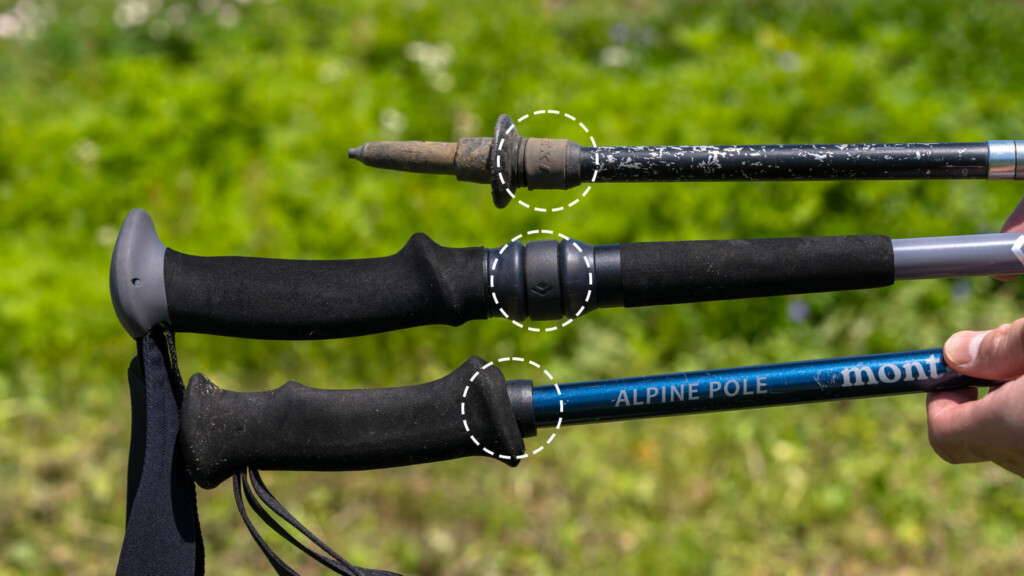
This cushion itself is not bad, but it does add some weight, and considering the risk of malfunction or breakage due to the intricate construction required for this mechanism, I personally don't think it's such an essential feature. Each manufacturer uses different shock-absorbing parts, so it's hard to say that all of them have such disadvantages, but when choosing, I recommend taking these disadvantages into consideration and deciding whether they are still worth it
Female Model

Generally, trekking poles can be used by both men and women, but recently, more and more manufacturers have started offering "women's models" that are more suitable for women
The features of women's trekking poles are:
- Narrow grip diameter for people with small hands
- The length variations are mostly short
- Some color variations are suitable for women
There are three points to note:
In that sense, if you are a man who is actually smaller or prefers shorter, smaller, and lighter poles, there is absolutely nothing wrong with choosing a women's model. Just buy what suits you
summary
Above, I've introduced some recommended trekking pole models that are worth checking out from the many available, and outlined the key points you should keep in mind when choosing the perfect pair for you. My personal recommendation for general mountain climbing and hiking would be a "moderately lightweight, foldable carbon fiber pole with a lever lock." When it comes to trekking poles, price and quality are relatively directly proportional, so I think you're unlikely to regret your choice if you choose one of the above types within your budget
Finally, the tips of trekking poles can damage soil, boardwalks, and vegetation. When using trekking poles, be mindful of where you use them and remember to minimise your impact on the environment by Leave No Trace
Related reading
 How to choose trekking poles you won't regret
 Weight? Function? Price? 7 Recommended Trekking Poles by Type
 Comparison Review: Comparing Different Types of Trekking Poles [For Hiking, Snow Mountains, and Trail Running]
 A mountain enthusiast who has worn through over 100 pairs of hiking socks recommends this season's socks and how to choose them wisely [Complete Guide]