



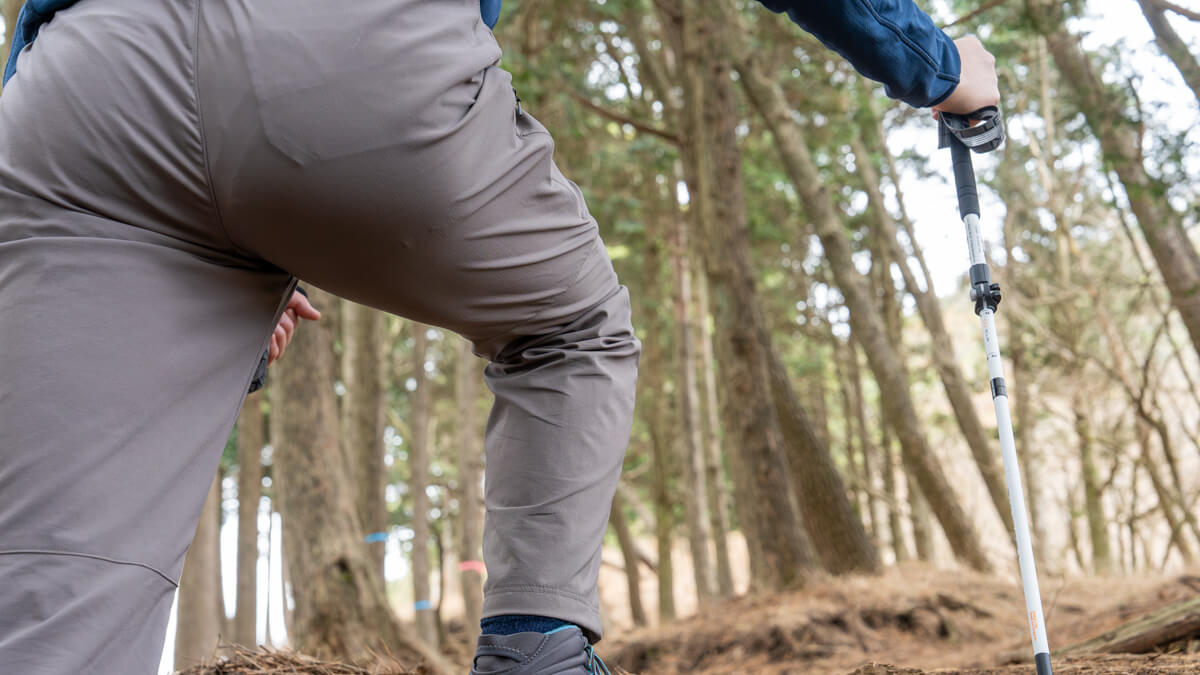
Sweaty, torn... A professional solves your trekking pants problems. Learn how to choose the "best pair" from Finetrack

Written by Yasushi Hisatomi
table of contents
- Why is it so difficult to choose hiking pants (trekking pants) these days?
- 1. What are the "essential features" of trekking pants? [Q&A]
- What makes trekking pants different from other pants?
- What is the "ease of movement" required for trekking pants?
- What are the "breathable and quick-drying" features required for trekking pants?
- Why do hiking pants need to be "durable water repellent"?
- No matter how comfortable your pants are, do they have to be strong?
- 2. How do you choose the best pair of trekking pants for you? Finetrack's smart way to choose trekking pants
- Step 1: Check the "three essential conditions" common to all seasons and uses
- Step 2: Check the "important features" according to the season and environment
- Step 3: Check out the "specialized features" that match your activity and play style
- Step 4: Trying on the right pair is key to finding the right pair
- 3. Finetrack's new proposals for the 2026 season: the best models for each season and purpose
- 0. [Common features] High durability and high water repellency
- 1. [When in doubt, try this! The all-arounder] Camino Pants
- 2. Silfa Pants (for those who are sensitive to heat and are on low mountains in midsummer)
- 3. Miyama Pants (for light summer outdoor activities)
- 4. Stormgo Casual Pine Pants (for all-around hard activities)
- [2026] Finetrack trekking pants positioning map
- 4. Why Finetrack? Our commitment to manufacturing revealed through our four key points in trekking pants
- summary
- Find out more about Finetrack's latest trekking pants and where to buy them
Why is it so difficult to choose hiking pants (trekking pants) these days?
"These pants are cool and easy to move in, but the fabric tears easily and they're ruined."
"I thought these pants were strong enough, but they made it hard to walk because my knees felt stiff every time I walked."
"Pants that get wet easily and don't dry easily are uncomfortable, and they keep you chilled for a long time..."
This is a mistake that many beginner mountain climbers will make at least once with their hiking pants (trekking pants)
In the past, knickerbockers and simple long pants were the norm for mountain bottoms, but in recent years, the number of options has increased dramatically due to the increasing sophistication of materials and the diversification of activities, making it possible to choose a piece of clothing that is perfectly matched to each scene and activity
However, it is also true that the diversification has made it difficult to find the one that truly suits you . Nowadays, not only beginners but even veterans often find themselves wondering, "Which is the right answer?"
Finetrack , who define themselves as "playmakers = creators" and are known for their thorough hands-on approach that does not allow even the slightest compromise in the pursuit of their ideals , about what is required of excellent hiking pants and how to choose the best model for you, from a mountaineer's perspective.
From simple questions like "Why aren't training wear or work pants good enough?" to "Why mechanical stretch instead of polyurethane?" and "Why are they so committed to the world's highest level of durable water repellency?", Fightrack will reveal the inside story of how trekking pants are made, which you can only find here
What we received was a thorough, almost obsessive commitment to wetness, leg support, and durability. This was infused with a thorough belief in the pursuit of manufacturing trekking pants that are not just pants, but "gear" for comfortable walking
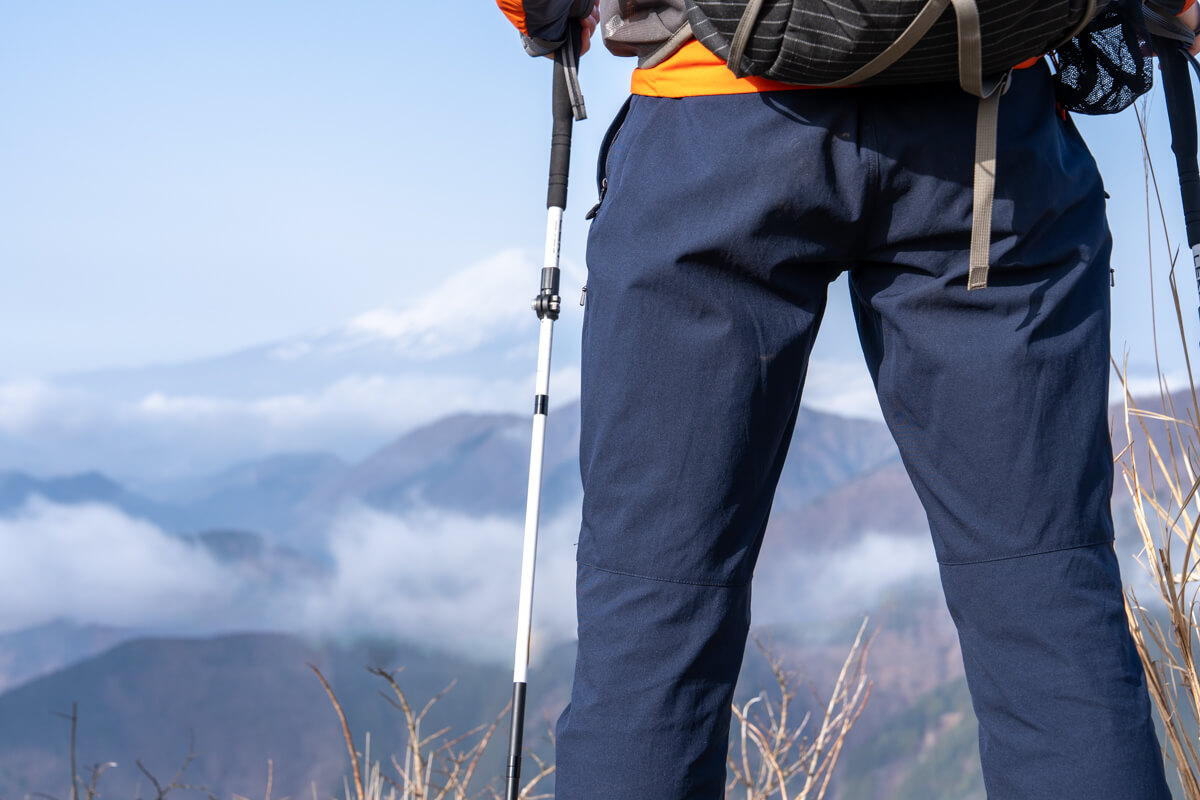
We spoke to…
1. What are the "essential features" of trekking pants? [Q&A]
To put it simply (obviously), trekking pants are " pants that are carefully made for use in mountain climbing ." Naturally, they are more suitable for mountain climbing than pants made for other purposes, but what exactly makes them different? Few people can clearly answer that question.
So, first of all, let's clarify, "What makes trekking pants different from other pants?" and "What are the characteristics of trekking pants and what functions are required of them?"
What makes trekking pants different from other pants?
Q1. Beginner's mistake: "When climbing mountains, why can't I just wear comfortable training clothes or sturdy work pants?"
Some beginner hikers have experienced situations where they went on a hike in calm weather, thinking that as long as they were comfortable and easy to move in, they would be fine wearing training pants, only to find that the sweat never dried and they were uncomfortable, or that they got caught on tree branches or torn by rubbing against rocks. Others have worn work pants because they were durable, only to find that their knees would strain and make it difficult to walk. Would trekking pants avoid these discomforts and dangers?
A1. Answer from a professional (Finetrack): "Trekking pants are different in that they offer ease of movement, durability, and protection from moisture and sweat, all of which are well-rounded."
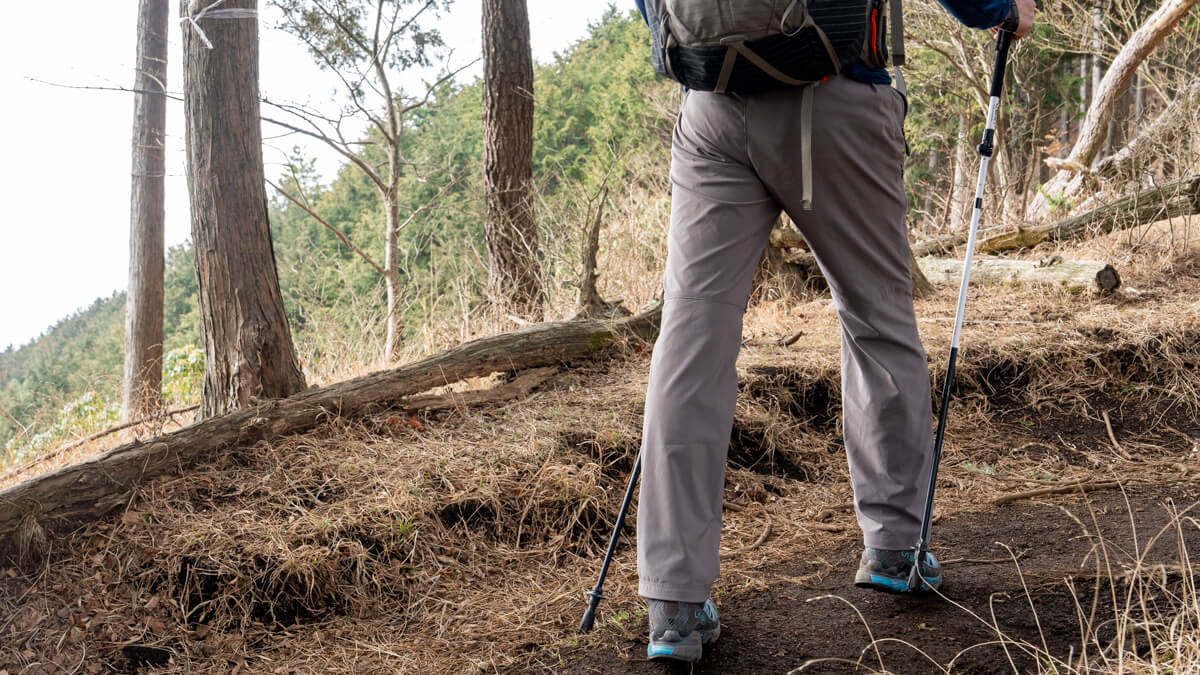
Sportswear and jerseys are easy to move in and absorb sweat, but they don't dry easily. When hiking for long periods of time, wet fabric is uncomfortable, makes the clothing heavy, and keeps the body cold, which can lead to dangerous situations. Furthermore, the surface of training wear fabric is prone to snagging, so it can be easily damaged by tree branches and rough rocks, and it's not particularly durable
On the other hand, while work pants may be durable, many of them have straight patterns (cuts) and lack stretch, which means they are not suitable for the "lifting your legs high" action that is unique to mountain climbing, restricting your movement
In other words, trekking pants worn for mountain climbing must not be just "easy to move in" or "durable"; they must have all of these qualities. What makes trekking pants fundamentally different from other clothing is their high overall functionality, combining these diverse functions
What is the "ease of movement" required for trekking pants?
Q2. A beginner's question: "I thought looser, wider pants would be easier to move in, so I tried them out, but I found they were difficult to walk in and made large movements..."
When you first start mountain climbing, the first thing that comes to mind when you hear "clothes that are easy to move in" is "larger sizes and wider pants." Some people don't like feeling constricted, so they might think, "Wouldn't wider pants be better?" However, there is a blind spot that is unique to mountain climbing that you can't imagine in everyday life
A2. Professional answer: "Generally, wide pants can sometimes make it difficult to move around when hiking."
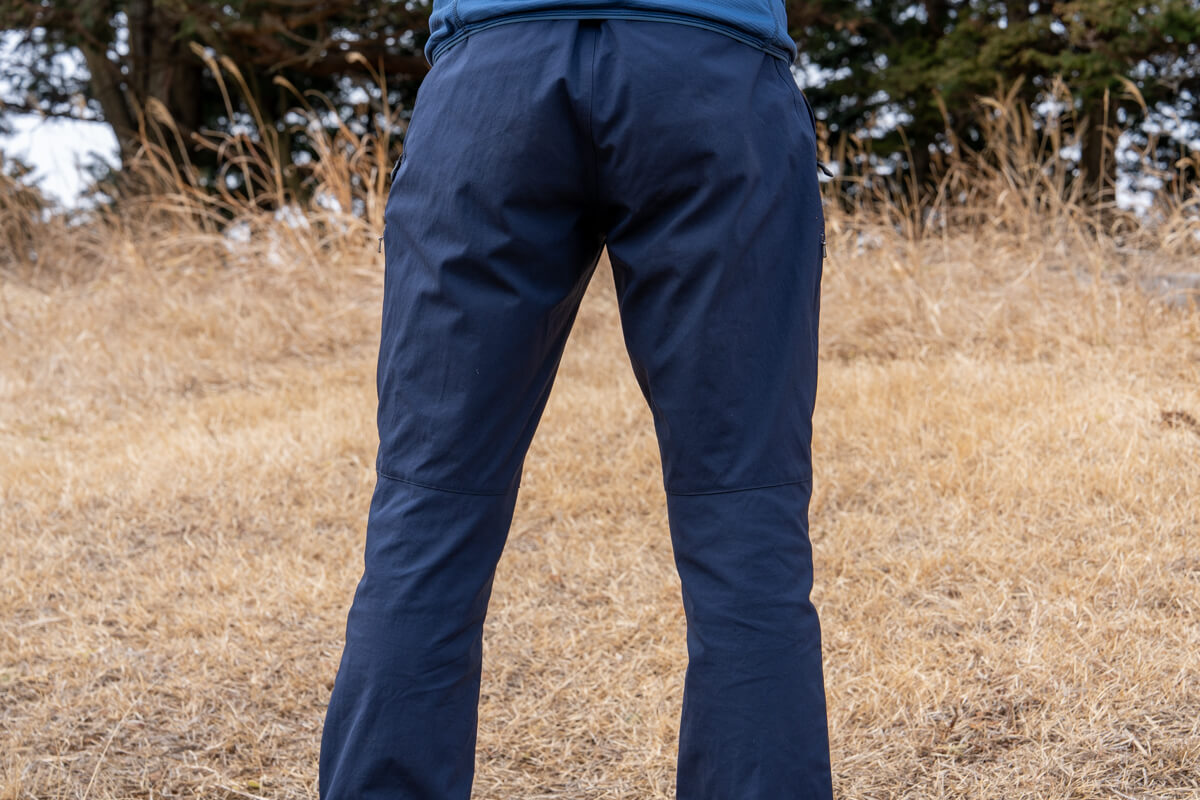
It's true that wider pants may be relatively easy to move in when making small movements like walking slowly on flat ground. However, it's important to note that they can actually make it difficult to move when hiking. In the mountains, you'll be constantly doing things like lifting your legs high and stepping over rocks. In such situations, pants that are simply wider will get caught at the knees, making it difficult to lift your legs. Also, wider pants are heavier due to the fabric, and there's a risk that the excess fabric will flap and get caught on rocks or branches, or that it will be difficult to see what's going on under your feet
For this reason, hiking pants are designed to be not too wide, but rather have a moderate width, and are designed with three-dimensional pattern " and " stretchy
In that sense, Finetrack aimed to achieve the seemingly contradictory functionality of " a slim and beautiful silhouette, yet allowing amazing leg movement ," and the optimal solution was to combine high-performance " mechanical stretch " fabric with a precise " three-dimensional pattern ."
What are the "breathable and quick-drying" features required for trekking pants?
Q3. A beginner's concern: "It's so hot in the mountains these days, and no matter what pants I wear, my pants get stuffy inside..."
Recently, summers have been experiencing unusually high temperatures not only in Japan but all over the world. Until now, we've managed to endure the heat, but we're reaching our limit. I'm sure there are many people out there who feel the same way. Nowadays, when hiking in the summer, your pants get soaked with sweat just by walking. But that doesn't mean you should let them stay wet all the time. So, what kind of pants should you choose to deal with sweat and stuffiness inside your pants? And what should you do if they start to get stuffy?
A3. Professional answer: "Breathability and sweat-resistance will become more important than ever."

In seasons when you sweat profusely even when standing still, it is essential to evaporate the moisture from sweat as quickly as possible, which means that fabrics and structures with higher breathability are essential
"Highly breathable fabric" doesn't simply mean that it has large holes (gaps). It's true that fabric with lots of holes (mesh fabric being the most extreme example) allows air to pass through more easily, but the more holes there are, the weaker the fabric becomes. The key to high-quality summer hiking pants is to use fabric that is highly breathable while also maintaining the strength required for outdoor pants
On the other hand, adding ventilation to pants is also very effective in reducing the discomfort caused by stuffiness. For example, the "Link Vent" on Finetrack pants is a zippered ventilation opening on the side of the thigh, which, when opened, allows hot air inside the pants to be released all at once. With or without this, the coolness is completely different
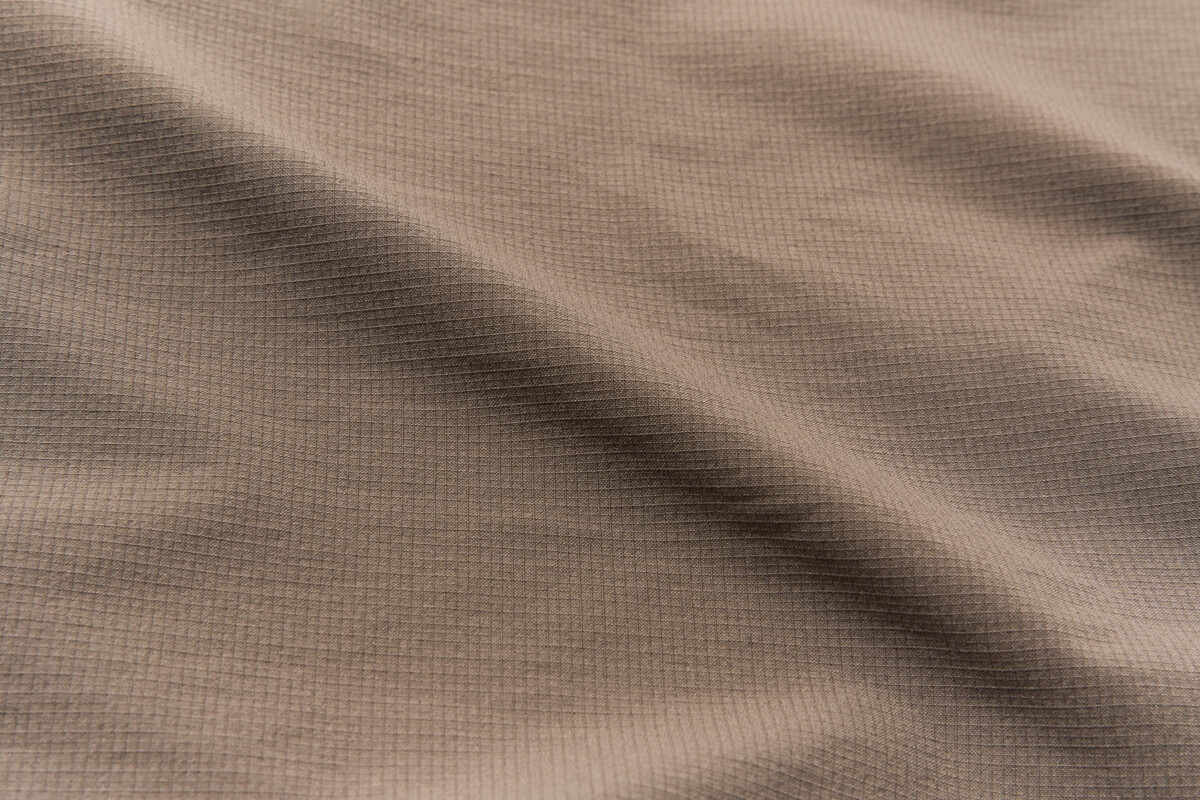
In addition, the use of textured ripstop fabric allows for a smooth, comfortable feel against the skin and allows for easy air circulation, even in sweaty situations
As such, to create trekking pants that are cool and don't get stuffy, various approaches are needed to improve breathability while maintaining a balance with strength
Why do hiking pants need to be "durable water repellent"?
Q4. A beginner's concern: "When pants get wet from light rain, morning dew, or sweat, they become uncomfortable and heavy. Should I just choose "quick-drying" pants?"
Even if it's a crisp, sunny day during the day, when hiking, it's rare to be completely free from water during your activities; for example, passing through grass wet with morning dew, fording a small stream, or being hit by a sudden light rain as soon as you reach the ridge, and the risk of getting wet is everywhere. However, putting on rain pants every time is a waste of time, and putting up with getting wet is uncomfortable in its own way. What is needed to make pants that are as water-resistant as possible and dry quickly? It seems that the key to this is to increase the pants' water-repellent properties
A4. Professional answer: "The key to staying dry and comfortable is to have a fabric that repels water."
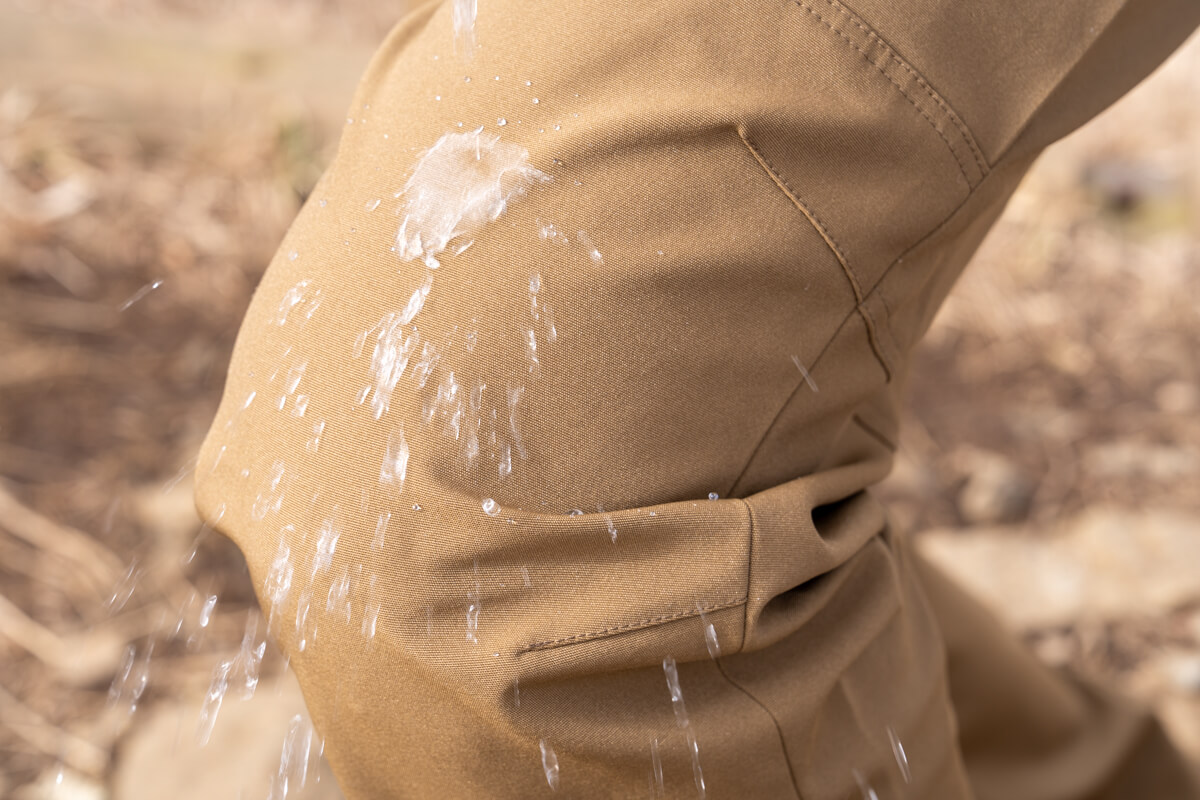
It is generally said that quick-drying (drying quickly even when wet) is important for comfortable clothing that dries easily, but we believe that it is equally important that the fabric is water-repellent in the first place. If the fabric repels water, it will not retain water as easily, so it will not become heavy and will also prevent you from getting cold. As a result, even if it gets wet, it will dry much faster
While typical water-repellent finishes lose their effectiveness after about 20 to 30 washes, Finetrack has set an industry-leading strict standard of " maintaining performance of 80 points or more even after 100 washes* ." This means you can go about your day in light rain without taking out your rainwear, and it also makes it less likely for mud to get on your pants. The pants' long-lasting performance, even after repeated washing, also extends their lifespan.
*JIS L1092 spray method
*Excluding some items
No matter how comfortable your pants are, do they have to be strong?
Q5. A beginner's problem: "I was walking in my training pants and they got caught on a branch and ripped easily..."
I'm sure I'm not the only one who has had the experience of finding a favorite pair of pants that are light, easy to move in, refreshing, and water-resistant, only to have the fabric quickly tear when they get caught on a branch in a small bush or rub against a rocky area. No matter how functional a pair of pants may be, they are not suitable for mountain climbing. Since all of Finetrack's employees are mountain climbers, they say that it is essential that their pants are not only highly functional on the surface, but also durable enough to withstand harsh mountain use and continue to be used for a long time even under tough conditions
A5. Professional answer: "On mountain trails, where there are many dangers such as slashing, puncturing, tearing, and abrasion, it is necessary for the material to be strong enough to withstand damage."
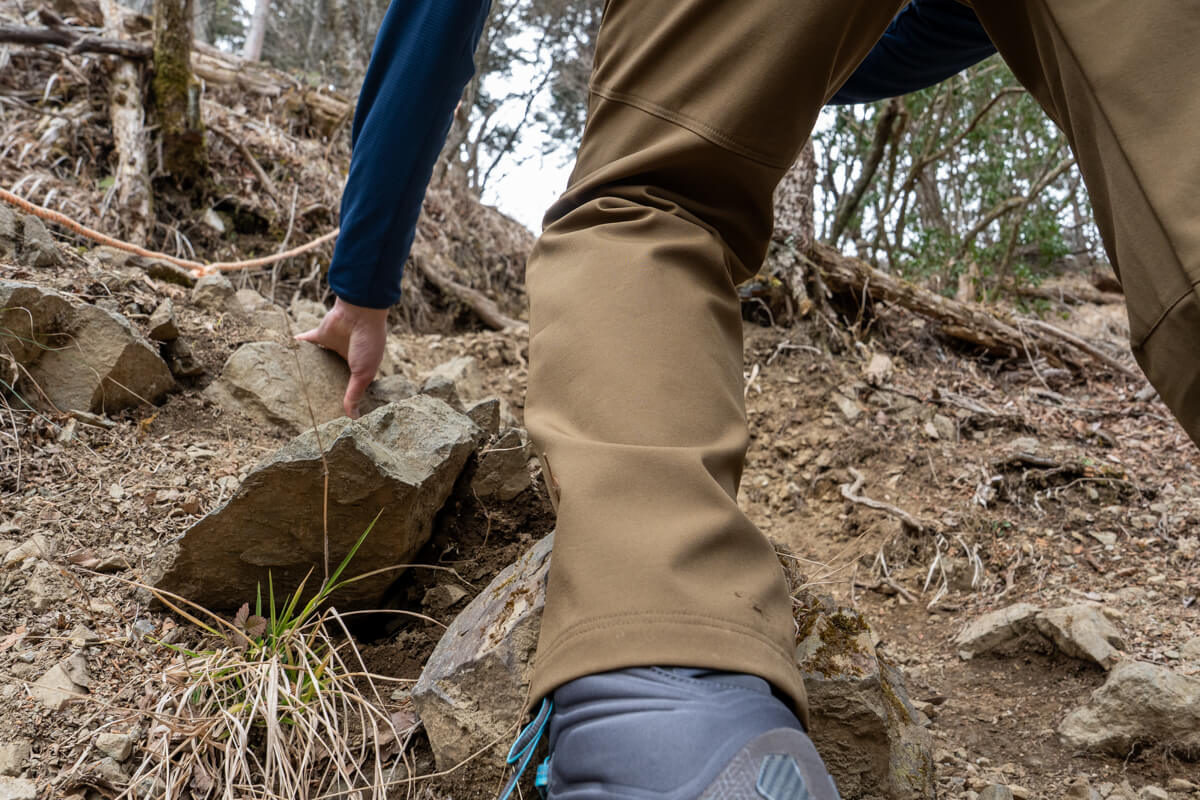
There are always dangers around hiking trails, such as sharp tree branches, sharp rock corners, rough rock surfaces, and sharp trekking poles. No matter how careful you are, it is almost impossible to return unscathed if your pants are made of delicate fabric
Pants for mountain climbing must be strong enough to withstand all of this damage. Of course, it's not enough just to be strong. Naturally, the balance between lightness and breathability is also important. For example, Finetrack's Camino Pants are made from a strong nylon that "will not tear even when rubbed with sandpaper 1,000 times" and a unique fabric structure developed to create a fabric that "combines lightness and quick-drying while achieving greater strength" that cannot be achieved with ordinary polyester
2. How do you choose the best pair of trekking pants for you? Finetrack's smart way to choose trekking pants
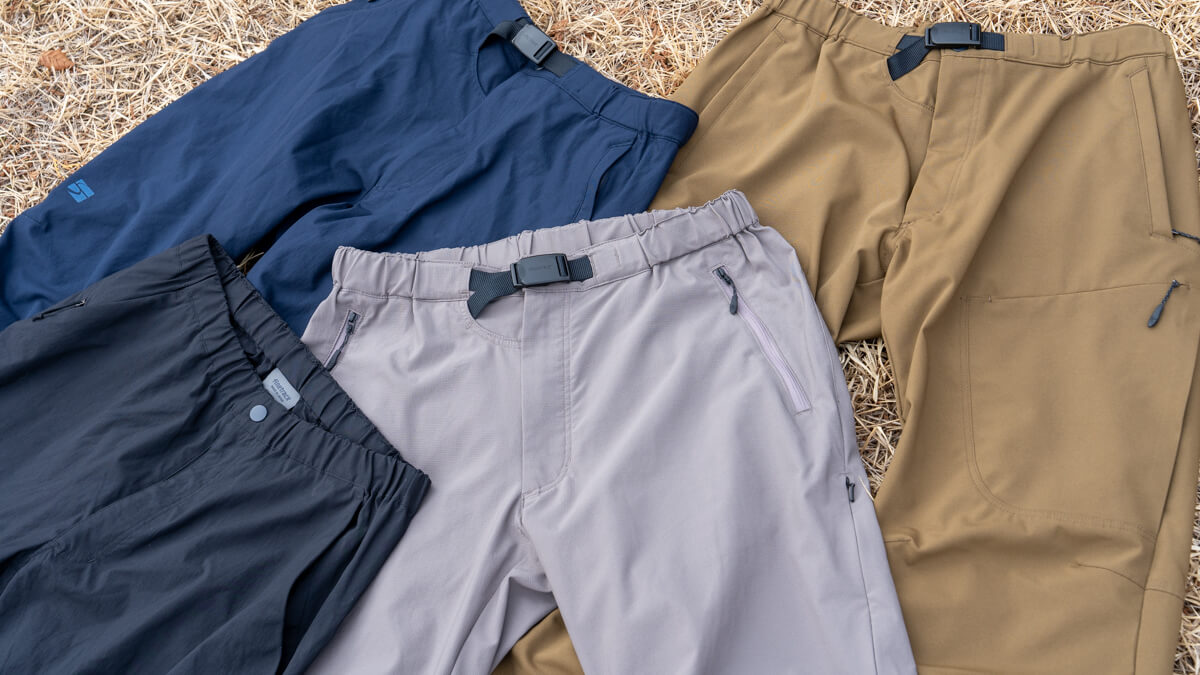
So far we've outlined the basic functions required of hiking pants, but of course, there is no "ultimate pair" that satisfies all of these functions. Each product focuses on functions that are suited to a specific season, purpose, or activity. Users must determine the focus of each product and find the perfect pair from the shelves of pants packed into outdoor shops, which, frankly, is an extremely difficult task for beginners. However, by prioritizing each of the functions required for trekking pants listed above based on " when, where , and what " you will be doing, anyone should be able to narrow down their options to an ideal choice to some extent. Here are the steps to follow.
Click on each title below to read more
Step 1: Check the "three essential conditions" common to all seasons and uses
First of all, no matter what kind of pants you choose, there are some minimum requirements that they must meet for mountain climbing
1. Do they meet minimum durability standards? (Cotton pants are a no-no)
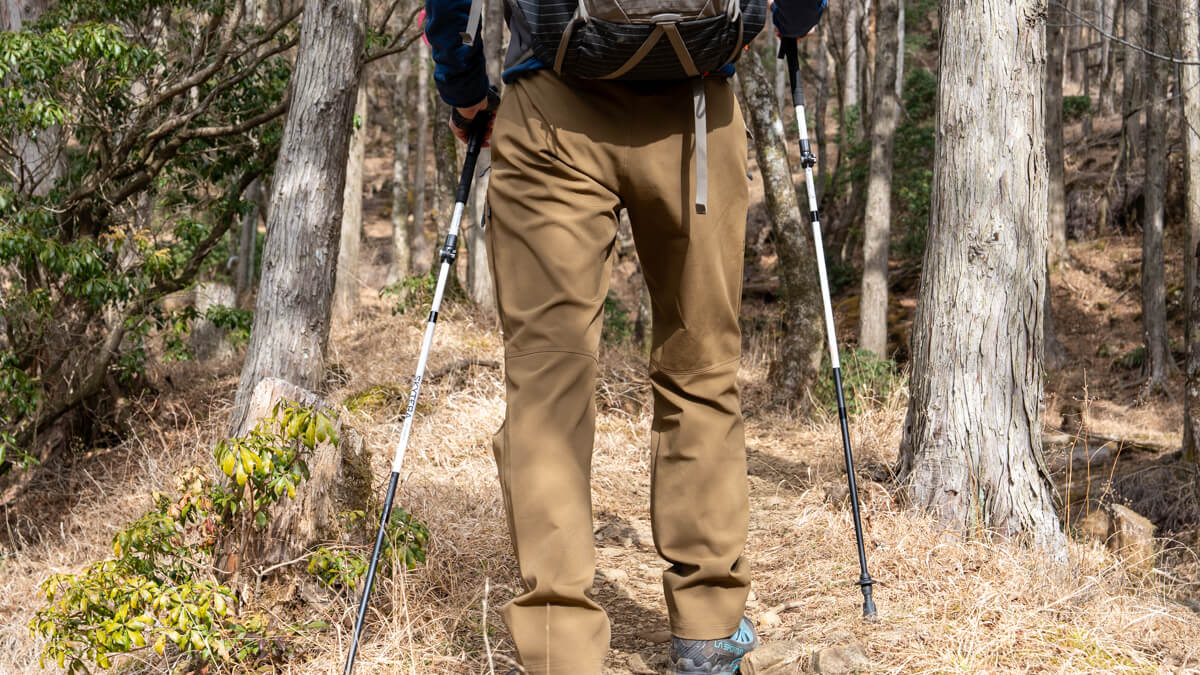
The most important thing is that the clothing you choose must be designed for use in harsh environments such as mountain climbing. Also, cotton materials like jeans and chinos do not dry when wet with sweat or rain, continue to rob you of body heat (risk of hypothermia), and become heavy when wet, so they are not suitable for mountain climbing. Be sure to choose clothing made from 100% synthetic fibers such as polyester or nylon
2. Does it have a water-repellent function?
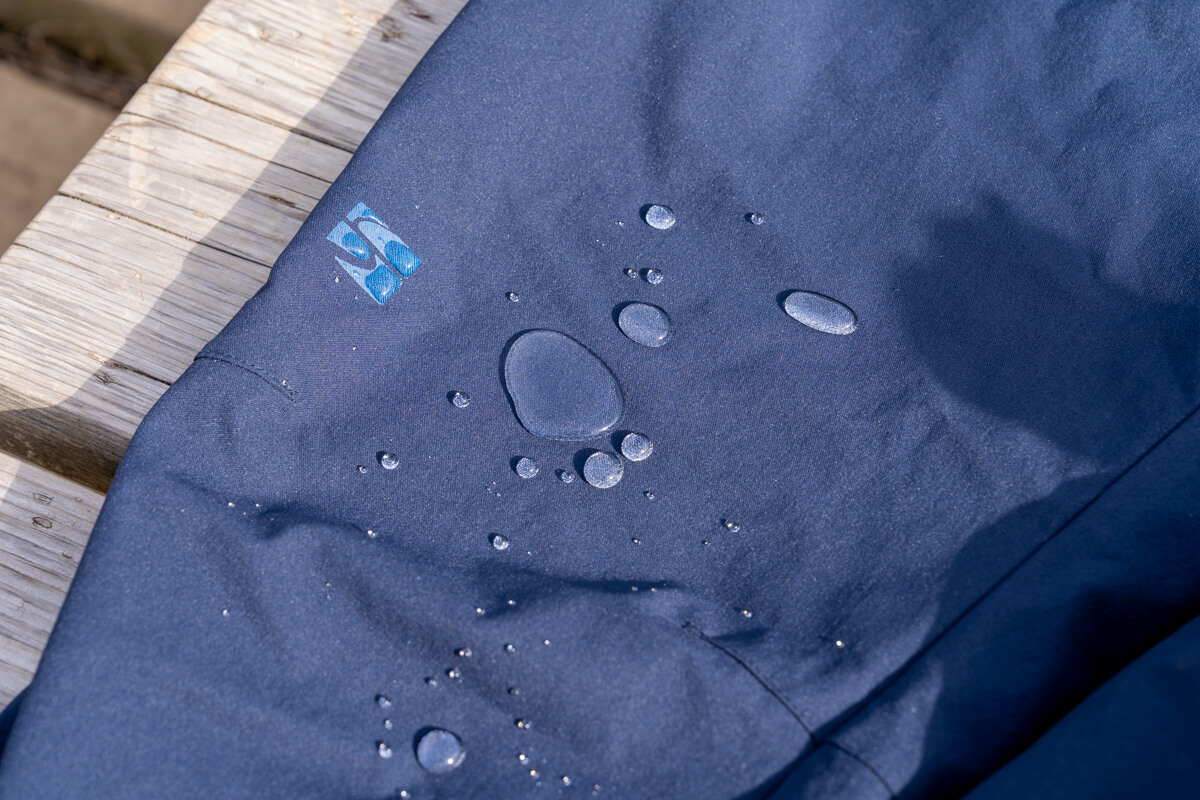
As mentioned above, pants are always at risk of getting wet due to unexpected rain, morning dew, wading, mud, sweating, etc. Staying dry while on the move is very important to protect your life from hypothermia and other illnesses. Water-repellent fabrics help keep you dry by preventing the fabric from getting wet from various influences, regardless of the season or activity. At the very least, check whether the product has a "durable water repellent (DWR)" rating (of course, the higher the rating, the better)
3. Does it interfere with "lifting your legs"? (Stretchability and pattern)
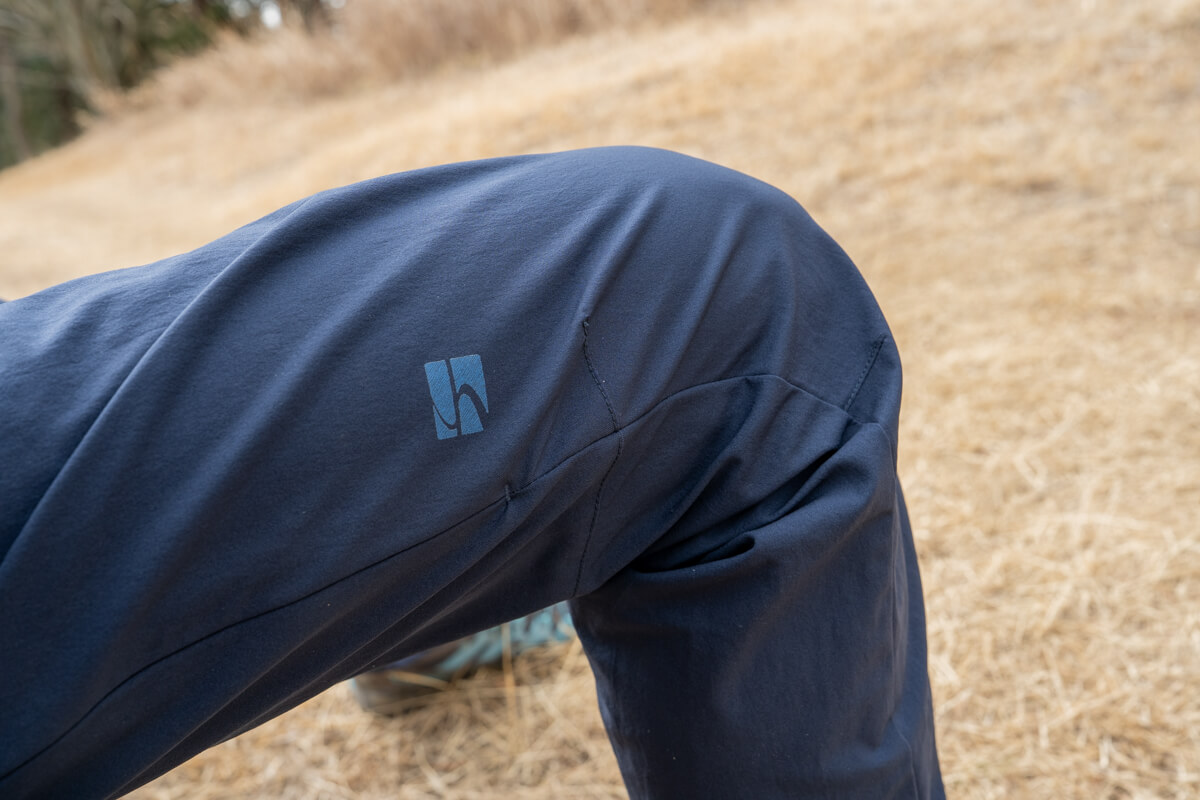
High mobility of the lower body is also the most important factor when climbing mountains, regardless of the season or activity. Whenever possible, try bending and stretching deeply and lifting one leg high in the fitting room to check the ease of movement in the hips, knees, and other joints and whether they feel tight. It's important not only to check the stretchiness of the fabric, but also to check that the three-dimensional cut, sewn to fit the shape of the knees and hip joints, works well
Step 2: Check the "important features" according to the season and environment
In today's Japan, it is no longer possible to completely cover both the hot and humid summers and the cold winters with just one pair of pants. There are pants that are labeled "all-season," but depending on the activity, there are still limitations. So, keep in mind the general average temperatures of the seasons and areas in which you expect to wear them, and prioritize the following features for each
[For summer mountains (excluding high mountains) and low mountains in spring...prioritize "breathability" and "skin-free" clothing]
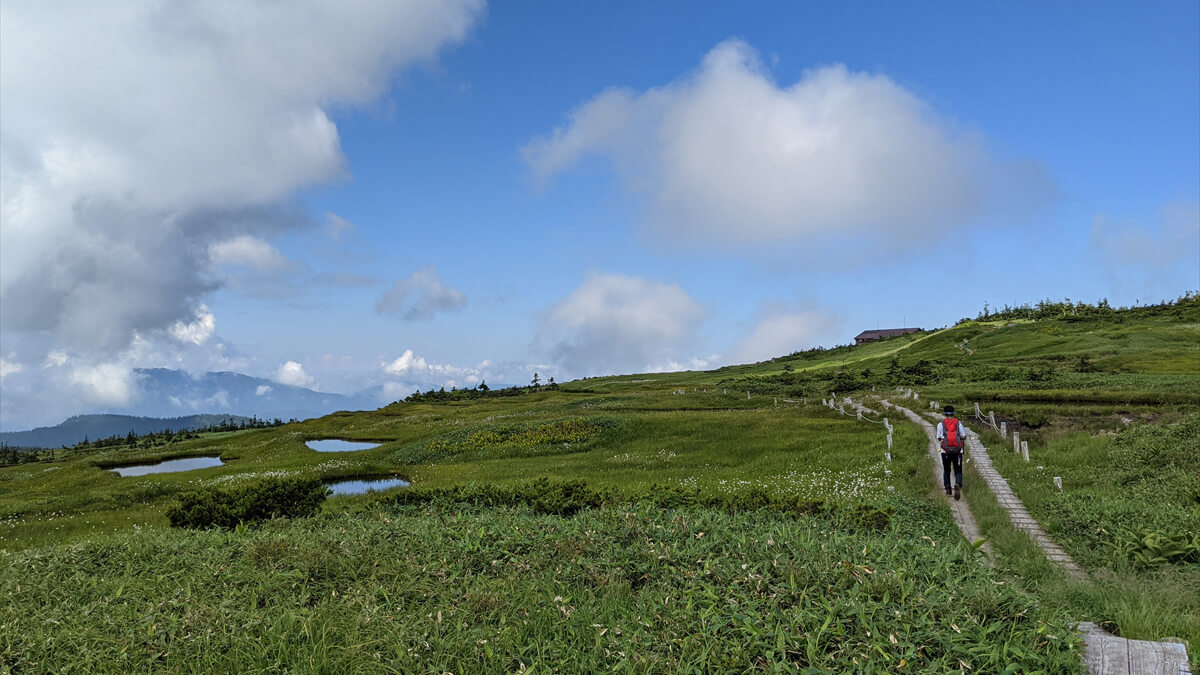
- We place emphasis on quick-drying and breathability
- Models with "ventilation function." The breathability of the fabric itself is limited. Models with zippered ventilation openings on the sides of the thighs, etc., allow for forced release of heat, so are especially recommended for people who get hot easily
- "Three-dimensional texture of the fabric that touches the skin" When you sweat, if the fabric sticks to your thighs, it becomes uncomfortable and restricts movement. If you choose a fabric with a three-dimensional lining (point contact) or a fabric with a little firmness, it will stay away from your skin and be comfortable even when you sweat
- "Thin but strong fabric" Fabric for summer use is thinner, but it is better to choose "nylon material" which is as thin as possible but strong so that it does not tear on rocky areas or in bushes
[For autumn and winter (cold seasons)... Prioritize wind resistance and heat retention (ease of layering)]
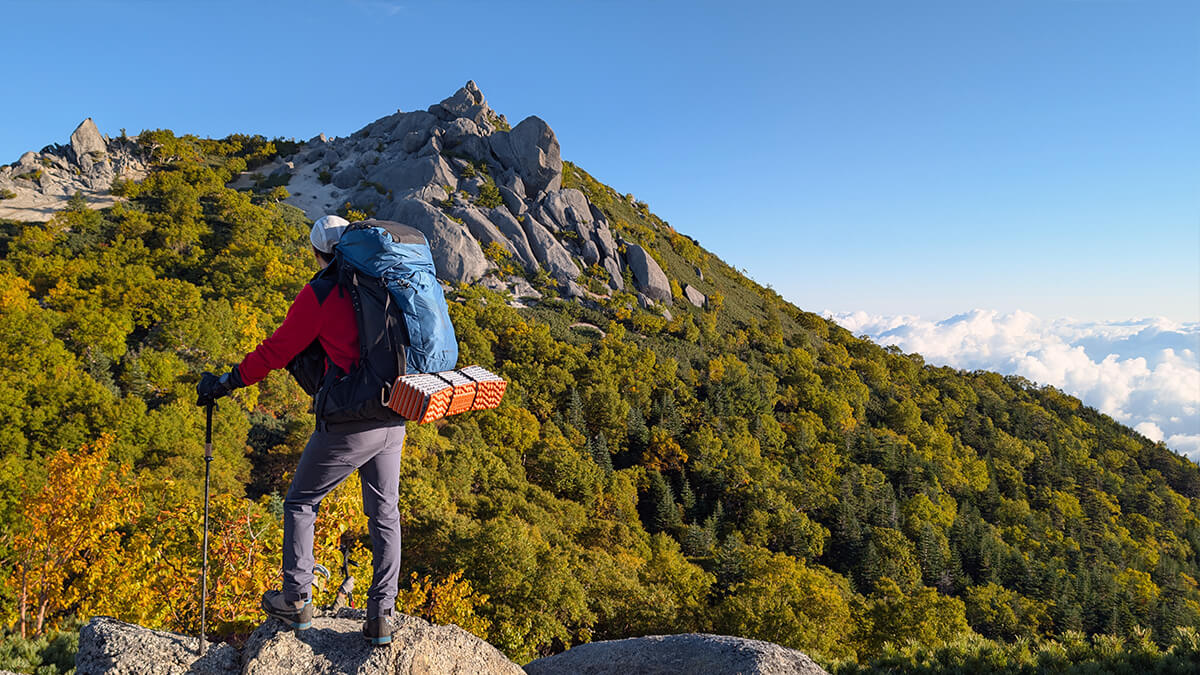
- As for "windproof" properties, even in cold temperatures, as long as the wind is blocked, the perceived temperature can be maintained. Generally, choose a "high-density" material with a tight weave that is windproof, or a medium-weight or thicker material, or a thick, windproof fabric such as a double-weave
- "Roomy enough to wear tights" If you plan to use them in the harsh winter or when there is still snow remaining, it is important to make sure that you can wear thermal tights underneath the pants. When trying them on, make sure that there is a little room, and that you can wear them over your tights without restricting your movement
[For spring and autumn mountains (or high mountains in summer): emphasis on "balance" that can withstand both heat and cold]
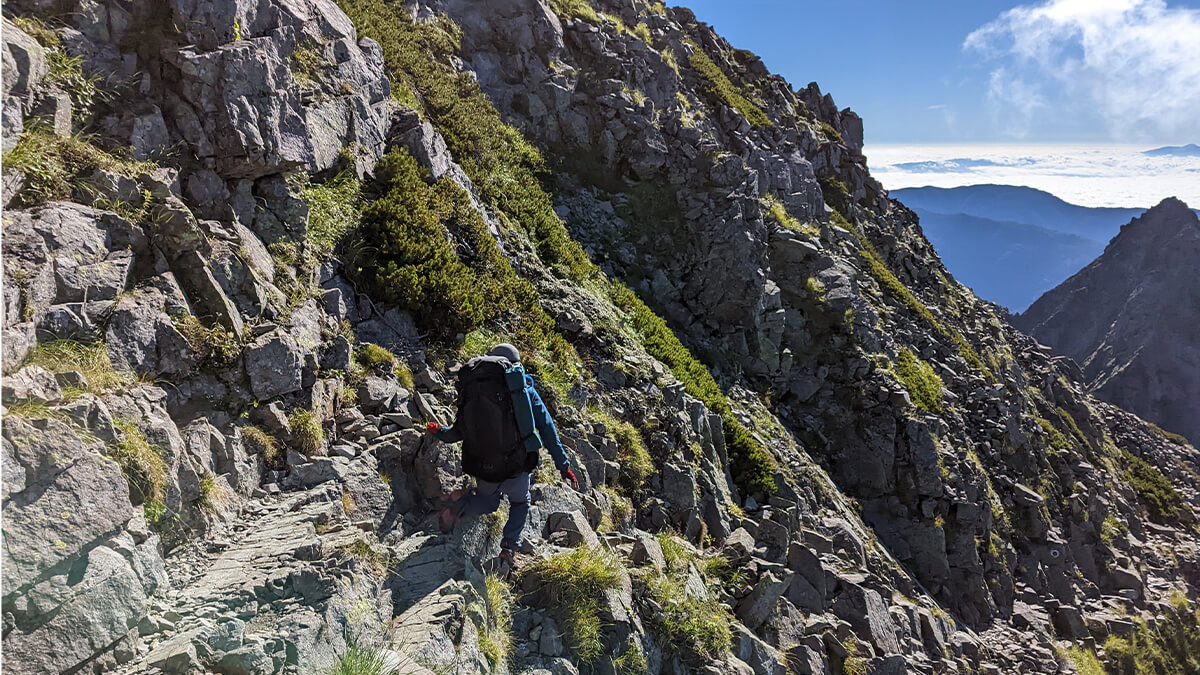
- If you're considering a jacket for use in the mild temperatures of spring and autumn, or during the transitional periods between summer and winter, it's important to balance the elements needed for both of these situations. The key is to choose the most standard model that isn't designed for extreme seasons, and that has medium thickness, breathability, and warmth
Step 3: Check out the "specialized features" that match your activity and play style
The optimal shape of pants will vary depending on the style and activity of your mountain climbing, whether you will be mainly walking or actively climbing rocky areas and ridges
[General mountain climbing/traverse (mainly walking)]
- Even if you're not going very fast, when hiking or trekking in the mountains you'll be doing long periods of stop-and-go, have an all-round balance of comfort (breathability and heat retention) , ease of movement , and durability .
- You should also pay attention to practical aspects such as the location and number of pockets for storing maps, smartphones, etc
- Another important point is whether the belt will rub when walking for long periods of time
[Climbing, rock climbing, and stream climbing (mainly large movements)]
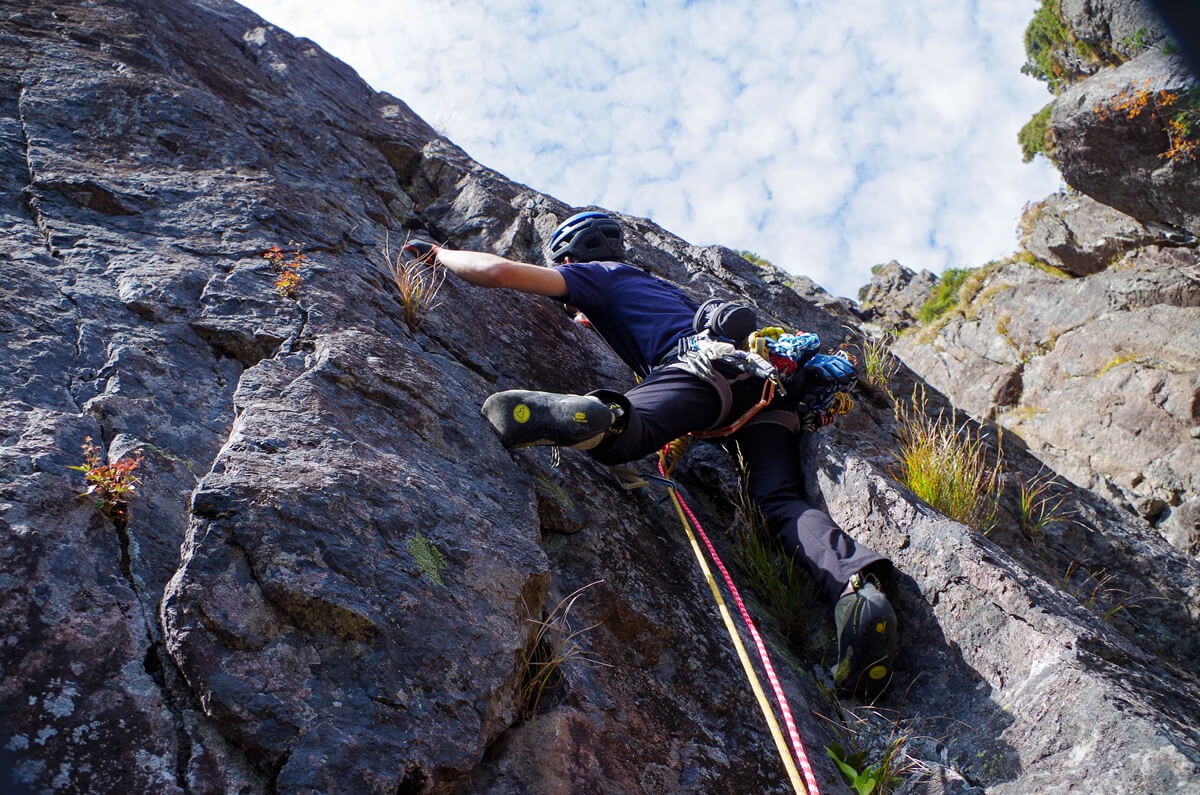
- This type of skiing involves the most dynamic movements and mainly takes place on dangerous rocky terrain, so the most important points to consider are ease of lifting your legs and movement " and " durability
- Simple designs are preferred so that waist belts and pockets do not get in the way when wearing a harness
- The slim silhouette with no flapping hem makes it easy to see your feet, ensuring safety
[High-tempo mountain climbing such as fast hiking]
- In fast hiking, where the same walking style is required but with more agility, " lightness ," " ease of movement ," and " sweat-processing ability " are particularly important.
- The highly breathable and quick-drying fabric can withstand heavy sweating
- The tight silhouette prevents wind resistance, and the pattern and stretchability allow for intense movement
- Details such as a simple waistband that reduces discomfort around the waist and pockets that don't move even when running are also important
Step 4: Trying on the right pair is key to finding the right pair
Online shopping is convenient these days, but beginners should try on shoes in a store and actually put them up on their feet to check the size
3. Finetrack's new proposals for the 2026 season: the best models for each season and purpose
Finetrack will explain how to choose using the new lineup for 2026 as an example
0. [Common features] High durability and high water repellency
- High durability that can withstand serious outdoor use
- Durable water-repellent finish
- Ease of movement and a beautiful silhouette
- Mechanical stretch and precise three-dimensional cutting make it resistant to deterioration over time
1. [When in doubt, try this! The all-arounder] Camino Pants
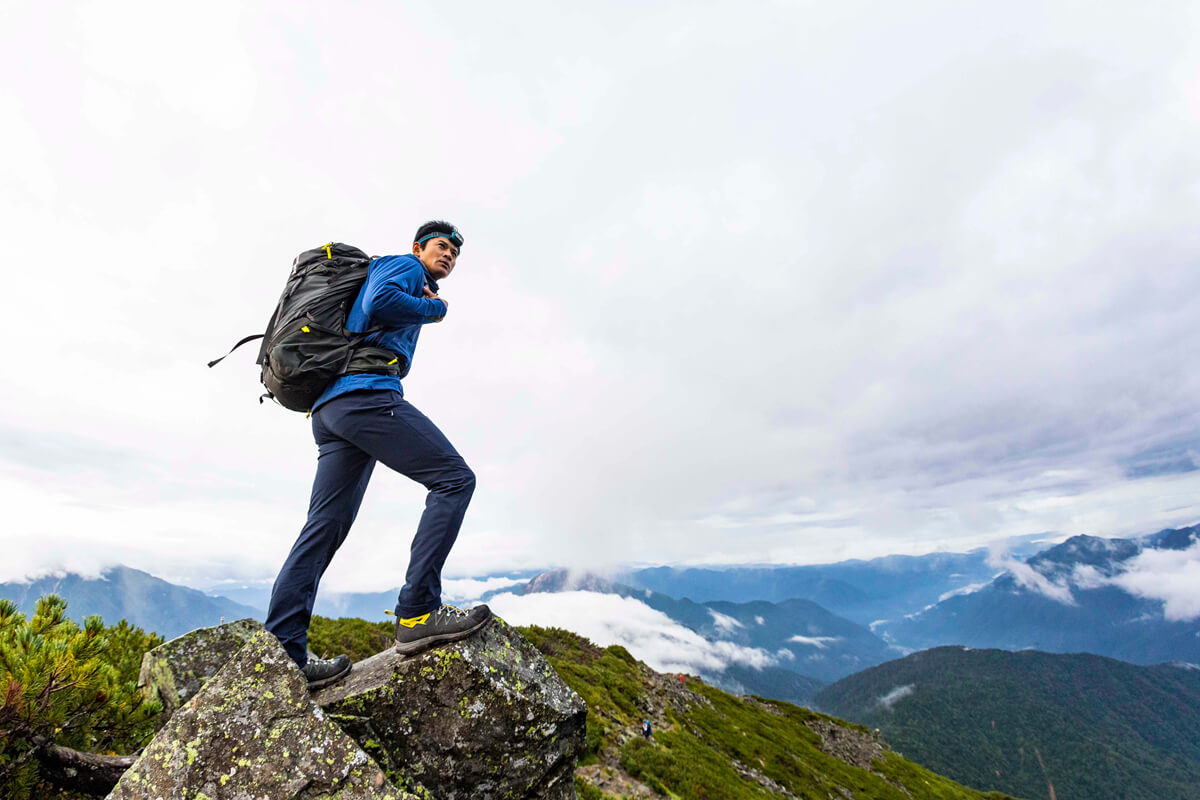
- Features: Lightweight yet durable, thanks to the unique nylon material. A good balance of breathability and wind resistance. An all-rounder for spring and autumn mountaineering, canyoning, and climbing.
- Recommended for: People looking for their first pair of shoes, people who plan to use them on rocky terrain or through bushwhacking, and people who want a clean silhouette that can be worn around town.
2. Silfa Pants (for those who are sensitive to heat and are on low mountains in midsummer)
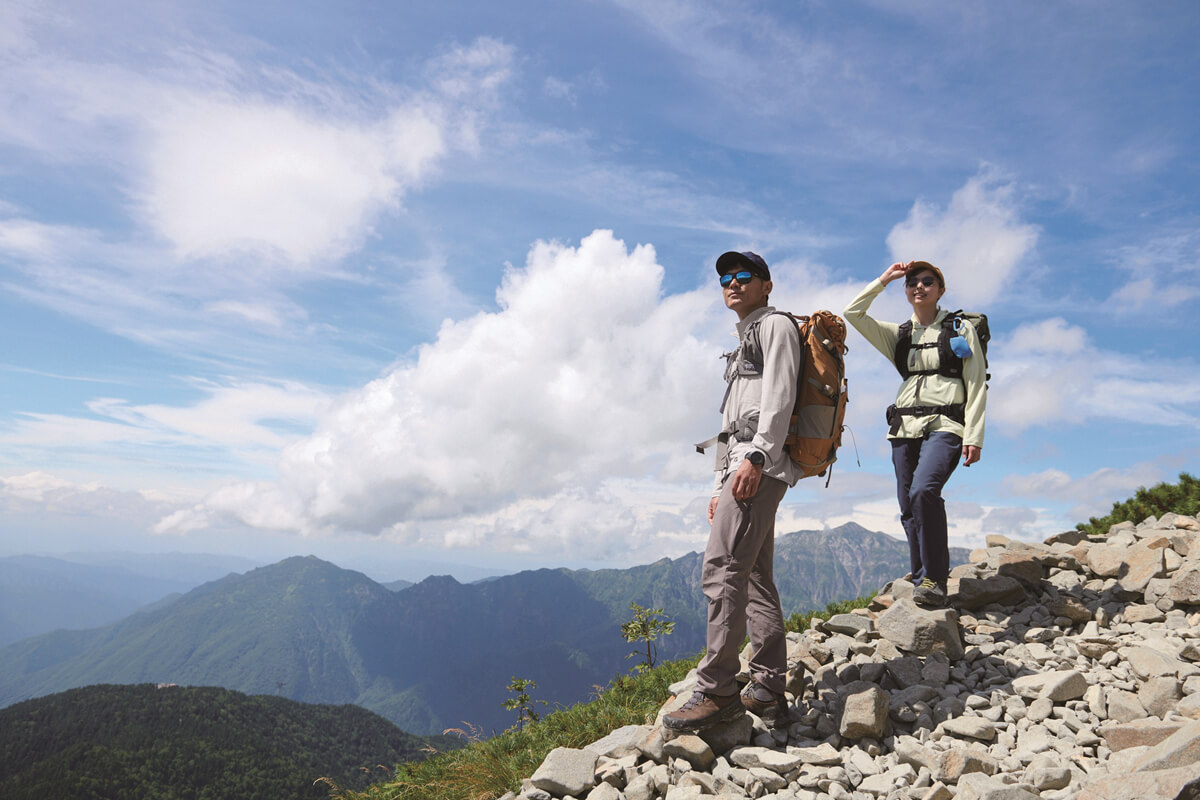
- Features: Not only are these pants thin and lightweight, but they are also incredibly breathable and don't trap moisture, making them cool even in the heat of summer. The textured lining keeps them away from the skin even when you sweat.
- Recommended for: People who mainly go mountain climbing in the summer, such as serious mountain climbing in the hot season, and people who simply can't stand the heat.
3. Miyama Pants (for light summer outdoor activities)
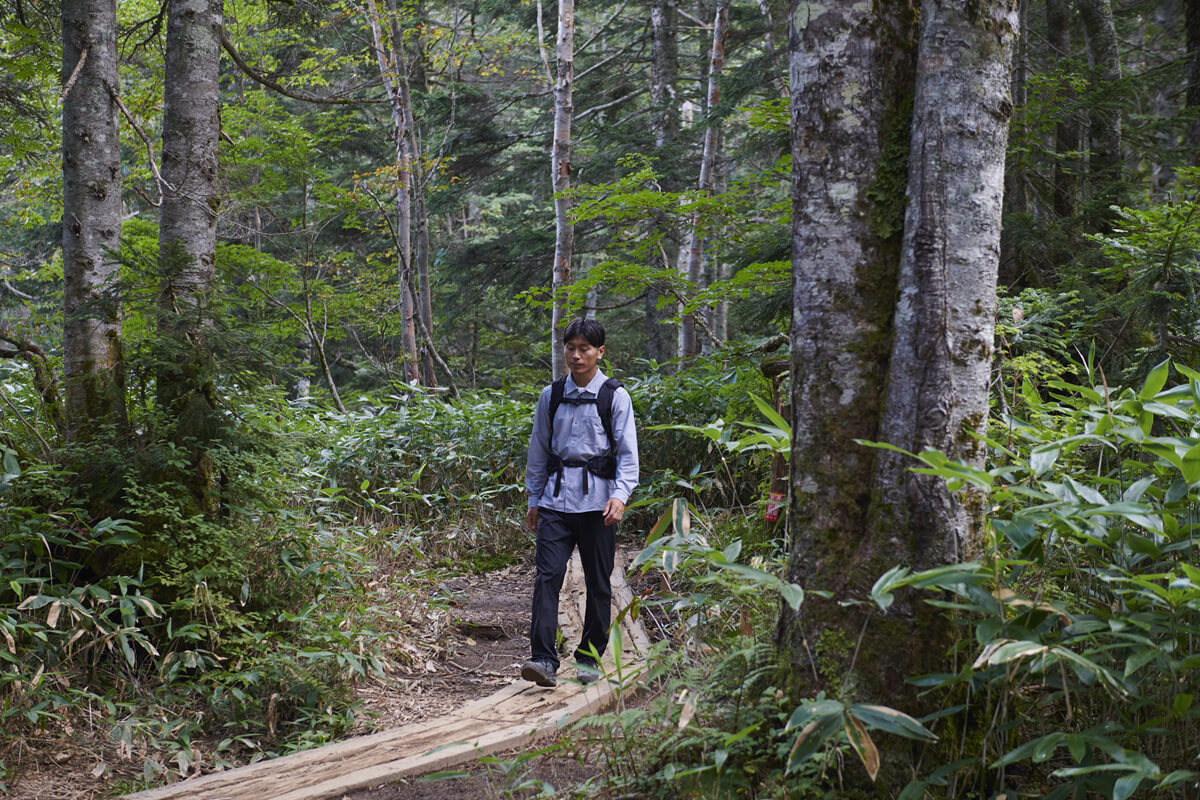
- Features: Thin and lightweight yet highly durable, it's comfortable and dry, and stays away from the skin even when you sweat. The relaxed silhouette provides just the right amount of room for long periods of wear without stress. It also has plenty of pockets to suit a variety of occasions.
- Recommended for: People who want to use it for a wide range of summer activities, from mountain climbing in hot weather to light outdoor activities such as hiking.
4. Stormgo Casual Pine Pants (for all-around hard activities)

- Features: Made with a medium-weight fabric, it's windproof and warm, yet easy to move in and dry quickly, making it ideal for use in low-mountain winters and when snow remains. A tough model built for heavy use. Large thigh pockets prevent interference.
- Recommended for: People who want to use it on hard mountain climbing without worrying about scratches or dirt, and people who are planning to go mountain climbing in slightly colder weather.
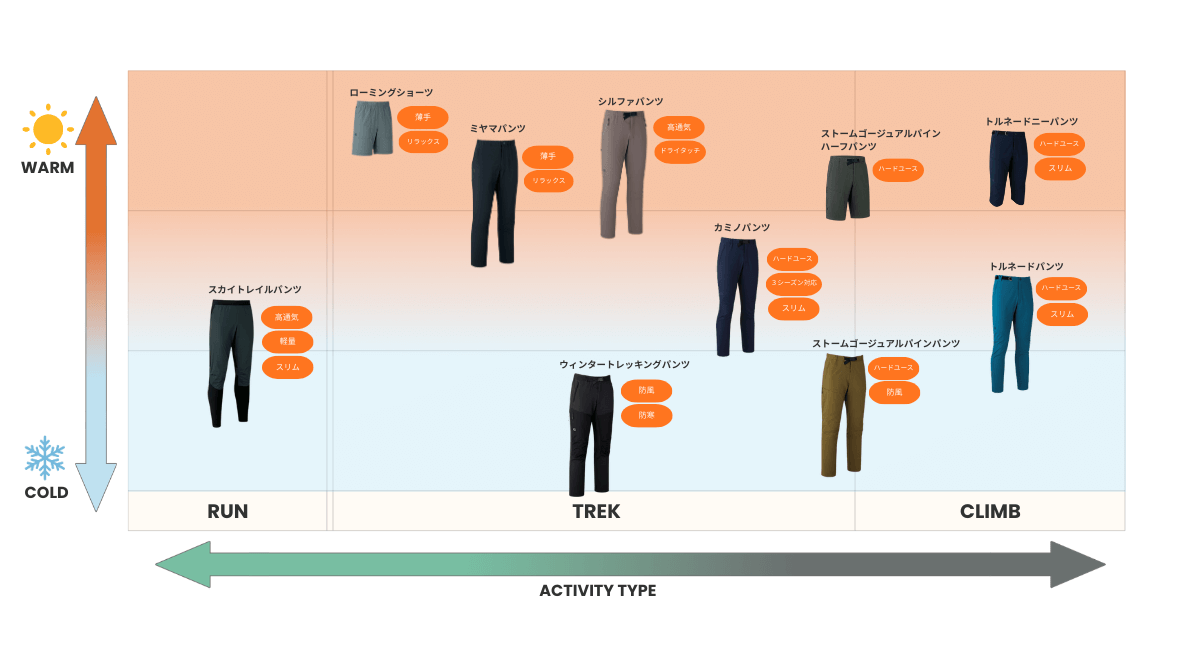
[2026] Finetrack trekking pants positioning map
If we organize Finetrack's 2026 sales lineup by "recommended temperature (vertical axis)" and "activity (horizontal axis)," it looks like this
4. Why Finetrack? Our commitment to manufacturing revealed through our four key points in trekking pants
So far, we have introduced the essential features of trekking pants and how to choose them. If you look at the catalog specs alone, you may find similar products from other companies, not just Finetrack. So, in the end, we asked, " Why does it have to be Finetrack? " What we discovered was that the true value of their products lies in their relentless commitment to quality, backed by a solid development philosophy that could be described as a "commitment to manufacturing" behind the catalog numbers. Here, we will unravel the four core commitments.
Dedicated to achieving amazing durable water repellency
The water-repellent performance of most rainwear and pants is generally measured at around 80 points after 20 to 30 washes in tests such as the JIS standard. However, since its founding, Finetrack has been developing fabrics with the strict goal of maintaining a score of 80 points or more even after 100 washes, which is far beyond industry standards.
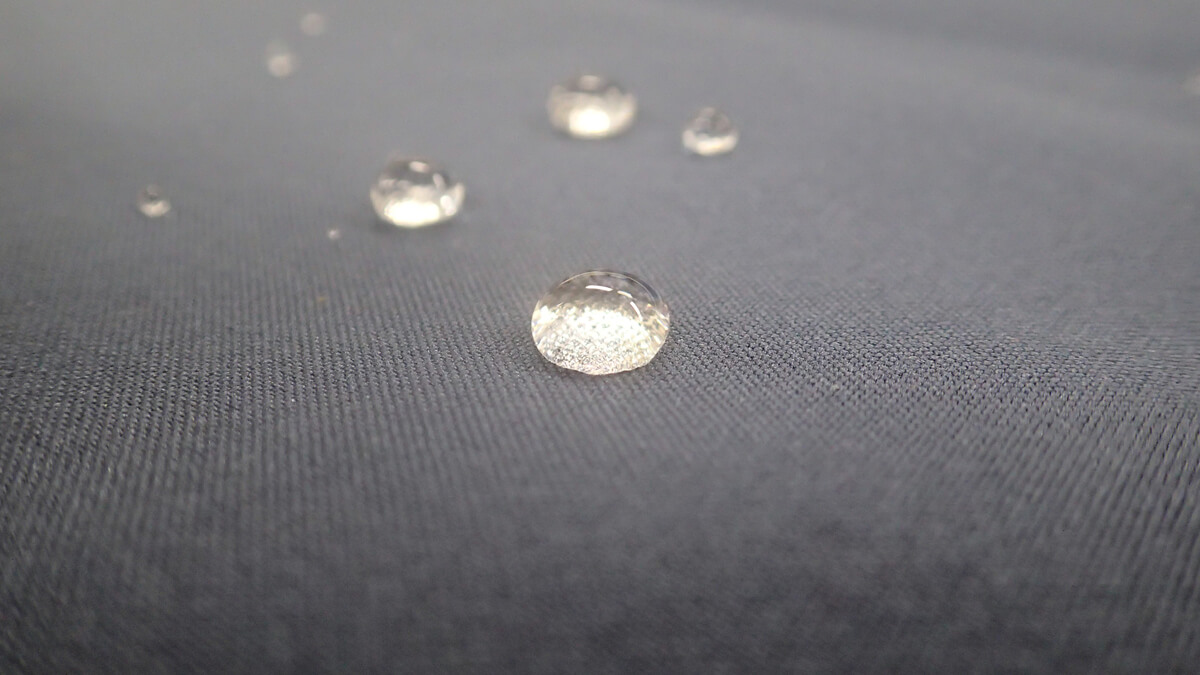
Why are we so committed to water repellency? It's because we believe that water repellency is the best way to achieve quick drying. If the fabric repels water, the fibers themselves are less likely to retain water , and this prevents a drop in body temperature (chilling sweat) due to evaporative cooling. To achieve this performance, we collaborate with a processing factory with some of the best technology in Japan, and apply a fabric treatment that focuses on durable water repellency. Maintaining water repellency means that the lifespan of a product is significantly longer, which is the very essence of Finetrack's sincerity towards "user safety" and "long life as gear."
Polyurethane-free "mechanical stretch"
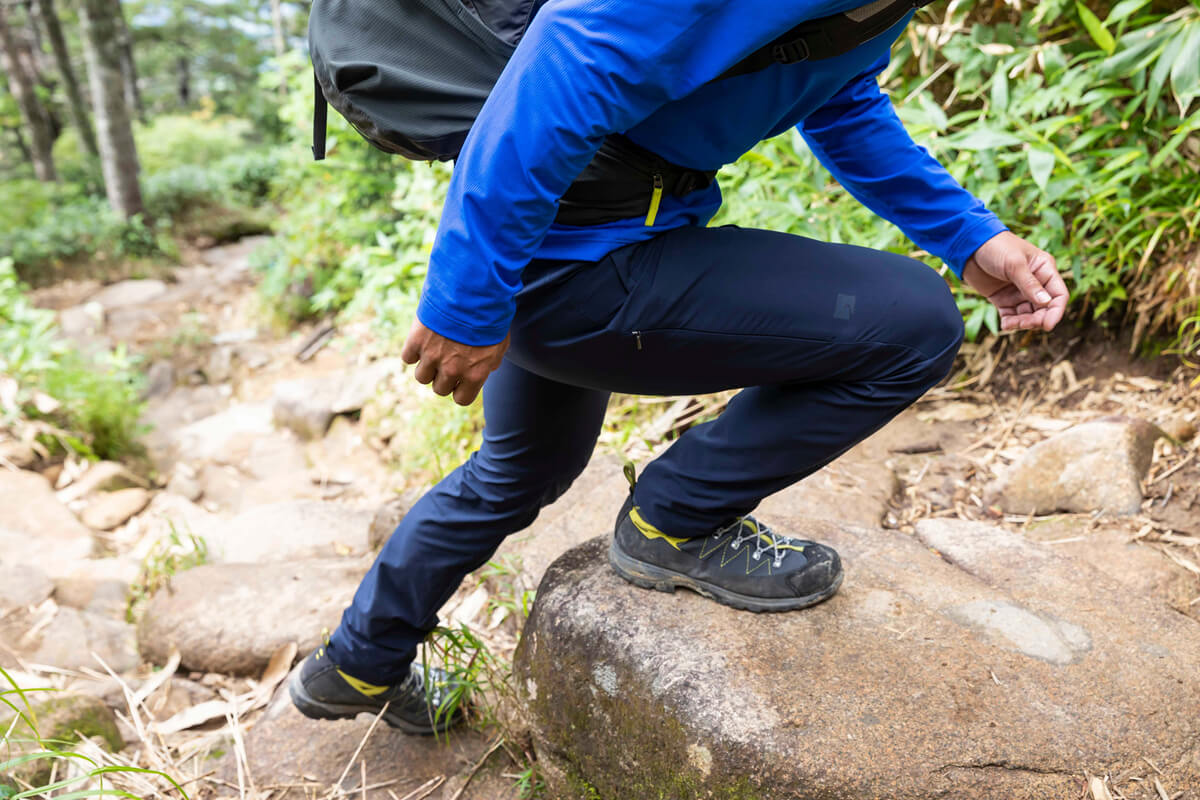
Most stretch pants get their stretchiness from blending in a rubber-like fiber called "polyurethane (spandex)." However, Finetrack generally does not use polyurethane in its trekking pants. This is because polyurethane has fatal weaknesses for mountain wear: it absorbs moisture easily, is slow to dry, and deteriorates over time (hydrolysis), causing the fabric to become dull after a few years
Instead, they use " mechanical stretch ." This is a technology that creates spring-like elasticity through the structure of the thread itself, by applying a special twist to the thread to make it coiled (spring-like), or by using thread that combines two different types of polymers with different properties. In particular, making the nylon material used in the Camino Pants stretchy was technically extremely difficult, but they succeeded in developing it after two years of work. This resulted in the creation of ideal pants that are "strong nylon that won't tear even when scraped against rocks," yet "stretch and contract without stress," and "will not wear out even after years of use."
A thorough commitment to "original materials"
Finetrack is not a manufacturer that simply buys ready-made fabric from a trading company and sews it. If all manufacturers use the same fabric to make the same product for the same purpose, their models will all end up looking similar. As a manufacturer of tools, we believe that there is no point if we cannot create " the best product we can imagine ." As our founder, Yotaro Kanayama, himself was a textile professional, we are committed to developing original products, starting from "a single thread," as needed.
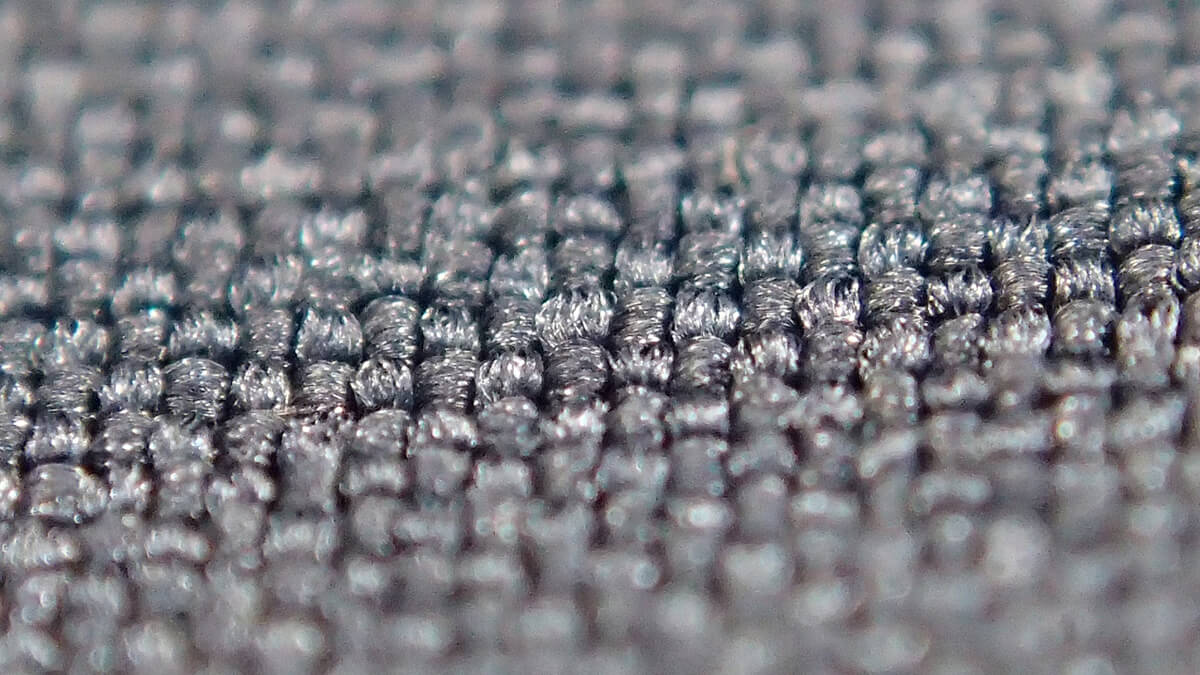
For example, when developing the three-season "Camino Pants," they chose high-strength nylon instead of polyester to address the challenge of "making it thin for coolness but at the cost of reduced strength." They teamed up with a textile manufacturer and created a "stretchy nylon fabric" specifically for the Camino Pants from scratch. Rather than trying to match an existing fabric, they worked backwards from their ideal of "desired functionality" to create the material itself. It is this process that allows them to create unique functions that other companies cannot imitate
In addition, Finetrack's new Silfa Pants, developed this season, maintain the outstanding breathability and ease of movement of the previous model (Chrono Pants), while changing the thread itself from polyester to nylon, without sacrificing fabric strength
"On-site" feedback from all employees who are players
The final hurdle in Finetrack's product development is not numerical data, but field testing by employees. All employees, including not only developers but also sales and PR staff, are serious players who enjoy mountain climbing, river climbing, backcountry skiing, trail running, and more
Once a prototype is completed, employees test it on weekend mountain hikes, receiving relentless, harsh feedback such as, "The numbers suggest it's highly breathable, but it's actually too stuffy," or "The water repellency is weaker than expected." For example, when renewing the "Sky Trail Pants," the pocket structure and silhouette were adjusted down to the millimeter based on the opinions of staff who had used the pants extensively on commuter runs and trail runs. It's not uncommon to hear honest comments like, "Would I want to wear this?" → "No, I don't." Overcoming these harsh feedback, Finetrack only releases products that they truly believe are desirable in the field. This strict hands-on approach underpins the overwhelming practicality of Finetrack products
summary
Trekking pants are more than just clothing; they are important gear that protect you from harsh natural environments and support safe and comfortable walking. Finetrack's dedication to manufacturing reveals their uncompromising pursuit of functionality and sincerity toward their users. Their clothing, which combines ease of movement, durability, and water resistance at a high level, dramatically reduces fatigue and discomfort during mountain climbing. If you're unsure which pair to try on, try the versatile Camino Pants. The difference you'll feel the moment you bend and stretch deeply will surely lead you to a more comfortable mountain world
In the second part, we will provide a thorough review of the Silfa Pants and Miyama Pants, trekking pants for summer mountain climbing that Finetrack has eagerly released this season, including the differences between them and standard pants
<Continued in Part 2>
Find out more about Finetrack's latest trekking pants and where to buy them
For the latest product information and details, please visit the finetrack official website

Consider a paid membership for access to premium content and events!
Related reading
 Snow Bibs You Need This Year 2021-2022 - 5 Reasons Why Snow Bibs are Recommended for Backcountry Skiing and How to Choose Them Wisely -
 What you may not know: How to choose the best trekking pants
 [2025FW] It looks easy but it's surprisingly difficult. The best trekking pants for autumn and winter and tips on how to choose them without regrets
 Comparison Review: We tried out the best trekking pants for each season: Spring/Autumn and Summer