



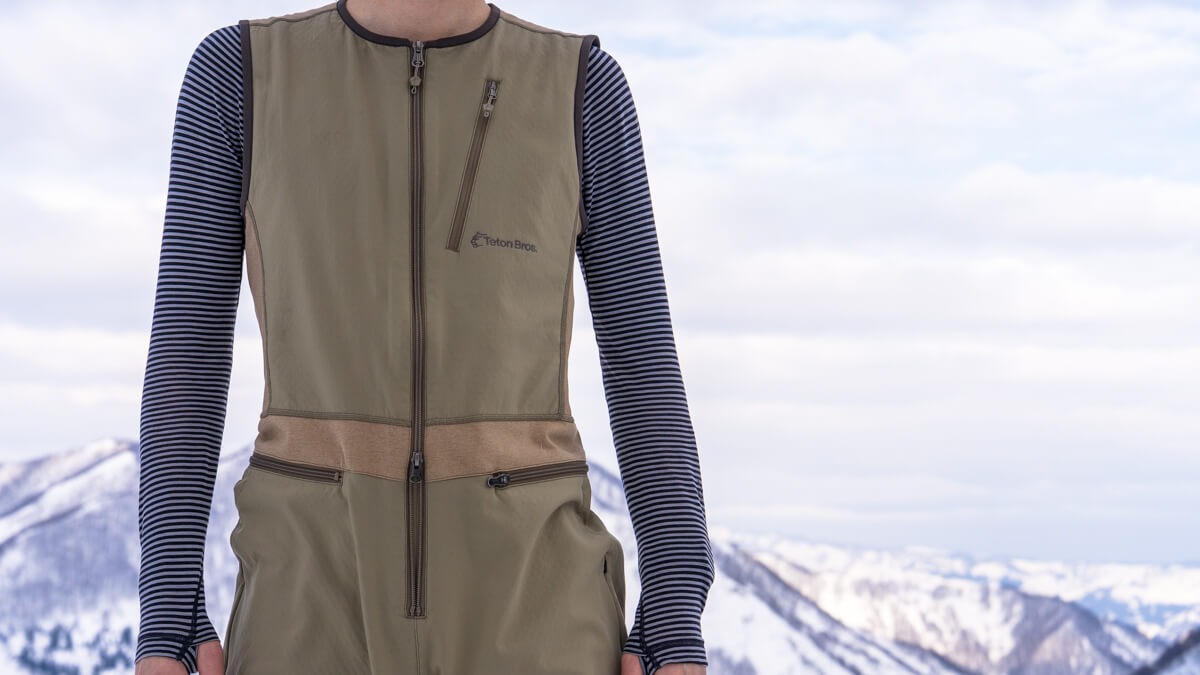
Teton Bros. Hoback Suit Review: Unprecedented comfort, once you try it on you'll never go back. A suit-style midlayer perfect for backcountry skiing and snowy mountain climbing

Written by Yasushi Hisatomi
Searching for the perfect mid-layer for the snowy mountains. The Hoback Suit solved the problem of tops and bottoms all at once
Having visited snowy mountains for many years, I've noticed that activities on snowy mountains inevitably require a lot of layering. In winter mountains, the weather changes drastically, so you have to take off and put on clothes frequently while you're out and about, making the question of "what to wear and how" more complicated on snowy mountains than in the snow-free season. For these reasons, it's not easy to find the "right" answer for layering when skiing or climbing snowy mountains, and it's been a headache for many enthusiasts
Of all the layers for winter, perhaps the most difficult is the "mid-layer" worn between the base layer that touches the skin and the outer hard shell. This layer plays an important role in maintaining a constant level of comfort inside clothing during the rapidly changing winter climate. Especially when worn while on the move, it's not enough to simply provide endless warmth, but it also shouldn't be too breathable to avoid stuffiness. Naturally, you can't compromise on comfort, ease of movement, or lightweight and compactness. There are countless factors to consider, such as fabric performance, thickness, pattern, whether or not it has sleeves or a hood, and manufacturers offer a wide variety of options, making it difficult to choose
Teton Bros. Hoback Suit, a suit-style mid-layer that combines a vest and knee pants .
I tried wearing it during this winter's peak season for backcountry and snowy mountain climbing in various areas, including Hokkaido, Hakuba, Tanigawa, and Joetsu, so I'd like to share my review right away
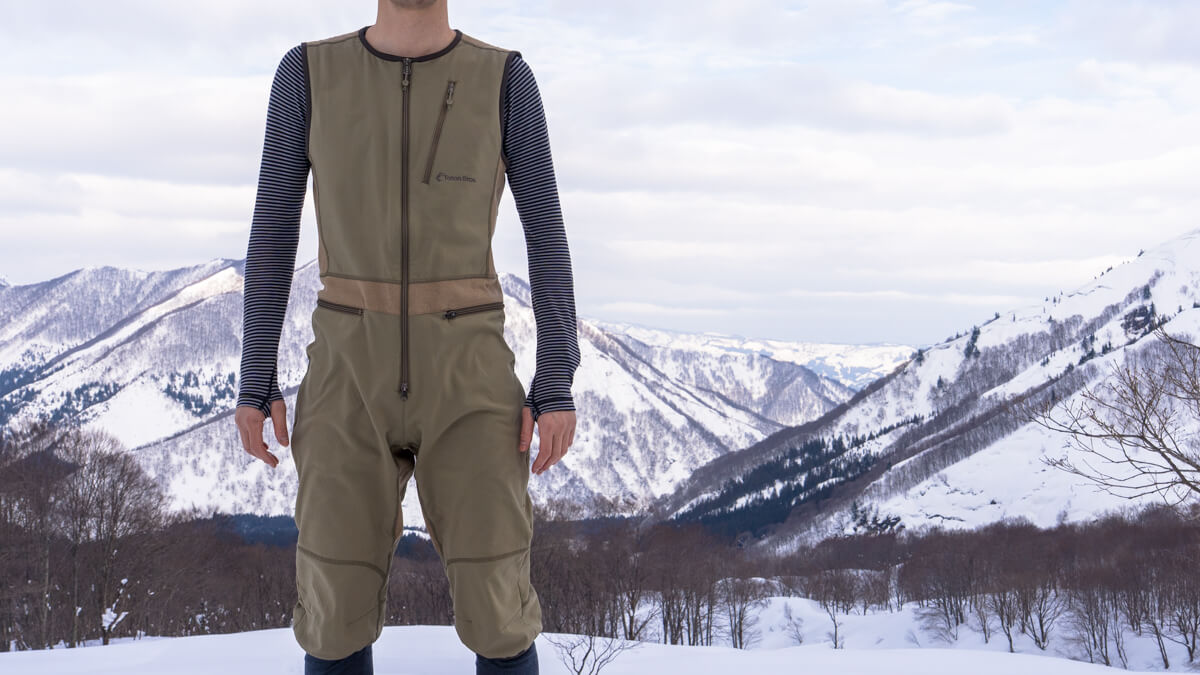
table of contents
- Key Features of the Teton Bros. Hoback Suit
- Detailed Review
- If you don't care about appearance or ease of putting on and taking off, a jumpsuit is the best mid-layer. What are its unique advantages?
- Draped and stretchy for exceptional ease of movement
- A hybrid of dynamic padding "Octa" and 4-way stretch soft shell "Primeflex" for excellent temperature, moisture control, and stretch
- The vest and knee pants are neither too cold nor too hot, and are the best layering for hiking when paired with bibs and a wind shell
- Practical design for field use, allowing you to wear it all day
- Summary: If you're an aggressive player, you'll never want to go back to the way you were before, thanks to the unparalleled comfort and practicality of this jacket
Key Features of the Teton Bros. Hoback Suit
The Teton Bros. Hoback Suit is a mid-layer suit consisting of a vest and knee pants that can be worn all day over a base layer for backcountry skiing and other winter activities. The main lining is made of "Octa," which offers a high level of balance between breathability and warmth. The outer layer is made of "Primeflex," a lightweight softshell material with excellent wind resistance, stretch, and breathability. This fabric is directly bonded to the outer layer with "Stretch Octa Bonding" technology for improved ventilation. This suit prevents both cold and stuffiness during intense activities in extremely cold environments, keeping the inside of the garment constantly dry.
The all-in-one top and bottom are one piece, so there's no bulk or tightness around the waist when layered. The knees and crotch are draped for movement, and stretch fleece is placed around the sides, waist, and back, so there's no looseness or tightness, making this a perfect mid-layer for active wear in harsh winter conditions. Other convenient features that are carefully considered down to the smallest detail make this a great mid-layer for active wear in harsh winter conditions
Favorite points
- "Octa" provides just the right amount of warmth as a mid-layer (not too hot, not too cold)
- "Primeflex x Stretch Octa Bonding" provides moderate breathability and prevents overheating
- No gaps at the waist to prevent heat from escaping
- The waist is neat and tidy without the bulkiness or tightness caused by layering
- Exceptional ease of movement thanks to draping and stretch fleece
- Knee-length so it won't interfere with boots
- Waist zipper construction makes it easy to use the toilet while wearing it
Points of interest
- Personally, I would have liked a little more warmth around the neck (though as a manufacturer, there are various preferences and styles regarding whether or not to have a hood around the neck, and they chose the simplest round neck to avoid hood overlap issues)
- Since these are designed to be worn in the backcountry, it is difficult to use a Western-style toilet (although it is possible to do so by lowering the front zipper)
Main specifications and evaluation
| item | Teton Bros. Hoback Suit (Unisex) |
|---|---|
| weight | 335g (Size M) |
| Color (Men's) | Deep Blue, Khaki |
| size | XS / S / M / L / XL |
| Women's model | unisex |
| Outer fabric |
|
| Lining (insulation) | Octa |
| Chest zip pocket | |
| others |
|
| Outdoor Gearzine Review | |
| Comfort | ★★★★★ |
| Heat retention | ★★★☆☆ |
| Stuffiness | ★★★★★ |
| Ease of movement | ★★★★★ |
| quick drying | ★★★★★ |
| durability | ★★★★☆ |
| weight | ★★★★☆ |
| Practicality in snowy mountain fields | ★★★★★ |
Detailed Review
If you don't care about appearance or ease of putting on and taking off, a jumpsuit is the best mid-layer. What are its unique advantages?
When reviewing this item, I cannot help but touch on the question, " What do you think about this one-piece suit-style top and bottom? " I have tried out many mid-layers for snow mountain climbing and backcountry skiing, and I have many favorites among the regular separate top and bottom pieces, so to be honest, I was on guard and thought, "I can't just accept this so easily."
However, by the end of the day, all of that wariness had been easily dispelled after I put it on. What is this? It's amazing . The hassle of separate tops and bottoms, which I'd given up on, thinking "layering on snowy mountains is unavoidable," has been completely eliminated, and it feels like I've opened the door to a new level of comfort I've never experienced before. Personally, I can summarise this new level of comfort in three main points:
Reduced layering means a slimmer waist
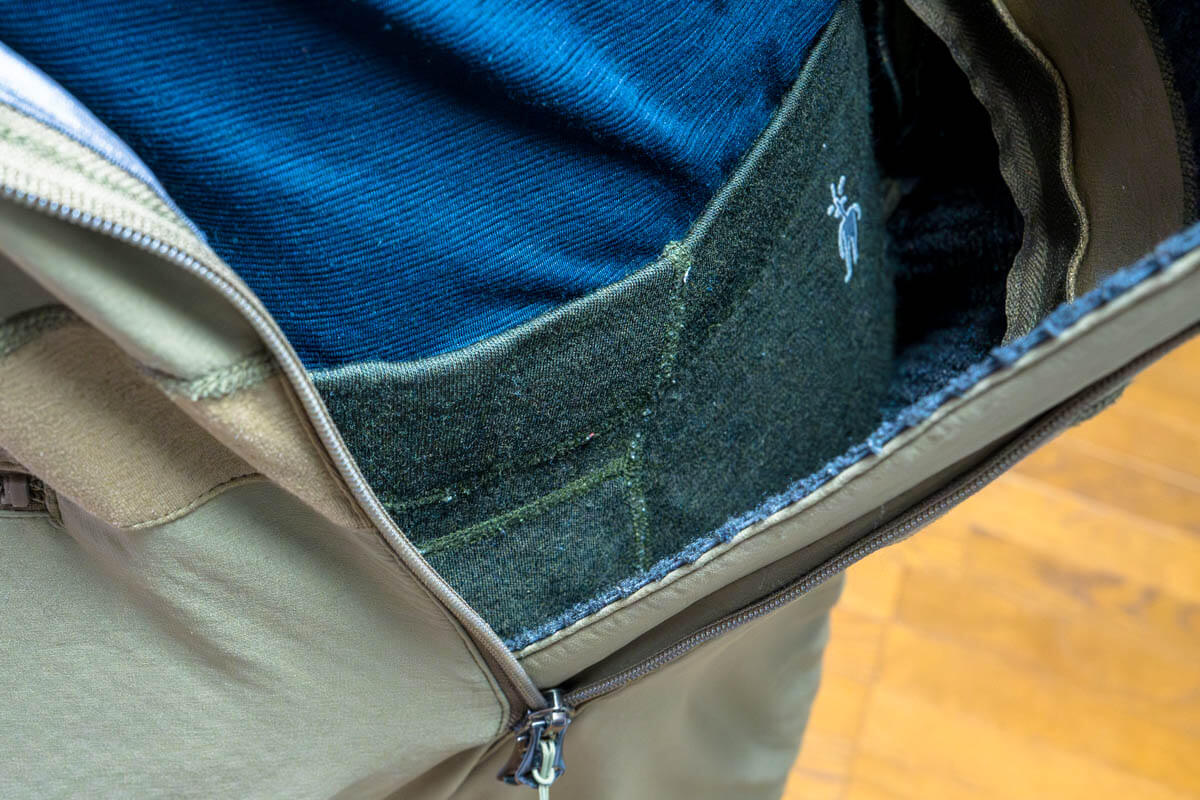
The first benefit of the suit-style design is that it reduces the number of layers of pants you need to wear. The under-base, mid-outer, and potentially four layers of waist can be quite restrictive (which is why I love bib pants or suspender-style shells). The fewer elastic, belts, or strings there are to tighten, the better. This eliminates the feeling of tightness around the body, allowing for a relaxed and comfortable fit
Also, when climbing snowy mountains or skiing, you often lift your legs high and bend your waist, which can often cause you to worry about the thickness of the waist or any excess or tightness in the moving parts. In this regard, suit-style clothing is made slightly looser around the waist, so you are free from such tightness and feel more free to move
No more pants slipping down and making it difficult to lift your legs
Related to the above, when you're wearing a lot of layers, if one of them is loose at the waist, have you ever had the experience of the whole outfit slipping down? This has happened to me quite a few times, and before you know it, it's become difficult to lift your legs, which can be very uncomfortable (and dangerous)
But the Hoback Suit , you can say goodbye to that discomfort. Because the top and bottoms are one piece, you don't have to worry about the bottoms sliding down even when you make big movements like standing up or squatting, and of course the top not getting flipped up.
No gaps at the waist to keep heat in
With a typical separate-type mid-layer, there is a gap between the top and bottoms, which means that although wind does not get in directly, heat still tends to escape. This gap does not exist in a jumpsuit-type mid-layer, so it can block wind and cold air from outside and retain heat better than a separate-type mid-layer. Of course, snow and dirt also cannot get in
Draped and stretchy for exceptional ease of movement
Not only is this suit a one-piece jumpsuit style, but the pattern is also carefully and skillfully designed, allowing for a smoothness of movement that is not possible with separate suits
This is most clearly evident in the gusseted crotch and three-dimensional cut of the knees. The crotch and knee joints have a particularly significant impact on ease of movement in activities that involve significant lower body movement, such as ski mountaineering, but the pattern has been cleverly cut with the three-dimensional movement of the joints in mind, providing an extremely comfortable movement even in the field
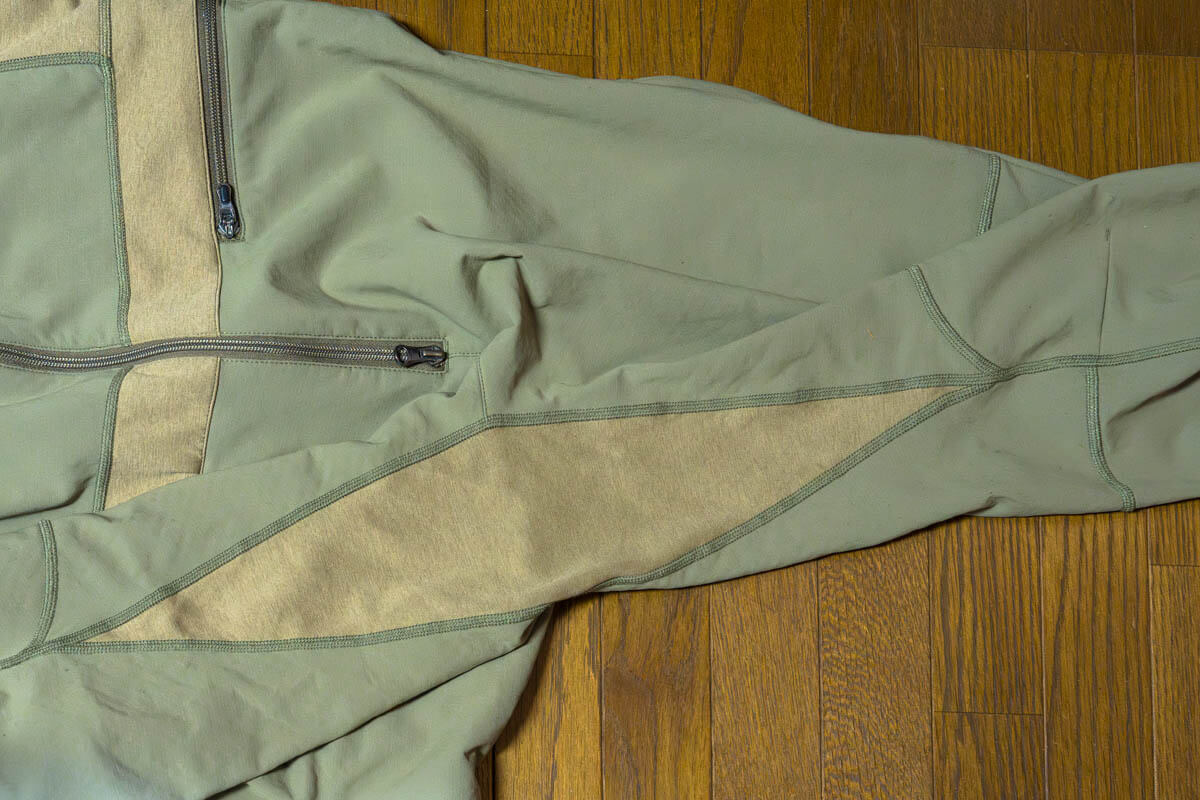
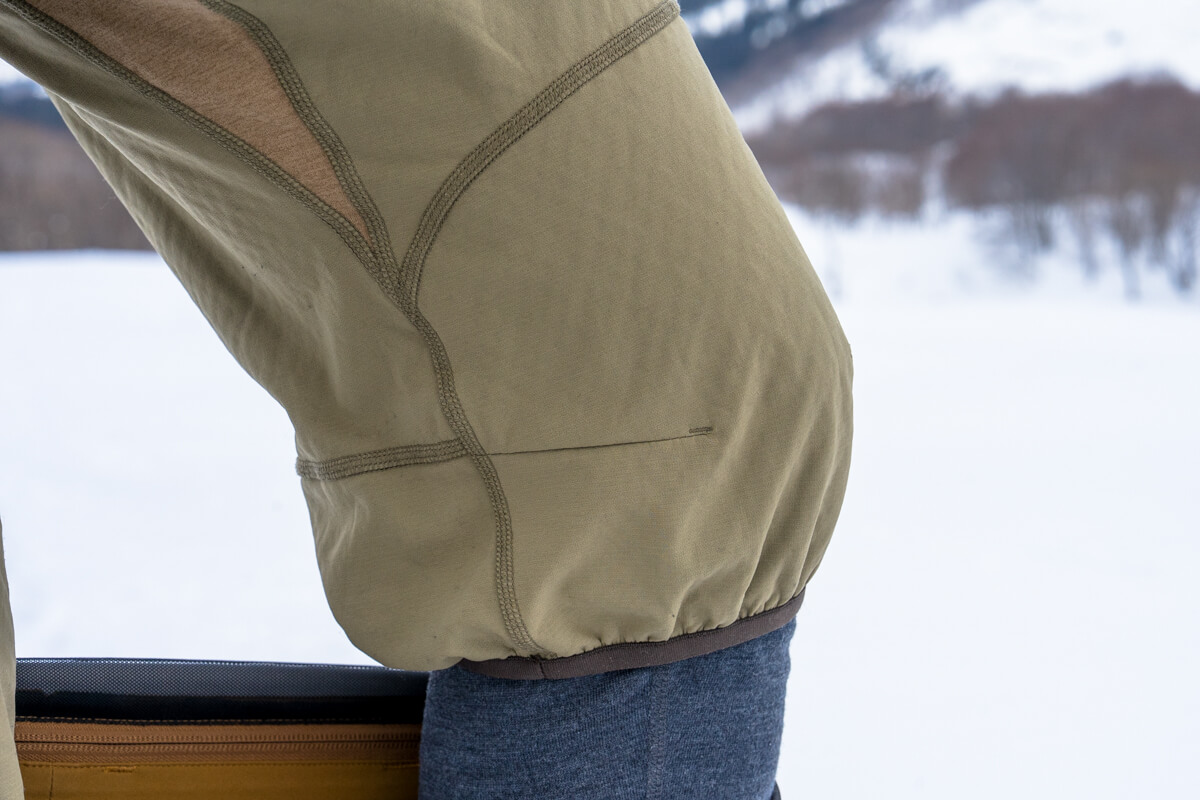
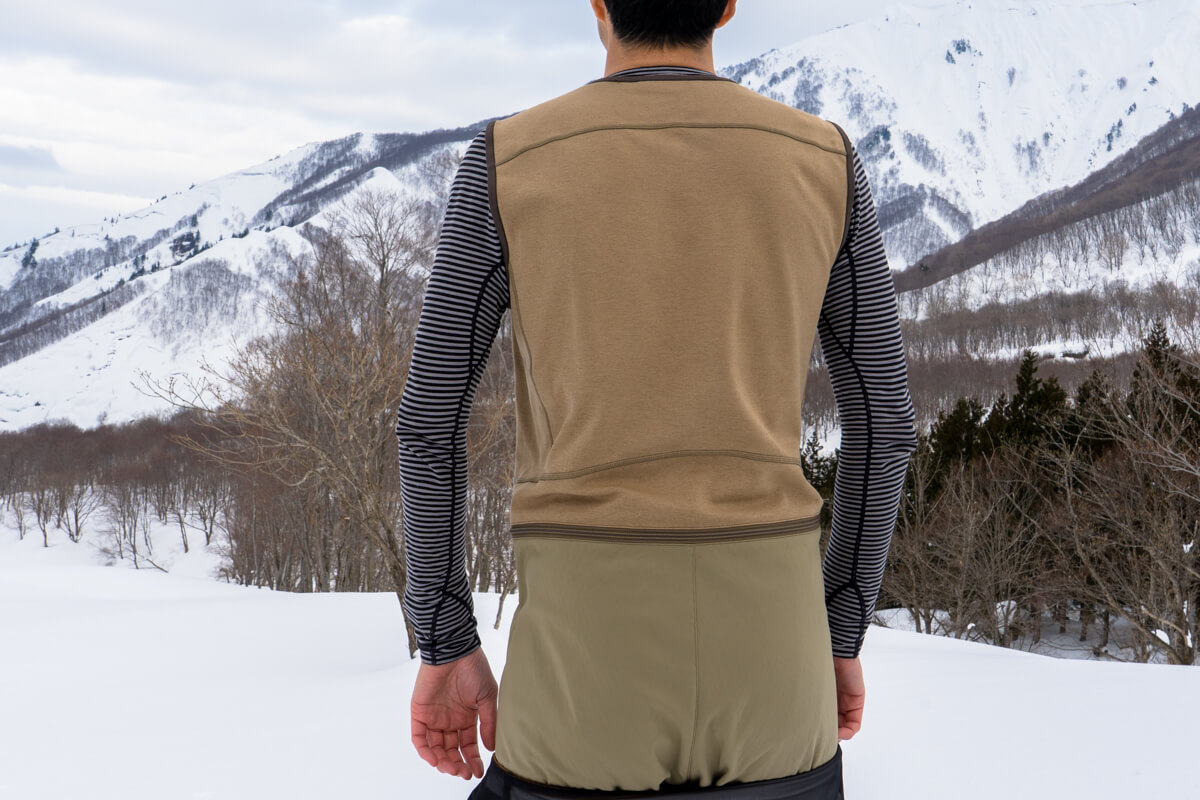
The upper body is also designed with stretchy and moisture-wicking recycled polyester fleece on the waist, side panels, and back, which are all areas that bend significantly, to prevent any tightness caused by the integrated top and bottom. The seams are also positioned away from the top of the shoulders to avoid the weight of the backpack, and flat stitching is used to reduce roughness, with attention paid to every detail to minimize discomfort during activity
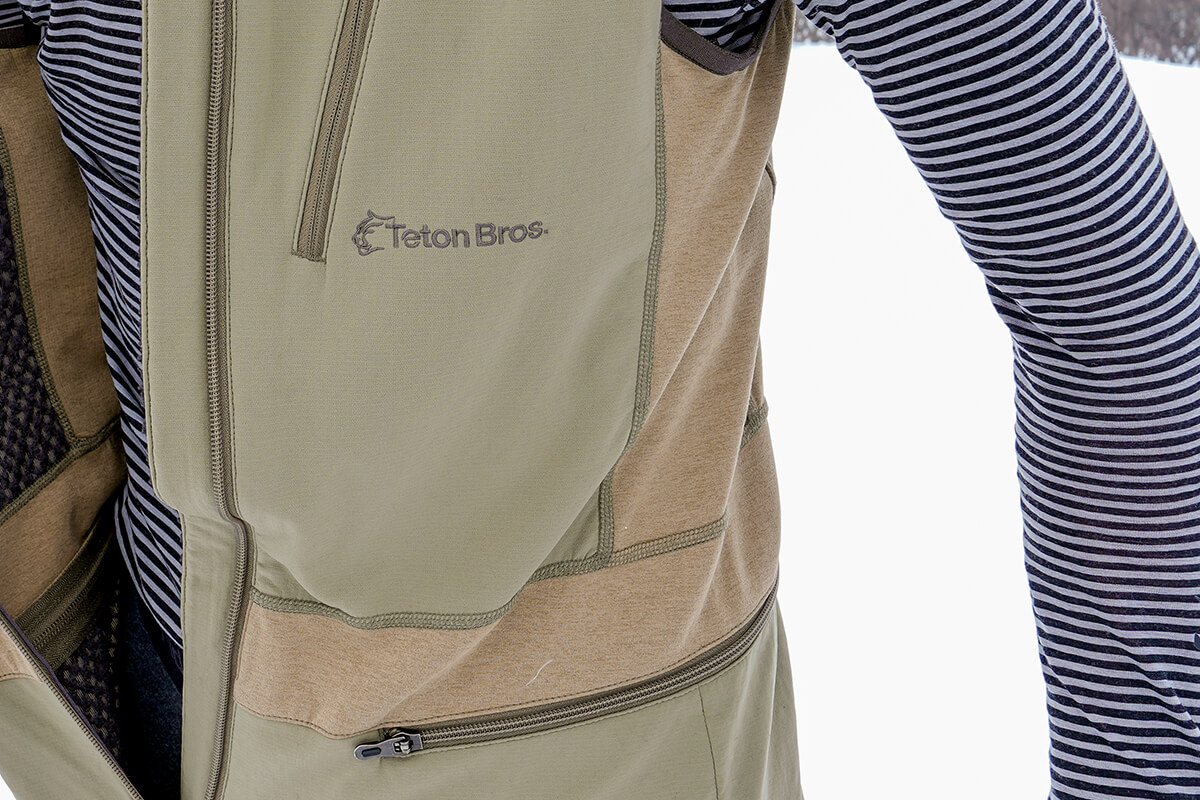
A hybrid of dynamic padding "Octa" and 4-way stretch soft shell "Primeflex" for excellent temperature, moisture control, and stretch
Next, this mid-layer is also outstanding in terms of temperature and humidity regulation (warmth and comfort). What's the Hoback Suit is that, among the many mid-layer materials available today, it has been carefully designed down to the smallest detail, from the combination of fabrics to how they are combined, to provide the highest possible balance of elements necessary for winter warmth in active clothing, such as heat retention, breathability, quick-drying, and mobility.

For example, it uses Teijin Octa (particularly the Thermo Fly type with its high sweat management capabilities) padding as the lining, which is now used by many brands as an active insulation that combines lightness, warmth, and breathability, and further combines it with the 4-way stretch soft shell material "Primeflex." Furthermore, rather than simply layering the two materials, they have achieved "Stretch Octa Bonding," which directly bonds the two fabrics together through development collaboration between Teijin and Toray.
The "bonding" process eliminates unnecessary spaces between the fabric layers, allowing for more efficient ventilation and breathability. This should contribute greatly to improving the problem of heat not escaping (overheating), which is a common issue with suit-type mid-layers. Thanks to these features, the Hoback Suit is able to achieve the right balance of the various functions required for thermal clothing for active use, such as heat retention, breathability, quick-drying, stretchability, and moderate protection
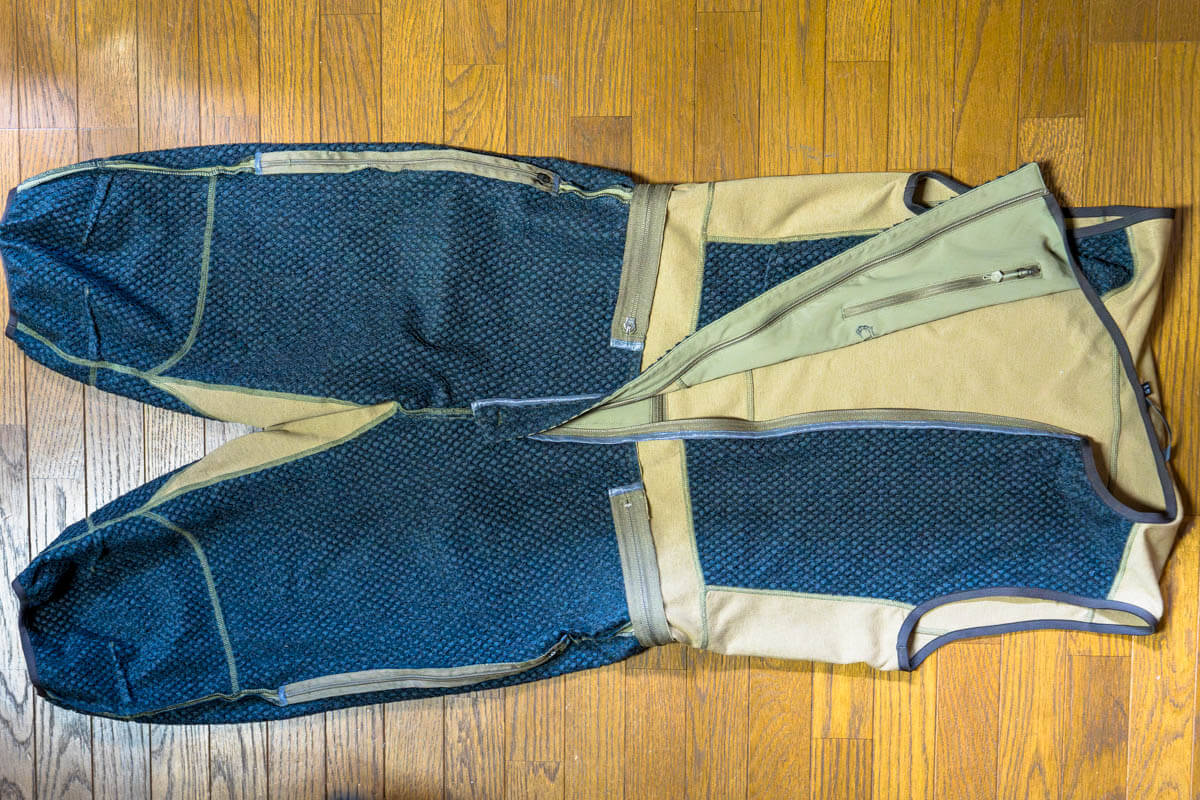
In fact, this fabric combination of "Octa on the back x Primeflex on the front" is basically the same as that used in the brand's other item, the "Sub Jacket," and I've been a big fan of the Sub Jacket since last season
The balanced performance of the insulation, breathability, and quick-drying properties, which have been carefully crafted down to the smallest detail, was clearly noticeable in the field. Unlike exposed active insulation, it blocks wind and cold air, while unlike simple insulation, it effectively expels excess heat and moisture that can lead to stuffiness
Although it is quite thin for a mid-layer, it always maintains enough warmth to keep my body warm while I'm moving, and its quick-drying properties also helped a lot, allowing it to dry before I even noticed, even if I sweat
The vest and knee pants are neither too cold nor too hot, and are the best layering for hiking when paired with bibs and a wind shell
Furthermore, the fact that the top and bottom of this suit are a "vest" and "knee pants" respectively is an excellent choice for me
First, regarding bottoms, the best combination for me on snowy mountains is a base layer with full-length tights (not too tight, not too loose), and on top of that a half-length mid-layer with a slightly looser fit that doesn't interfere with ski boots
The Hoback Suit has a loose fit that doesn't restrict the body as much as possible, stretchy piping at the hem to prevent it from riding down, and a knee-length that's not too long, making it just right for my taste. Its careful and flawless construction, like something made for backcountry skiing that combines skiing and mountaineering, gives me a glimpse of the skills of a brand that knows ski mountaineering inside and out.

Next, regarding the top. If this had been a jacket type with sleeves, it would obviously have been more insulating, but I imagine there would have been more situations where it was too hot and I wanted to take it off. In the end, the vest type was not only fine, but was the best. Above all, a suit type is not easy to take off, so it's better to avoid situations where you get too hot and want to take it off than to get cold and want to put on another layer
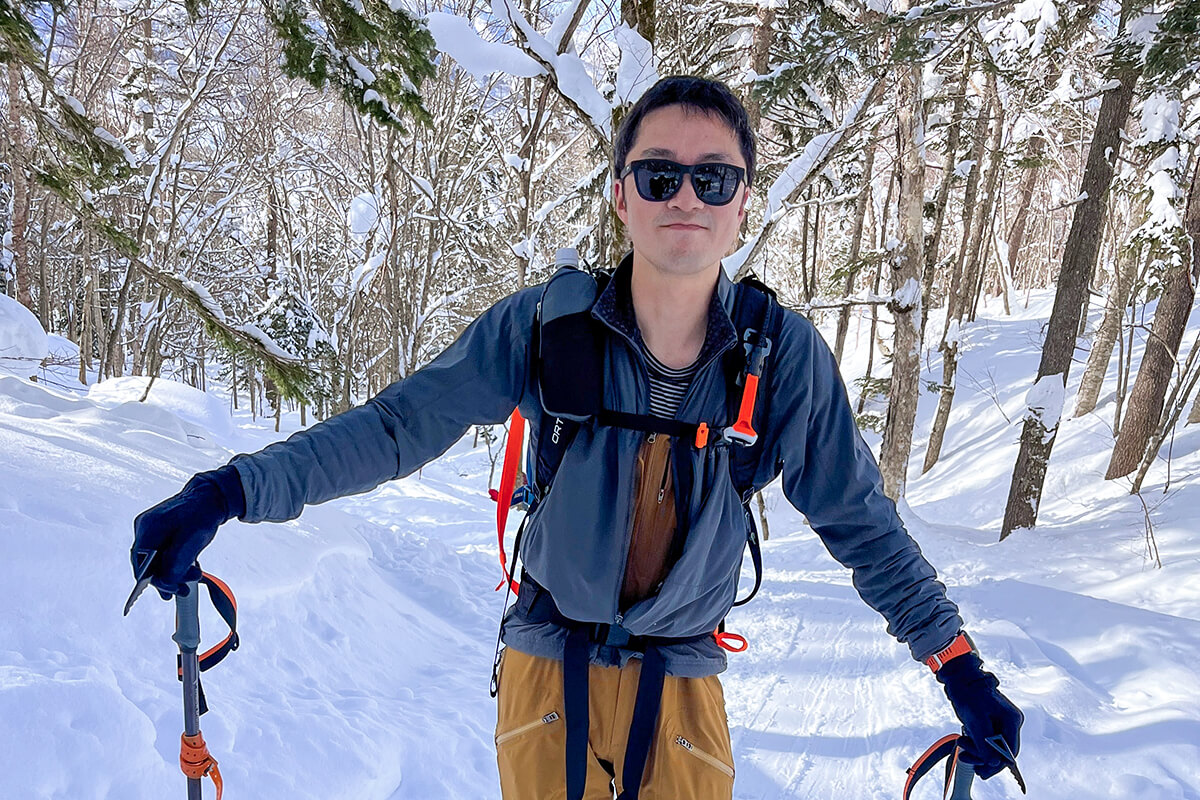
During testing, I wore it in February during the harsh winter months on a full-hike backcountry ski trip in Joetsu (around -10°C) and Asahikawa/Hakuba (-10 to -20°C). In both cases, I had no problems while hiking up the mountain, layering it with an autumn/winter wool base layer, the Hoback Suit, the TB Pant (bib), and if it got cold, the TB Jacket (hard shell). Perhaps it's precisely because it's a suit-type jacket with higher thermal insulation efficiency that I didn't feel too bad about this minimal vest-type jacket
Furthermore, the manufacturer's staff members shared some additional layering recommendations from experienced skiers, which was eye-opening: a Wind River Hoody over the Hoback Suit . It's true that in Asahikawa, with temperatures well below -10°C and wind, even if your body heats up, the cold air is still a concern, and the Hoback Suit can feel a little chilly. On the other hand, wearing a hard shell makes you a little hot when climbing. Naturally, adding another layer of cold weather gear also makes you too hot.
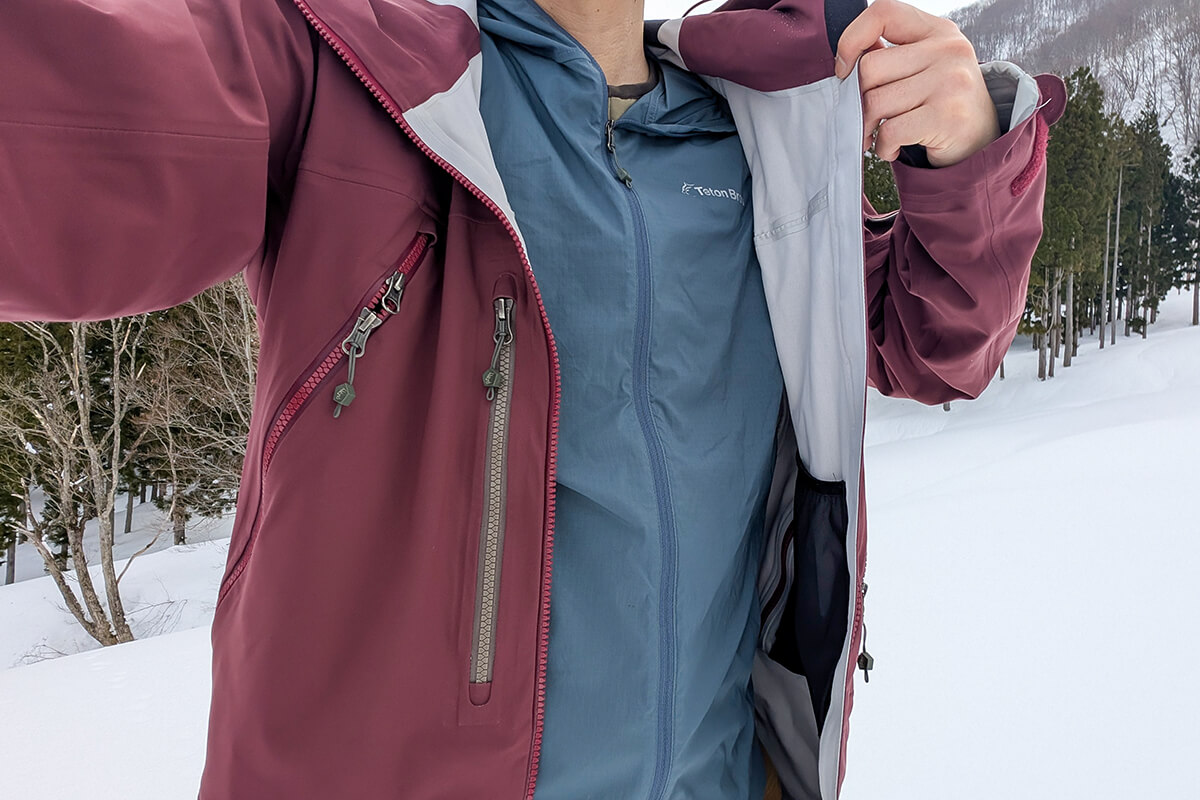
So I tried wearing this thin windshell over my Hoback Suit
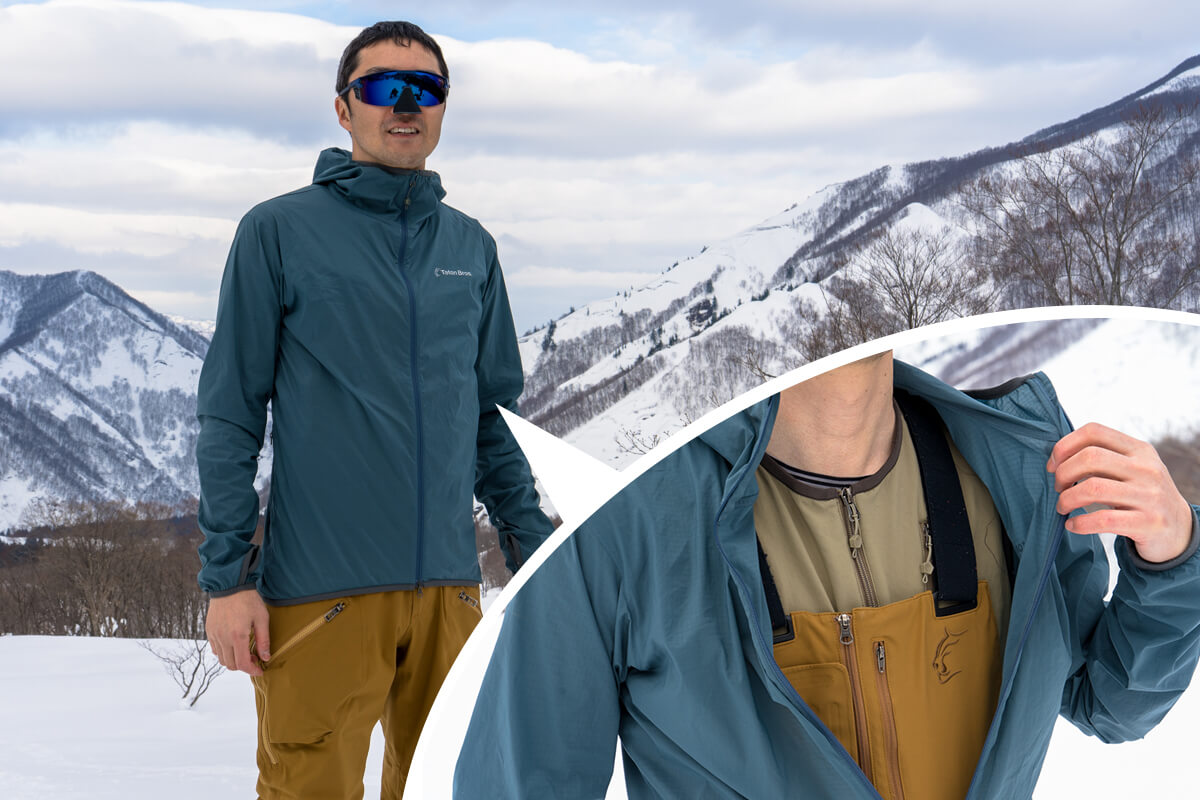
With just one jacket, it doesn't insulate too much, but rather adds a thin layer of air all over, so it keeps you warmer than you'd expect. Best of all, it's lightweight and compact, so it doesn't get in the way when you carry it around or put it on. Its mechanical stretch makes it easy to move around. From steep climbs in the forest at low altitudes and with no wind, to when the wind picks up and you feel a bit chilly, wearing this jacket is versatile and has significantly reduced the need to take off and put on a shell
The only thing that bothers me is the collar. Currently, it has a round neck and no collar, so you have to somehow protect your neck from the cold. For example, you could wear a hooded base layer or cover your neck with a neck warmer. In either case, your neck is covered, so it's too hot. Personally, I think it would have been better if it had a higher collar and a zip neck to protect against wind and cold
However, it seems that the manufacturer took this into consideration when they chose the round neck, and since where you place the hood when layering with BC can vary greatly depending on weather conditions and each individual's way of thinking, it seems that the Hoback Suit that is least likely to cause the problem of hood overlap.
Practical design for field use, allowing you to wear it all day
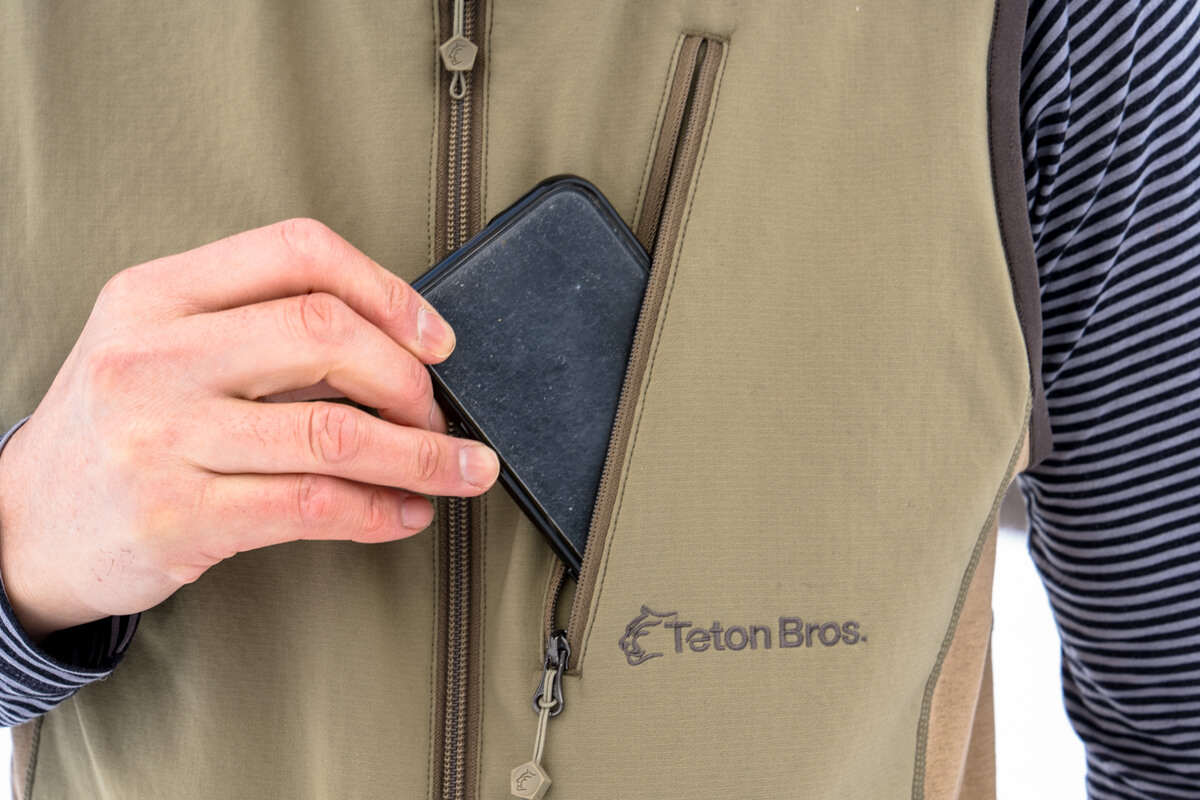
Chest zip pocket
There is a chest zip pocket on the left chest where you can store your smartphone etc. This way you won't have to worry about where to put your smartphone even when you're not wearing an outer layer
Side ventilation
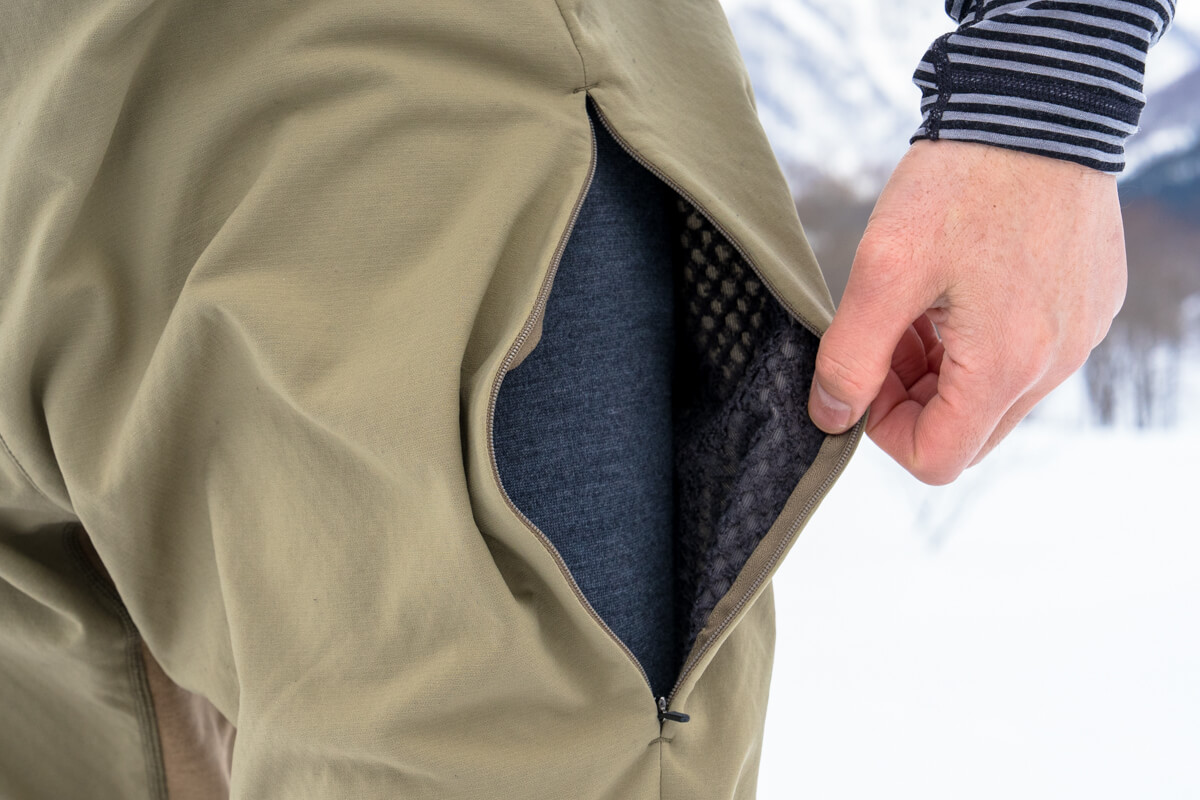
The outside of both thighs are equipped with ventilation zippers to promote ventilation. They are synchronized with the ventilation of hard shell pants such as the TB Pant, so if you open both and walk, you can move air back and forth quite actively
It also takes measures to address the "difficulty in using the toilet" issue, which would normally be a disadvantage
A commonly cited disadvantage of regular coveralls is that you have to take off your top every time you go to the toilet, but the Hoback Suit is well-made in this regard, with a double zipper on the front that can be opened from the top or bottom, and a zipper at the waist that goes almost all the way around the back, so you can easily go to the bathroom while wearing it by opening the zipper.

What's more, this zipper is synchronized with the zipper on the TB Pant, so if you're wearing the TB Pant with hardshell pants, you can go to the bathroom while still wearing your bib and midlayer. If you're forced to be in the mountains, smoothness is of the utmost importance in the harsh snowy conditions of the mountains. In that regard, the waist zipper on the TB Pant is one of my favorites, even among the various jumpsuit pants I've worn, so this ease of use is extremely appreciated

However, since this jumpsuit is designed to be worn in the field (although I know this is a bit much), it is important to note that when using a regular toilet, such as a Western-style toilet, the front zipper is connected (it cannot be completely separated like the TB Pant), which can be a bit of a hassle.By the way, the front zipper is long to compensate for this, so if you open it all the way when using the toilet, it will be quite comfortable
Summary: If you're an aggressive player, you'll never want to go back to the way you were before, thanks to the unparalleled comfort and practicality of this jacket

The Hoback Suit a one-piece mid-layer for backcountry skiing that offers excellent comfort and balance that conventional separates just can't offer, making it a piece of clothing with an appeal that can't be compared to any other mid-layer. If you don't mind the appearance and how easy it is to put on and take off, I personally think there's no reason why anyone who skis in the mountains wouldn't choose this.
Of course, since it's an all-in-one unit, it takes some time to get used to putting it on and taking it off, and it's true that it's difficult to take off once you've put it on, but my honest opinion is that the many benefits it offers more than make up for that. Although there are some small requests for further refinement, I have almost no complaints with the current version, and it will undoubtedly be useful throughout a wide range of snow seasons, from slope skiing to backcountry skiing, and for all types of active snow mountain activities, not just skiing
If you're looking for a more streamlined and next-level level of comfort for those hard-hitting snowy mountains, be sure to try out this new layering style, available only at Teton Bros
Please consider a paid membership to support the website while enjoying premium content and exclusive events!
Related reading
 Review: Teton Bros. PPP 1/2 Zip LS Tee
 Sparkling technology and ideas. A complete review of seven exceptional fleece pieces that give a glimpse into the future of fleece
 [An honest, self-funded comparison review] Lightweight active insulation perfect for minimalist hikers, as revealed by actual wear comparisons
 Solve your worries about choosing insulation for autumn and winter mountain climbing by comparing the different types. Review and testing of three of MONTURA's latest insulation jackets