



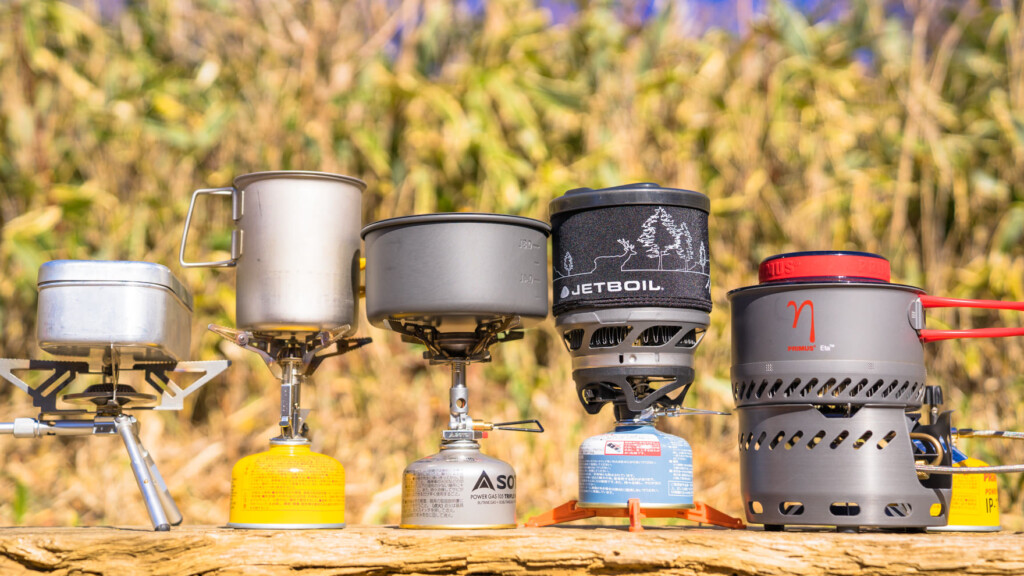
Comparison Review: Which gas stove should you choose for your mountaineering? I compared it

written by Outdoor Gearzine Editorial Department
On the previous page, we introduced a ranking of the models we compared, a list of ratings and specs, and recommendations based on them. From here, we will explain what criteria were used to evaluate the evaluation and why it was evaluated in that way.
table of contents
Detailed reviews of each item
Burning power
The output (kcal/h) published by each manufacturer can serve as a rough guide to heat output, but which one will actually heat the contents of the pot in the shortest time? You won't know that until you actually compare them under the same conditions
Therefore, in this test, we compared the actual combustion power by comparing the time it took for water of the same temperature to fully boil (the lid floated up with a short gap between them, and steam continued to come out vigorously from the drain hole in the PCS) on the same date, time, and place
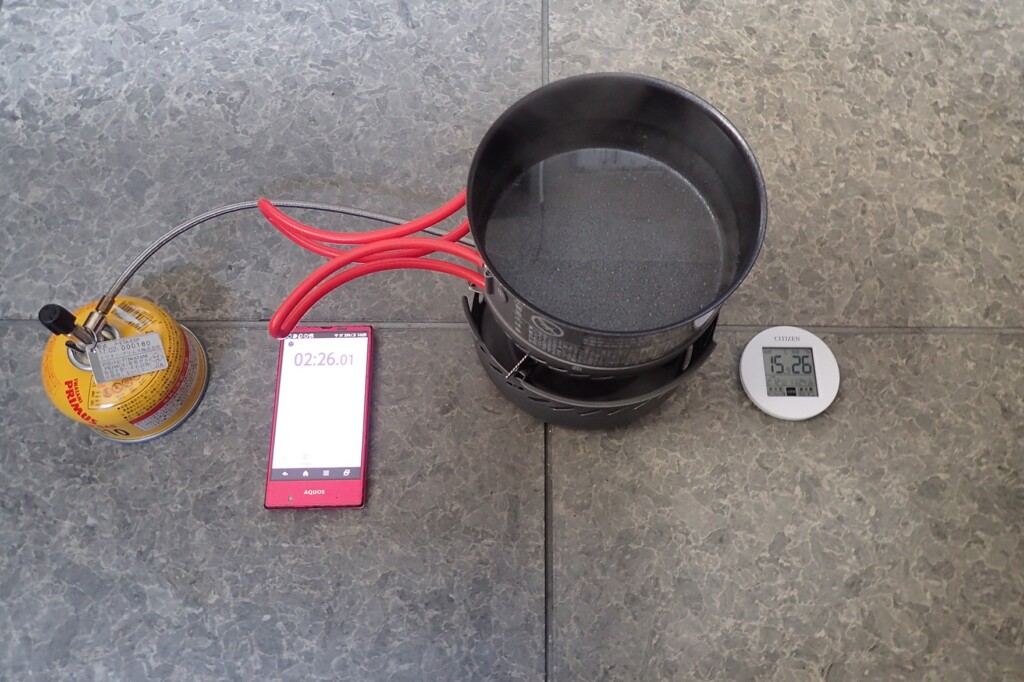
Comparison of boiling speed in a windless area
Time taken to boil (no wind)
| item | P153 | Wind Master | Reggie | Jetboil | Eta Spider |
|---|---|---|---|---|---|
| Nominal maximum output | 3,600kcal/h | 2,800kcal/h | 2,900kcal/h | 1,512kcal/h | 1,900kcal/h |
| Time to boil | 03m30s | 02m45s | 03m46s | 02m31s | 02m26s |
| Test conditions |
| ||||
The model with the shortest boil time was the Eta Spider, followed closely by the Jetboil. The dedicated cup with a heat exchanger is certainly advantageous. However, the Windmaster, which came in third, was also far from being low in combustion power , and the top three models all boasted high combustion power. While the spec figures here do not necessarily match the actual combustion power, please note that this may not always be the case, as there is of course some variation depending on the environment and conditions.
Wind resistant
The combustion power test was conducted in a windless environment, but this time we compared the combustion power in a more difficult environment, with some wind blowing. Since it is used outdoors, usability in such harsh conditions is important
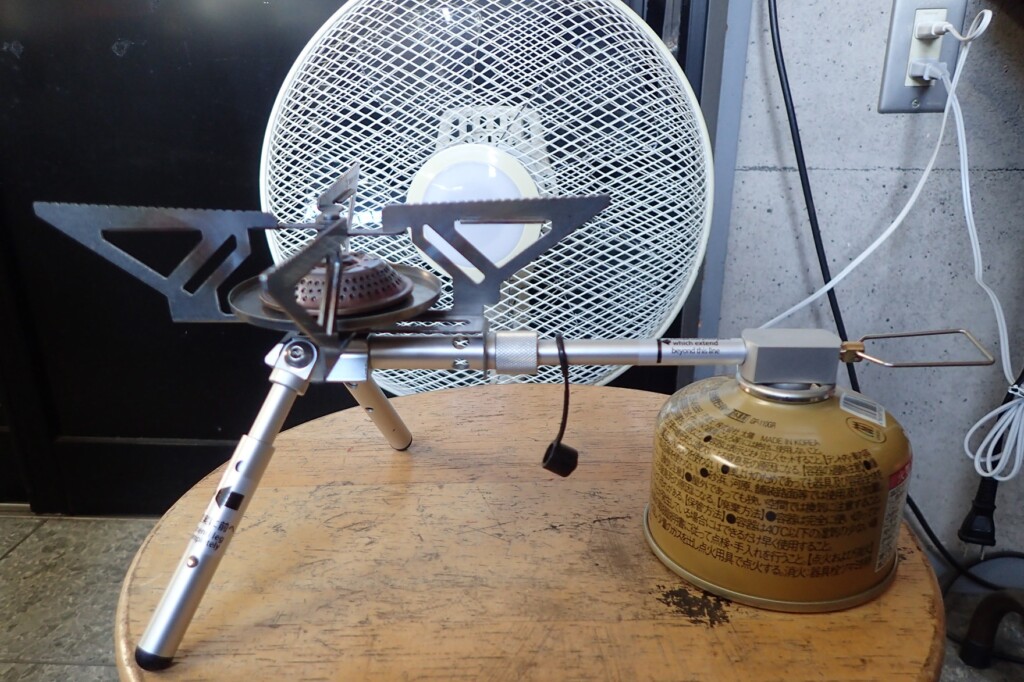
A wind resistance test. Depending on the model, the heat output can drop dramatically when exposed to wind
Time taken to boil (with wind)
| item | P153 | Wind Master | Reggie | Jetboil Minimo | Eta Spider |
|---|---|---|---|---|---|
| Time to boil | 04m21s | 03m41s | 06m29s | 03m58s | 03m09s |
| Test conditions |
| ||||
Even taking into account the advantage of cookers with integrated windshields, the Eta Spider's performance is undeniable. It's not much different from no wind . I was also surprised that the Windmaster performed better than I expected , even without a windshield
On the other hand, the P-153 took noticeably longer to boil, and the Reggi took nearly twice as long. Both models have exposed heads, making them susceptible to wind . When using these models in the field, proper wind protection is required . Always remember to prepare for the natural conditions at hand, such as choosing a location based on the wind direction and using windbreaks to block the wind.
Combustion efficiency
Here we compare "how efficiently they can heat with the least amount of fuel." However, since precise measurements are nearly impossible, we have used the gas consumption per hour published by each company for convenience, as well as the "weight of new gas minus the weight of used gas" , to compare combustion efficiency based on actual use. The results are as follows:
Comparison of gas consumption until boiling
| item | P153 | Wind Master | Reggie | Jetboil Minimo | Eta Spider |
|---|---|---|---|---|---|
| Nominal maximum output | 3,600kcal/h | 2,800kcal/h | 2,900kcal/h | 1,512kcal/h | 1,900kcal/h |
| Nominal Burn Time | Approximately 55 minutes (when using IP-250 type gas) | Approximately 90 minutes (when using SOD-725T) | private | private | Approximately 84 minutes (when using IP-250 gas) |
| Published gas consumption | 245g/h | 130g/h | 235g/h | 120g/h | 160g/h |
| Gas consumption until boiling | 11g | 8g | 13g | 7g | 8g |
As expected, the Jetboil was head and shoulders above the rest in terms of combustion efficiency, but the Windmaster and Eta Spider were not far behind. In general, models with low output (heat output) but short boiling times tended to consume less gas (i.e. stoves with good combustion efficiency).
weight
This time, the comparison method is a bit tricky because the models are different in terms of set contents, but as mentioned at the beginning, in order to make the conditions as uniform as possible, we measured the actual weight of the entire PCS set and the Mont-Bell Alpine Cooker 14 (0.8L, actual weight 180g) as a standalone model, and compared them. Incidentally, the ignition device and storage case were not included
weight comparison
| item | P153 | Windmaster (+SOD-460) | Reggie | Jetboil Minimo | Eta Spider |
|---|---|---|---|---|---|
| Set Weight | 295g (115g) | 267g (87g) | 402g (222g) | 440g | 635g |
*The weight in parentheses is for the main body only
The lightest is the Windmaster , followed by the P-153 . As expected, the direct-connection models can be made lighter by simplifying the cooktop . The Reggie is a little heavier, though not as heavy as the PCS, due to its separate design. The remaining PCS2 models come with a cooktop with heat conduction fins, a cozy, a draining lid, a measuring cup, a stabilizer, and other components, so there's a limit to how light they can be. That said, the individual parts aren't useless, so it seems like it's a trade-off between weight and style .
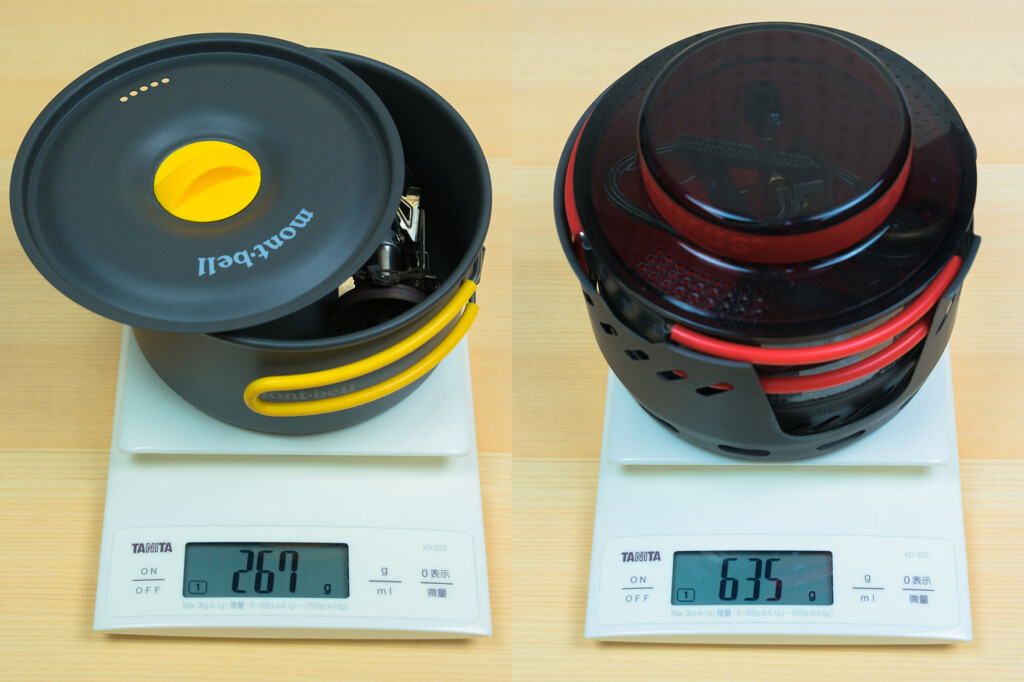
Compared to the Windmaster and P-153, which have a simple structure and allow for weight reduction, the fully equipped Eta Spider, while convenient, can weigh as much as a can of juice
Storageability
was compared using the entire PCS set and the Mont-bell Alpine Cooker 14 The P-153 . Its incredible compactness is immediately apparent in the photo below. Although it was a close second, the Windmaster also fit easily into this cooker, along with its gas cartridge. On the other hand, the Reggie , due to its large head and gas supply pipe , did not fit perfectly into the Alpine Cooker 14 Alpine Cooker 16 (1.5L) , as shown in the photo. The PCS is also designed to be stacked with the gas cartridge, so it's not particularly difficult to use.
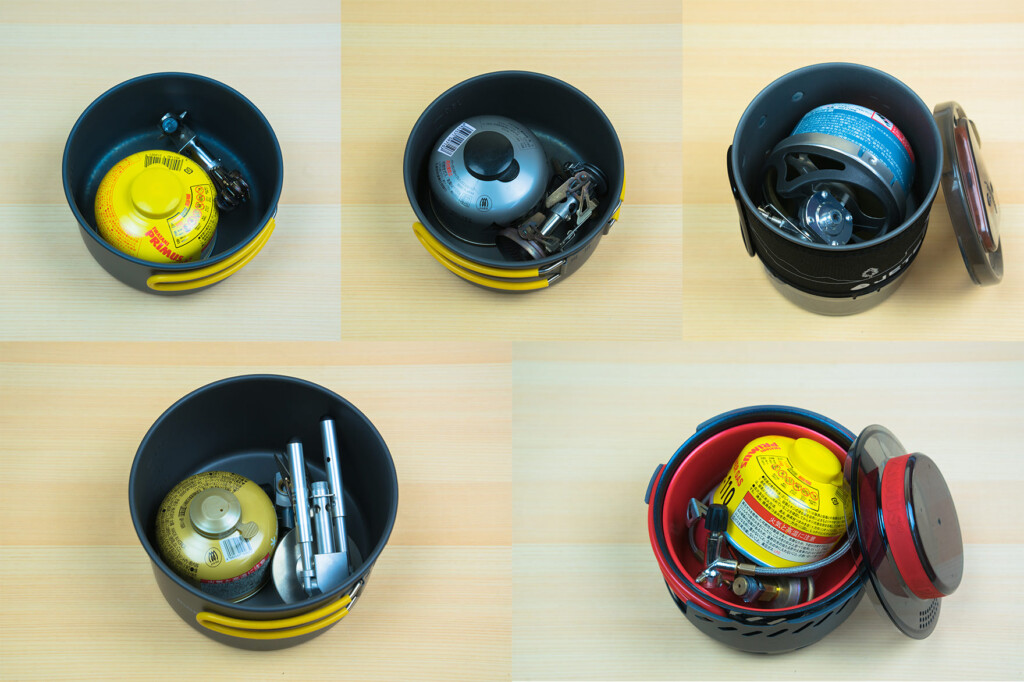
The stove and 110 size gas cartridges are stored. The photo was taken at the same angle and scale
Stability and ease of use
The stability referred to here refers to the stability when a pot is placed on it to cook. As a basic premise, all of the models compared this time are at a high level when it comes to heat adjustment and ease of handling, so no matter which one you choose, there is no model that gives the impression of being difficult to use. Furthermore, we have looked at the details of usability and evaluated them based on three points: "ease of setting up (cleaning up)," "ease of cooking/eating," and "other functions."
ease of setup the P-153 and Windmaster are generally easy to set up and take down due to their simple structure The P-153 has only one part, including the ignition device, so there is no hassle. Other models require assembly, which can be a bit more time-consuming and can make it easy to lose parts.
Next, in terms of ease of cooking and eating, the Eta Spider 's stability stood out. Not only is it stable with a low center of gravity, but it also boasts a wide-mouthed cooker that's resistant to burning, an easy-to-see lid, and effortless heat adjustments, making it ideal for cooking. The Jetboil Minimo is not only stable even for simple cooking, but its integrated neoprene cozy allows you to hold it upright after cooking, making it extremely convenient. the legs was also highly praiseworthy, but it took more skill than I expected to stabilize it, as the two legs could not be adjusted to any length and the gas supply pipe was stiff.
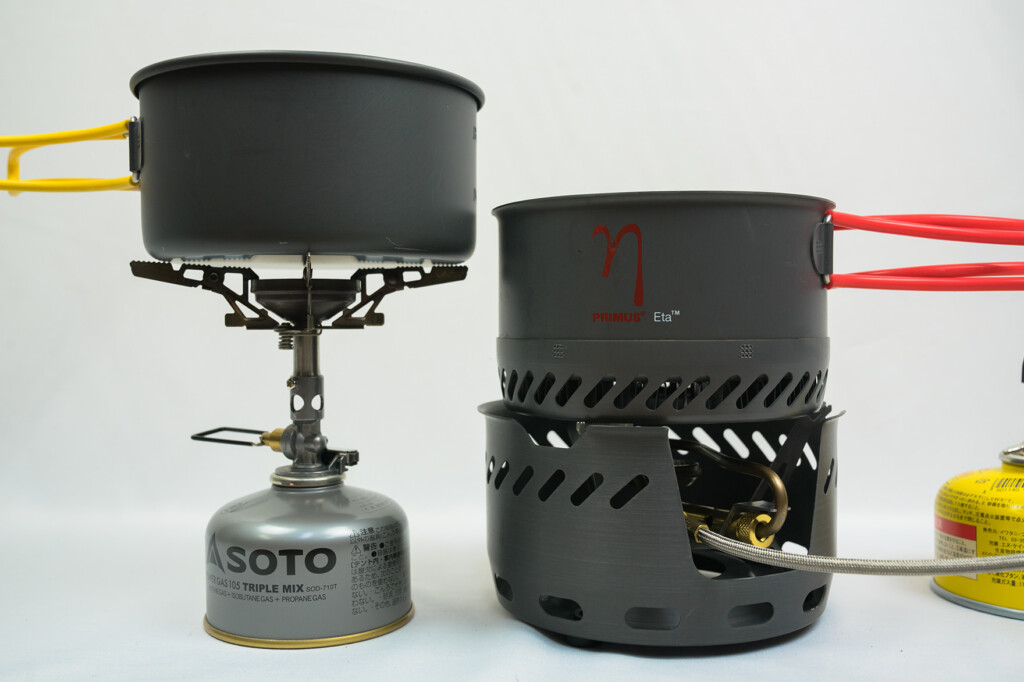
Separate stoves like the Eta Spider (right) allow for stable cooking even in fields with little flat ground
Other notable features include the Windmaster and Jetboil 's "regulator" mechanism and the Eta Spider 's "preheat" mechanism, both of which offer the advantage of stable heat even in extremely low temperatures. The circular knobs on the P-153 and Eta Spider allow for both delicate and quick adjustments, while the wire knobs on other models are difficult to use and can be difficult to adjust quickly. The Jetboil 's ignition system also ignited almost immediately under all conditions during testing, making it superior to other models.
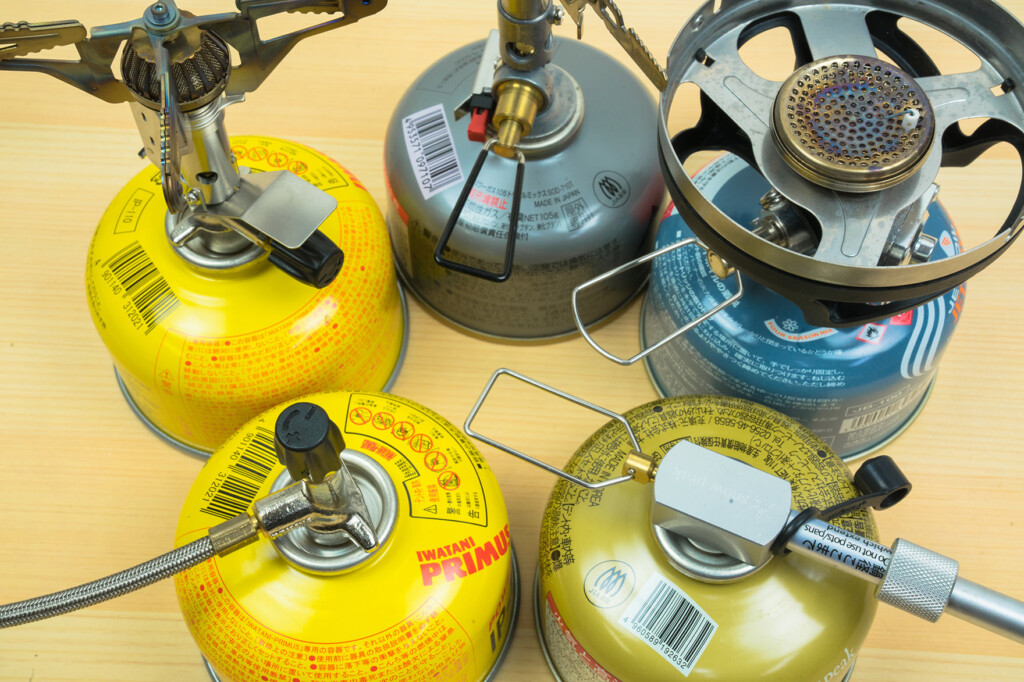
The circular heat control knob is easier to adjust, but it is slightly heavier and less compact
summary
While I expected the PCS to have a clear advantage in this comparison, I was still the Windmaster P-153 , which boasts the highest firepower and is likely Japan's best-selling lighter (though not necessarily a bad product), performed poorly in comparison, which was a bit of a shock for me as a personal favorite. It reminded me that results cannot be determined by catalog specifications or popularity alone. However, this test was conducted under limited conditions, and different environments may yield different results. Above all, I believe the most important thing is to choose a lighter that suits your environment. Choose the model that best suits your needs: the lightweight, all-around Windmaster; the Jetboil, with its efficient combustion and ease of use; the Eta Spider, heavy but reliable and easy to use; or the Regi, suitable for mild camping activities.
We also recommend this article about gas stoves
- Comparison Review: Comparing Lightweight Gas Stoves (Burners) for Mountaineering [Ideal for Beginners and Solo Hikes]
- Directly taught by a mountain climbing guide! A story about gas stoves that outdoor enthusiasts should know - from mechanisms to how to choose, how to use, and maintenance -
- [Archive] 20 points you should know to use gas equipment more safely and conveniently
Related reading
 Comparison review: Comparing lightweight gas stoves (single burners) for mountain climbing [Ideal for beginners and solo hiking]
 Best Outdoor Gear of 2014 by the US Outdoor Web Magazine Gear Institute
 Mountain gas stoves (burners): Best buys for each type that you can understand when you actually use them, and 5 tips to choose them wisely
 Comparison review: I tried using all the cooker Kochel for mountain climbing.